Lecture 4: 4/9/26 Yeasts: "Candida" & Cryptococcus
 Call Kai
 Learn
Learn Practice Test
 Spaced Repetition
 Match
Match Flashcards
 Knowt Play
1/30

There's no tags or description
Looks like no tags are added yet.
Name | Mastery | Learn | Test | Matching | Spaced | Call with Kai |
|---|
No analytics yet
Send a link to your students to track their progress
31 Terms
Which yeast is the most common invasive fungal opportunist?
Candida
What phylum does Candida belong to?
Ascomycete
Candida is endogenous and ubiquitous in the environment and infections usually come in from …
gastrointestinal tract (where it can reside normally) or the skin (such as with intravenous catheter or trauma)
What is the most common candida species, and can form true hyphae.
Candida albicans
Treatment for invasive infections: Until you know the sensitivities, start with
echinocandin
C. glabrata can be resistant to
fluconazole (inducible/acquired)
C. krusei is always resistant to
fluconazole (intrinsic)
Fluconazole is still good for most
C. albicans and C. parapsilosis
___is multi-drug resistant, especially to azoles and even amphotericin, so echinocandins should be used
C. auris
Candida location of infection
nvasive: From blood, likes to go particularly to eye and skin - can go basically any other area as well, except pneumonia are rare (because you do not inhale it to become infected) and urinary tract infections are also rare.
difference between pseudohyphae and hyphae (note: C.albicans forms both)
Pseudohyphae is “pinched” ay budding point shorter and more elliptical
True hyphae is parallel walls, apical elongation, longer & more cylindrical
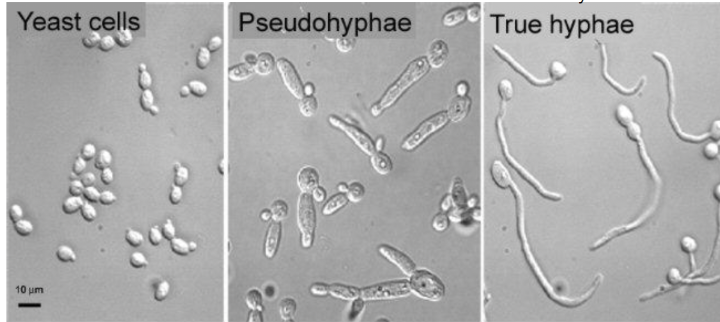
Virulence factors for Candida:
biofilms, morphogenesis, adhesins
What is the diagnosis technique for Candida?
culture
B-D-glucan (antigen test) is
fairly good sensitivity, but specificity is lower (positive in pneumocystis and other fungal infections).
C. auris can be particularly difficult to
diagnose
What phylum is cryptococcus?
Basidiomycetes
cryptococcus is both primary and opportunistic pathogen. Give example of these two/
Primary: C. gattii
Opportunistic: C. neoformans
What is the major risk for C. neoformans?
HIV/AIDS
What cryptococcus species is associated with Australia (eucalyptus, koalas), New Zealand, and the Douglas Fir Zone around Vancouver, BC
C. gattii
cryptococcus is a yeast that has a
thick capsule in body, and has a sexual phase
What are two virulence attributes for cryptococcus?
polysaccharide capsule and melanin
polysaccharide capsule
small until gets into lungs than can grow thick - protects from phagocytosis. Mutants without capsule are not pathogenic
Melanin
Protects fungal cell from respiratory burst of human phagocytosis
Primary pulmonary infection after inhalation of the yeast – usually
self-limited, but can progress
Cryptococcus can go to the
brain (meningitis) frequently and the skin
cryptococcal antigen (CrAg)
can be measured in blood or spinal fluid – very sensitive and specific
Cryptococcus yeast description for diagnosis
Narrow-based budding yeast with thick capsule.
What is the tx for cryptococcus for the lungs?
No treatment for asymptomatic or minimal lung symptoms in immunocompetent host. Otherwise, use fluconazole.
What is the tx for cryptococcus for the Meningitis?
Amphotericin + 5-FC (Flucytosine) at first, then switch to fluconazole.
What antifungal drug doesn’t work for cryptococcus?
Echinocandins
Describe the complication for cryptococcus for meningitis?
Complication: Elevated intracranial pressure : Presents with fever, headache, nausea
Lumbar puncture or surgical drain to remove CSF