4.1 Structure of the Cell membrane
 Call Kai
 Learn
Learn Practice Test
 Spaced Repetition
 Match
Match Flashcards
 Knowt Play
1/24

There's no tags or description
Looks like no tags are added yet.
Name | Mastery | Learn | Test | Matching | Spaced | Call with Kai |
|---|
No analytics yet
Send a link to your students to track their progress
25 Terms
What is a cell membrane? (1)
A barrier surrounding a cell or within a cell
What does the ‘phospholipid bilayer’ refer to? (1)
The two layers of phospholipids of the cell membrane
The phospholipid bilayer is selectively permeable. What does this mean? (1)
That it allows some molecules to pass through but not others.
What are the two main types of cell membranes? (2)
Cell-surface membranes
Membranes around organelles
What do cell-surface membranes do? (2)
Act as a barrier between the cytoplasm and external environment (extracellular space)
They control what substances enter and exit the cell.
What do membranes around organelles do? (1)
Separate organelles from the cytoplasm
Describe why the ‘fluid-mosaic’ model is called this. (2)
Fluid: because in the phospholipid bilayer, the phospholipids are constantly moving.
Mosaic: because there are proteins of various shapes and sizes embedded in the bilayer.
Name the 4 main components of the cell-membrane. (4)
Phospholipid bilayer
Cholesterol
Proteins (Extrinsic and intrinsic)
Glycoproteins & Glycolipids
What are phospholipids composed of and what are the separate parts of this? (2)
Phospholipids
Which are composed of a hydrophilic head and hydrophobic tail.
What do hydrophilic and hydrophobic mean? Explain and determine which parts of the phospholipid are these. (3)
Hydrophilic: attracts water
Hydrophobic: repels water
Phospholipid has a hydrophilic head and a hydrophobic tail.
Where are the two places that the hydrophilic head of the cytoplasm are facing outwards to? (2)
Water in cytoplasm
Water in extracellular space
Describe the hydrophobic structure of the cell membrane and why this is important. (2)
Hydrophobic core in centre of bilayer
Allows lipid-soluble molecules to pass through, not water-soluble.
Where is cholesterol located in the phospholipid bilayer? (1)
Sits between some of the phospholipids in the bilayer.
Why is the cholesterol able to sit in the phospholipid bilayer like this? (2)
Because it contains a hydrophobic region that binds to the hydrophobic tails of the phospholipids
And a hydrophilic region that binds to the hydrophilic heads of the phospholipids.
What is the main function of the cholesterol? (1)
Helps stabilise membrane at different temperatures as it influences its fluidity
What does the cholesterol do when temperature is high and why? (3)
Phospholipids have more kinetic energy
So cholesterol packs phospholipids more closely
Reducing the fluidity.
What does the cholesterol do when temperature is low and why? (3)
Phospholipids don’t have much energy
So cholesterol prevents phospholipids from packing too tightly
Increases fluidity
Name the two types of proteins in the phospholipid bilayer. (2)
Intrinsic proteins
Extrinsic proteins
Describe the structure of intrinsic proteins in the phospholipid bilayer. (2)
Span all across whole bilayer
Include channel proteins and carrier proteins
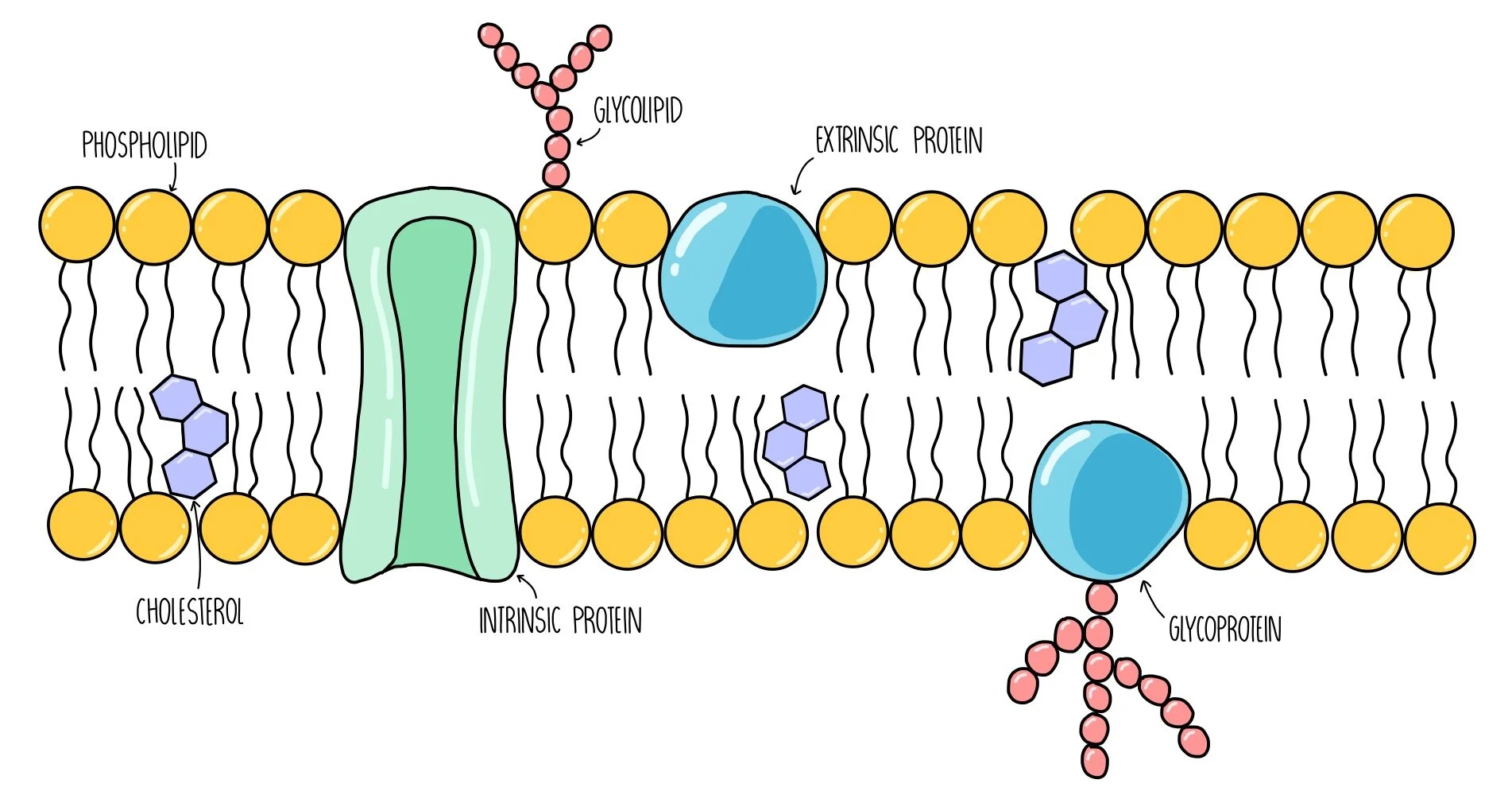
State the function of intrinsic proteins. (1)
To transport large molecules and ions across membrane.
Describe the structure of extrinsic proteins in the phospholipid bilayer. (1)
Only on one side of the phospholipid bilayer
State the functions of extrinsic proteins. (2)
Help with cell signalling
Provide structural support
What does the ‘glyco’ in glycoproteins and glycolipids mean? (1)
That they have carbohydrates attached
Define what glycoproteins and glycolipids are. (2)
Glycoproteins: Proteins with carbohydrate attached
Glycolipids: Lipids with carbohydrate attached
State the key functions of both glycolipids and glycoproteins (they’re the same). (3)
Cell adhesion
Cell recognition
Cell signalling