Comm Final Exam
 Call Kai
 Learn
Learn Practice Test
 Spaced Repetition
 Match
Match Flashcards
 Knowt Play
1/66

There's no tags or description
Looks like no tags are added yet.
Name | Mastery | Learn | Test | Matching | Spaced | Call with Kai |
|---|
No analytics yet
Send a link to your students to track their progress
67 Terms
Empowerment
an intentional ongoing process centered in the local community, involving mutual respect, critical reflection, caring, and group participation, through which people lacking an equal share of valued resources gain greater access to and control of those resources
Benefactor
view communities as a bundle of needs instead of empowerment
mission statements look like, “here is what we will do/improve for communities”
Intermediary
encourage, advocate, interdependent, act as a broker or guide, promotes action of community members (i.e. to encourage or assist)
Ex. to promote the full participation of women in the social, economic, and political life of their countries
Paradox of empowerment
Sense of empowerment versus self empowerment
we feel that we have the power to decide or alter decision but it is different than empowerment because there is always a higher system that controls everything (i.e. an organization can give and take away your power)
Dynamic system of power: the rules and social norms we have in our head limits us to do more (i.e. group quizzes)
Citizen Participation and power of spin
Citizen participation
a process in which individuals take part in decision-making in the institutions, programs, and environments that affect them
BUT it is critiqued as useful rhetoric in a fashionable way of speaking rather than authentic practice; tokenism
Tokenism
you can sit at the table but you don’t have real power or voice over decision making (sense of empowerment)
Shaping the Definition of a Public Issue or Conflict
Power of Spin: define public problems or shape the terms of public debate on issue
Ex. key decision maker favored technical jargon and scientific expertise while discounting practical knowledge of resident (client vs. citizen)
BUT
Ex. social media shaped how police violence towards African Americans are viewed
How does empowerment manifest?
Citizen Participation, power to, power from, empowering settings, empowered settings
Power to
the ability of individuals or groups to pursue their own goals and develop their capacities
Ex. negotiate strategies to affect managerial decisions or policies
Power from
ability to resist the power or unwanted demands from others (i.e. work, feminism)
Ex. context in organization (nondiscriminatory or macrosystem influences)
Value and Empowerment
For some, this involved spiritual faith and practices; for others, it centered on a secular commitment to moral principles such as social justice and ensuring a future for our children and the larger planet
Spiritual support for community involvement included a sense of innate value within everyone, a sense of “calling” to the work, and a certainty of the work’s spiritual necessity. Beliefs that enabled taking risks included a certainty that “God will provide” and a “willing suspension of fear and doubt” as participants began new challenges. A capacity for forgiveness in the rough and tumble of community decision making was also important
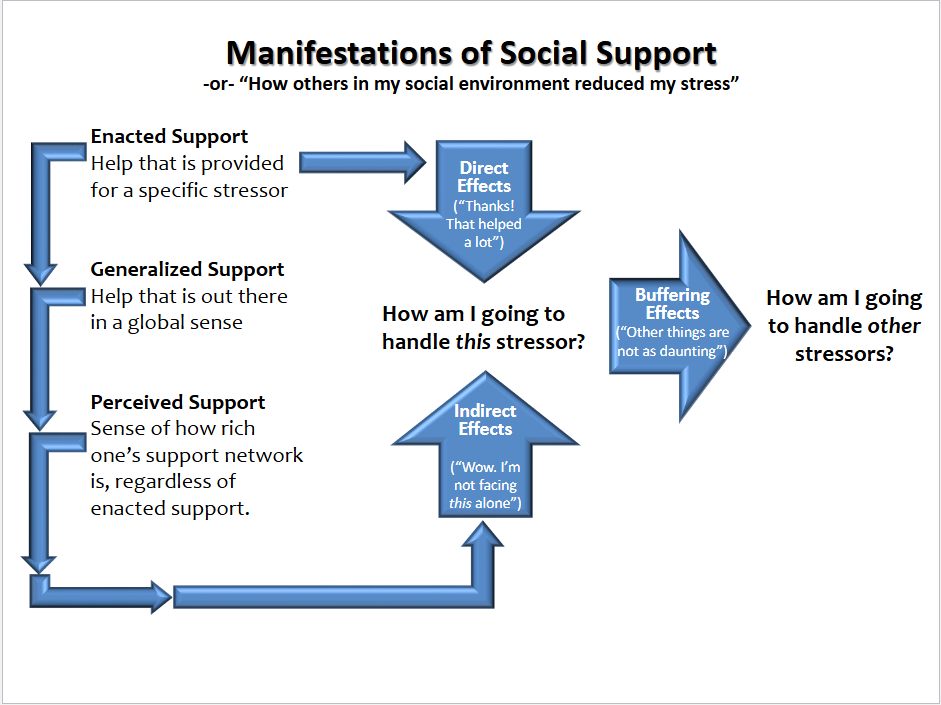
Manifestations of Social support
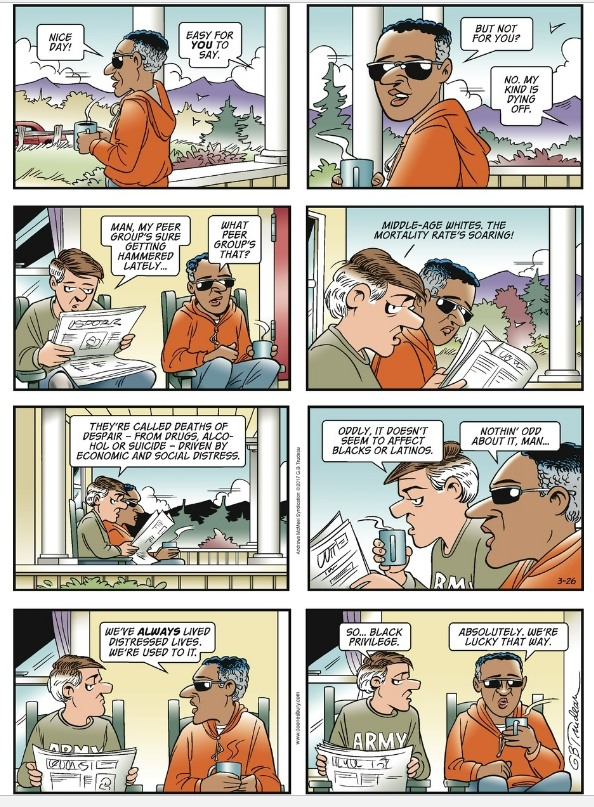
Which racial group has low mortality and why?
when the levels of playing field is equalized, equality feels like oppression (ED>IC); stress increases
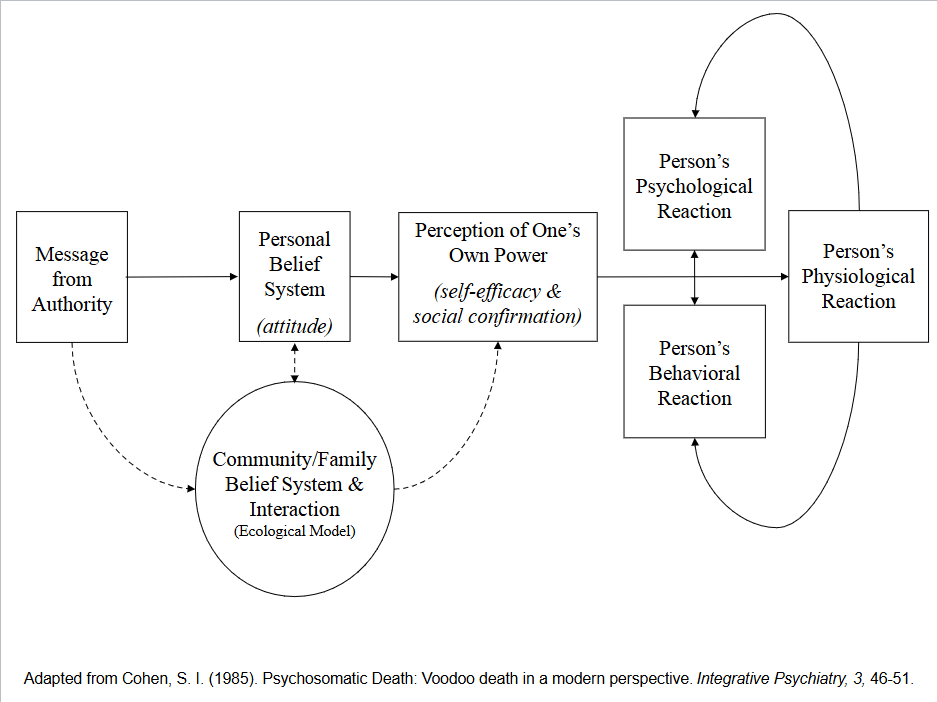
BioPsychoSocial Diagram
Message from Authority: A witch doctor say you’re going to die
Community/Family Belief System (Eco Model): Whether they also believe the authority or not which may lead to withdrawing support
Personal Belief System: You have to believe the authority to feel the effects (does your individual capacties meet environmental demands)
Perception of one’s own power (self-efficacy and social confirmation): can’t change oppressive system
Person’s Psychological Reaction: deserted, isolated
Person’s Bio Reaction: ANS/SNS, digestive, heart
Both leads to person’s Physiological reaction
Biopsychosocial Examples: Which goes with which?
Ex. Minorities always have to think about their race because you always have to be on guard from harm compared to whites
Ex. African Americans don’t have time for relaxation, always hypertensed
Ex. People with terminal illness gets treated differently (i.e. death talk)
Ex. U.S. POW who were in solitary confinement did not die because they had a sense of community (in their heads) while soliders were confronted by their community that they did not belong
Racism exist because we make it exist, it’s not real, it is voodoo
Voodoo Death
the sudden, unexpected death of a healthy person caused by extreme emotional stress, such as fear or the belief they have been cursed.
Autonomic Nervous System
Sympathetic versus Parasympathetic
Sympathetic
fight/flight
pupils dilate; more visual info to locate survival tools
increase heart rate, relax bronchin (absorbing more oxygen), blood vessels constrict; more energy to fight
Digestive and immune system shuts down to save energy
Adrenal gland is always activated
#1 leading cause of death is heart diseases and it is caused by stress
Parasympathetic
rest/digest
Stress
ED>IC; when we feel that our individual capacities can’t manage environmental demands
Learned helplessness
In the study of rats that were switched to another cage and next to a new rat and died compared to the group of rats that stayed in the same cage and didn’t die, they were waiting out the pain until something changed because there is no escape
Minor vs. Major
Minor: Big deals but episodic (acute)
Major: daily hassels, chronic
Social embeddedness
number of people you recognize that you can rely on (not a good measure as quality can overpower quanitiy)
Distal factors
contributors to or buffers against a problem that may not be readily observable or obvious
vulnerabilities that increase the likelihood of a problem developing (i.e. an economic recision that may reduce fiancial resources for employers)
buffers that decrease likelihood
Proximal stressors
event or situations that represent a threatened or actual loss of resources
major life events, life transitions, daily hassels, disasters, minority-related and acculturative stressors, and vicious spirals (loss of one resource triggers other losses)
Coping
you’re at the point where things aren’t getting worst but isn’t getting better either
Process: cognitive appraisal, reappraisal, categories of coping, virtuous spirals, positive emotions, postraumatic growth
Cognitive appraisal
ongoing process of constructing the meaning of a stressful situation or event
Reappraisal
reframing a problem involves altering one’s perception of the situation or its meaning
Categories of coping
Problem-focused coping: involves adressing a problem situation directly, especially by making a plan to change the situation and following the plan
Emotion-focused coping: addresses the feelings that accompany the stressors
Meaning focused coping: involves finding significance in the stressor by reappraising it, especially if this leads to growth or learning of important lessons
Virtuous spirals
resources are increased, successes build on each other, and the stressor is transformed into a catalyst for growth
Postraumatic Growth
the positive psychological change that results from struggling with highly challenging circumstances (i.e. greater appreciation for life)
Positive emotions
expand our “thought-action repertoires,” stimulating novel and adaptive mindsets and ways of coping. Help build our intellectual, social, and psychological coping resources
Types of support
families, natural helpers and mentors (bartenders), relationships, mutual help groups, multidimensional relationships
Multidimensional relationships
two persons involved do a number of things together and share a number of role relationships (i.e. coworker)
Online Mutual Groups
mutual assistance or self-help groups and mutual support groups, are voluntary associations of persons who share a life situation or status that produce challenges for coping in their environment
Channel Theory
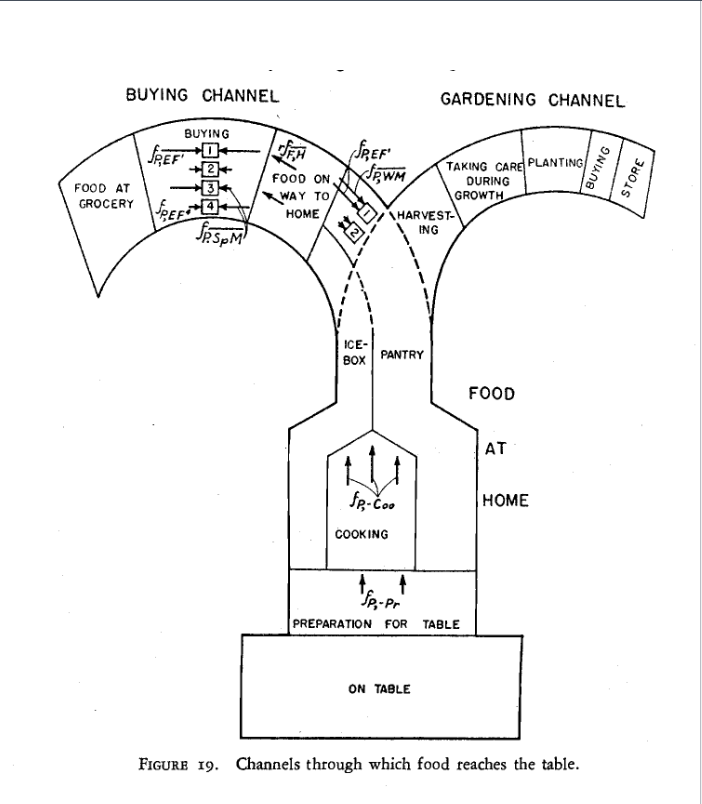
Homeless Channel Theory
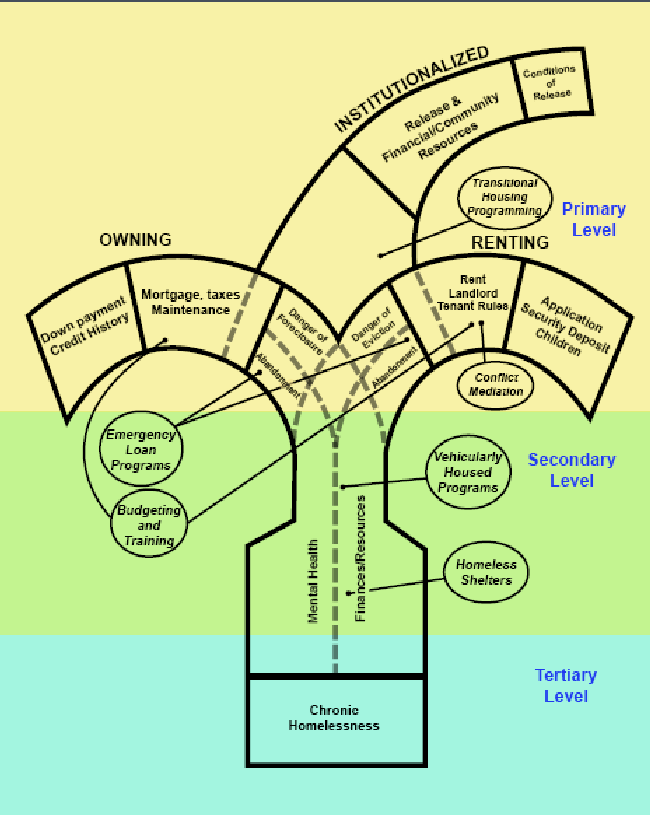
Primary Prevention
Problem-focused
acting to prevent the symptoms of a social problem from manifesting in the first place
Cons: high upfront costs, difficulty in measuring immediate impact, and the prevention paradox where high-population efforts yield low individaul benefits
Promotion
Ex. in addition to preventing obesity, there is an excerise program also put in place to promote people’s health
Secondary Prevention
Problem-focused
early intervention where problem is caught at its early manifestation
Teritary Prevention
Problem-focused
efforts directed at situations where the problem is full manifest. Work to reduce the symptoms and duration. Rehabilitation
Universal prevention
population-focused
given to everyone in a selected population
Ex. smoke ad campaigns
connected to primiary
Selective prevention
population-focused
given to those population that are more at risk to experience a social issue
Ex. high-school dropouts; preent by adding fun extracurriculars, programs and events
connected to secondary
Indicated prevention
population-focused
directed at those in a population who are considered at high risk, or who display symptoms, of the social issue
Risk factors
characteristics of individuals and situations that are thought to increasethe likelihood that a person will experience problematic outcomes, like personal distress, mental disorders, or behavior problems
Ex. multiple factors that put children with ch
Protective factors
provide resources for coping and often represents strengths of persons (personal qualities), families, and communities
Ex. Chronically ill parents have interpersonal resources such as relatives or friends
Cumulative-risk hypothesis
posits that the total number of risk factors a person experiences matters more for their development than any single risk factor alone
Gatekeepers
preventing the entering or not enetering a channel and moving from one section of a channel to another
Ex. housewife
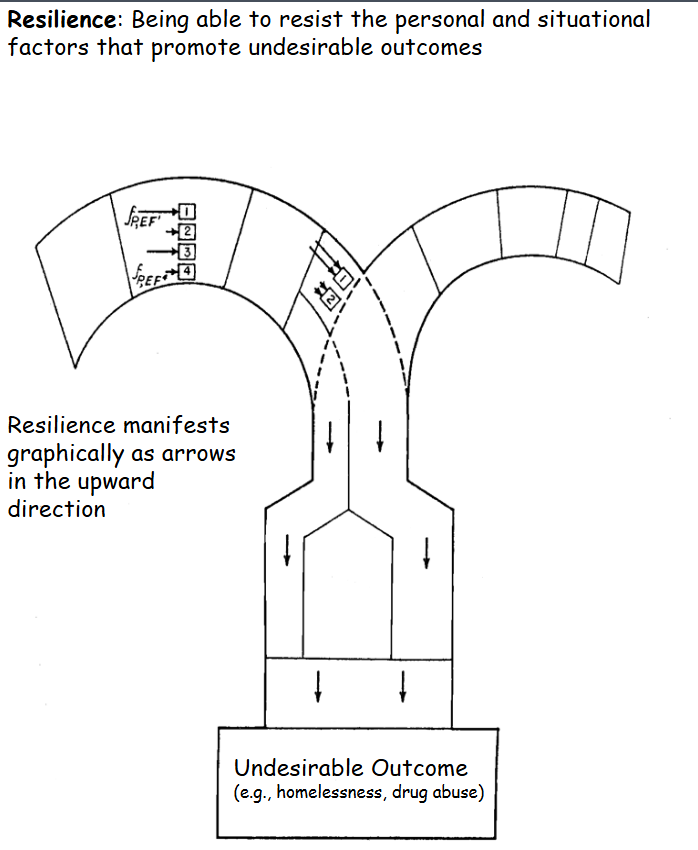
Resilience
positively adapting despite significant adversity
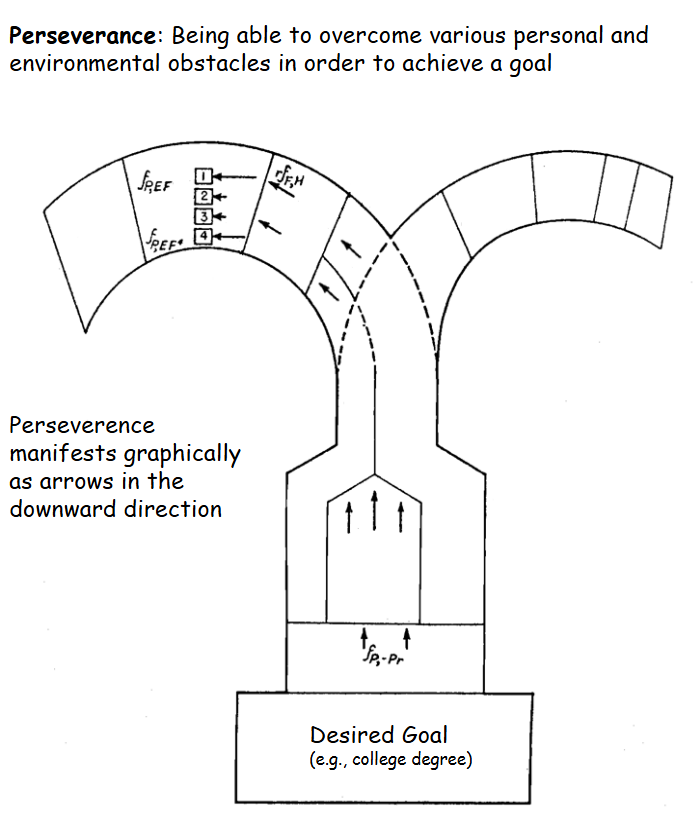
Perseverence
succeeding by overcoming adversity
Adversity
a state of serious, persistent misfortune, hardship, or affliction, characterized by circumstances that feel "turned against" an individual.

Flea Scenario: What kind of opening was made in the sphere?
Think channel theory
Fleas escaping isn’t based on resilience and perseverance, it is random
Fleas who jumped while fleas that stayed on the ground escaped
What fundamentally drives human?
Fear
Uprising occurs because conditions gets so bad, fear no longer holds people back
What makes humans unique?
we can create and make anaglogies; make connection, understanding that one object can represent another, and phonological awareness
Power of narratives
stories that binds communities together and show how to overcome our fears
Fear: courage, putting it into context to know how to respond to it through analogies which forms narratives
Ex. “Defund the police” narrative failed because there is no substances added such as banning chokeholds or allocating funds from police to other social services system
Narrative examples
Taking Root: Maathai told the story of when the God Tree dies, the stream draisns of water and tadpoles no longer lives there because of loss water supply which connects to when we cut down forests it leads to malnutrition and disease
Wrong Bus Syndrome: stop the bus — stop the ignorance and confront the driver — take action (Civic and Environmental Education Seminar came about as tribal members started killing each other for resources)
At the political prisoner protest, women stripped naked to tell soliders that they are in trouble as mothers used it as a form of punishment for their children for disrespecting them
Story of me, story of us, and the story of now
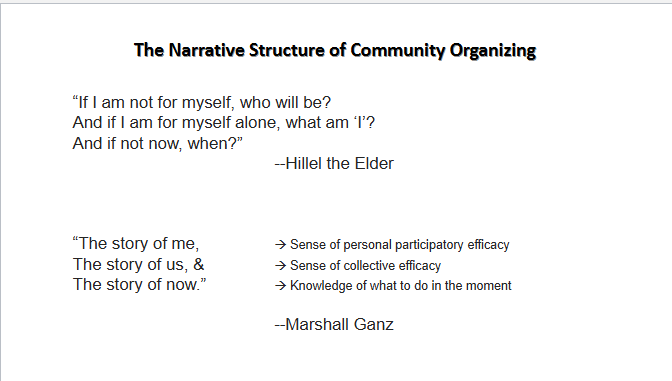
Narrative theory
focuses on how individuals and communities construct meaning through stories, utilizing these narratives to foster empowerment, identity, and social change
Qualitative research
process of naturalistic inquiry that attempts to make sense of phenomena in terms of the meanings that people bring to them
useful for examining situations, processes, and contexts that have not been studied in detail
Contextual meaning: allowing persons to speak in their own voices to represent a form of insider knowledge
Ex. participator research
Participatory Research
collaborative research within community members and for understanding diverse social and cultural contexts; important to be part of the community due to perspectives and connection
Increase of quality of questions: EMIC perspectives on research questions which participants come up with
Increase of quality of data/results of reporting: community members know how to speak to the community in a way they can understand instead of academic words
Role modeling and empowerment: motivates participants to get a degree
Action Research
Kurt Lewin; purse answers to questions about how individuals shape ecological contexts and how ecological contexts impact individuals
A collaborative, cyclical approach focused on solving immediate, practical problems and fostering social change, rather than merely creating generalizable theory
Ex. How do we develop a psychological sense of a community in a neighborhood?
N.A.O.M.I
Reducing addiction to heroin by supplying a safe way to give heroin
amount spent on heroin decreased more than half (1200 — 300)
they were able to hold jobs and build better rapport with families
Quantitative research
methods that emphasize measurement, statistical analysis, and experimental or statistical control
analyze measurable differences among variables and the strength of relationships among those variables
Mixed-methods
qualitative and quantitative methods can be used in a single study to offer the advantages of both perspectives and overcome the limitations of each
Qualitative acts as an exploratory role that can help researcher ask questions in their quanitative research in the 1st sequence of research design
Also serves as an explanatory role to help uncover why the researcher found the quantitative results they did
Positive externalities
Qualitative: empowerment, knowledge transfer, actionable insights (better policies), therapeutic effect
Mixed: richer. more accurate understanding of social impactsand actionable social data
Negative Externalities
Qualitative: psychological distress, community sigmatization, breach of condfidentiality, resource depletion (consume local time and energy without improvements)
Mixed: distorted findings, resource inefficiency
Effectiveness vs. efficiency in program evaluation
Effectiveness: