Music Cog - ALL
 Call Kai
 Learn
Learn Practice Test
 Spaced Repetition
 Match
Match Flashcards
 Knowt Play
1/610

There's no tags or description
Looks like no tags are added yet.
Name | Mastery | Learn | Test | Matching | Spaced | Call with Kai |
|---|
No analytics yet
Send a link to your students to track their progress
611 Terms
what is the psychology of music concerned with?
the processes by which people perceive, respond to, and create music, and how they integrate it into their lives
makes important use of cognitive psychology, drawing on sensation. perception, etc.
acoustics
the science of the production, propagation, and reception of vibrations in the air that are relevant to hearing and music
the science of sound
neuroscience in music
surge of interest in neural underpinnings of human musicality, and how the neural activity may constrain or enhance our experience of music/music-making
musicology
the study of structure and history of human music
philosophy in music
brings out certain presuppositions in the practices by which psychologists try to reach an understanding as a human phenomenon
music education
music requires the development of a set of highly elaborated skills, and a growing base of knowledge that allows for the sensitive interpretation of music
ethnomusicology
the anthropological study of music, looking at the different musical cultures, and distinctness
range of research methods in the psychology of music
empirical studies
recording
physiological/brain imaging
motion capture
electromyography
qualitative/naturalistic observations
3 things we need to understand about how we use and process sound
what you don’t hear affects what you do hear
little details matter
context is vital
semiotic theory
indexicality, AKA a thing that represents a thing (like a footprint representing a foot)
affordance
the actionable possibilities that the environment provides an individual
We use context clues to understand how to use something
We need to think about a sound's features as context for what the sound comes from
feedback loops
sound gives us information about our performance
ex, a sound when we hit someone
major → _____ effect, and minor → _____ effect
positive
negative
causal influence
with sound we can make sense of vague visual stimuli
when we see sharper shapes we assign it with sharper words (Bouba and Kiki experiment)
organizing principles of sound (Gestalt principles)
Proximity → if close together, we assume the sound came from the same source
Similarity → if similar, we assume the sound came form the same source
Closure → we fill in the gaps of what we don’t hear from what we expect
Symmetry
Common Fate/Continuity → sound will come/stay in the same direction
Past Experience
scientific definition of perception
our internal experiences of the external world
sound becomes music only when it is perceived by listeners
long vs short percussion gesture test - methods
4 conditions, 2 are hybrid (audio and gesture are mismatched)
participants told they may be mismatched, and told to only rate auditory length
long vs short percussion gesture test - results
with audio alone, the ratings of sound are not rated differently (despite long and short gestures)
when we pair sounds with gestures, the sound are impacted by gesture length
our perception of the sound is longer when mixed with the visual, but solely the audio shows no difference
why do we get those results with the long vs short gesture test?
our brain is implicitly thinking for us
it uses shortcuts that lead to illusions
what are ancillary gestures
expressive body movements used by musicians during performance, that aren't directly needed
what do ancillary gestures do?
enhance communication, express emotion, and guide the listener’s interpretation
they are not prescribed in traditional music scores, or evident in audio recordings, so some assume they are not integral to formal musical analysis
growing evidence that ancillary movements alter an audience’s listening experience
effective vs ancillary gesture
effective → required for sound production
ancillary → not necessary for the creation of sound
ancillary commonly thought of as secondary, but that is naive!
visual information in music (Stravinsky’s piece)
judgements of tension were rated differently depending on whether the participant viewed the performance or simply heard it
emotions are communicated through these gestures on a number of instruments
subgenre of theatrical percussion
modern performers are giving instructions on the motions to be used while performing, many of which are ancillary
capitalizes on the relationship between gestures, music, and perception
more common now, but not a new concept
dance and ancillary gestures
dance → human movement that frequently occurs concurrently with acoustic information
if ancillary movements accompany the music without affecting its acoustic characteristics, it can technically be dance
music induced movement
dance movements made in response to music
involves reacting to the low-level temporal structure of the music but also reflect the rich hierarchy of temporal information
when asked to dance freely, movement of the extremities tend to synchronize with faster metric levels, whereas movement of the torso tends to synchronize with slower metric levels
ancillary gestures can be used to accomplish _____ what cannot be accomplished _______
perceptually
acoustically
they can create musical illusions
marimba and ancillary gestures
'when sharp wrist motions are used, the only possible results can be sounds of staccato nature, and when smooth, relaxed wrist movements are used, the player will then be able to feel and project a smoother, more legato-like style'
others argue that motion after impact is not directly relevant to the acoustic consequences of the preceding event
shaded circle illusions
we see bumps when dark on bottom, and indents when dark on top, due to our assumption that light is coming from above the top of our head and the darkness = shadows
mcgurk effect
visual information categorically changes our perception of concurrent speech
Pairing one speech sound with the lip movement used to produce a different sound
The resulting percept is essentially the average between the two conflicting acoustic and visual components
The sound "ba" with the movements "ga" give "da”
integration of visual-audio
In everyday perceiving we often experience a number of events occurring simultaneously
Visual-audio integration is a constant background process assisting with the organization of a chaotic stream of sights and sounds into the coherent perceptual experience of unified multi-modal events
one of the cues for discerning multi-modal relationships is causality
importance of causality and manipulation
The importance of causality in audio-visual integration is best illustrated by viewing the perceptual ramifications of its absence
Manipulations of weakening causal links diminish the strength of the illusion
Manipulations breaking it destroy it entirely
for example, sounds that could not be caused by impact gestures (human voices) fail to integrate with impact motions
but, some alternate sounds don’t fail to integrate
when paired with a visual impact gesture, other sounds caused by impact events may integrate to a certain degree
for example, a piano sound may integrate with an impact gesture
the illusion is contingent upon detection of congruity between the visual motion and the auditory timbre
3 audio-visual pairings marimba experiment
the note occurred slightly before (audio lead the gesture)
the note occurred slightly after (audio lagged the gesture)
the note occurred at the same time
3 audio-visual pairings marimba experiment - results
the illusion was strongest in the synchrony condition
the gestures integrated with the marimba sound in the audio lag (2) condition, but not the audio lead (1) condition
demonstrates importance of causality (can’t integrate a motion to a sound that already happened, since sound moves slower than light)
which part of the impact controls the marimba illusion?
the magnitude of post-impact (showing only the motion concurrent with the sound) was similar to that of the full-gesture video
no illusion found in the pre-impact condition
point light vs edited videos when studying
edited videos lack ecological validity, so point light versions can be better representations of complex movements
we can use this to create hybrid gestures (mixing pre-impact of one and post-impact of another)
auditory signals offer important advantages:
can reach individuals not in the range of sight
faster response times
effective interfaces in saturated environments
easiest ways to classify alarm sounds
speech → easy to understand, direct
non speech → universal, and dominates the ambient noise form other speech
medical device alarms - IEC
opted for message standardization → attempting to improve interoperability across locations
created a global standard (specific sounds)
short tone sequences signal key states, with 2 levels of urgency
individuals required to differentiate between similarly sounding alarms
issues with the current melodies of medical device alarms
they sue identical rhythms, similar frequency ranges, and share a starting pitch
ensures uniformity, but poses barriers to the effectiveness due to frequency confusion/misidentification
very poor learnability
what is alarm masking
when alarms have similarities in acoustic structure, it increases the risk of simultaneous masking (concurrent alarms prevent one another from being heard)
risk further increased by similarities in the signals temporal structure, pitch range, and timbre
alarm confusion in hospitals
terrible learnability (less than 30% can identify after training)
only 2/14 nurses could identify every alarm
the arrangement of sounds within the alarms are too similar to eachother
what is timbre and how can we use it in hospital alarms
timbre provides rich acoustic information, allowing for the differentiation between sound sources, and facilitating recognition
we can use different timbres in different alarms
but, the universal standards mandates the same timbre throughout
musical sounds - complex or simple?
musical sounds from instruments are incredibly complex, making them enjoyable to listen too:
one note produces multiple tones over the fundamental frequency (overtones/harmonics)
the notes’ strength changes overtime
hospital alarms - complex or simple?
temporally simplistic
the alarm tones contain multiple harmonics, but little temporal variation
alarms are made up of flat/simple tones
leads to uniformity, but this decision was driven by technical benefits rather than perceptual best practices
2 ways we can use music’s temporal complexity to improve alarm design
lowering annoyance
proven by experiments
improve recognition compared to current alarms
no differences in learnability proven by experiments
new 2020 standard for alarms
aligns with auditory principles and extensively validated
they are temporally simple and have few harmonics
less notes = less urgency
alarm annoyance not considered!
perceptually well-designed alarms were created. why were they rejected?
they sounded unpleasant (patterson)
issues with alarms being annoying
contributes to alarm fatigue and staff turning off alarms
overall, what can we do to hospital alarms to make them less annoying?
add temporal variability!
two key concepts in this class
our brains think for us
music reflects the features of my mind
similarly to how a glove reflects the features of my hand
mcgurk effect is the speech equivelant to the
marimba illusion
there is a sensory integration between the visual and acoustic information, creating a specific perceptual experience
unity assumption
some sight and sound go together
ventriloquist effect
our brain is always looking for sights and sounds that go together
our perception of music can be entirely changed by adding other _____
modalities, especially visual components
integration of impact gestures (marimba) and other sounds
y-axis is visual influence, long to short gestures
x-axis is: marimba, piano, horn, clarinet, voice, and white noise
important features
marimba the highest
piano about half of the marimba
horn, clarinet, voice, and white noise are all similar and close to 0
higher bars = higher binding between modalities (sense of unity)
difficult to separate these modalities
what dominates in a spatial vs temporal task?
visual system dominates for spatial, auditory system dominates for temporal tasks
in general, which modality dominates and why?
visual systems, simply due to their ease!
to see motion, we need at least 60 frames per second
to fool our soundwaves, in audio CDs we need 44,000 samples per second
duration perception and modality integration
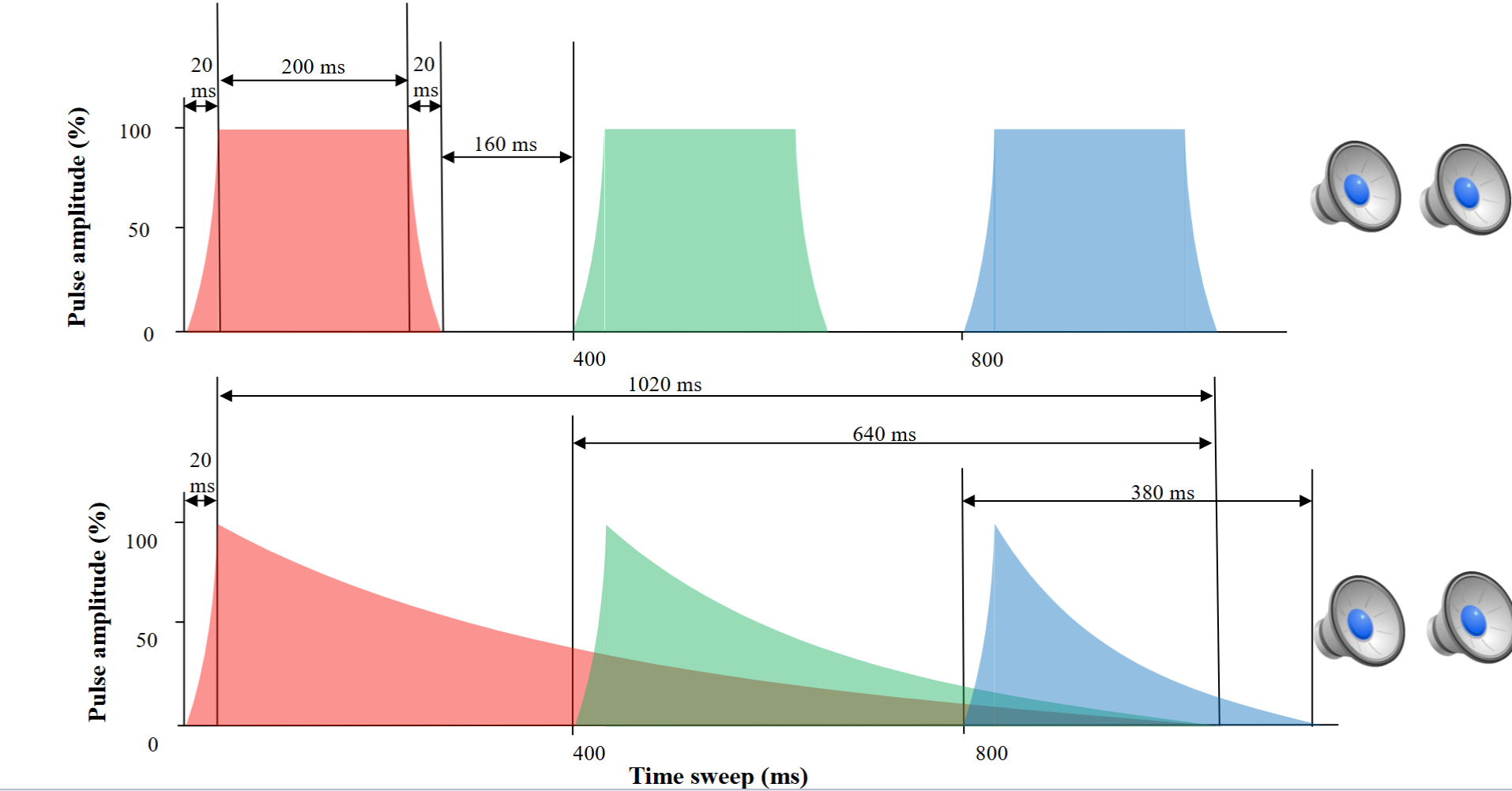
if we have a flat tone vs a percussive tone (with a spike and fall):
we see a stronger pattern of visual influence with percussive tones
likely due to the fact that the percussive tone has better ecological validity, making it easier to bind
how do musical tones differ from tone beeps?
tone beeps → unnaturally flat, with an instant start and instant end, and a constant pitch
musical tones → more variety, gradual, ebbs and flows, natural, overtones within the same note, temporal variation, etc.
in past experiments on auditory perception and visual system binding…
the majority is done with flat sounds (90% beeps), and only about 10% have temporal variation (percussive sounds)
in everyday listening, we have way more percussive sounds than simplistic ones
our everyday experiences show the opposite pattern to what is researched!
initial assumption about unity assumption in music
exp compared piano vs guitar, separated visual vs auditory
found no benefit of congruency (same instrument visual + auditory)
similar binding found in hybrid conditions
therefore, concluded there is no unity assumption in music
issue with using the guitar and piano when looking at unity assumptions
the amplitude envelopes of piano and guitar notes are pretty similar
so, failure of unity benefits may be due to the fact that some level of binding occurred in the hybrid conditions
if we retest the unity assumption with the cello and marimba, what do we find?
we find stronger binding with congruency, therefore unity assumption met
this succeeded because they have extremely different amplitude envelopes
what are amplitude envelopes?
amount of energy (amplitude) over time
when we consider complex vs simple sounds, the biggest differences are in amplitude envelopes
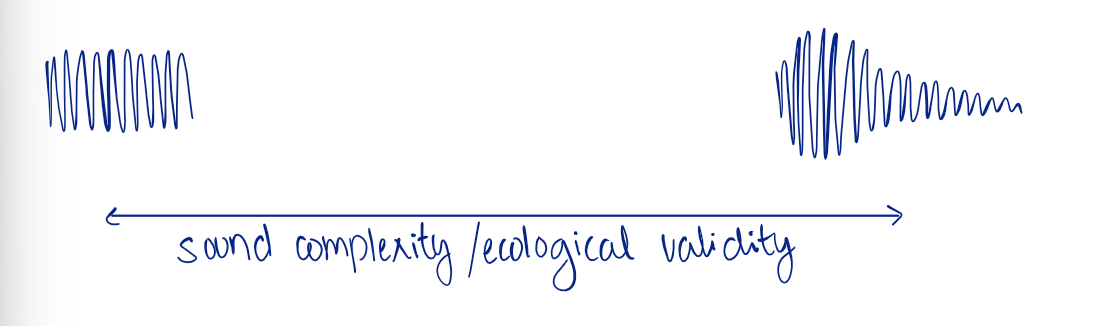
continuum of amplitude envelopes by ecological validity/sound complexity
as sound complexity increases, ecological validity increases (and vice versa)
interfaces
a device or program enabling a user to communicate with a computer (in this context, with sound)
interface may be a better term than ‘alarms’ when discussing hospital beeps
3 things to consider in alarms
learning/learnability → need to increase
memory → need to increase
annoyance → need to decrease
3 burning questions about creating new interfaces
why not add a visual interface?
why not add speech?
isn’t annoying good?
answers to the 3 burning questions
there are often times where visual attention is needed elsewhere
in a busy hospital this would be more annoying, no universality, and compromises shielding (don’t need to tell patient everything immediately)
not all alerts are alarms (these are interfaces) meaning they need not be annoying, can create fatigue
what slight change can we make to standard device sounds without changing the tones?
alter their amplitude envelopes to be more percussion-like
allows for decay and overlap
this allowed the tones to be perceived as less annoying
the benefits of this experiment are due to the temporal structure changes
stats of types of sounds in research on auditory perception
28% percussive
28% flat
1% click
8.5% other
33% undefined
many were not including the amplitude envelopes
huge issue! impossible to recreate without these/separate
other meta analyses found the undefined category to be the largest again
metaphor for the downfall of amplitude envelopes
they are like the outline/shadow of the person, rather than the entire person
we need to also consider the complexity in harmonics, not just amplitude across time
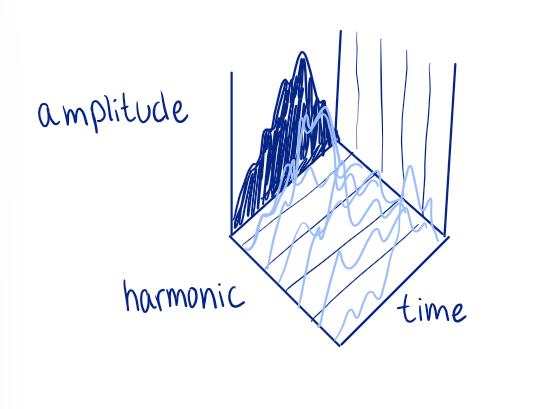
decreasing from 100% harmonic
with flat and percussive tones, decreasing from 100% harmonic (same the whole time) it becomes less annoying
percussive notes inherently less annoying too, and detection is easier
musical acoustics
focuses on the mechanisms of sound production by musical instruments, effects of reproduction processes or room design on music sound, and human perception of sound as music
3 physical characteristics of sound waves
frequency
amplitude
power spectrum
pressure wave
physical disturbances propagating through the air form
we need density in air molecules so sound can travel
tine movements on a tuning fork
Compression → as a tine moves in an outward direction, the air molecules adjacent to it cluster together
Expansion → then, as the tine moves back in, past its midpoint, the molecules spread apart
the compression and expansion of air molecules creates
an oscillation, leading to a sound wave
compression is the amp above 0, and expansion is amp below 0
the movement of a sound wave is
longitudinal
the movement of the oscillation is parallel to the direction of movement overall
a sine wave is the equivalent of a ____ tone
pure/simple
its pattern can be described fully using one frequency of the vibration
takes a very smoothed pattern
most sounds do not take this pattern
2 parameters of sine waves:
frequency
amplitude
frequency
every time a sine wave completes a full cycle (AKA a full period)
Hz → number of cycles per second
what can we use to control frequency?
tension, which causes sound frequency to increase, influencing pitch
pitch is a ____ variable
subjective
many cycles in a span of time is perceived as high
few cycles in a span of time is perceived as low
ampltitude
the maximum displacement compared to the resting state
generally, the greater the amplitude of a wave = the more energy it transmits
more energy seems to = more loudness
amplitude is related to the percept of ____
loudness
complex soundwaves
most sounds are best understood as a combination of many frequencies that occur simultaneously
any complex tone can be understood as a combination of sine waves
we can sum multiple sine waves/components to describe a complex tone
fourier analysis
the process by which a complex wave is decomposed into a set of component sinusoids
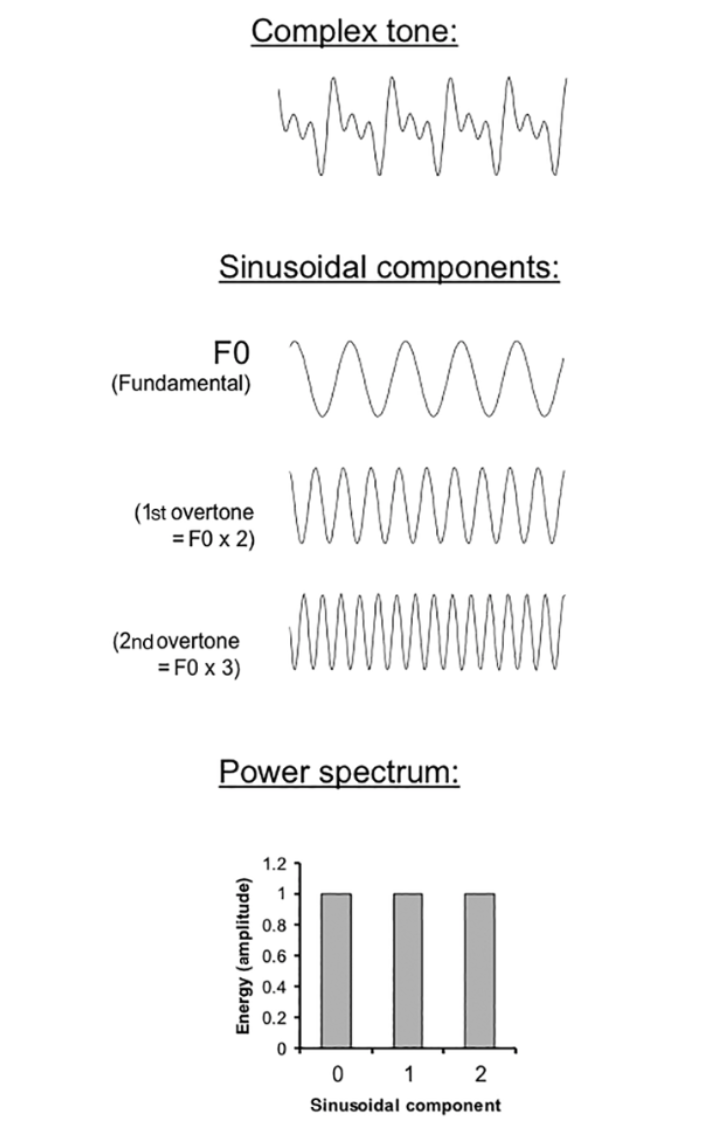
fundamental frequency
the component with the lowest frequency (longest wavelength)
often associated with the pitch of the complex tone
overtones
higher frequency components of the complex tones
the quality of sound formed by the pattern of the overtone series is
timbre
timbre helps us differentiate between different sounds
harmonic complex tones
the frequency of each overtone is an integer multiple of the fundamental frequency
tones are simply called ‘harmonics’ in these tones
for example, can have a first harmonic double the fundamental, the second triple, the third quadruple, etc.
harmonic complex tones often convey a
clear pitch
how does the numbering convention for frequency components vary between harmonics vs overtones?
harmonics → the numbering includes the fundamental, starting at 1 (F1)
overtones → a general distinction between fundamental and overtones, so the fundamental starts at 0 (F0)
anharmonic complex tones
sounds with rough or noisy timbre, they have overtones that are not so simply related to the fundamental
this is white noise!
in real life, what do we normal hear? (in regards to harmonic and anharmonic complex tones)
the sounds we hear are often never entirely one or the other
but, we still use the distinction to distinguish between different sorts of timbre
for ex, Micheal Buble’s voice is closer in structure to the sound wave of a harmonic complex tone
amplitude relationships in the overtone series
not all overtones emerge with the same intensity
overtone series determining timbre are based on numerical relationships among sound frequencies AND through amplitude associated with each frequency
power spectrum
plots the amount of energy (power) associated with each frequency component in a tone (expressed as amplitude)
can be thought of as showing the amplitude of sine waves in a complex tone
spectral centroid
how the amplitudes of different partials are distributed defines this part of timbre
spectral centroid reflects the center of gravity in the sound’s spectrum