Electricity: Principles, Laws, and Circuit Types for Physics Students
 Call Kai
 Learn
Learn Practice Test
 Spaced Repetition
 Match
Match Flashcards
 Knowt Play
1/74

There's no tags or description
Looks like no tags are added yet.
Name | Mastery | Learn | Test | Matching | Spaced | Call with Kai |
|---|
No analytics yet
Send a link to your students to track their progress
75 Terms
What is the atomic nature of electricity?
Electricity is based on the movement of electrons, which have a negative charge, and protons, which have a positive charge.
What are the laws of electrostatics?
The principle of conservation of charge, Coulomb’s Law and like charges repel while unlike charges attract
What is electrification?
The process by which electrons are added to or subtracted from an object.
How can matter be electrified?
Through friction, contact, or induction.
What happens when an object has more electrons than another?
It is negatively charged.
What happens when an object has fewer electrons than another?
It is positively charged.
What is the effect of friction on electrification?
Friction causes electrons to be removed from one object and transferred to another, resulting in a charge difference.
What is static discharge?
The phenomenon where electrons jump the gap between oppositely charged objects, releasing energy as light.
What is an electroscope?
A device used to illustrate the laws of electrostatics, showing charge distribution through movement of metallic leaves.
What is induction in electrostatics?
Induction occurs when one object's electric field affects another without direct contact, causing electron movement.
How is electrostatic charge measured?
In SI units, electrostatic charge is measured using the coulomb (C).
How many electrons are in one coulomb?
1 coulomb equals approximately 6.24 x 10^18 electrons.
What is Coulomb's Law?
The force between two electric charges gets stronger when the charges are larger, and weaker when they are farther apart.
What does the Inverse Square Law state?
The intensity of an electric field decreases with the square of the distance from the charge.
What is the difference between conductors and insulators?
Conductors allow electrons to flow easily, while insulators do not.
Where do electric charges reside in conductors?
Electric charges reside on the external surfaces of conductors.
What is the law of distribution in electrostatics?
Electric charges are distributed equally throughout non-conductors and on the surface of conductors.
What is the significance of outer-shell electrons?
Outer-shell electrons have low binding energies, allowing them to move outside the atom and contribute to electric charge.
What is the role of protons in an atom?
Protons have a positive charge and are generally locked inside the nucleus by strong nuclear forces.
What happens during contact electrification?
When two objects touch, electrons move from one object to another, equalizing their charges.
What is an example of friction electrification?
Rubbing a balloon on your hair, which transfers electrons and charges the balloon.
What occurs when a charged object touches an electroscope?
Excess electrons distribute throughout the rod and leaves, causing the leaves to move apart.
Where do electric charges concentrate on a conductor's surface?
Along the sharpest curvature.
What type of charges move along solid conductors?
Only negative charges (electrons).
What is electrodynamics?
The study of moving electric charges, primarily electrons.
What environments allow electrons to move?
In a vacuum, within a gas, within an ionic solution, and along metallic conductors.
What are conductors?
Materials that easily permit electrons to flow.
Name three common conductors.
Copper, silver, and gold.
What are insulators?
Materials that do not allow electrons to flow.
Name three common insulators.
Rubber, glass, and plastic.
What is electric current?
The movement of electrons along a wire.
What creates an electrical potential in a wire?
An excess of electrons at one end and a deficiency at the other end.
What is the typical speed of electron movement in a wire?
Electrons push each other at about 2 mm per second, causing rapid movement nearly at the speed of light.
What is the conduction band?
An area within the force field of an atom just outside the outermost shell that contains free electrons.
What are superconductors?
Materials that allow electrons to flow with almost zero resistance when cooled to very low temperatures.
What are semiconductors?
Materials that act as either a conductor or insulator, depending on their construction and environment.
What is an electrical circuit?
A pathway that allows electrons to flow from their source, through resisting electrical devices, and back to the source.
What is the direction of electron flow?
From the negative terminal to the positive terminal
What is current measured in?
Amperes (A).
What does 1 ampere represent?
An electric charge of 1 coulomb flowing through a conductor each second.
What is potential difference (PD)?
The force or strength with which electrons flow.
What is the SI unit of potential difference?
Volts (V).
What unit do radiographic units and CT scanners use for current?
Milliampere (mA).
What is the relationship between potential difference and electron flow?
The greater the potential difference, the greater the force of electron flow.
What is the significance of valence electrons in conductors?
Elements with only 1 valence electron are good conductors, as they can easily become free and conduct electricity.
What is the effect of resistance on electron movement?
There is some resistance to electron movement on the surface of the wire as they flow.
What is the role of batteries in electrical circuits?
They convert chemical energy to electrical energy, providing excess electrons to power a circuit.
What is the role of generators in electrical circuits?
They convert mechanical energy to electrical energy.
What does PD stand for in electrical terms?
Potential Difference, sometimes referred to as electromotive force (EMF).
What is the significance of ground potential?
The earth is neutral, containing equal positive and negative charges, and has no potential to perform work.
What voltage do most household electrical outlets supply?
Approximately 120 V for most devices and 240 V for large devices.
What is electrical grounding?
Connecting an electrical circuit to the earth to cancel out electric charges and enhance safety.
What are the three slots in a standard 120 V outlet?
Neutral (left), hot (right), and ground (bottom).
What is the purpose of the ground wire in electrical devices?
To provide a safe path for excess electrons to travel to the earth, preventing electric shocks.
What voltage range do diagnostic x-ray machines operate at?
40-150 kV (40,000-150,000 volts).
What is resistance in an electrical circuit?
The opposition to electron flow in a circuit, measured in ohms (Ω).
What factors affect resistance in a wire?
Length of the conductor, cross-sectional diameter, and temperature.
What is Ohm's Law?
Current (I) is proportional to potential difference (V) and inversely proportional to resistance (R), expressed as V = IR.
How do you calculate amperage using Ohm's Law?
I = V/R.
What is the formula for calculating electric power?
P = IV, where P is power in watts, I is current in amperes, and V is voltage in volts.
What is the SI unit for electric power?
Watt (W).
What is the difference between alternating current (AC) and direct current (DC)?
AC moves electrons back and forth, while DC moves electrons in one direction.
What is a series circuit?
A circuit where elements are connected one after another, and if one element fails, the entire circuit is broken.
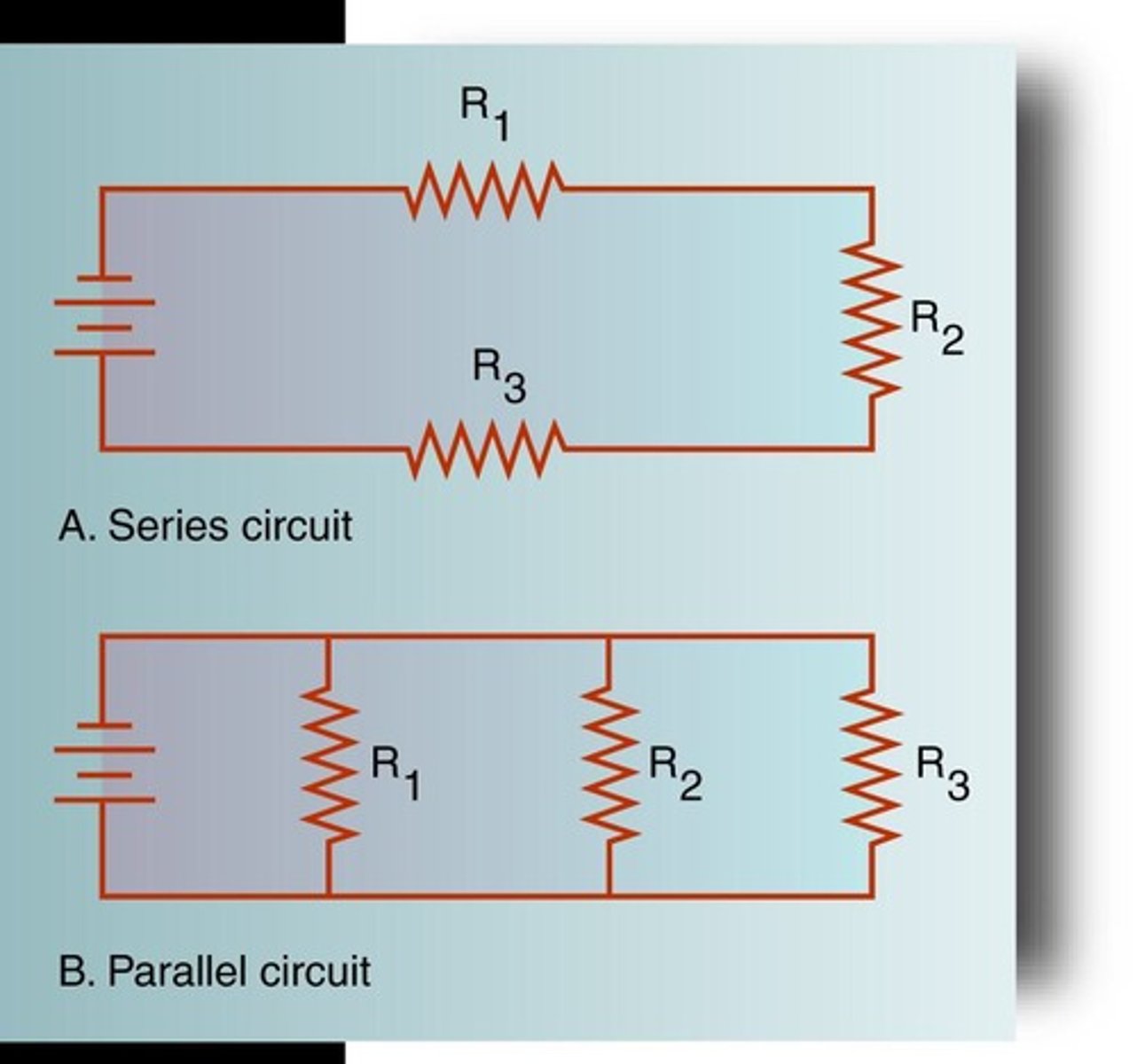
What is a parallel circuit?
A circuit where elements are connected across the same voltage source, allowing current to flow through multiple paths.
How do you calculate total current in a parallel circuit?
Write down the supply voltage.
Write down the resistance of each branch.
Use I= V/ R to calculate the current in each branch.
Add all branch currents together. Total Current =I1+I2+I3
The sum is the total current in the circuit.
How do you calculate total voltage in a series circuit?
By summing the voltage across each element: Vt = V1 + V2 + V3 + ... + Vn.
How do you calculate total resistance in a series circuit?
By summing the resistance of each element: Rt = R1 + R2 + R3 + ... + Rn.

How do you calculate total resistance in a parallel circuit?
By summing the reciprocals of each resistance: 1/Rt = 1/R1 + 1/R2 + 1/R3 + ... + 1/Rn.
What happens to current in a series circuit if one element fails?
The entire circuit is broken and current stops flowing.
What happens to current in a parallel circuit if one element fails?
The rest of the circuit remains operational and current continues to flow.
What is the relationship between resistance and the length of a conductor?
Resistance increases as the length of the conductor increases.
What is the relationship between resistance and the diameter of a conductor?
Resistance decreases as the diameter of the conductor increases.
What is the effect of temperature on resistance?
As temperature increases, resistance typically increases due to heat buildup.
How do you convert kilovolts to volts?
Multiply by 1,000 (1 kV = 1,000 V).
How do you convert milliamperes to amperes?
Divide by 1,000 (1,000 mA = 1 A).