QUANTUM WAVES
 Call Kai
 Learn
Learn Practice Test
 Spaced Repetition
 Match
Match Flashcards
 Knowt Play
1/28

There's no tags or description
Looks like no tags are added yet.
Name | Mastery | Learn | Test | Matching | Spaced | Call with Kai |
|---|
No analytics yet
Send a link to your students to track their progress
29 Terms
Evidence for the wave nature of electrons.
Diffraction is a wave property which occurs when waves pass through small gaps and spread out. Electrons passing through a crystal produce a diffraction pattern of rings, not a single spot, so must behave as waves.
de Broglie hypothesis
All particles have a wave-like nature and a particle-like nature
de Broglie equation
λ = h / p
Wavelength (m) = Planck constant / momentum (kgms^-1)
If you increase the pd, electrons travel...
Faster, so have a larger momentum (p = mv), smaller wavelength (λ = h / p) and smaller diffraction angles (nλ = dsinθ), resulting in a smaller ring radius. Voltage is inversely proportional to ring radius
Photon
A discrete packet of electromagnetic energy
E =
hf
Energy of a photon (J) = The Planck constant x Frequency (Hz)
Power of a beam =
nhf
Power (W) = No. of photons in a second x The Planck constant x Frequency (Hz)
The particle model of light
Light behaves like a stream of particles called photons, which each carry a discrete amount of energy, which is proportional to frequency. Higher intensity = more photons per second
Photoelectric effect
The emission of electrons from a metal when light above a certain frequency is shone on it due to them gaining energy
Photoelectron
An electron released through the photoelectric effect
Photoelectric effect gold leaf experiment
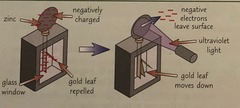
Charge builds up on the metal plate and spreads to the gold leaf. They will have the same charge, so will repel each other and the leaf will rise. If light is shone onto the metal, it will transfer energy to the electrons. If an electron gains enough energy, it will leave the surface, so charge is lost and the leaf will fall
How photoemission should occur according to the wave model
Delayed emission
Still emits eventually at a low emission
Energy of electrons build up over time
Electron KE increases with intensity
How photoemission actually occurs
Instantaneous emission
No emission below threshold frequency. If below this, the energy is re-emitted
One electron absorbs one photon
Electron KE increases with frequency
This is evidence for the particle model
Threshold frequency
The minimum frequency of light needed to liberate an electron via photoemission
Work function
Minimum energy required for photoelectric emission from the surface of a metal
ϕ =
hf₀
The photoelectric equation
hf = φ + KE(max)
The Planck constant x Frequency (Hz) = Work function (J) + Maximum kinetic energy (J)
On a graph of maximum KE against frequency, the y-intercept is...
- the work function
On a graph on KE against frequency, the gradient is...
The Planck constant
On a graph of maximum KE against frequency, the x-intercept is...
The threshold frequency
Not all electrons will have the maximum kinetic energy as...
Some will come from deeper in the metal and will lose energy via collisions
To convert from eV to J...
Multiply by 1.6x10^-19
To convert from J to eV...
Divide by 1.6x10^-19
Ground state
Lowest energy state of an atom
Excitation
When electrons absorb a photon and move to a higher energy level. Photon energy must be exactly equal to the difference between energy levels
De-excitation
The atom will now be unstable, so the electron emits a photon and moves to a lower energy level
For ionisation to occur, energy must be...
Greater than or equal to the work function
Absorption spectrum
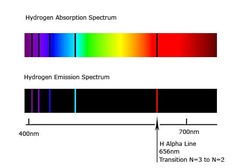
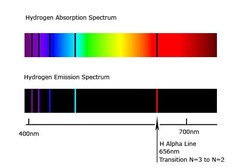
Dark lines on a coloured background. Electrons are in discrete energy levels. A single photon interacts with a single electron, which will become excited. The photon energy = hf, so energy absorbed must be equal to an energy level difference. Frequency is inversely proportional to wavelength. Only certain transitions are possible, so only certain wavelengths are possible. There are specific wavelengths missing, so dark lines are formed
Emission spectrum
Coloured lines on a dark background. Electrons are in discrete energy levels. A single photon interacts with a single electron, which will become excited. It will then become de-excited, and emit a single photon. The photon energy = hf, so energy absorbed must be equal to an energy level difference. Frequency is inversely proportional to wavelength. Only certain transitions are possible, so only certain wavelengths are possible. Specific wavelengths are produced, so bright lines are formed