Ch 8: Mendel- Monohybrid and Dihybrid cross
 Call Kai
 Learn
Learn Practice Test
 Spaced Repetition
 Match
Match Flashcards
 Knowt Play
1/44

Name | Mastery | Learn | Test | Matching | Spaced | Call with Kai |
|---|
No analytics yet
Send a link to your students to track their progress
45 Terms
Inheritance
traits are passed from parents to offspring
Blending inheritance
hypothesis of mid-1800’s
offspring inherit characteristics that are a blend that are a blend of those seen in the parents
Particulate inheritance
determinates = genes
determinates are passed to the next generation without blending
Gregor Mendel
father of genetics
performed genetic crosses with pea plants
discovered two laws of inheritance
What did Mendel do to his pea plants?
controlled mating of pea plants by removing pollen from stamens and manually placing it on pistils of..
another plant = cross fertilization
same plant = self-fertilization
Why did Mendel do what he did to pea plants?
he wanted to understand how traits in pea plant are passed on from parents to offspring (inherited)
Characters vs. traits
Characters: observable physical features
flower color, seed color
Traits: forms of a character
purple vs. white flowers
round vs. wrinkled seeds
True breeding
when self-fertilized or crossed with one another, they produce offspring with the same trait(s) as the parents
Mendel selectively bred plants to create
true breeding purple-flowers
true-breeding white flowers
Reciprocally crossed
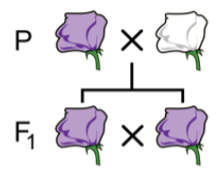
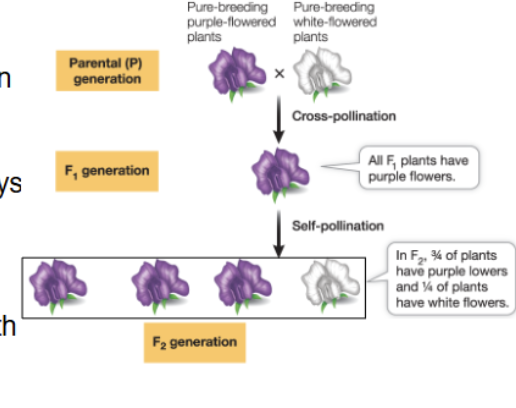
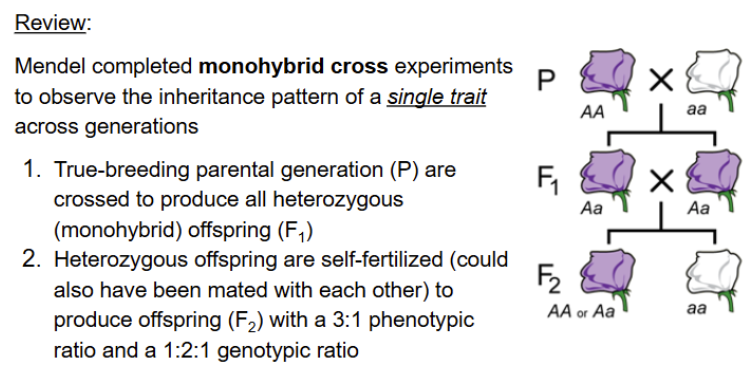
Mendel reciprocally crossed true breeding plants (purple and white)
Reciprocal cross: pollen is transferred between plants, with each one giving and receiving
Parent (P) generation: first set of plants crossed
F1generation: offspring of P generation
F1 generation were monohybrids: offspring of two individuals that differ in a single trait
Monohybrid
mating of two true-breeding lines
F2 generation
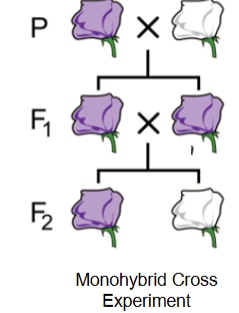
Mendel allowed the F1 generation to self-pollinate to produce F2 (second filial) generation
this was his monohybrid cross
A pattern from Mendel’s experiment emerged
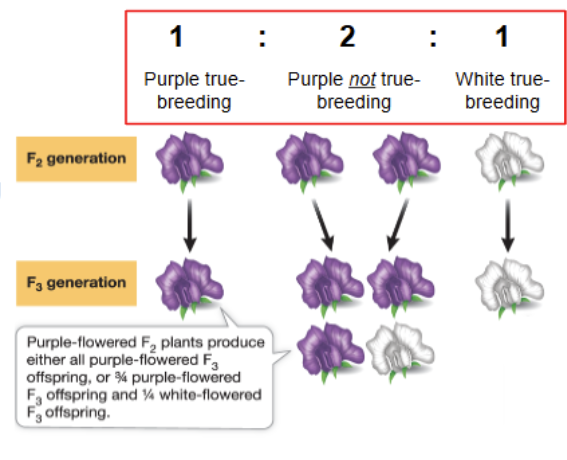
one trait disappeared in the F1 generation and reappeared in the F2
the F2 traits were always in a 3:1 ratio
¼ had the trait that disappeared in the F1
this disproved blending inheritance
F3 generation
Mendel found an underlying pattern when considering potential offspring
underlying pattern = 1:2:1 ratio
What did Mendel decide determine traits?
pairs of discrete particulate genes
Genes
a sequence of DNA at a specific locus that performs a function
Alleles
different versions of the same gene
example: A = purple flower, a = white flower
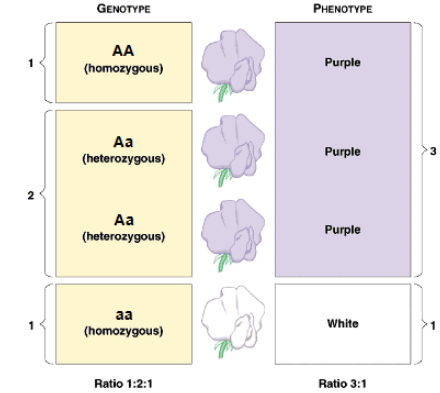
Genotype
allelic makeup of an individual
example: Aa
Phenotype
outward expression of the genotype
example: purple flower
Dominant trait
requires only one copy of that allele to be expressed (A)
Recessive trait
requires both copies of that allele to be present (a)
Homozygous genotype
two alleles at a locus are the same (AA or aa)
Heterozygous genotype
two alleles at a locus are different (Aa)
Laws of Inheritance
Law of Segregation
Law of Independent Assortment
Law of Segregation
during the formation of gametes, alleles separates equally so that each gamete receives only one copy
Meiosis = process of create gametes
3:1 phenotypic ratio and 1:2:1 genotypic rati
Punnett Square
write alleles that can be given (one allele per gamete) by one parent along the top and those from the other parent on the left
combine alleles from the top and side to create the possible genotype combinations for the offspring
intersections of columns and rows represent fertilization between gametes
Interpreting Punnett squares
Character: flower color
A = purple flower = dominant
a = white flower = recessive
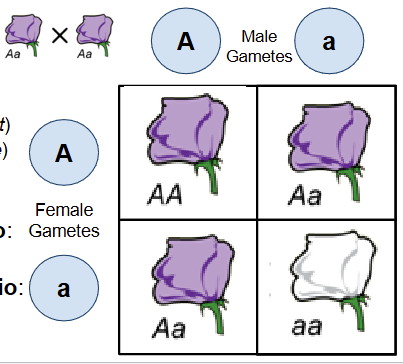
monohybrid cross: Aa x Aa
both heterozygotes
offspring genotypic ratio: 1:2:1 (AA, Aa, Aa, aa)
offspring phenotypic ratio: 3:1 (3 purple, 1 white)
Test Cross
plant with dominant phenotype but unknown genotype (A_) is crossed with a plant with a recessive homozygous genotype (aa)
resulting offspring were either..
100% dominant phenotype
50% dominant phenotype and 50% recessive phenotype
pattern aligns with law of segregation
Overview of Monohybrid cross
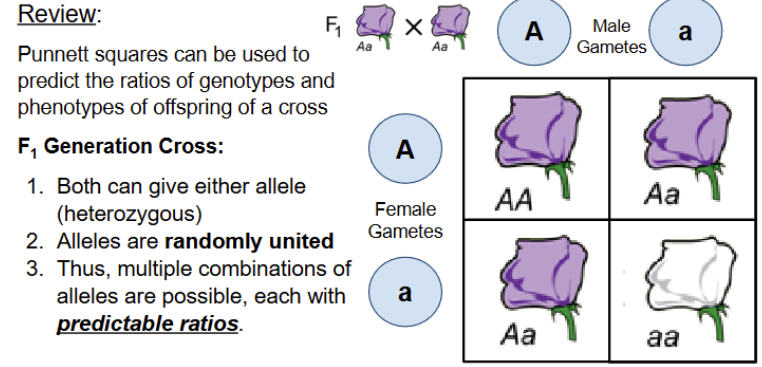
Overview of F1 generation cross
What do Punnett squares show us?
probability of each combination of alleles —> predicted ratio is statistically likely, but not guaranteed
Alleles are segregated ____ and _____ into _____
Alleles are segregated equally and randomly into gametes
Passing on an allele is like a coin flip…
but some people have a double sided coin
Rules of Probability
Event is certain to happen, then probability = 1
like a double-headed penny landing on heads
Event cannot possibly happen, probability = 0
like a double-headed penny landing on tails
all other events with multiple possible outcomes
probability between 0 and 1
standard penny flip
What do the rules of probability allow us to do?
predict possible phenotypic outcomes
Multiplication rule
multiply the probability of independent events to find the probability of both happening together
probability of two people flipping a coin and both getting heads = ½ x ½ = ¼
Addition rule
add the probabilities of mutually exclusive events to find the probability of either event happening
probability of either getting tails-heads or heads-tails = ¼ + ¼ = ½ chance of either
Mendel’s use of the dihybrid cross
used to observe the inheritance pattern of pairs of traits
Mendel’s observations in his dihybrid cross
F1 generation: two traits temp disappeared
F2 generation: any combination of traits was possible; always in a 9:3:3:1 phenotypic ratio
Law of Independent Assortment
alleles of different genes are distributed into gametes independently of each
assortment of the seed shape and seed color alleles are independent events (do NOT impact each other)
What can you predict using dihybrid crosses?
find the predicted offspring ratio of a dihybrid cross using a Punnett square
Law of segregation says…
each gamete gets one copy of each allele
Law of independent assortment says…
alleles of different genes are distributed into gametes independently of each other
Ratios of a dihybrid Punnett square
Phenotypic ratio: 9:3:3:1
Genotypic ratio: 1:2:2:1:4:1:2:2:1
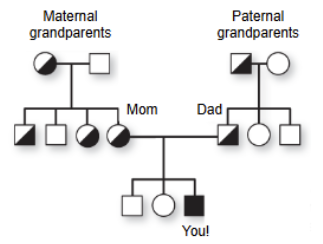
What is a predigree?
diagram showing inheritance pattern of a trait within a family —> allows us to trace the inheritance of rare alleles