Exam 2 Developmental Psychology
 Call Kai
 Learn
Learn Practice Test
 Spaced Repetition
 Match
Match Flashcards
 Knowt Play
1/242

Earn XP
Description and Tags
Chapters 5-8
Name | Mastery | Learn | Test | Matching | Spaced | Call with Kai |
|---|
No analytics yet
Send a link to your students to track their progress
243 Terms
Sensation
The process by which sensory receptor neurons detect information and transmit it to the brain
Five Sense and Somatosensory Center
Somatosensory Center is located in the
postcentral gyrus in anterior parietal lobe
responsible for touch/sensation
Perception is the
interpretation of sensory input
processed in the FRONTAL LOBE with input from parietal and occipital lobes
EX ) recognizing what you see or understanding what is said to you
Action is
motor activities prompted by 1 (sensory) 2 (perception) and/or 3 (internal initiative)
EX ) Sitting on our sofa, our ears may detect a sound, which our brain accurately perceives or interprets to be a doorbell
The Motor Cortex controls
all voluntary body movements
Posterior portion(precentral gyrus) of the FRONTAL LOBE ; long axons link to spinal cord
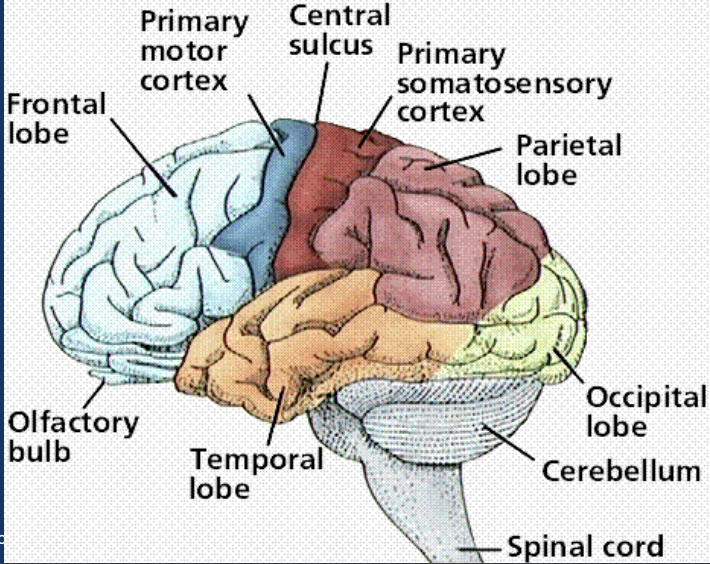
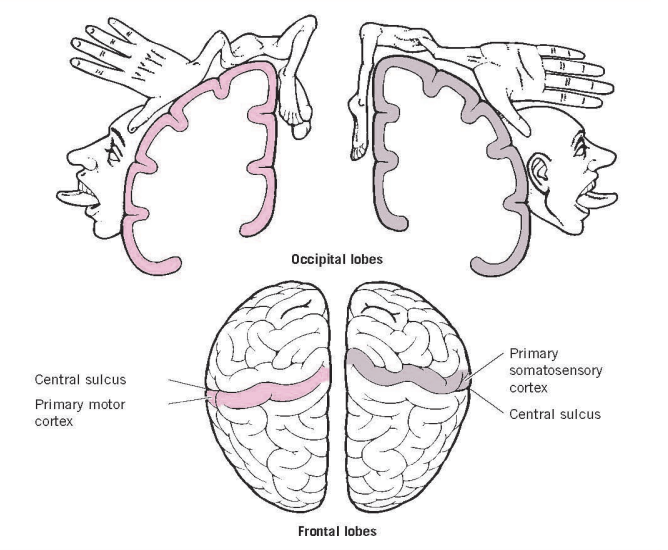
What does Homunculus mean?
little person
the drawing of a strange “little person” indicates where in the brain the different parts of the body are controlled and how much space is allocated to each part
What are the 2 types of perspectives on Perception?
Constructivist and Nativist
Constructivists Perspective leans on the side of
nurture
Children construct a perceptual system based on learning & lived experiences
susceptible to environmental factors
Example : Jean Piaget
Nativists Perspective leans on the side of
Nature
Children are born with innate capabilities to interpret sensory information
Maturational programs drive perceptual development
Perception does not always require interpretation/understanding, e.g., depth
Perception is direct
Gibsons Ecological Theory of Perception states nature and nurture are
inseparable
argues that we do not need to construct how we might interact with object
AFFORDANCES
What are affordances ?
What an object has to offer us (how it might be used by us)
The opportunities/possibilities are relative to both the actor’s maturation and previous experiences
What are different methods for assessing infant perception?
Habituation, Preferential Looking, and Evoked Potentials
Habituation is when the
same stimulus is repeatedly presented until the infant grows bored with what has become familiar and disengages. Researchers can measure how long until an infant becomes bored. They can measure how distinct a second, new stimulus needs to be in order to recapture the infant’s attention.
Example : baby staring at new toy, losing interest after seeing it over and over, and then when a new toy appears, interests reappears.
Preferential Looking is when
Two stimuli are simultaneously shown to an infant to determine which one they prefer, which is inferred to be the one they look at longer. Adding head-mounted, eye-tracking cameras has allowed researchers to more precisely measure preferential looking
showing an infant a plain, gray card alongside a card with black-and-white stripes. Because infants prefer patterns, if they look at the stripes longer, it demonstrates they can distinguish the stripes from the gray background, allowing researchers to measure visual acuity and cognitive development
Evoked Potentials
Electrical activity in different parts of the brain is measured while the infant is exposed to stimulation. Electrodes are attached to the surface of the skull and a computer records the pattern of electrical activity corresponding to various stimuli.
How does vision work?
Eye takes in stimulation in the form of light
Photoreceptor cells in the retina converts it to electrochemical signals
What is visual acuity?
ability to perceive detail
Birth : 20/200 - 20/400
1 Month Old : 20/120
4-6 Years Old : 20/20
What is Visual Accommodation ?
Ability of the lens of the eye to change shape to bring objects at different distances into focus
Example :
far = flatter thinner
near = rounder & thicker
The retina detects?
light and converts it into signals your brain can use
The eye lens
absorbs, focuses, and directs incoming light to the retina
flexes and changes its shape to bend the incoming light towards your retina
The pupil regulates
the amount of light that enters the eye
True or False : Color vision is NOT present at birth
False
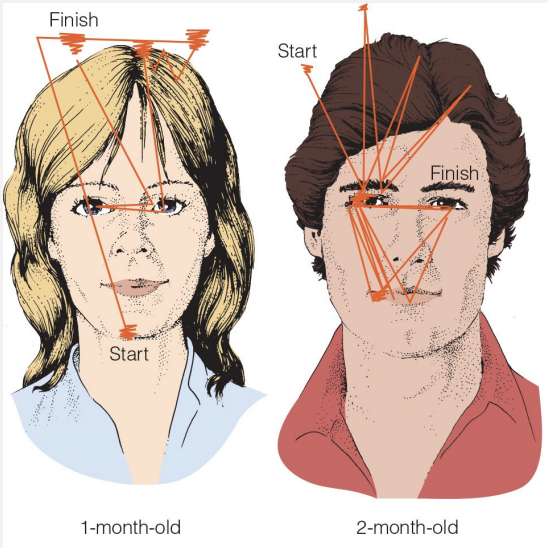
Perception Formation 1 month old vs. 2 month old and 6 month old infants
1 month : figure/background separation AND scanning edges
2 month : wholeness and scanning most contracted parts of the objects
6 month : determine the boundaries/edges of stationary objects (use common motion as a cue)
Vision Scanning in Early Infancy Image
What are the properties of patterns that capture the young infant’s attention?
Patterns that have a large amount of light-dark transition or contour, dynamic displays or contain movement, and they moderately complex
What age do infants perceive faces ?
3-5 months old
What are some sensitive periods during which vision development is susceptible to experiences and environmental factors ?
first 3 months are critical for normal development
before/after 10 weeks → lack of holistic face processing (sleeper effect)
Congenital cataracts (3/5K) a rare, often treatable birth defect where a baby's eye lens is cloudy instead of clear, causing blurry vision or blindness
Newborns visual acuity (ability to perceive detail) is
40 times worse than adults but improves the first month of life
The visual cliff experiment emphasizes that
most crawling-age infants perceive depth and are afraid of drop-offs
Visual cliff: consists of an elevated glass platform divided into two sections by a center board (see photo below). On the “shallow” side a checkerboard pattern is placed directly under the glass. On the “deep” side the pattern is several feet below the glass, creating the illusion of a drop-off or “cliff.”
Hearing is _____ developed than vision at birth
more
How does hearing work
Moving air molecules enter the ear → cause the eardrum and 3 middle ossicles to vibrate → vibrates are transmitted to the cochlea in the inner ear → converted to electrochemical signals to be delivered to the brain
Infants are biologically prepared to learn
any language
Unborn fetuses can distinguish and show preference for their mothers voice from a
stranger voice
Newborns recognize
vowel sounds from their native language due to prenatal learning
infants 2-3 months old can discriminate between similar
consonant sounds
1 Year Olds are largely
insensitive to contrasts of sounds not made in their native language(s) and show increased sensitivity to native language sounds
Early exposure to auditory stimulation facilitates
auditory perception skills (pruning process of brain develop)
Newborn babies can distinguish what kind of taste?
sweet, bitter, savory (umami) and sour
prefer sweets (universal)
When is the critical window for taste?
4-6 months
feeding sour vs bland milk
Sense of smell is ____ developed at birth
well
Newborns can recognize and prefer the smell of
mothers scent and amniotic fluid
exposure to familiar smells can calm newborns
show preference to human milk over formula
How could mothers identify their newborns?
by smell
Greater exposure to a variety of flavors during infancy—what a breastfed baby with a mother who eats many different foods might experience—may lead
to a more adventuresome eater later on
Somesthetic Sense includes ?
body sense
touch, temperature, pain, and kinesthetic sense
Sense of touch is ___ ____ at birth
well developed
What are the benefits of touch ?
premature babies w/ gentle touch gain more weights, more relaxed, & sleep more regularly
Gross Motor Skills are
large muscles and whole-body / limb movements
kicking, waving arm, running
Fine Motor Skills are
precise movements of the hands/fingers or feet/toes
writing letters, tying shoes
Infants acquire ________ skills before mastering _____ motor skills
gross ; fine
Early motor development follows the
cephalocaudal and proximodistal principle
Cephalocaudal Principle describes
the "head-to-toe" pattern of physical growth and motor skill development in infants, where control over the body is acquired from top to bottom
The Proximodistal Principle
the trunk and core muscles develop first, followed by arms and legs, and finally hands and fingers
pincer grasp
Dynamic Systems Theory states ?
Complex systems develop over time through interaction, feedback, and a “self-organizing” process.
When trying different movements, children use sensory feedback to modify their motor behavior in adaptive ways.
Previous sensory-perceptual-motor experiences → best action
Senses and motor skills function in an integrated way at birth: Newborns will look in the direction of a sound.
Researchers found toddlers could
adjust their walking changes in both their body dimensions and slope of a walkway
Motor milestones (e.g., crawling, turning, walking) are the learned outcomes of a process of
interaction with the environment.
In Gibson’s ecological framework, walking opens up new environments and new affordances, or ways of interacting with objects in the environment. To make this transition, the young child must learn to integrate
perception with action
Perception-Action Coordination
the continuous, reciprocal loop where sensory information guides movement, and movement changes the sensory information available
ex) navigating a crowd by adapting speed to gaps
Which is the best example of the process of perception?
a. hearing a sound in the room
b. detecting that a light has been turned on in a dark room
c. sensing that someone has touched your arm
d. realizing that the odor you smell is vanilla
Realizing that the odor you smell is vanilla
Infants can flap their arms around before they can move their hands and fingers with precision. This illustrates which principle of growth?
a. cephalocaudal
b. cephalodistal
c. proximodistal
d. proximocaudal
Proximodistal
Piagets Constructivist Approach states that cognition is
the activity of knowing and the processes through which knowledge is acquired and problems are solved
Piagets Constructivist Approach used
flexible question-and-answer technique to discover how children think about problems
Contemporary researchers consider Piaget’s method imprecise because it does not involve
asking standardized questions.
Piaget says that “Mistakes” children make reflect what?
the nature of their thought process
as children develop, the model and structure of their thinking changes
What are the key concepts of Piagets theory?
schemas, assimilation, accommodation, equilibration, and disequilibrium
Schemes are
cognitive units/structures/patterns that children construct to interpret their experiences
can be repeated and generalized
affected by environmental factors
EX) Babies explore how they and objects move. Dropping food from a highchair, throwing balls, or watching running water.
Infants grasping actions and sucking responses are early behavioral
schemes
Assimilation is the ability to
interpret new experiences using existing schemes
ex) kid sees a skunk (does not know its a skunk) and tries to relate it to something familiar. If the kid already has a scheme that mentally represents its knowledge of cats, they kid might label this “new creature” kitty.
Accommodation is when you
modify existing schemes to better fit new experiences
EX) skunk example : you find this “kitty” moves different than a cat, and smells weird, so you create a better understanding of 4 legged animals. Perhaps ask what it is or invent a new name
What perspective did Piaget take?
interactionist-constructivist
leaning on nature side on the nature-nurture
In piaget theory, assimilation →
equilibrium
In Piagets theory, failure of assimilation →
disequilibrium → internal conflicts
Children are motivated to reduce
internal conflicts caused by disequilibrium
What does Equilibration mean?
the process in which children actively create knowledge by building new schemes and/or modifying existing schemes to adapt to their experiences
What are the stages of Piaget’s Cognitive Development ?
Sensorimotor, Preoperational, Concrete, and Formal Operations
Sensorimotor Stage is from birth to
2 years
reflexes to goal-directed activity
During the Sensorimotor Stage, what are the milestones?
1-4 Months: Reflexes used to satisfy needs (motor schemas)
8-12 Months: goal directed
12-18 Months: actively experimenting
During the Sensorimotor Stage, newborns lack the understanding of?
object permanence
(The understanding that objects are permanent even when they are no longer visible; gradually development over the sensorimotor period)
What stage does the A-not-B error occur in?
Sensorimotor Stage
Tendency of 6- to 12-month-olds to search for an object in the place where they last found it (A) rather than in its new hiding place (B)
Preoperational Stage occurs during what ages?
2-7 years old
symbols, imagination, imaginary companion, fantasy play
During the preoperational stage what 2 things occur?
Egocentrism and Animism
What is Egocentrism?
Unable to see things from others’ view (lacking perspective taking)
3 Mountain Task
Animism is when
giving human characteristics to inanimate or natural things
EX) Paw Patrol
What is lacking in Preoperational Stage ?
Conservation
Piagets Theory states that preschoolers focus on
perceptual salience
most obvious features of an object or situation
Centration is the
tendancy to center attention on a single aspect of the problem/situation
Preoperational thinkers fail to demonstrate
Reversibility & conservation because of limitations in transformational thought.
What are transformational thoughts?
ability to understand & conceptualize transformations
Concrete Operations stage is from ages ?
7 - 12 years old
think logically ; transformational thinking
Conservation, Reversibility, Classification, and Seriation
Conservation is the understanding of
certain property/quantity of an object or substance remains the same even when its appearance is altered in some superficial ways
EX) girl with the two different height glasses that hold the same amount of liquid but she thinks the taller one holds more liquid.
Reversibility is the process of
mentally undoing or reversing an action
EX) melting ice back into water
Classification is the ability to classify objects into
categories
EX) Guess Who
What is Seriation?
putting objects in order by height, weight, etc.
Stage of Formal Operation is ages ?
12+
Formal Operational Thought is
more abstract than concrete
permits systematic and scientific thinking
During the Formal Operations stage, what reasoning exists?
Hypoethical-Deductive
intuitive and scientific reasoning coexist
Time of achieving some formal-operational thinking features depends
on opportunities to learn scientific reasoning.
Formal-Operational Thought prepares the individual to
gain a sense of identity
What is adolescent egocentrism?
Difficulty differentiating one’s own thoughts/feelings from those of others
imaginary audience, personal fable (think your thoughts/feelings are unique)
Piagets Contributions are ?
Systematic research on cognitive development
Showed us that infants and children are active in their own development
Children think differently than older people do
Coined many concepts of cognitive development
Growth beyond formal operations looks like
relativist and dialectical thinking