Actual Perception Final
 Call Kai
 Learn
Learn Practice Test
 Spaced Repetition
 Match
Match Flashcards
 Knowt Play
1/294

There's no tags or description
Looks like no tags are added yet.
Name | Mastery | Learn | Test | Matching | Spaced | Call with Kai |
|---|
No analytics yet
Send a link to your students to track their progress
295 Terms
Sensation
Ability to detect stimulus and turn the detection into a private experience
Perception
Act of giving meaning to detected sensation
Materialism
The only thing that exists is matter and all things, mind and consciousness, results from interactions of matter
Psychophysics
The science of defining quantitative relationships between physical and psychological events
Just Noticeable Difference (JND)
Smallest detectable difference between two stimulus or minimum change that can be correctly judged
Absolute threshold
Minimum amount of energy to just detect stimulus or 50% of the time, just beyond chance
Method of constant stimulus
Many stimulus rarely to almost always perceptible at one time
Method of adjustment
Observer controls strength of stimulus until criteria is matched
Magnitude of estimation
Participant assigns values according to perceived magnitudes of stimulus
Cross-modality matching
Matches intensity of stimulus with intensity of different sensation
Signal detection theory
Response to presentation of signal in presence of noise
Hit
Got out of shower, phone ringing
Miss
Did not get out of shower, phone ringing
Correct rejection
Did not get out of shower, phone not ringing
False alarm
Did get out of shower, phone not ringing
Criterion
Internal thresholds set by observer
Sensitivity
Value that defines ease that observer can tell difference between presence and absence of stimulus or difference between stimulus 1 and stimulus 2
Fourier analysis
Mathematical procedure where signal is broken down into many different sine waves
Spatial frequency
Number of white and black stripes per square inch
Doctrine of specific nerve energies
Hitting your head and seeing stars or light, mechanical input or visual input = nerve activated
Synapse
Junction between neurons that allows info transfer
Neurotransmitter
Chemical substance used in neuronal communication at synapses
EEG
Electrodes on scalp, electrical activity from many neurons
fMRI
Blood oxygenation change with activated neurons
Psychophysics founder
Fechner
Signal detection theory uses
Both signal and noise
Reflection
Hits surface and comes back
Absorption
Hits and does not come back
Refraction
Hits and is altered
Aqueous humor
Watery fluid in anterior chamber
Vitreous humor
Gel-like fluid, fills large chamber, holds eye shape
Pupil
Dark circular opening in center of Iris
Iris
Colored muscle, expands or contracts pupil
Lens
Focus image into back of eye
Retina
Light sensitive membrane, contains rods and cones at back of eye
Myopia
Nearsightedness, long eye
Transduction
Process of light energy turning into electrical energy in photoreceptors
Rods
Night vision, no color
Cones
Daytime vision, fine visual acuity, color vision
Fovea
Very high resolution spot in vision, for focus
Lateral inhibition
Antagonistic interaction of adjacent areas of the retina
Ganglion
Retinal cells, axons leave eye through optic nerve
ON-Center ganglion cells
Spot of light in center, dark ring around
Off-Center ganglion cells
Ring of light, dark in center
P ganglion cell features
More sensitive to color, small
M ganglion cell features
Less sensitive to color, large
Highest number of cells in eye
Rods
Light and dark adaptation
Changes in photoreceptor concentration and pupil constriction/dilation
Contrast
Difference in illumination between figure and its background
Acuity
Smallest spatial detail resolved at 100% contrast, good in fovea, bad in periphery
Visual angle
Size an object takes on retina
Contrast sensitivity
Function of how spatial frequency and contrast interact to make grading more/less visible
Lateral Geniculate nucleus (LGN)
Axons of retinal ganglion synapse to either, have two
Topographical mapping
Orderly mapping of the world in LGN and Visual cortex
Orientation tuning
Tendency of neurons in V1 or striate cortex to respond optimally to some orientations but not others
Complex cells
Neurons WITHOUT clearly defined excitatory or inhibitory regions
Simple cells
Neurons WITH clearly defined excitatory or inhibitory regions
Hypercolumn
1 mm chunk on V1 with two sets of columns with cells that cover all orientations, 1 prefers left and 1 prefers right
Adaptation
Diminishing response in sense organ to sustain stimulation
Strabismus
Misalignment of both eyes
Amblyopia
Reduced spatial vision in healthy eye
Neurons in LGN
Magnocellular, Parvocellular, Koniocellular
Other visual cortex names
Area v1, primary visual cortex, striate cortex, area 17
What does 20/20 vision mean? 20/500?
At 20 ft away you can see an image that a standard observer can see at 20 ft away. At 20 ft away you can see an image that a standard observer can see at 500 ft away
Left eye = ? visual cortex
Right
Right eye = ? visual cortex
Left
Grandmother cell
Cell that responds best to one specific object person (grandma/Jennifer Aniston)
Agnosia
Failure to recognize objects even though you can physically see them
Feed-forward process
Process that carries computation sequentially without need for feedback from later stage
Illusory contours
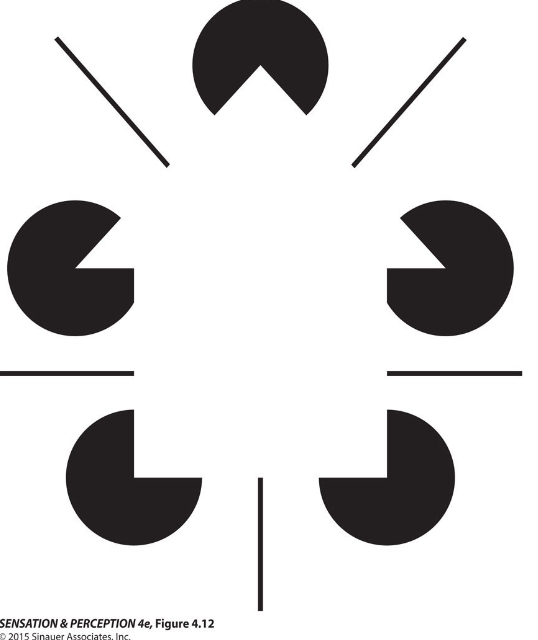
Gestalt psychology theory
Perceptual whole is greater than sum of its parts
Gestalt principle common region
Things in same area appear visually grouped together
Gestalt principle synchrony
Things that change at the same time are grouped together
Bayesian theory
Prior knowledge of world plus current stimulus
FFA: fusiform facial area
Process faces more than other objects
PPA: parahippocampal place area
Process places like a picture of a house
EBA: Extrastriate body area
Process body parts
Geons
Object representations according to structural model of object recognition like cylinder cone pyramid wine glass
Structural model of recognition
Recognize objects by breaking things down into subunits (geons)
Template model of recognition
Stored pattern for everything in the whole world at every angle and size
Prosopagnosia
Inability to identify faces but can identify other objects
Re-entrant process
Process in brain that sends signals back downstream to earlier areas in processing higher to lower
Process _____ features in image before _____ features
Global; local
Photopic lighting
Day
Scotopic lighting
Night
Principle of Univariant
Infinite combinations of wavelength and intensity that give same response if looking at one photoreceptor
Metamers
Different mixtures of wavelengths that look identical
Number of lights needed to match any color humans can see
Three lights = three types of photoreceptor
Cone opponent cells
Cells in LGN that compute chromatic differences
Opponent color theory
Theory that perception of color is based on the output of three cones, each an opponent of two colors
Color opponent pairs
Red-green, yellow-blue, black-white
Where double opponent cells are first found
Visual cortex
CIE diagram
Representation of color used as standard for paint and plastic makers, way of categorizing color numerically
Hue
What color something is
Saturation
How vivid is color
Brightness
How dark or light is color
Deuteranope
Colorblind person due to absence of M cones
Additive color mixing
Shining lights together to make one color, end up with white
Subtractive color mixing
Mixing paint, end up with black
Rod Monochromat
Someone with no cones