Combined GameDev
 Call Kai
 Learn
Learn Practice Test
 Spaced Repetition
 Match
Match Flashcards
 Knowt Play
1/256

There's no tags or description
Looks like no tags are added yet.
Name | Mastery | Learn | Test | Matching | Spaced | Call with Kai |
|---|
No analytics yet
Send a link to your students to track their progress
257 Terms
Game Development
is the art of creating games and describes the design, development and release of a game, it may involve concept generation, design, build, test and release. While you create a game, it is important to think about the game mechanics, rewards, player engagement, and level design.”
Alexander Shafto “Sandy” Douglas (A.S Douglas)
(1962) was a British professor of computer science, credited with creating the first graphical computer game OXO
OXO
is a noughts and crosses or tic-tac-toe computer game in 1952 on the EDSAC computer at University of Cambridge.
Spacewar!
the game features two spaceships, “the needle” and “the wedge”, engaged in a dogfight while maneuvering in the gravity well of a star.
• Both ships are controlled by human players.
• Each ship has limited weaponry and fuel for maneuvering, and the ships remain in motion even when the player is not accelerating.
Steve Russell
invented Spacewar!, a computer-based combat video game for the PDP-1 (programmed data processor-1).
Spacewar!
was written for the newly installed DEC PDP-1 minicomputer at the Massachusetts Institute of Technology.
Ralph Baer, The Brown Box
• In 1967, developers at Sanders Associates, Inc., led by _______, invented a prototype multiplayer, multi-program video game system that could be played on a television. It was known as ____________
Odyssey
licensed his device to Magnavox, which sold the system to consumers as the _____
Magnavox Odyssey
is the first commercial home video game console.
It came packaged with dice, money, and other board game paraphernalia to accompany the games.
1972, Pong
• In _____, _______ a table tennis-themed twitch arcade sports video game, featuring simple two-dimensional graphics manufactured by Atari.
• was one of the earliest arcade video games.
• was the first commercially successful video game.
Allan Alcorn.
who created / designed Pong
Pong
is a 2-dimensional sports game that simulates table tennis. The player controls an in-game paddle by moving it vertically across the left or right of the screen.
1978, Space Invaders Arcade
game was developed by Tomohiro Nishikado and was manufactured and sold by Taito in Japan.
• It was licensed to the Midway division of Bally for Overseas distribution.
Space Invaders
was the first fixed shooter and set the template for the shoot ‘em up genre.
The goal is to defeat a wave of descending aliens with a horizontally moving laser to earn as many points as possible.
1980, Pac-Man
• In _____ Namco released ________ – a maze action video game developed for arcades.
• It appealed to a much wider market, in part because it did away with the “shooting” theme that pervaded most other games at the time.
1981, Donkey Kong
was developed and published by Nintendo in arcades.
• As Mario, the player runs and jumps on platforms and climbs ladders to ascend a construction site and rescue Pauline from the titular giant gorilla.
1991, Street Fighter II
• In ____, Capcom released ___________.
• _________ improved many of the concepts introduced in the first game, such as including the use of special command-based moves, a combo system, a six-button configuration, and a wider playable characters, each with a unique fighting style.
Videogame Rating Council in 1993
In response to the violent game, Sega created the _____________ to provide descriptive labeling for every game sold on a Sega home console.
Entertainment Software Rating Board (ESRB)
The council later gives rise to the industry-wide ____________, which is used to rate video games based on content.
Virtual Fighter
• In August 1993, an early prototype version of ______ was tested and was released worldwide in October 1993.
• It is the first arcade fighting game to feature fully 3D polygon graphics.
• It is a fighting game created for the Sega Model 1 arcade platform by AM2, a development group within Sega, headed by Yu Suzuki.
Super Mario 64
• Between 1996 and 1997, Nintendo developed and published ______________
• It is the first 3D Super Mario game, combining the traditional Super Mario gameplay, visual, and characters in an open world.
Lau Chan vs. Jacky Bryant (Arcade)
• Designer(s): Seiichi Ishi, Yoshinao Asako, Youji Kato
• Platform(s): Arcade, Saturn, 32X, R-Zone, Windows
• Release: WW - 1993
• Genre(s): Fighting
• Mode(s): Single-player, Multiplayer
Microsoft’s xbox 360, Sony’s PlayStation 3, and Nintendo‟s Wii
• In 2005 and 2006, ________________ kicked off the modern age of high-definition gaming.
Blu-rays
Though the PS3–the only system at the time to play __________–was a successful in its own right.
Notable Games between 2005 to 2013
• Grand Theft Auto V (2013)
• Mass Effect 2 (2010)
• Portal 2 (2011)
• The Elder Scrolls V: Skyrim (2011)
• Red Dead Redemption (2010)
• Far Cry 3 (2012)
• Fall out 3 (2008)
• Portal (2007)
Nintendo‟s Wii U
• The 8th generation of video games began with the release of _________ in 2012, followed by PlayStation 4 and Xbox One in 2013.
Nintendo Switch
• In early 2017, Nintendo released ________.
Xbox One X
While Microsoft released ____________ in late 2017.
PlayStation 5
In 2020, Sony released _______
Xbox Series X and Series S
In 2020, Sony released PlayStation 5 and _____________ for Microsoft.
Notable Games from 2013 to present
• The Last of Us (2013)
• Five Nights at Freddy‟s (2014)
• Life Is Strange (2015)
• Pokemon Go (2016)
• Horizon Zero Dawn (2017)
• Super Smash Bros Ultimate (2018)
• Death Stranding (2019)
• Ghost of Tsushima (2020)
• Back for Blood (2021)
• Elden Ring (2022)
Sid Meler’s Definition
“A game is a series of interesting decisions.”
An interesting decision is generally one where:
The player has multiple valid options from which to choose.
Each option has both positive and negative potential consequences.
The outcome of each option is predictable but not guaranteed.
• This brings up the second goal as a game designer: “to create interesting decisions.”
• If the player is presented with a number of choices, but one choice is obviously superior to the others, the experience of deciding which to choose doesn’t actually exist.
• If the game is designed well, players will often to have multiple choices from which to choose, and those decisions will be tricky ones.
Iterative Design
is a design methodology based on a cyclic process of prototyping, testing, analyzing, and refining a product or process.
Iterative Design
This process is intended to ultimately improve the quality and functionality of a design.
Iterative Design
In ___, interaction with the designed system is used as a form of research for informing and evolving a project, as successive versions, or iterations of a design are implemented.
Analysis
Design
Testing
Implementation
The Four Phases:
Analysis
In ___, every design seeks to solve a problem or take advantage of an opportunity, and before starting a design, designers must have a clear idea of what that problem or opportunity is.
“For whom am I designing the game?” knowledge of your target audience.
“What are my resources?” Talent and time.
“What prior art exists?”
“What is the fastest path to a playable game that demonstrates what I want to test?” Think about the core mechanic of the game.
Prior art
is the term used to describe existing games and other media that are related to a game in some way.
Design
The ____ stage starts with brainstorming and ends with a concrete plan for implementation.
Jesse Schell
(author of the book The Art of Game Design) states that listening is the most important skill that a game designer can have.
audience
team
client
game
self – gut
health
Schell lists five kinds of listening a game designer needs to develop.
Listen to your audience
“Whom do you want to play your game?”, “Whom do you want to buy your game?”
Listen to your team
A job of a designer is to listen to all of other team members thoughts and ideas and work with them to discover ideas that will create the best game for the audience.
Listen to your client
A lot of time, as a professional game designer, a game designer will be working for a client, and a designer should listen to their input.
Listen to your game
Even if a certain aspect of a game is brilliant design, it might not fit well with the rest.
Listen to yourself – gut
“When your gut tells you something about a design, give it a try.”
Listen to your health
Pulling all-nighters, being stressed, and not exercising have a real and tremendously negative effect to do creative work.
Design
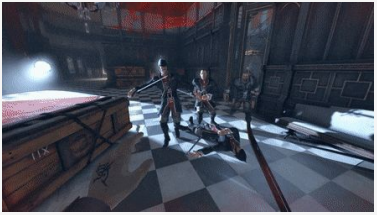
Dishonored (2012) is a action-adventure game developed by Arkane Studios and published by Bethesda Softworks
Implementation
In this phase, Game designer must playtest or execute the current design in the most effective way possible.
Implementation
If a game design revolves around shooting, a game designer must make a digital prototype.
Implementation
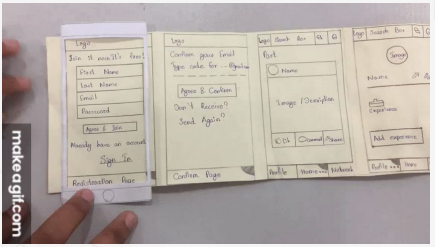
If a game designer is testing a Graphical User Interface (GUI) menu system, printing out images of the various states of the menu and asking testers to navigate through them is enough (paper prototype).
Implementation
Testing
after a game designer have the minimum of a prototype working, ___ is the next phase.
Testing
It is to identify and locate what’s not working or performing to expectations. Stakeholders, users, and product testers weigh in with their experiences.
Brainstorming and Ideation
is a group problem-solving method that involves the spontaneous contribution of creative ideas and solutions.
game jam
is an accelerated opportunistic game creation event where a game is created in a relatively short timeframe exploring given design constraint(s) and end results are shared publicly.
Step 1: Expansion Phase
Game Jam Theme: Fiction
Everyone start with some kind of brainstorming. Draw a fiction character/object in the middle of a whiteboard, draw a circle around it, and start free-associating.
Don’t worry about what you’re writing at this point – don’t censor anything – just write whatever comes to mind as you go.
Step 2: Collection Phase
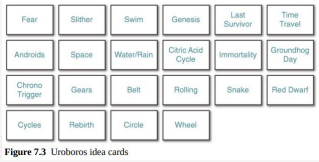
Collect all the nodes of the brainstorming expansion phase and write them each down on one note card. These are called Idea Cards
Step 3: Collision Phase
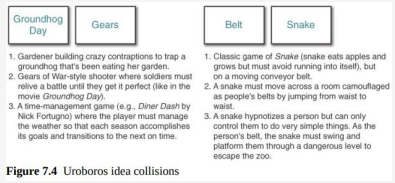
Shuffle together all the idea cards and deal two to each person in the group. Each person takes their two cards up to the whiteboard and reveals them to everyone. Then the group collectively comes up with three different game ideas inspired by the collision of the two cards.
If the two cards either are too closely paired or just don’t work together at all, it’s okay to skip them.
Step 4: Rating Phase
Now that ideas are set, it’s time to start culling them. Each person should write on the whiteboard the two ideas from Step 3 that she/he thinks have the most merit.
After everyone does this, then everyone should simultaneously put a mark next to the three ideas written on the board that they like the most. Everyone should end up with some ideas with lots of marks and some with very few.
Step 5: Discussion
Continue the selection/culling process by modifying and combining several of the ideas with the highest rating.
With dozens of different crazy ideas to choose from, you should be able to find a couple that sound really good and to combine them into a great starting point for your design.
Step 1: Expansion Phase
Step 2: Collection Phase
Step 3: Collision Phase
Step 4: Rating Phase
Step 5: Discussion
Activity: Brainstorming and Ideation
Visual storytelling tradition
a flat, 2D images that told simple stories without words or sound, similar of that to a Cave paintings.
Games
form a significant proportion of the highly visual medium of interactive entertainment; this medium incorporates the visual storytelling tradition, but it has also revolutionized the way stories are told.
Idea
in general description is a thought or suggestion as to a possible course of action.
Sometimes, writers often get ideas from thoughts that just come to them throughout the day.
These ideas could be anything from observations of the people and the environment around them to portion of dreams.
Direct personal experience is another common idea generator.
Getting inspired from stories that already exist as well generates new ideas.
Character archetype
is a type of character who represents a universal pattern, and therefore appeals to our human collective unconscious.
Within this collective unconscious are universal themes and archetypes, which appear in our culture in the form of stories and character types in art, literature, music, and games.
Hero
____ archetype is the central character in a single-player game.
Link from Zelda Series depict a Hero Archetype
Hero
___ character will always be the player’s avatar – and the player must identify and bond with this character.
Hero
always presented with a problem toward the beginning of the story and embarks on a physical or emotional journey to eventually solve this problem.
Shadow
an extremely important character – representing the hero’s opposite, often the ultimate evil character in a story.
Joker, known as the shadow from Batman Series
shadow
The ___ could be the adversary who is responsible for the hero’s problem.
Shadow
Sometimes this character remains hidden until the story’s climax, which can add to the story’s dramatic tension.
shadow
Sometimes, the ___ represents the dark side of the hero.
Mentor
is a character who often guides the hero toward some action.
Mentor
provides the hero with the information needed to embark on the hero’s journey.
mentor
The ____ is often an older advisor character – someone who might have been in the hero’s shoes at one time, who can provide the hero with wisdom from that experience of making a similar journey.
Aldus Dumbledore in Harry Potter and the Order of the Phoenix is a mentor who trains the player character
Ally
is a character who helps the hero progress on the journey and may also assist the hero with tasks that might be difficult or impossible to accomplish alone.
Kasumi in Mass Effect 2 makes some of the hardest segments in the game easier
Guardian
blocks the progress of the hero by whatever means necessary – until the hero has proven his or her worth.
guardian
Sometimes the ___ character is the shadow’s henchman.
guardian
The ___ could also be a block that exists within the hero’s mind – such as self-doubt, fear, discomfort – that makes the character hesitate to continue on the journey.
Trickster
is a neutral character who enjoys making mischief.
GlaDOS in Portal 2
Trickster
___ characters can either cause sever damage through their pranks – which can stop the hero from progressing along the journey – but they are more often simply jesters who provide comic relief for the story.
Herald
facilitates change in the story and provides the hero with direction.
Princess Zelda from Zelda Series
hero
shadow
mentor
ally
guardian
trickster
herald
Character Archetypes enum
Protagonist
Antagonist
Co-protagonist
Supporting Characters
Classic Character Types
Protagonist
who is often equated with hero archetype.
protagonist
The ____ is the main character, the game’s story is told from this character’s point of view – even if the game is not played in the first-person perspective.
Protagonist
must always drive the story forward – acting instead of waiting for them to happen.
Antagonist
is the complete opposite of the protagonist.
Antagonist
does not mean that the character is bad.
Transformational
Mistaken
Exaggerated
Realistic
Antagonist Types
Transformational antagonist
is an anti-hero character who could have been a protagonist. The antagonist receives punishment at the end of the story to satisfy the audience’s need for justice.
Mistaken antagonists
are characters who the audience initially thinks are villains – but they turn out to be innocent.
Exaggerated antagonists
are those who are larger-than-life, bizarre, and sometimes even comedic villains who might even dominate the story because they are often more interesting than the protagonist.
Realistic antagonists
are the opposite of exaggerated – and the toughest to create.
Co-protagonist
join forces with the protagonist in a story.
Co-protagonist
These character often appear in games such as MMOs that require teams.
co-protagonists
Sometimes these characters do not start out as ___, but as antagonists.
Supporting Characters
are also known as pivotal characters – exists primarily to prevent the protagonist from walking away from this problem.