Chemistry End of Year 9 Exam Revision
 Call Kai
 Learn
Learn Practice Test
 Spaced Repetition
 Match
Match Flashcards
 Knowt Play
1/108

There's no tags or description
Looks like no tags are added yet.
Name | Mastery | Learn | Test | Matching | Spaced | Call with Kai |
|---|
No analytics yet
Send a link to your students to track their progress
109 Terms
Atoms
The smallest thing everything is made of
Molecules
Two or more atoms joined together. They can be the same or different atoms.
Elements
A substance made of only one type of atom
Compounds
Two or more different elements that are chemically joined together
What do you call the inside of an atom and what does it have?
The nucleus and it has the protons and neutrons
Where are the electrons in an atom
Orbiting around the nucleus in the electron shells
Protons relative atomic mass
1
Neutrons relative atomic mass
1
Electrons relative mass
1/2000
Protons relative charge
+1
Neutrons relative charge
0
Electrons relative charge
-1
Atomic number
Number of protons
Mass number
Total number of protons and neutrons
Isotopes
Atoms of the same element with the same number of protons but different number of neutrons
How to calculate the mean relative atomic mass of an atom of an element
mass of -element- atoms x number of -element- atoms/total number of -element- aoms.
If not given the number of -element- atoms you will be given a percentage - e.g: 26% and 84% - so just assume 100 atoms
How are elements in the periodic table organised into periods
Periods are the horizontal rows on the periodic table, and each element in each period has the same number of electron shells
How are elements in the periodic table organised into groups
Groups are the vertical rows on the periodic table, and each element in each group has the same number of electrons in their outer - shell
How to figure out an electron configuration of an atom of an element just by looking at it on the periodic table
Find the atomic number (the number below the element) and then as electron configurations:
1st shell → 2 max
2nd shell → 8 max
3rd shell → 8 max (for first 20 elements)
Metals vs Non-metals (conductivity + oxides)
Metals = conduct + basic
Non-metals = don’t conduct + acidic
Where are the non-metals on the periodic table
On the right, Starting with carbon and then going in a zig-zag pattern downwards to end with radon
How to figure out the electron configuration of an element simply from its period and group
Example:
Magnesium:
Group 2 → 2 outer electrons
Period 3 → 3 shells
👉 2,8,2
Why does elements in the same group have similar properties
Because they have the same number of electrons in their outer shell, so when they react and become an ion they all lose or gain the same amount, causing similar reactions
Why don’t Noble gases readily react?
👉 Group 0 (or 18)
👉 They have full outer shells
He = 2
Others = 8
💡 Why no reaction?
👉 Atoms want a full outer shell
👉 Noble gases ALREADY have it
👉 so they don’t need to gain/lose electrons
What are Ions
charged particles
How are ions formed
when two or more atoms react together they need to make full outer shells, so they gain or lose electrons, making them charged positively (if they lost electrons) and negatively (if they gained electrons) by a certain number
Charges I need to know: Group 1, 2, 3, 5, 6, 7, hydrogen, hydroxide, ammonium, carbonate, nitrate, and sulfate
Metals:
Group 1 → +1
Group 2 → +2
Group 3 → +3
Non-metals:
Group 7 → -1
Group 6 → -2
Group 5 → -3
Compound Ions:
Hydrogen → H⁺
Hydroxide → OH⁻
Ammonium → NH₄⁺
Carbonate → CO₃²⁻
Nitrate → NO₃⁻
Sulfate → SO₄²⁻
Writing formulas:
Example 1: Na⁺ and Cl⁻
Example 2: Mg²⁺ and Cl⁻
Example:
Na⁺ and Cl⁻
👉 +1 and -1 → balance
= NaCl
Example:
Mg²⁺ and Cl⁻
👉 need 2 Cl⁻ to balance +2
= MgCl₂
What are dot and cross diagrams for and what does a dot and cross mean?
They are used to show when atoms have reacted together and become ions, by drawing a normal atoms structure but then doing Dot = one atom’s electrons, Cross = the other atom’s electrons
What are the three states of matter?
Solid, liquid, and gas
What does the state depend on
The force of attraction between particles in the material
What's the force of attraction like in solids?
Strong
What's the force of attraction like in liquids?
Weak
What's the force of attraction like in gases?
Very weak
What is the structure of a solid like?
The particles are held in fixed positions, regularly arranged and touching, the solid will have a defined shape and volume, and the particles will vibrate around in fixed positions - If heated more of the particles will vibrate - Solid has the lowest amount of energy
What is the solid version of water?
Ice
What is the structure of a liquid like?
The particles are randomly arranged and touching - some may not touch - slowly moving and free to move past each other, the liquid will have a defined volume but no fixed shape - shape of the base of container, and the particles are constantly moving around their positions - If heated the particles will move faster
What is the state of water?
Liquid
What is the structure of a gas like?
The particles are randomly arranged and far apart, free to move far away from each other , the gas will have no defined volume and no fixed shape - shape of container, filling the container, and the particles are constantly fast moving, freely and randomly - If heated the particles will move faster - Gas has the highest amount of energy
What is the gaseous version of water
Steam
Substances can or cannot change from one state to another?
Can
Why can substances change state?
Because an increase in temperature increases kinetic energy and when there is enough kinetic energy bonds can be broken
What is the term for a solid turning into a liquid?
Melting
What is the term for a liquid turning into a gas?
Boiling or evaporating
What is the term for a gas turning into a solid
Deposition
What is the term for a solid turning into a gas?
Sublimation
What is the term for a liquid turning into a solid?
Freezing
What is the term for a gas turning into a liquid?
Condensing
What is a solvent?
A liquid in which a solute dissolves
What is a solute?
The substance being dissolved
What is a solution?
The mixture formed when a solute dissolves in a solvent.
What is a saturated solution?
A solution that contains the maximum amount of dissolved solute it can hold at a specific temperature - different solvents have different saturation points
What does solubility mean?
A measure of how much of a solute can dissolve in a solvent
What is diffusion?
The movement of particles from an area of high concentration to an area of lower concentration
What is dilution?
The process of making a solution weaker by adding more of a solvent
What does soluble mean?
A substance that can dissolve in a liquid
What does insoluble mean?
A substance that can't dissolve in a liquid
How is the solubility of a solid affected?
Temperature - as the temperature increases solids become more soluble
How is the solubility of a gas affected?
Temperature and pressure - as the temperature increases gases become less soluble, and as the pressure increases gases become more soluble
What is solubility measured in?
Grams of solute per 100 grams of solvent (g/100g)
What is a solubility curve?
A graph of solubility against temperature, used to find the solubility of a substance at a specific temperature
What is a heating curve?
A graph of temperature against the amount of heat added or removed
What is concentration?
The number of particles in a given volume of a substance
Melting point of pure water vs impure water
For a pure substance the temperature is fixed when it melts or boils. Mixtures will melt and boil over a range of temperatures
Test for pure water:
Heat liquid and then measure its boiling point and check it boils at 100 degrees Celsius
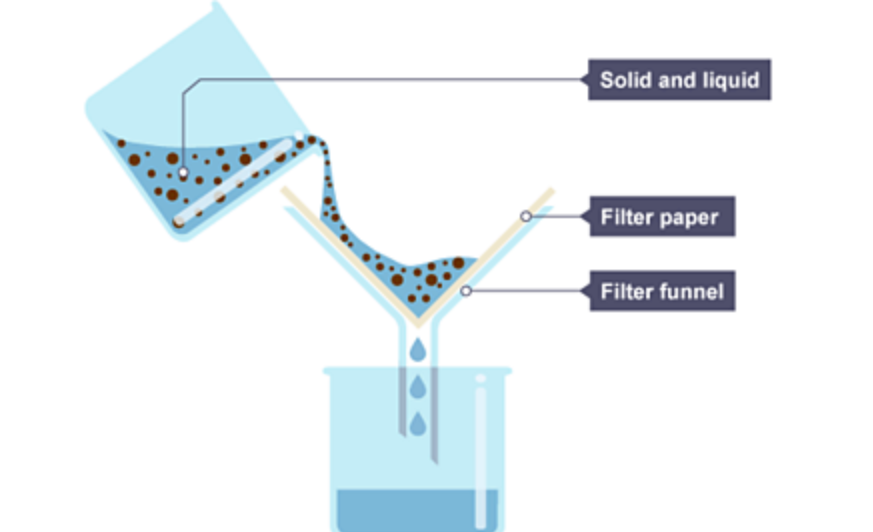
Filtration
Used to separate an insoluble solid from a liquid.
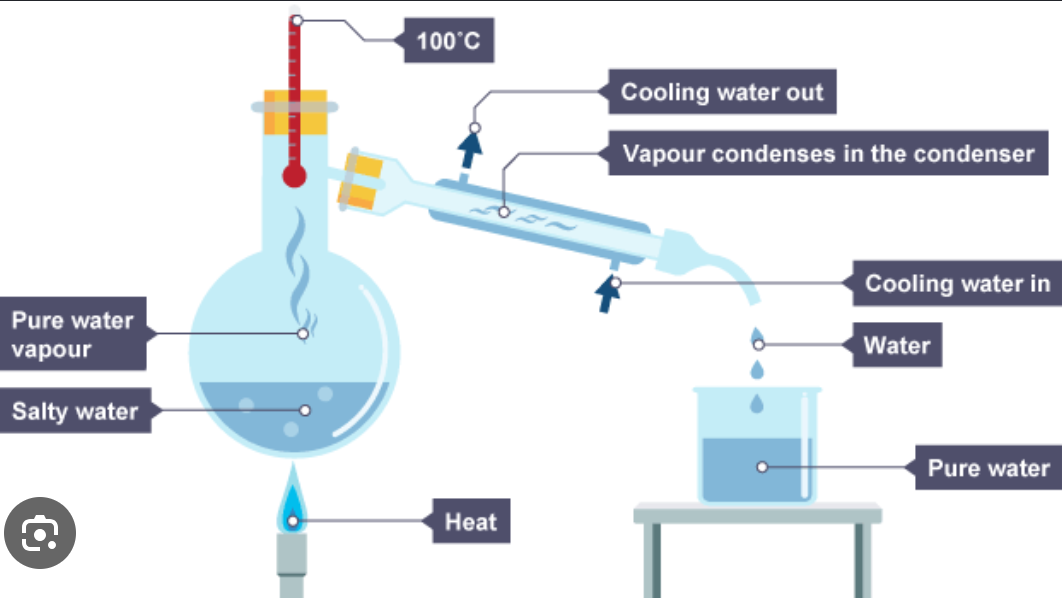
Simple distillation
Used to separate a liquid from a solution. The liquid (solvent) evaporates and then condenses in the condenser. The salt(solute) remains in the flask.
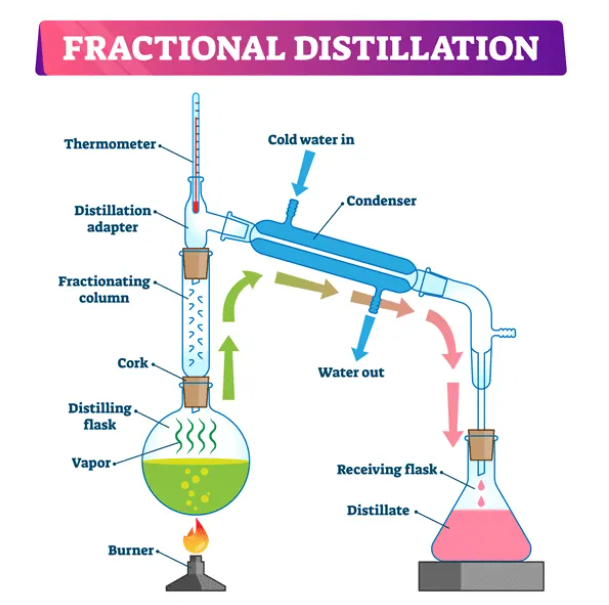
Fractional distillation
Used to separate liquids with similar boiling points.
Crystallisation
Obtaining a solute from a solution
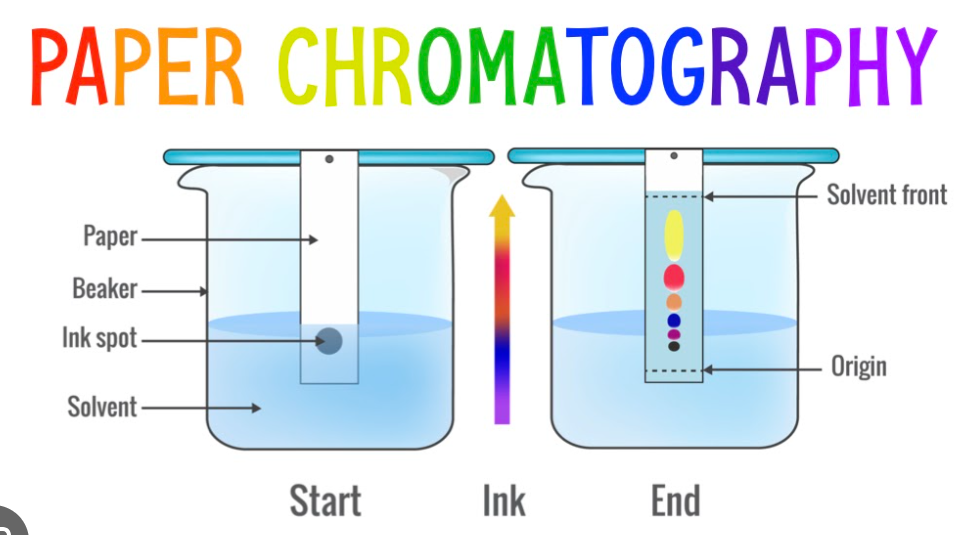
Paper chromotography
Separating mixtures of soluble substances
Filtration example
Sand and water
Simple distillation example
Sugar and water
Fractional distillation example
Ethanol and water
Crystallisation example
Sodium chloride from a sodium chloride solution
Paper chromatography example
Food colourings, inks and dyes
How does a condenser work?
Gas is cooled and condenses (gas to liquid)
Filtration diagram
Simple distillation diagram
Fractional distillation diagram
Paper Chromatography diagram
How does simple distillation work?
The liquid (solvent) evaporates and then condenses in the condenser. The salt(solute) remains in the flask.
What does Rf value measure?
How far a substance travels during a chromatography experiment.
Equation for Rf value
Rf = Distance moved by dye from baseline/Distance moved by solvent from baseline
Atoms
The smallest thing everything is made of
Molecules
Two or more atoms joined together. They can be the same or different atoms.
Elements
A substance made of only one type of atom
Compounds
Two or more different elements that are chemically joined together
Mixtures
Two or more substances that are together but not chemically joined.
In the periodic table which elements exist as diatomic molecules and what’s a good way of remembering?
I have no bright or clever friends. Iodine, Hydrogen, Nitrogen, Bromine, Oxygen, Chlorine, Fluorine
Chemical formulae ending meanings
When 2 elements are chemically combined the ending of the second element changes to -ide, and when there are 3 elements and 1 is oxygen the ending changes to -ate.
What do you call the inside of an atom and what does it have?
The nucleus and it has the protons and neutrons
Where are the electrons in an atom
Orbiting around the nucleus in the electron shells
Symbol for protons
p or p^+
Symbol for neutrons
n or n^0
Symbol for electrons
e or e^-
Protons relative mass
1
Neutrons relative mass
1
Electrons relative mass
1/2000
Protons relative charge
+1
Neutrons relative charge
0