BIO Week 4: Serna Paper & Transporting Material in Animals
 Call Kai
 Learn
Learn Practice Test
 Spaced Repetition
 Match
Match Flashcards
 Knowt Play
1/28

There's no tags or description
Looks like no tags are added yet.
Name | Mastery | Learn | Test | Matching | Spaced | Call with Kai |
|---|
No analytics yet
Send a link to your students to track their progress
29 Terms
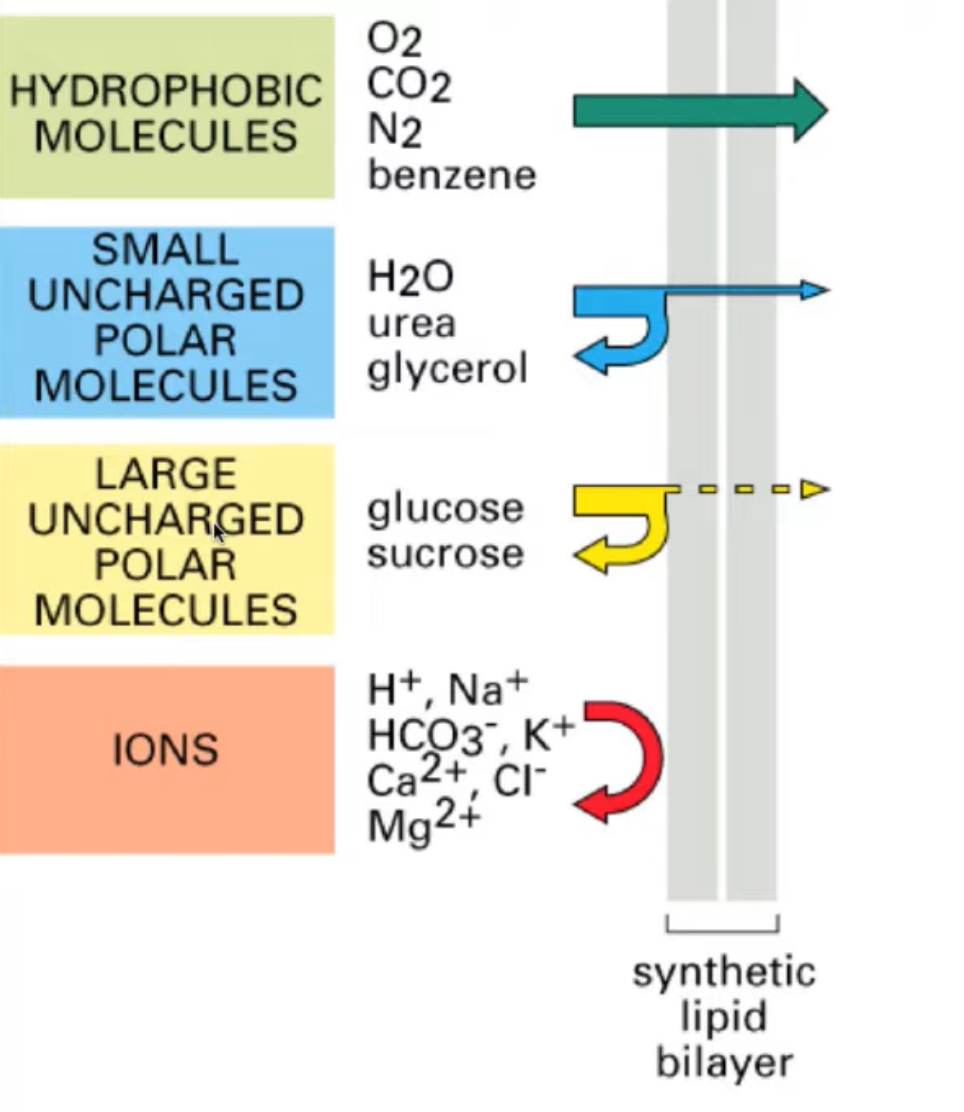
Regarding water/osmosis recap:
Water moves into and out of cells much faster than it can pass through a lipid bilayer because of aquaporins. Water always moves from a higher to a lower water potential. When water has solute in it it has negative osmotic potential. Only cells with walls can withstand a positive pressure, and we'll see later that only dead cell remnants can maintain a negative pressure, which is also called tension.
Regarding the expression of a gene:
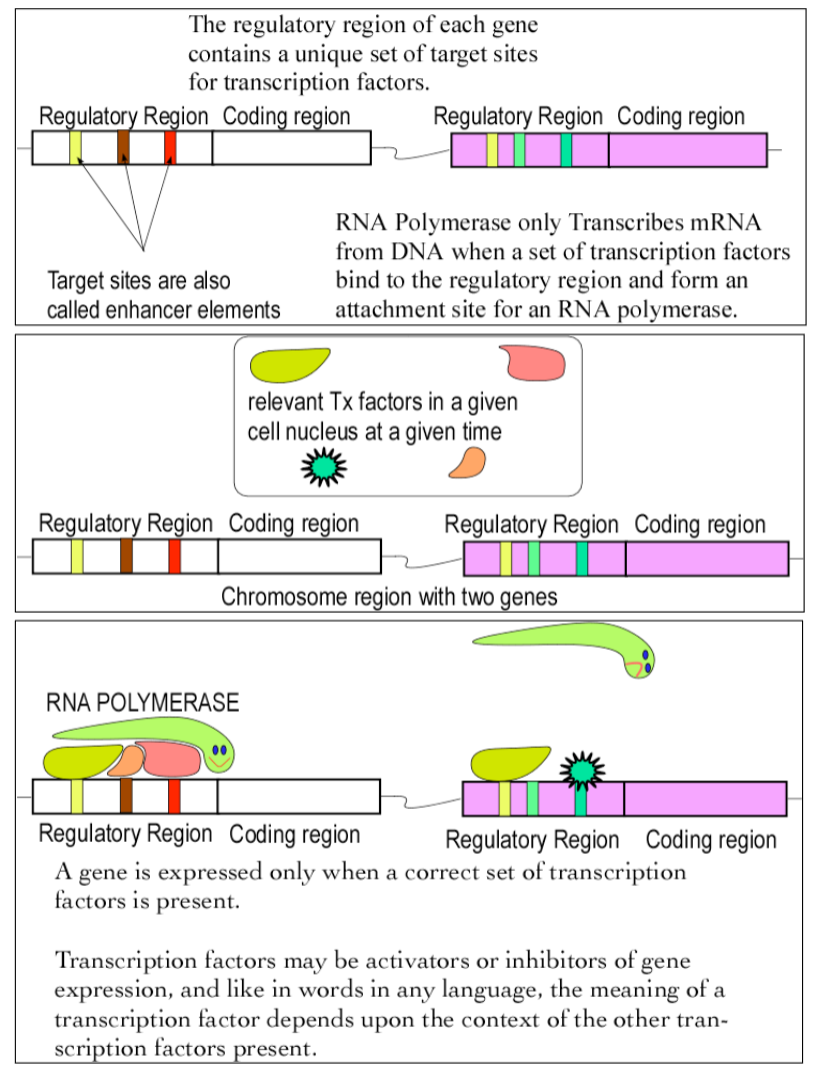
The expression of a gene is initiated when transcription factors, which are most often proteins, bind to elements of the regulatory region of the gene and attract RNA polymerase to begin transcription. The product of this process is mRNA which in turn must exit the nucleus in order for protein synthesis, aka translation, to begin.
Regarding totipotent cells and reproduction:
Embryos can be generated only by cells that are totipotent. This is true of animals or plants. Dolly the sheep was made using these cells.
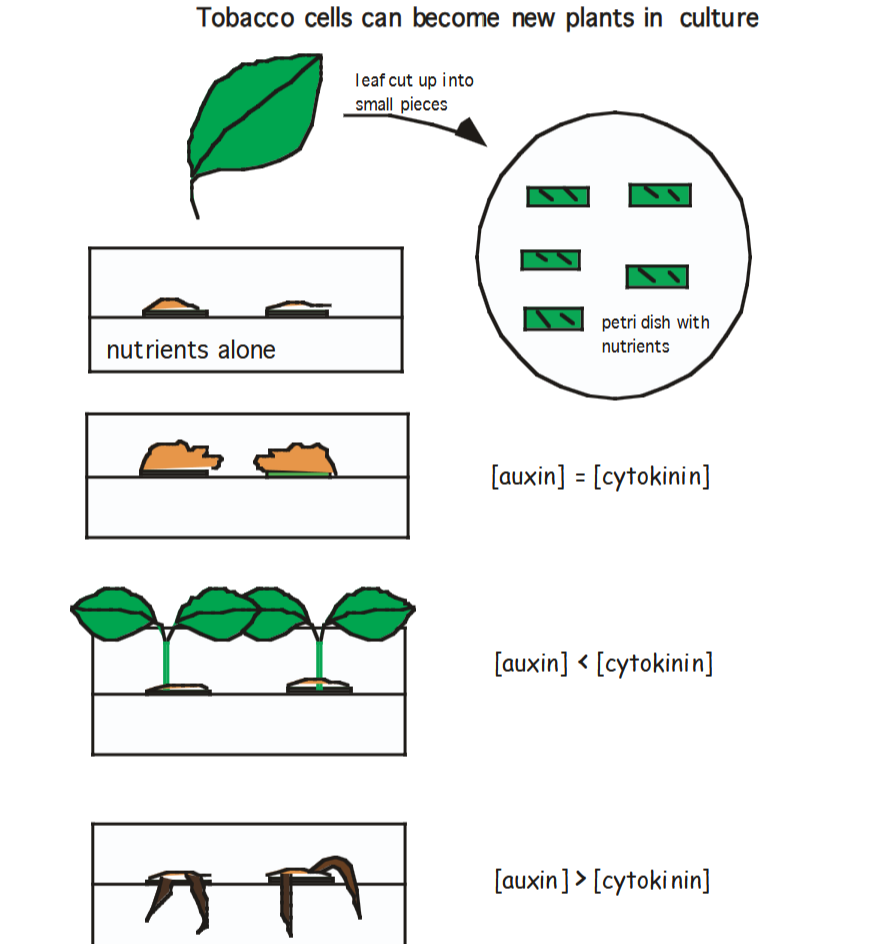
Before a parenchyma cell can obtain a new identity it must de-differentiate . A set of cells that are extracted from a carrot and then grown in the type of media that induces them them to form embryos would produce plants that are closer to genetically identical to one another than plants that arise from "selfing", which is when a plant egg cell is fertilized by a sperm cell from the same plant.
Auxin travels from the shoot to root of the plant (whereas cytokinin travels from root to shoot). Callus grown in media with more cytokinin than auxin will form shoots and not roots.
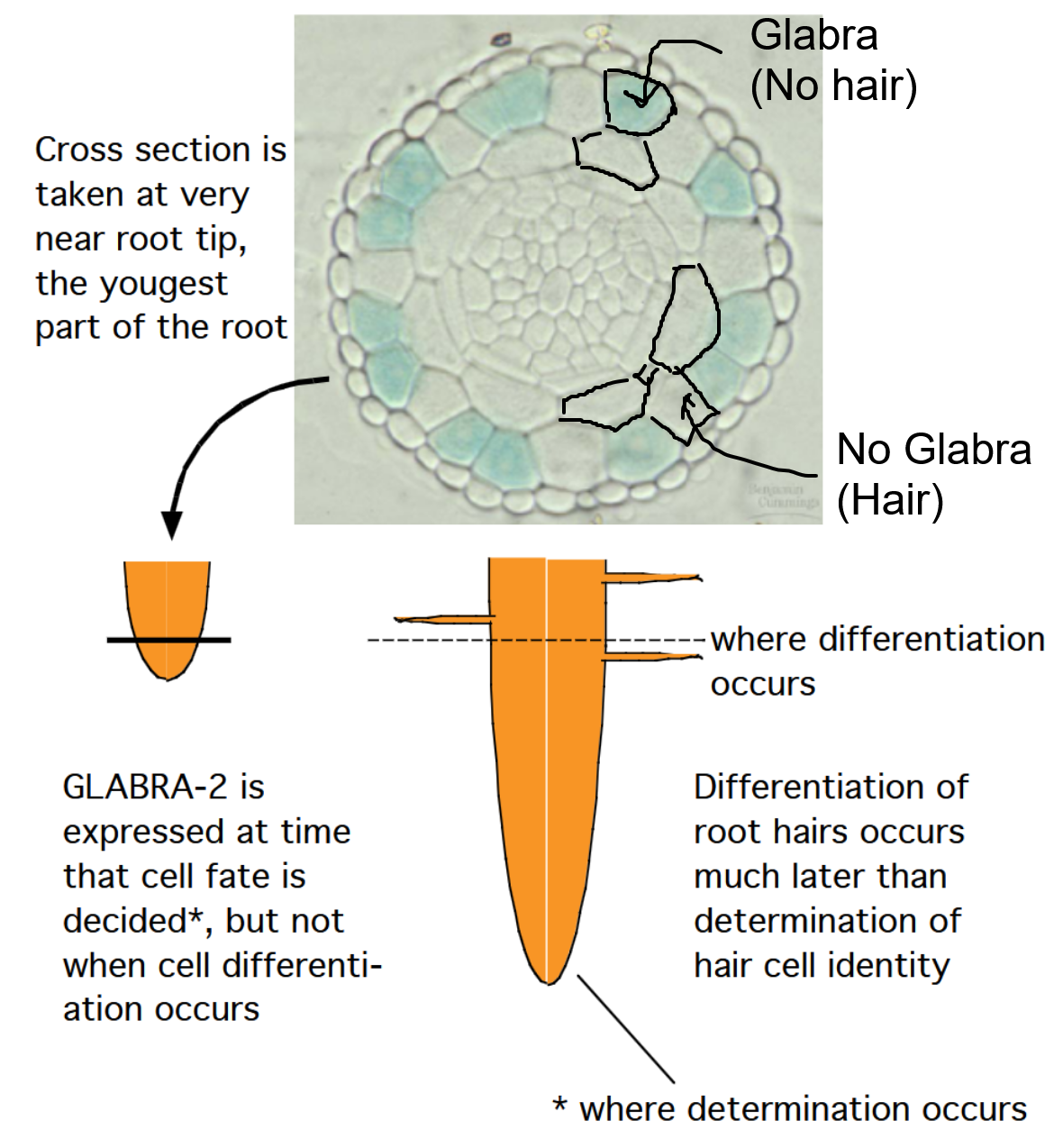
Regarding GLABRA:
Roots that lack glabra gene expression ( as in loss of function mutants) make a hair on every epidermal cells. This suggests that the glabra protein when present prevents hair formation in the cells in which it is expressed.
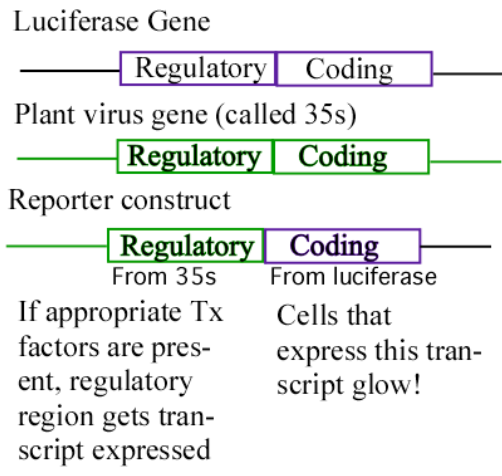
Reporter constructs reveal where the regulatory region of your gene of interest drives expression. In a 35s::GUS construct all the plants cells become blue, because 35s drives expression in all plant cells and GUS is a bacterial enzyme that turns cells blue. A 35s::Luciferase construct is made with the regulatory region from a virus and the coding region from an insect. I called them fruit flies - but it's really from FIREFLIES.
The GLABRA::GUS construct turns those cells blue that will not become root hairs later in development.
Glabra seems to be expressed in epidermal cells not adjacent to two cortex cells. These cells that express glabra will not form a hair when they differentiate in the maturation zone (AKA differentiation zone) later in development.
Note: The expression of Glabra-2 has an effect in leaves opposite of that in roots. It CAUSES leaf hair formation.
IMPORTANT FOR HOMEWORK: The 35s regulatory region is a key tool in plant biology. Any coding region attached to the 35s regulatory region will have that protein expressed in very high levels in all cells of the plant. The figure above uses only a part of the 35s regulatory region – that part that drives expression in vascular tissue!
So as a problem-solving tool remember that 35s is a ubiquitous promoter, which means it is a regulatory region that drives expression in all plant cells all the time. Know also that it will produce a volume of protein greater than almost any plant native regulatory region.
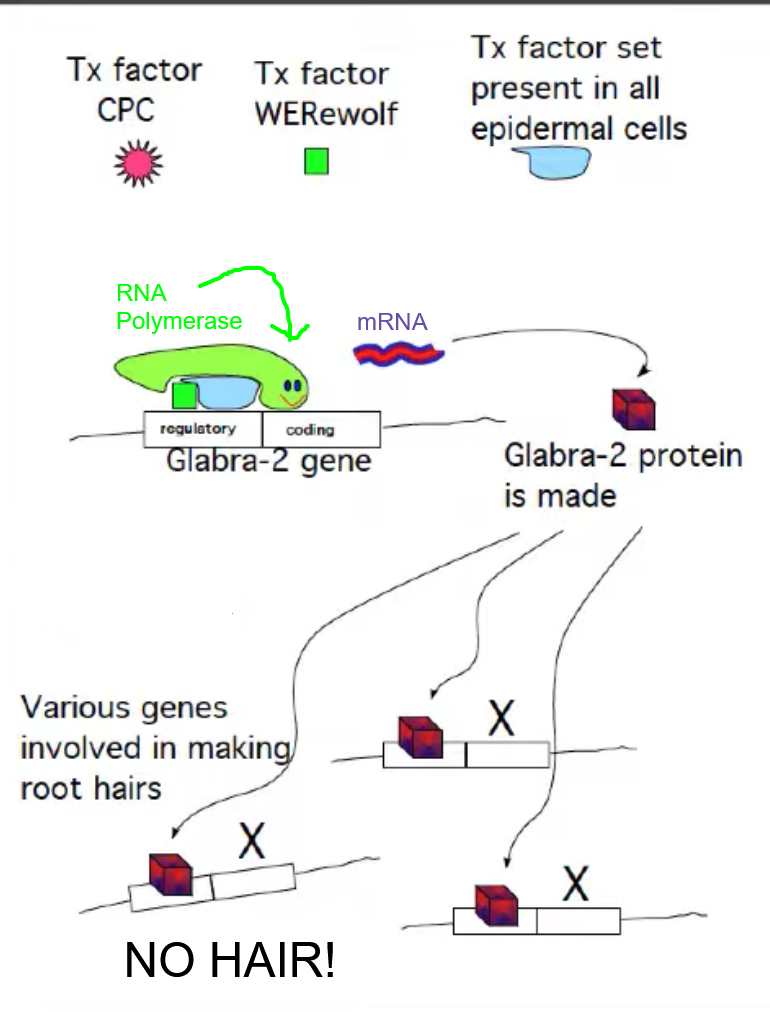
WEREWOLF pathway = no hair
CAPRICE (CPC) PATHWAY = HAIR!
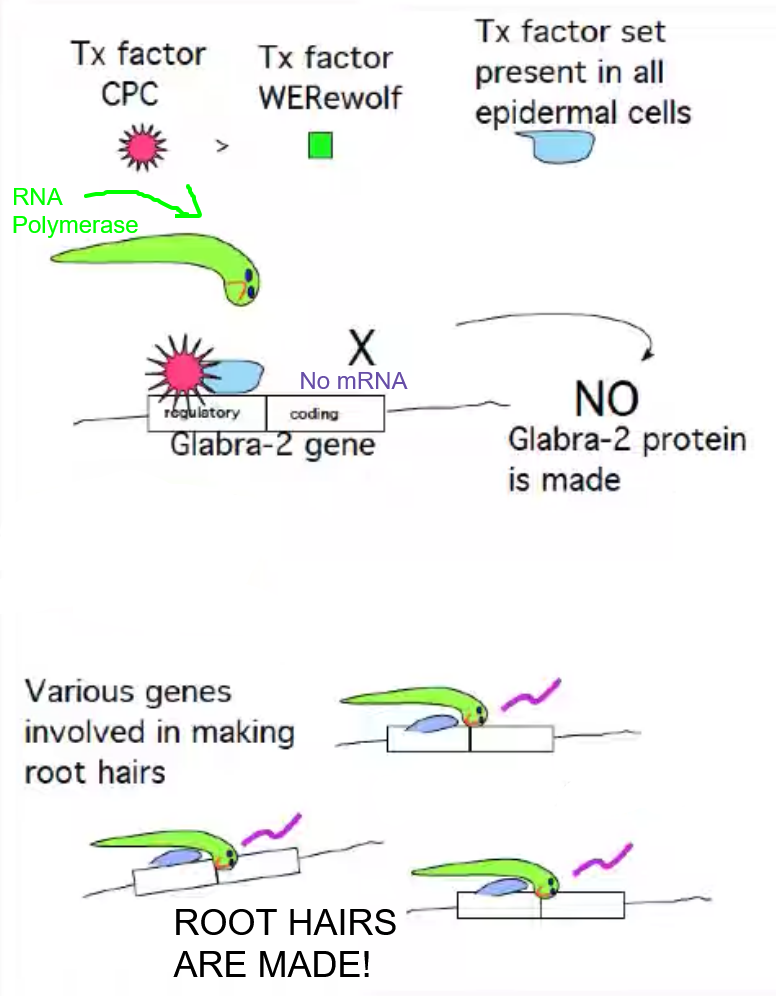
WEREWOLF is a transcription factor that must out-compete CAPRICE for a place on the GLABRA gene in order for GLABRA to be expressed. If WEREWOLF is missing in a plant due to a loss of function mutation, what will be the phenotype of the roots of that plant?
An excessive number of root epidermal cells will form hairs
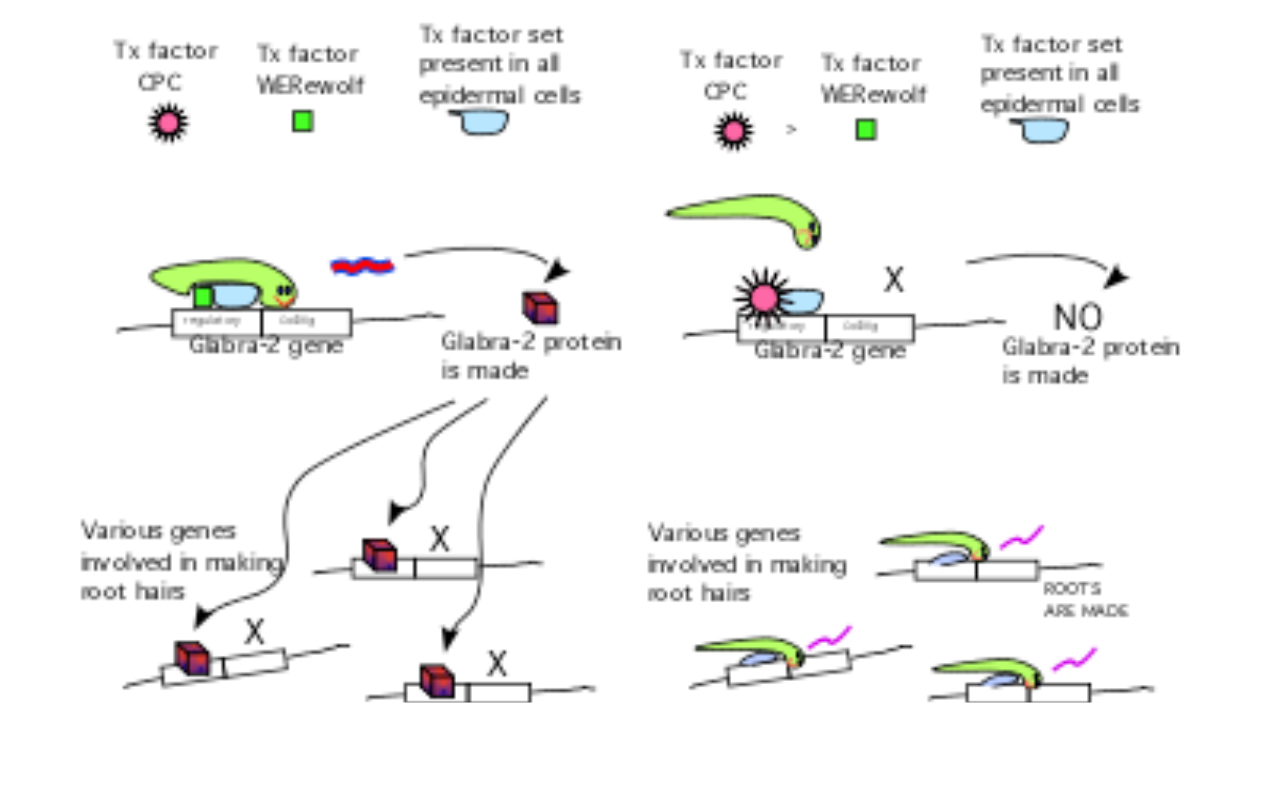
What is the phenotype of a plant engineered with a 35s::CPC construct?
(Assume 35s driven expression is stronger than that of any native gene, and remember that Werewolf can only bind to Glabra if there is more of it present than there is CPC.)
Every root epidermal cell generates a hair.
What phenotype would you expect from a 35s::WER construct added to a wild type plant?
No root epidermis cells form hair
What phenotype would you expect from a 35s::WER construct added to a plant lacking a functional GLABRA gene (often called glabra- mutant)?
All root epidermis cells form hair (because glabra is downstream, if it was not functional than the presence of WER wouldn’t matter)
We know that the CPC-| GL2 -| Hair formation pathway is true from the DOUBLE MUTANT DATA, which is:
All root epidermal cells make hair
What is the phenotype of a plant lacking both CAPRICE and WEREWOLF?
All root epidermal cells form hair (because there is no werewolf to make Glabra proteins)
What is the phenotype of a scrambled loss of function mutant?
no epidermal cells form root hairs
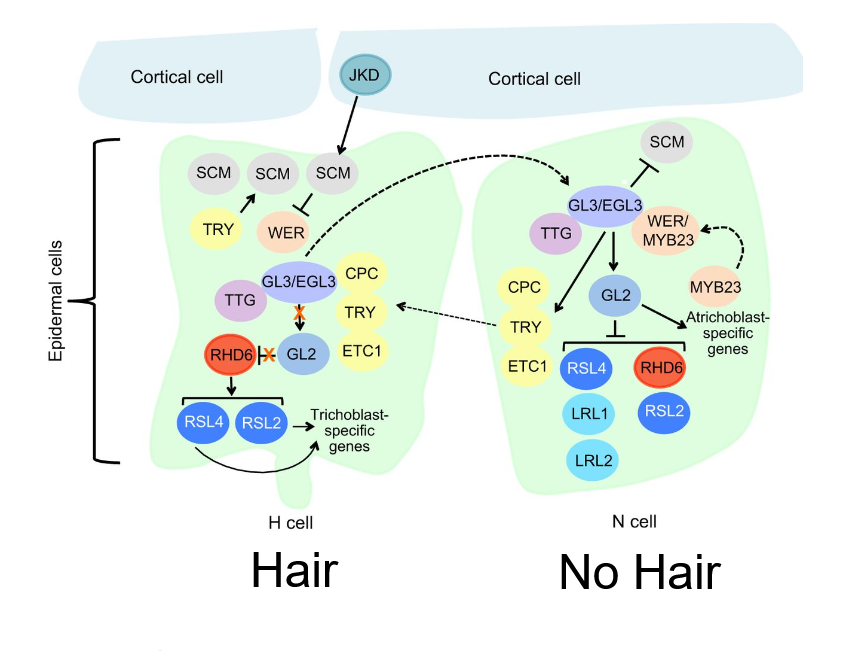
GLABRA epistasis pathway:
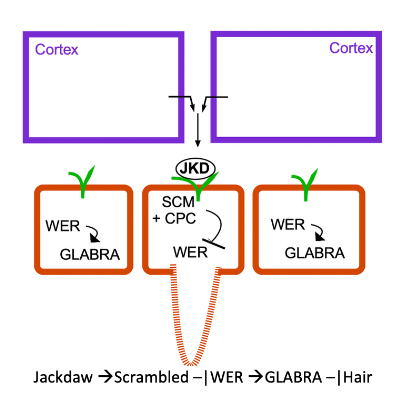
Jackdaw only arrives at the cell when two cortex cells are neighboring that cell, Scrambled binds jackdaw, and when it does it shuts down WER. This allows CPC to get together with the set of proteins that bind the glabra regulatory region, and stop expression of that gene, leading to hair.
When there is no jackdaw, WER gets with the other transcription factors and binds to the glabra gene, which gets expressed, so hair formation is stopped.
So….
Jackdaw → SCM + CPC —| WER → GLABRA —| Hair
(Read “→” as “activates” and “—|” as “inhibits/stops”)
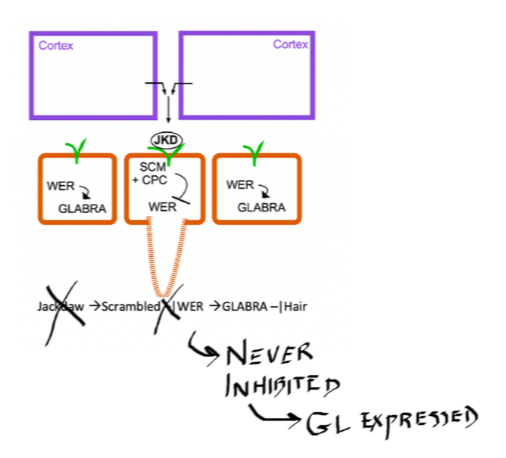
A loss of function of the JKD (jackdaw) mutant would have a phenotype of…
No root hairs
When chloride is cotransported into the cell this causes…
No change in charge (this is a charge neutral process)!
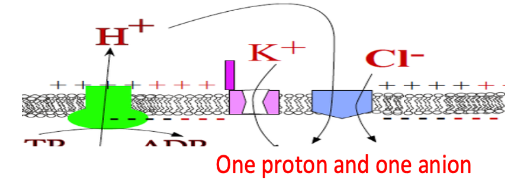
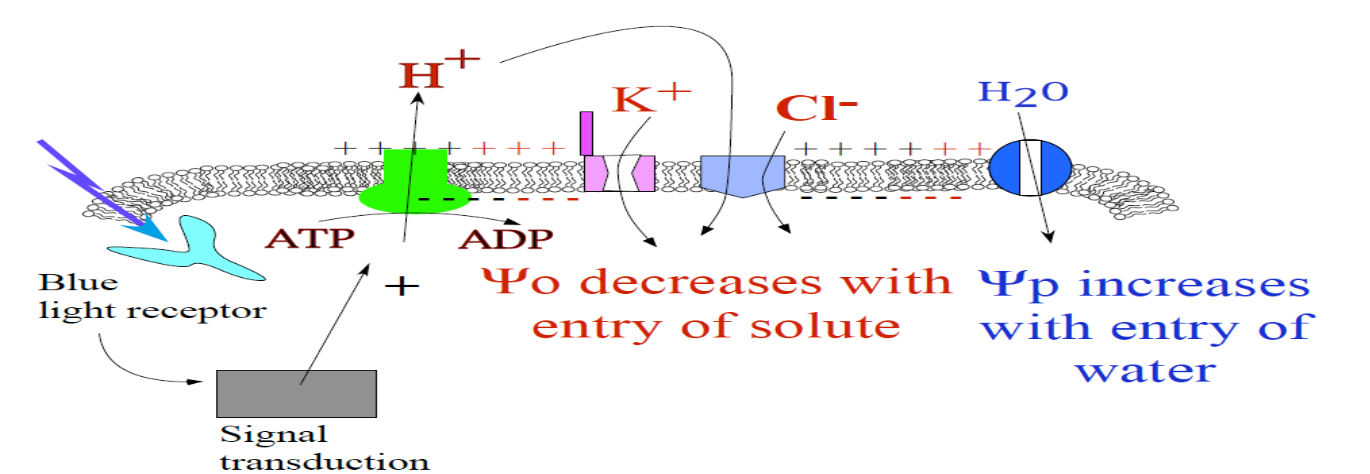
Opening stomata when blue light is the stimulus
1. Sensing light:
Blue light is sensed by a receptor, leading to an increase in the activity of the proton pump.
2. How ATP is spent:
ATP is used by the proton pump to build an increased proton gradient.
3. 𝜑m (membrane potential):
This increased proton gradient (removal of H+ ions from the cell into the I.F) HYPERPOLARIZES the cell.
4. Importing K+:
The hyperpolarization across the membrane causes the opening of K+ import channels (voltage gated Kin channels). The charge gradient of the hyperpolarized cell is of sufficient force to concentrate K+ inside of cell. Now there is more K+ in the cell than out.
5. Importing Cl-:
Chloride ions must enter against charge and concentration gradient, but the proton gradient is of sufficient force to use to cotransport chloride in.
6. 𝜑o (osmotic potential):
The increased internal concentration of K+ and Cl- ions reduces the internal osmotic potential was well as water potential.
7. Water entry:
Since water potential is now less inside the cell than outside, this brings in water. Aquaporins are opened to allow rapid water movement.
8. 𝜑p (pressure potential):
More water leads to an increase in pressure. This pressure causes the stomata to open.
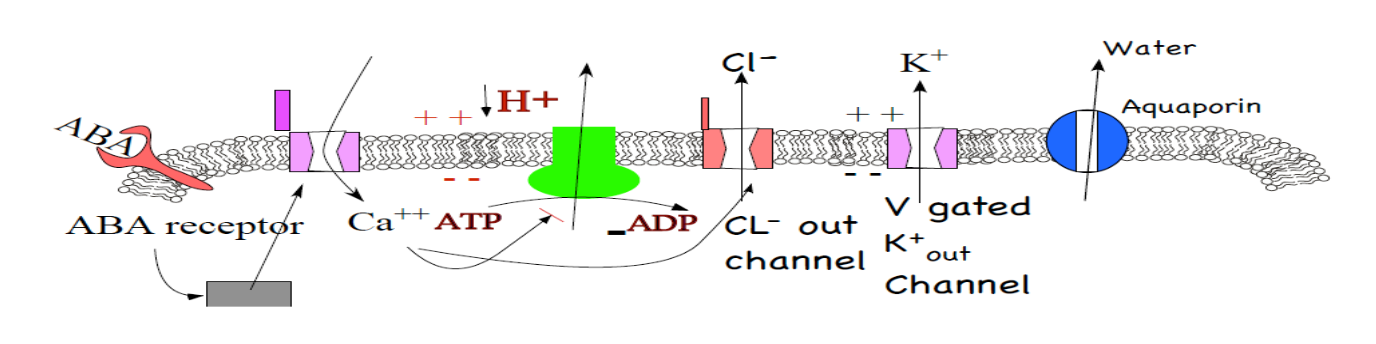
Closing stomata in response to ABA
1. Starting conditions:
Stomata is open, and so has a large cytoplasmic concentration of the ions used to reduce the cellular osmotic potential in order to open the stomata.
2. ABA:
ABA is a hormone that is sent indicates that there is water stress somewhere in the plant. Often roots detect water shortages first and must signal leaves to stop loosing water before the roots can no longer deliver it. These roots (or whatever bit of the plant senses the water deficit) produce a hormone that causes ABA to be produced in leaves, which is then detected by the guard cells. A membrane spanning ABA receptor on target cells (guard cells here) binds the ABA and begins the response.
3. Ca++ as second messenger:
Ca++ is always being pumped out of the cytoplasm. This makes it an ideal messenger because it moves fast to where it is absent via diffusion.
4. How ATP is spent:
Ca++ signal decreases proton pump activity and…
5. Exporting Cl-:
… Cl- efflux by signaling for the opening of Ca++ gated Cl-out channels. Chloride wants out because both concentration and charge are favorable for exit.
6. 𝜑m (membrane potential):
The slowing of the proton pump and chloride leaving both DEPOLARIZE the cell membrane.
7. Exporting K+:
Depolarization of the membrane triggers K+ efflux because it causes the opening of voltage gated K+out channels. K+ leaves because it is concentrated in the cell (when the stomata was opening) and because the charge gradient resisting its exit has been reduced.
8. 𝜑o (osmotic potential):
The decreased internal concentration of K+ and Cl- ions increases the internal osmotic potential was well as water potential.
9. Water exit:
Since water potential is now greater inside the cell than outside, causes water to leave following the solute. Aquaporins are opened to allow rapid water movement.
10. 𝜑p (pressure potential):
Flaccid stomata are “all the way” closed. In reality there is leakage of water vapor though stomata even when they are all the way closed. We’ll see later that because of this the number of stomata on a leaf is another feature regulated in response to environmental conditions.
Which ion is partially responsible for the closure of stomata?
Cl-, exiting from chloride channels.
The energy that drives K+ ions out of guard cells when stomata are closing is…
The concentration gradient of K+ but not the membrane potential.
What drives potassium across the membrane during a guard cell response to blue light?
Membrane potential
How were stomatal regulation mutants found in the Serna paper?
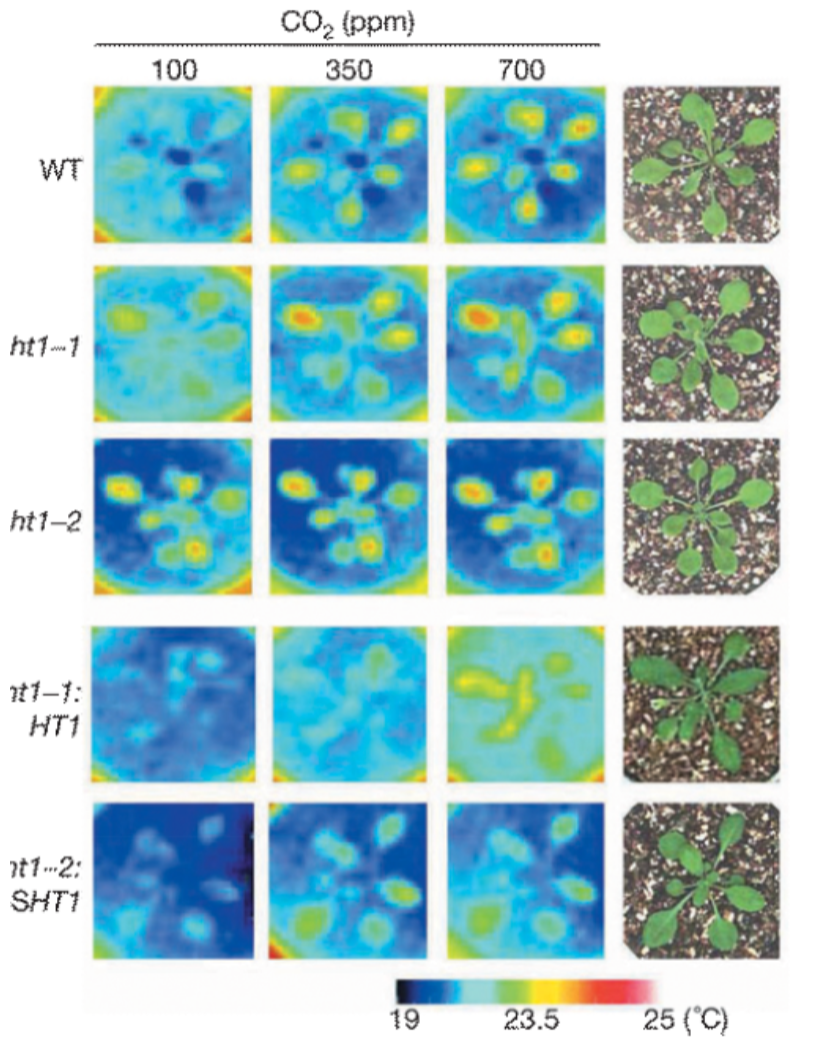
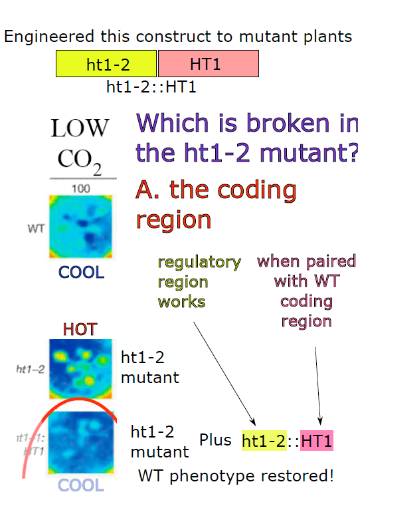
The researchers looked for mutants using thermal imaging under different levels of CO2, which allowed them to “see” the temperature of the leaves. They placed plants in low carbon dioxide, and found some plants that were evidently warmer than wild type. They called these high temperature 1 (HT1) mutants. They found 2 mutant alleles. Ht1-2 is the “stronger” allele; it is more fully broken (we’ll ignore ht1-1).
This change in temperature is because…
Stomata open = evaporative cooling (wild type)
Stomata closed = no cooling, gets hot (ht1-2)
Is the coding or the regulatory region broken in the ht1-2 mutant?
The coding region
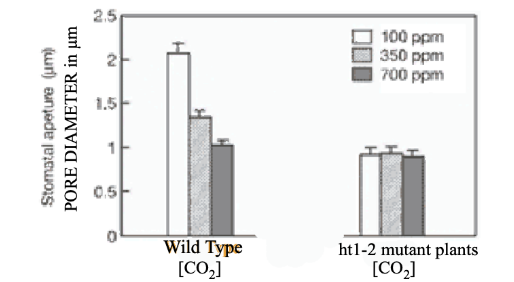
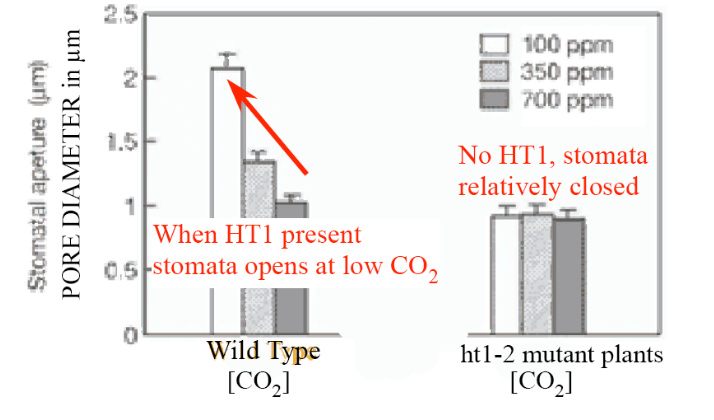
From the data below it appears that…
The function of HT1 is to open stomata when CO2 levels are low.
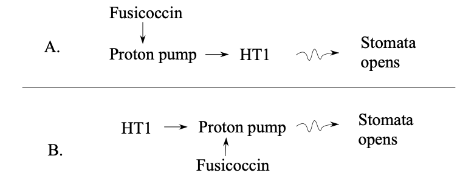
Which model is supported by the data?
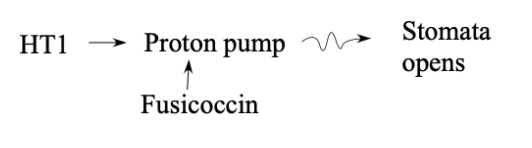
The correct pathway is HT1 → Proton pump → Stomata opens
This is because fusicossin (a fungal toxin that directly activates the proton pump, locking them into constant maximal activity so that the stomata opens against the plant’s will) has the same effect on mutant and WT plants. Thus, the proton pump must be more downstream from HT1.