Chap 26D - Electrochem
 Call Kai
 Learn
Learn Practice Test
 Spaced Repetition
 Match
Match Flashcards
 Knowt Play
1/6

There's no tags or description
Looks like no tags are added yet.
Name | Mastery | Learn | Test | Matching | Spaced | Call with Kai |
|---|
No analytics yet
Send a link to your students to track their progress
7 Terms
Describe differences between Alkaline–Manganese Battery and dry cell Main advantage: ~50% improvement in properties compared to Leclanche cell
Further development of Leclanche cell using Zn and MnO2 as the electrode
Main differences:
Use of KOH as the electrolyte which allows further reduction of the MnO2 at the cathode to Mn(II)
Use of metallic zinc powder suspended in alkali as anode rather than a sheet and the cell arrangement is the opposite of the Leclanche cell
MnO2(s) (OS Mn: +4) + H2O(l) + e– → MnO(OH)(s) (OS Mn: +3 )+ OH–(aq) ---- (1)
MnO(OH)(s) + H2O(l) + e– → Mn(OH)2(s) (OS Mn: +2) + OH–(aq) ---- (2)
State equations at electrodes at Alkaline–Manganese Battery
Cathode (+): Brass
Reduction: By (1) + (2): MnO2(s) + 2H2O(l) + 2e– → Mn(OH)2(s) + 2OH–(aq)
Anode (–): Powdered zinc
Oxidation: Zn(s) + 2OH–(aq) → Zn(OH)2(s) + 2e–
3. Overall reaction: Zn(s) + MnO2(s) + 2H2O(l) → Mn(OH)2(s) + Zn(OH)2(s); Ecell = +1.58 V
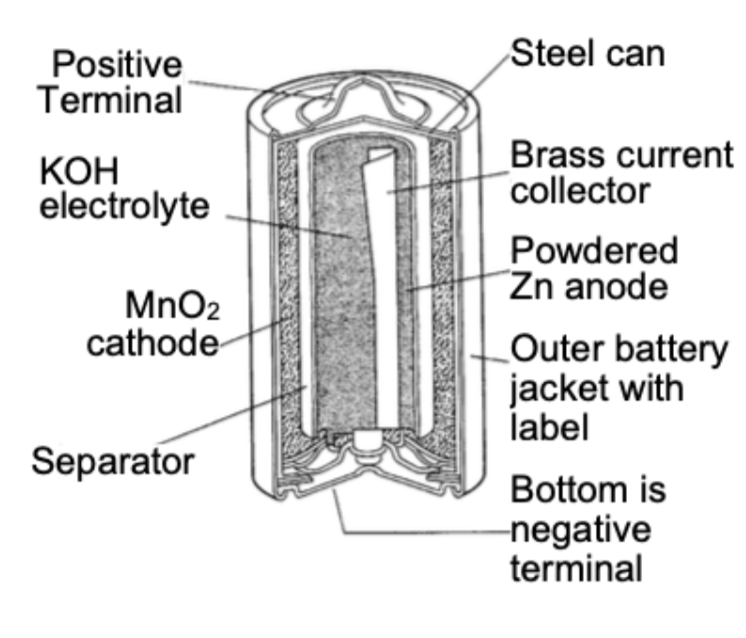
Draw Alkaline–Manganese Battery + state its advantages
Main advantage: ~50% improvement in properties compared to Leclanche cell
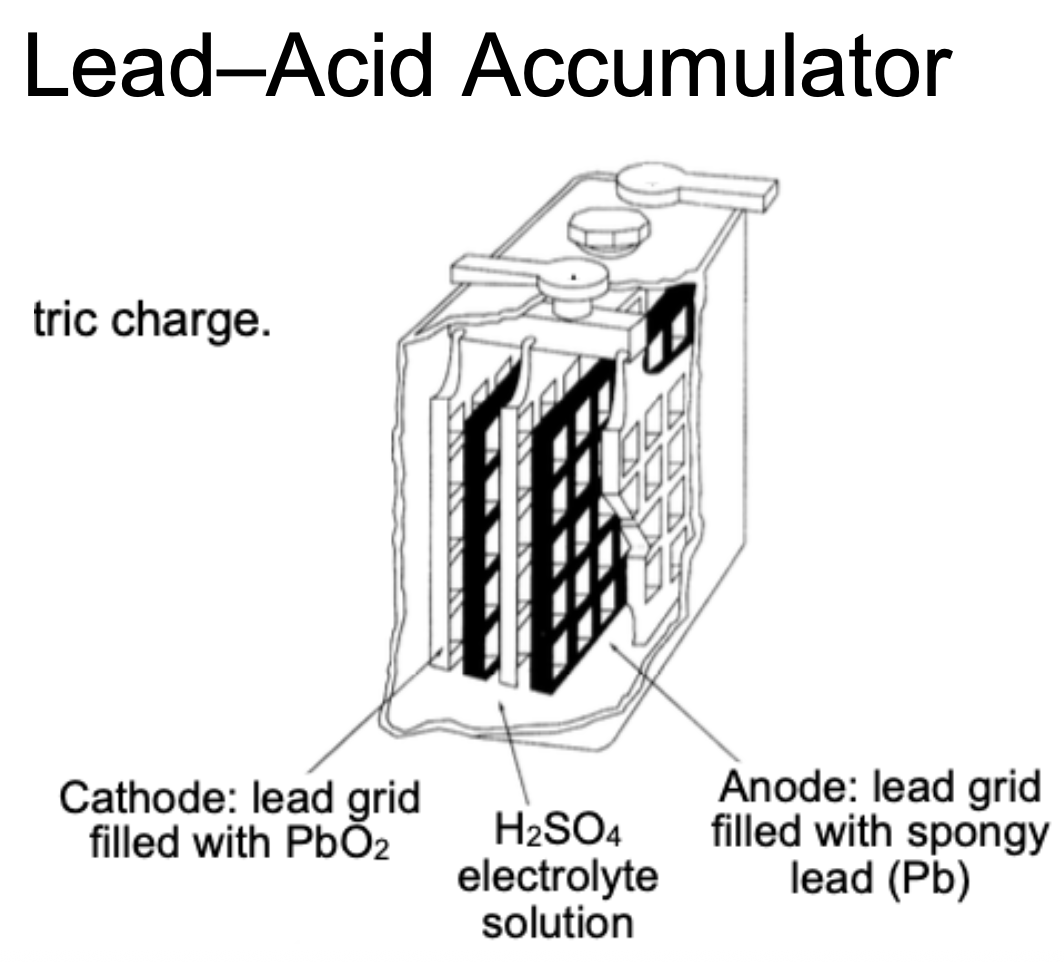
Describe Lead–Acid Accumulator
Stores accumulated electric charge.
During the discharging process, the cathode (+) is lead(IV) oxide, PbO2, the anode (–) is lead, Pb, and the electrolyte is aqueous H2SO4
State equations at electrodes of Lead–Acid Accumulator
Anode (–): Pb
Oxidation: Pb(s) + SO42–(aq) ⇌ PbSO4(s) + 2e–
Cathode (+): PbO2
Reduction: PbO2(s) + 4H+(aq) + SO42–(aq) + 2e– ⇌ PbSO4(s) + 2H2O(l)

State advantages and disadvantages of Lead–Acid Accumulator
Main advantages: High voltage / current and rechargeable
Main disadvantages: Heavy weight and discharge cannot take place completely since PbSO4 is non–conducting (at best 50% of the cell material is converted)
Draw Lead–Acid Accumulator