Lesson 5 - Recording Friction Ridge Skin
 Call Kai
 Learn
Learn Practice Test
 Spaced Repetition
 Match
Match Flashcards
 Knowt Play
1/15

Earn XP
Description and Tags
Name | Mastery | Learn | Test | Matching | Spaced | Call with Kai | Chat |
|---|
No analytics yet
Send a link to your students to track their progress
16 Terms
3 Types of Exemplars
Fingerprint / Ten Print Card
Palm Print Card
Major Case Print Card / Complete Friction Ridge Exemplar
Ink & Paper
A way to acquire FRS exemplars - printer’s ink & roller, ink pad, fingerprint cards
Pros:
Captures more of the finger
Sharper detail
Cons:
Too much or too little pressure
Too much or not enough ink
Movement / slippage
Not fully rolled / recorded
Overlapping or double touches
Recordings of incorrect areas
Chemicals & Paper
A way to acquire FRS exemplars - inkless pads, chemically treated fingerprint cards
Pros:
No mess
Cons:
Old pads / chemicals can prevent proper recording
Lack of “sharpness”
Livescan
A way to acquire FRS exemplars - electronic device
Pros:
Fast & easy (plus easy to re-do if necessary)
Lots of third level detail
Cons:
Stitching errors / artifacts
Blurriness
Ghost impressions
Poor quality
Too much or not enough residue
Accutrans / Mikrosil
A way to acquire FRS exemplars - 3D casting material
Pros:
3D recording of FRS
Easy to use on dead bodies (rigor mortis)
Cons:
Need to apply fingerprint powder first to get best detail
Hard to photograph afterwards
Handi-Print
A way to acquire FRS exemplars - black fingerprint powder & white contact paper
Pros:
Best way to get Major Case Prints
Easy to use on dead bodies (rigor mortis)
Cons:
Movement / Slippage
Messy
Photography
A way to acquire FRS exemplars - camera & appropriate lens
Pros:
No mess
Can often get very good detail
Cons:
Need to keep in mind that the ridges / furrows are flipped when comparing
Rolled Impressions
A fingerprint collected by rolling the finger from nail to nail
Fingers are rolled outward
Thumbs are rolled inward
Flat Impressions
aka Plain / Simultaneous / Slap
A fingerprint collected by placing the finger straight down & then lifting straight back up
The plain impressions are used to verify the sequence and accuracy of the rolled impressions
Writer’s Palm
aka the Hypothenar
The area on the side of the palm that normally rests against the paper while writing
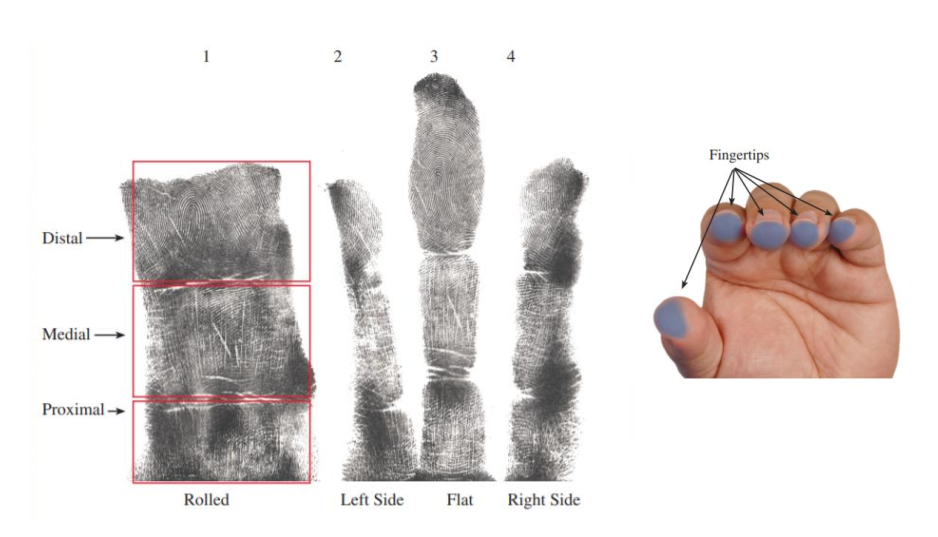
Major Case Print Cards
Recording of all FRS on hands…
Distal, medial & proximal joints of fingers
Fully rolled
Left edge
Flat
Right edge
Extreme fingertips
Palm prints
Full palm
Writer’s palm
Thenar - this is not always recorded separately because it’s usually visible enough in the full palm
Decomposed (Putrefied) Skin
Occurs due to bacteria, fungi & fermentation
Usually fragile - take care when handling skin
May need to remove FRS from underlying tissue
Formaldehyde may be used to firm up skin
Possible to print underside of skin or dermal skin = dermal papillae
Macerated Skin
Occurs when friction ridge skin is immersed in water
Epidermis separates from dermis = “de-gloving”
May need to stretch the skin to remove wrinkles
Can use tissue builder / glycerin
Can wear de-gloved skin like a glove in order to get prints
When the epidermis is missing the boiling technique can be used
Desiccated / Dry Skin
“Mummified” or very old bodies that are past the beginning stages of decomposition & putrefaction
May require use of a casting material = Accutrans or Mikrosil
Usually requires removal of hands / feet
Rehydration & softening
Sodium or potassium hydroxide
Dishwashing liquid or fabric softener
Tissue builder / glycerin to “fill out” the skin
Charred Skin
Subject to intense heat
Can draw fingers into tightly clenched fist - pugilistic attitude
Can cause separation of the epidermal layer
Charring can cause the skin to be very brittle
Refrigerate 5-7 days to allow epidermis to separate
May have to cut the connecting tissue
Rinse frequently in clean warm water
The Boiling Method
aka Osmotic Rehydration
On a hand / foot that is missing the epidermis, the dermis can be re-hydrated enough to print by briefly (10-30 seconds) dipping the skin into boiling water.