lecture 5
 Call Kai
 Learn
Learn Practice Test
 Spaced Repetition
 Match
Match Flashcards
 Knowt Play
1/22

Earn XP
Description and Tags
development
Name | Mastery | Learn | Test | Matching | Spaced | Call with Kai |
|---|
No analytics yet
Send a link to your students to track their progress
23 Terms
theory of mind (TOM)
the ability to make inferences about mental states (emotions, intentions or beliefs)
perceptive taking. involved empathy
how is theory of mind a subcomponent of social cognition
it helps developing the skills to manage social communications and relationships
it allows us to make sense of the social world and to predict peoples actions/ behaviours by thinking about internal states
study on children describing others
6-16year olds
young age - behavioural concepts e.g. the actions someone is doing. not someone is sad but someone is crying.
around 10 yrs - mental state described e.g. scared
later adolescence: organising our thoughts and relationships e.g. fear for the future. more abstract way of thinking.
examples:
•Billy runs faster than Joe” (behavioural)
•“James is a real stubborn kid” (psychological)
•“Linda is real sensitive, a lot more than most people” (organizing relationships)
Repacholi & Gopnik (1997): desire-based experiment for theory of mind.
researcher presented different foods. e.g. showed crackers or broccoli
when showing crackers, researchers used a disgusted face. when presenting broccoli they used a loving face
asked children: ‘can you give me some?’ - open ended as child could pick either food. can child understand that researchers wanted broccoli not crackers.
18-month-olds (but not 14 month-olds) gave the researcher broccoli. 14 months picked what they liked more. 18 months started understanding researcher wanted something they themsleves didnt want.
shows 18 month olds have an understanding that desires are subjective and differ person to person. first theory of mind seen.
theory of mind starts developing around 15/18 months of age and seems to develop gradually.
adults theory of mind and belief-desire reasoning:
understanding that others can have different mental states than me
requires one to be aware that
I (but also other people) can represent the surrounding world
The content of this representation might differ from reality
e.g. seeing different things due to different perceptive field. or attention being allocated somewhere else.
shift from a situation-based to a representation-based understanding of behaviour: e.g. explaining peoples behaviours as not dispositional based but situation based.
•Based on belief-desire reasoning: “I act in a way that I think will make something happen” → requires understanding others’ emotions and perception (social cognition)
belief = what we think is the cause of what we see
desire = other peoples wants and needs
e.g. lecturer sees confused faces. belief - material is too complicated. desire - students want to understand content. action - repeat explanation.
also own emotions and physiology can alter what we believe to percieve.

How to measure ToM in children?
•False-belief tasks: scenario in which someone’s knowledge about the world is different from the actual state of the world.
•The observer’s prediction of behaviour can differ according to:
–whether the observer refers to what they know about the contents of an individual’s mind, or..
–whether they rely on what they know to be reality (e.g. ‘reality-biased’).
•vs. True-belief tasks: can children represent what another person believes, and that belief matches their own beliefs or reality?
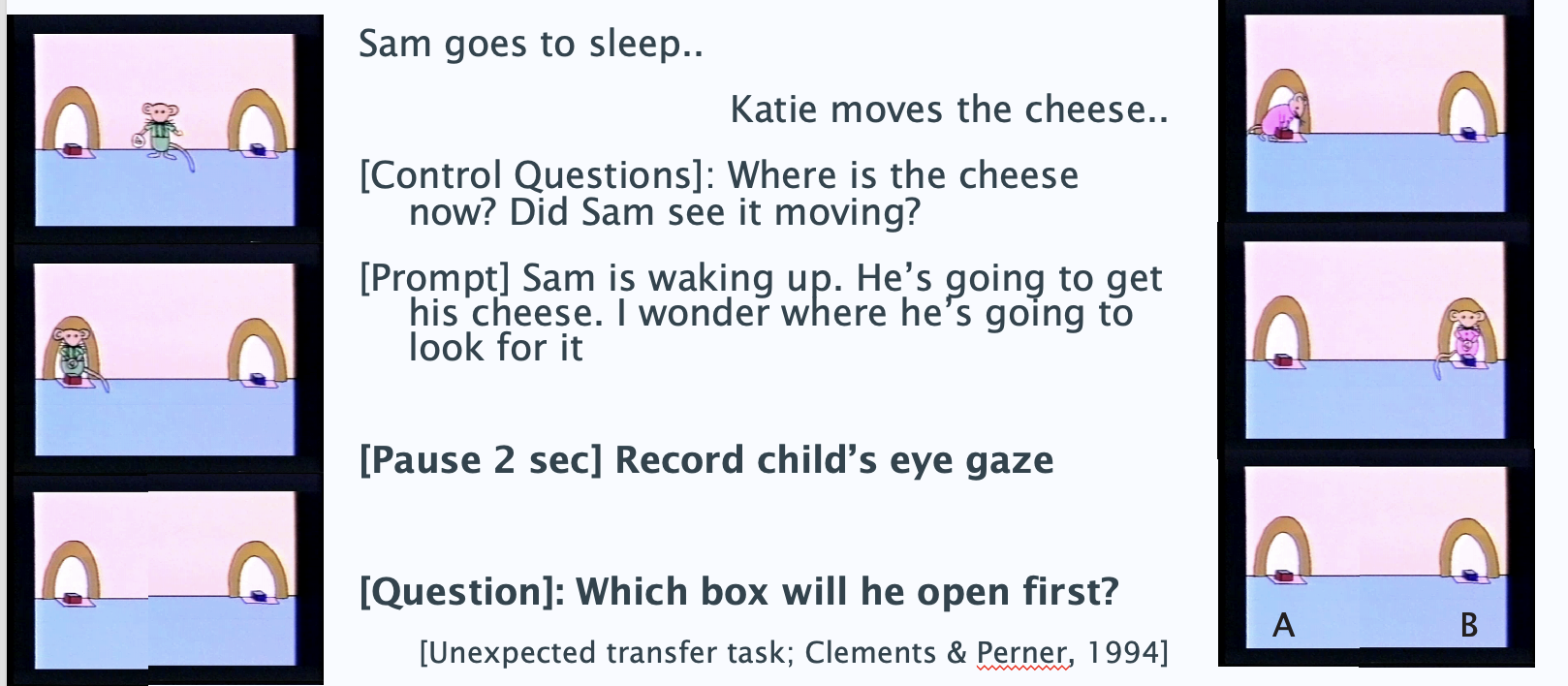
e.g. unexpected transfer task
unexpected transfer task
“Where will Maxi look for his chocolate?” [test]
•Implicitly requesting the child to compare memory (Where did Maxi put his chocolate?) vs reality (Where did Mum move the chocolate?)
•> 5-year-olds: “In the cupboard!”
•< 5-year-olds: “In the fridge!” - their own relaity. couldnt take maxi’s perspective.
false-belief: maxi doesnt know the chocolate was moved.
![<p><strong>“Where will Maxi look for his chocolate?” [test]</strong></p><p>•Implicitly requesting the child to compare <em>memory</em> (Where did Maxi put his chocolate?) vs <em>reality</em> (Where did Mum move the chocolate?)</p><p>•> 5-year-olds: “In the cupboard!”</p><p>•< 5-year-olds: “In the fridge!” - their own relaity. couldnt take maxi’s perspective.</p><p>false-belief: maxi doesnt know the chocolate was moved.</p><p></p>](https://assets.knowt.com/user-attachments/04d00d17-94fc-4fa6-a493-11828966a464.png)
Sally-Anne task
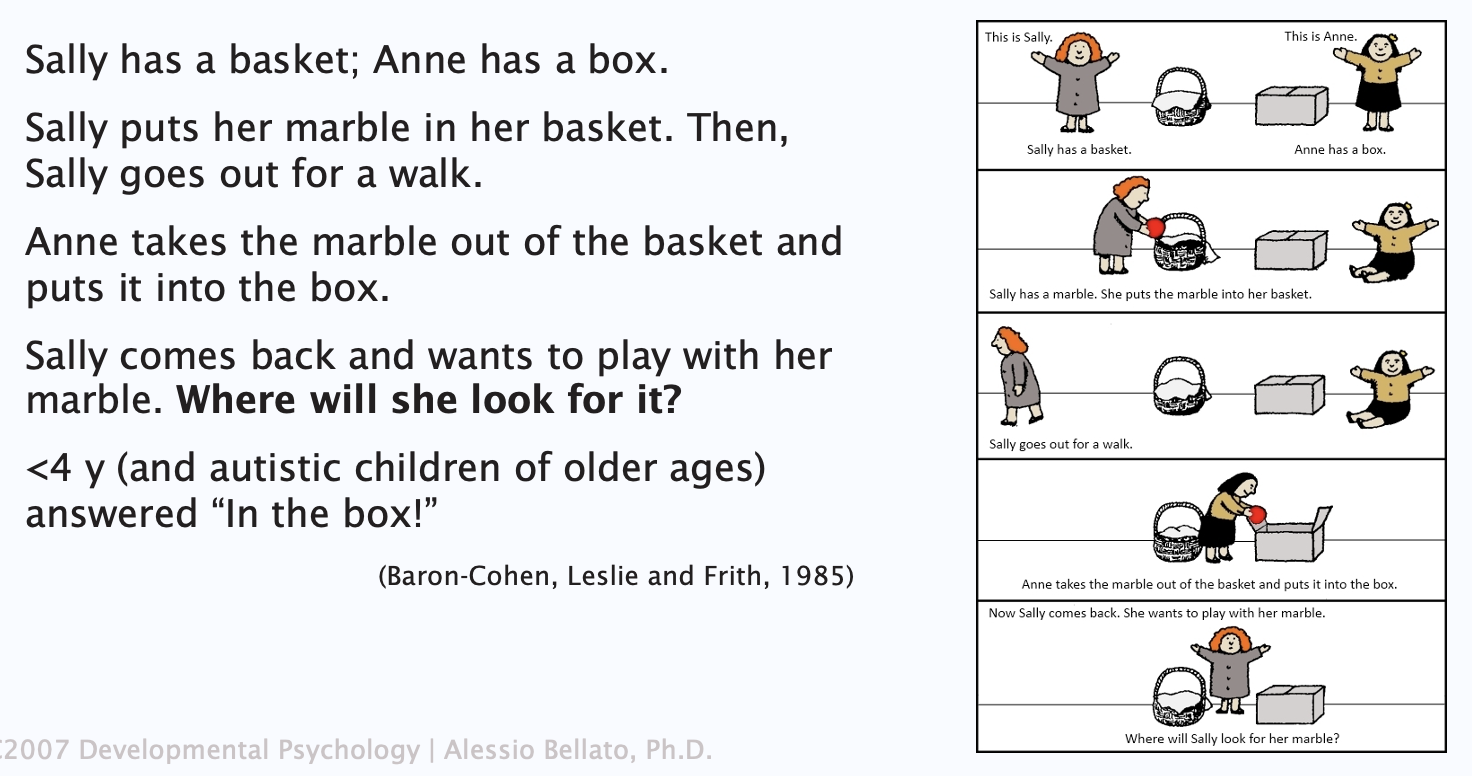
Deceptive box task
[meta-cognition]
Perner et al. (1987)
•“What do you think there is inside this tube?” “Smarties!”
•“Let’s see what’s inside.. Pencils!”
“What would your friend say there is inside, if they have not seen inside the Smarties tube?” [<4 y: pencils!, 4+ y: smarties]
replication - believed results were due to those of young age not understanding the question - Gopnik and Astington (1988)
•“When you first saw this tube, before we opened it, what did you think was inside?”
•3/4-year-olds: difficulty acknowledging false belief in others (someone else could have different representation of reality than their own) and own prior false belief once they know what is inside
issue with stating that it is at 4 years old that TOM develops - what else could influence younger than 4s to get the answer to TOM tasks wrong
•4-year-olds+ are successful in FB tasks - ToM develops at this age (major conceptual change)
•Do 3-year-olds not have any ToM at all? No, but they might fail to (still) understand representational mental states
•Competence (conceptual understanding required to solve a problem) ≠ Performance (other cognitive skills may affect how the child solves the problem)
Sometimes younger children perform better than older on simpler tasks.
ToM in 3-year-olds and younger - how to test implicit knoweldge
What is the child’s spontaneous response, e.g. gestures, eye movements, drawings, emotional responses, facial expressions
Helpful with children younger than 4 years of age
•Children’s facial expressions = indices of understanding of beliefs (conflict between someone’s belief and reality → signs of suspense such as lip biting or brows furrowing)
Child may be aware of the conflict but not able to express linguistically: e.g can understand that there is some level of theory of mind but cannot express this knowledge.
•signs of tension/suspense in processing false beliefs vs true beliefs are sometimes visible in 3-year-olds (Moll et al., 2016)
• • •Recording eye-gaze behaviour may give us hints about the child’s flow of thinking without requiring a verbal response
(unexpected transfer task)
found: •Gap between implicit and explicit understanding of the task
•Children develop an implicit/ unconscious understanding of FB at an earlier age than explicit/conscious understanding of FB
improvement of implicit knowldge happens much earlier therefore children around 2.5/3 yrs have evidence of implicity TOM.
Violation of expectancy task: broad aspects
•Infant familiarise with an event - see it until they know it
•Test behaviour is presented: consistent or inconsistent with the event.
•Infant looks longer at inconsistent event taken as evidence that they are surprised
•Indicates some level of knowledge about what should happen
15 month-olds
Onishi & Baillargeon, 2005
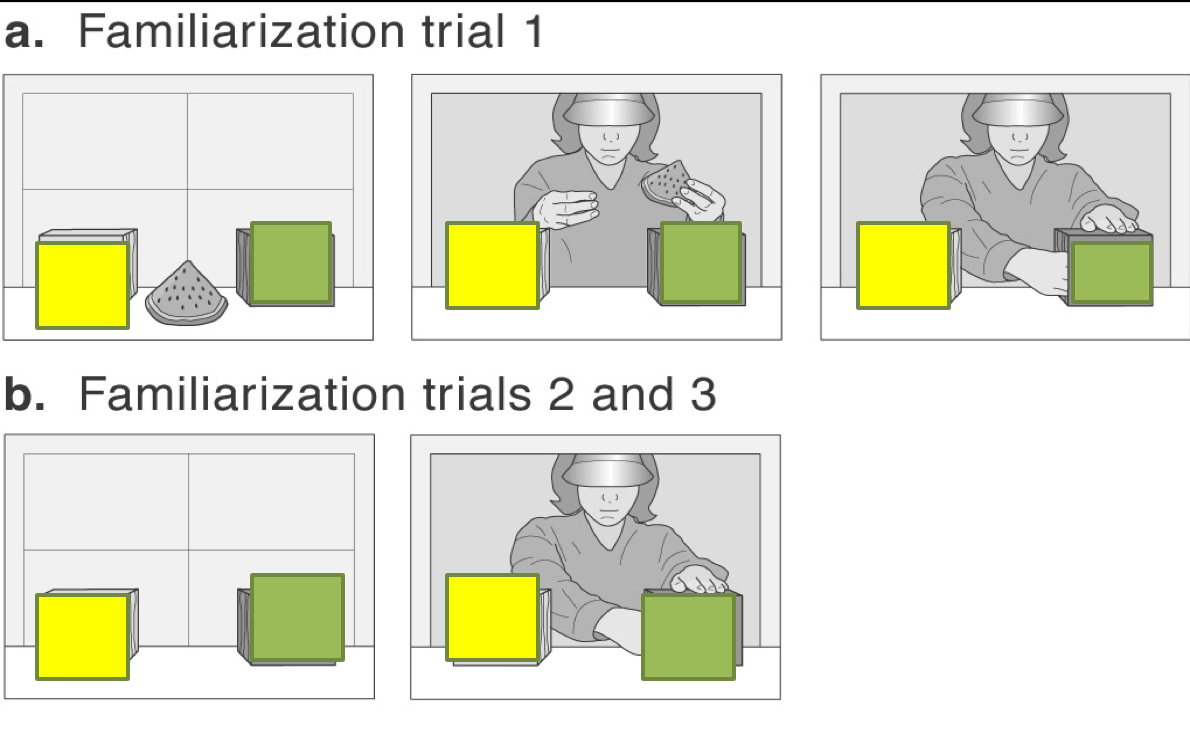
Violation of expectancy task: step 1
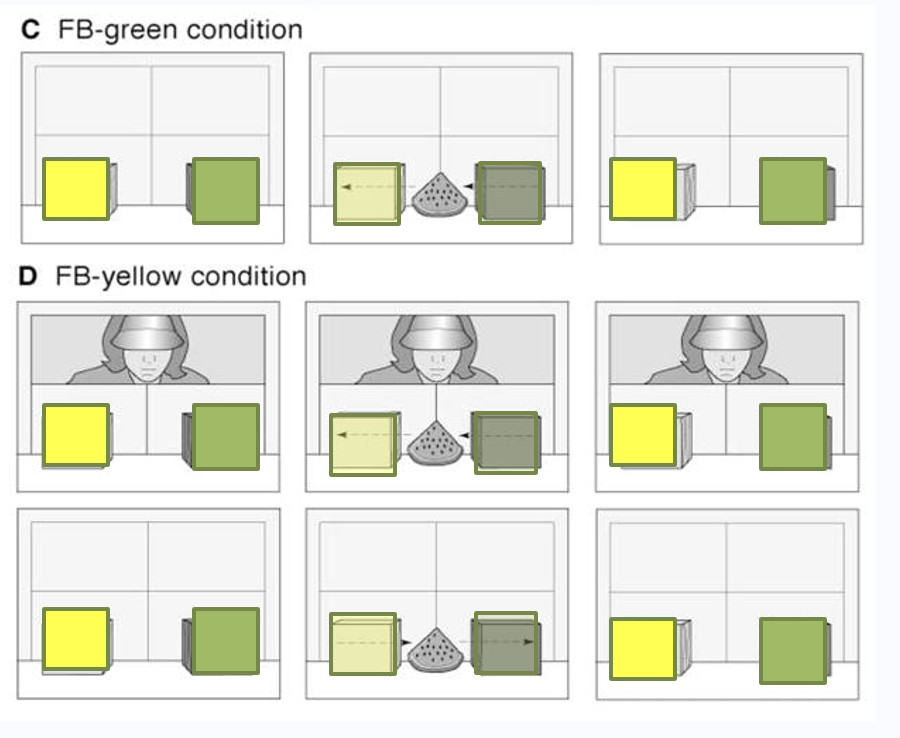
Familiarization: a toy watermelon slice rested between two boxes, one yellow and one green; the boxes’ openings faced each other and were covered with fringe. An actor opened doors in the back of the apparatus, played with the toy and then hid it inside the green box. After this pretrial, the actor paused, with her hand inside the box, until the trial ended (a curtain was lowered in front of the apparatus between trials). During the second and third familiarization trials, the actor opened the doors, reached inside the green box (as though to grasp the toy she had previously hidden there), and then paused until the trial ended.
children became familiar with the belief that the actor played with the toy and put it in the green box.
then 4 conditions: 2 true-belief and 2 false-belief
Violation of expectancy task:: step 2
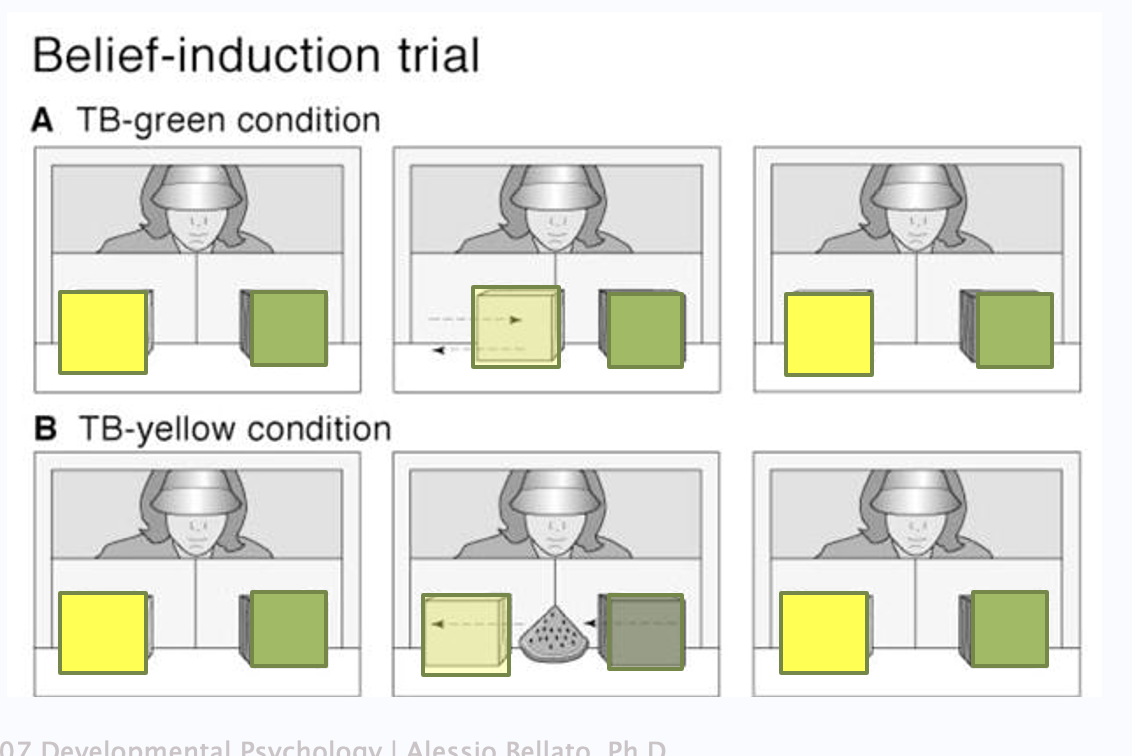
belief induction trial
Then, the infants witnessed a change that resulted in the actor holding a true or a false belief about the toy’s location.
A: after putting toy in green box they saw the yellow box move right and then back to original possition. toy still in green box and child ovserved this to be true.
B: actor moved toy from green to yellow box. baby observed this. relaity of baby is the same as reality of actor.
Violation of expectancy task:: step 3
False Belief Induction Trial:
C: actor left the room and the toy moved from the green to yellow. discrepancy between actors reality and baby as baby saw the change but actor didnt. where would character look - should say green as didnt witness change
D: actor witnessed change of location from green to yellow. then they left room and the toy went back to the green. actor should look in yellow as they still believe it in the yellow but baby saw it go to green.
test trial: actor came and looked for toy. tested if baby looked surprised with where the actor looked.
•15 month-olds seemed to realize that “others act on the basis of their beliefs and that these beliefs are representations that may or may not mirror reality.”
• ⁃ bablies looked more at trials that were incongruent with what they had seen
Violation of expectancy task: result
•15 month-olds seemed to realize that “others act on the basis of their beliefs and that these beliefs are representations that may or may not mirror reality.”
• ⁃ bablies looked more at trials that were incongruent with what they had seen
babies more surprised when actor knew toy was in green box but looked for it in yellow box.
same principle for all other conditions therefore sense of understanding of both true and false belief.
•The probability of responding correctly to false-belief tasks increases with age (128 studies) - meta analysis.
•Children start responding correctly to false-belief tasks around 3 ½ years (independently from the type of task or question, nature of the protagonist or object, and if the question is related to self or others).
•Situations where there is a deceptive motive (e.g., the chocolate is moved to trick the protagonist) improve performance at all ages.
•Performance was found to improve, at all ages, when the child actively participates to the task (e.g., transforming the target object and not passively watching), if the object is present and the protagonist’s belief is clearly stated or pictured
Factors contributing to ToM development
•Biological maturation of brain systems involved in ToM (associated with understanding mental states):
Executive functioning
Language and comprehension
Memory
Attention & Joint attention
•Social and cultural experience, and interactions with other people
•Neuro-divergence
Cognitive functions contributing to ToM development
•Charman et al. (2000): Joint attention skills in 20-months-old predicted their theory-of-mind performance at 3 years 8 months
•Development of brain systems involved in executive functions (mainly frontal lobes) is still ongoing during childhood and adolescence (pre-frontal cortex is one of the last to brain regions to mature)
e.g. ability to shift attention, stay focused etc.
Executive functions & False belief tasks
Inhibitory control (improvements between age 3 and 6) → Stopping a prepotent response (pointing towards an object before thinking if that is the correct object to point). must stay focused and not get distracted.
Task switching → moving from a real-world situation to think about an abstract representation
Working memory → holding different and conflicting representations in mind and manipulating this information to come to the correct answer
Social conversations and interactions effct of ToM development
Social referencing: 12-months-old monitor parental (or others’) emotional reactions to ambiguous situations and use this information to regulate own behaviour. children who are more exposed to social referencing helps children develop better theory of mind.
Conversations: talking about mental states and reflecting on others’ mental states, help children to acquire the appropriate vocabulary to discuss and reflect on mental states (Harris, 1999, Ruffman et al., 1999). aids better TOM.
Older siblings (role play) and parents who talk about mental states (causality between action and belief/desires): positive effects on ToM development
Low socio-economic status: less opportunities to experience conversation in the home environment
Cross-cultural differences? No evidence
Maternal mind-mindedness and ToM development - Meins et al., 2002
•Mind-mindedness ► tendency for parent to comment appropriately on infants' mental states, desires, knowledge, thoughts.
•Fifty-seven 6-month-infants & mothers, observed in a free-play context
•assessed Mothers' use of mental state language that commented appropriately or not appropriately on the infants' mental states; Security of attachment.
later assessed infants on TOM development (4 years old)
found: •Better performance to ToM tasks at 4 years old was predicted by increased mental mind-mindedness at 6 months.
ToM, pro-social behaviours and peer relations - Caputi et al., 2011
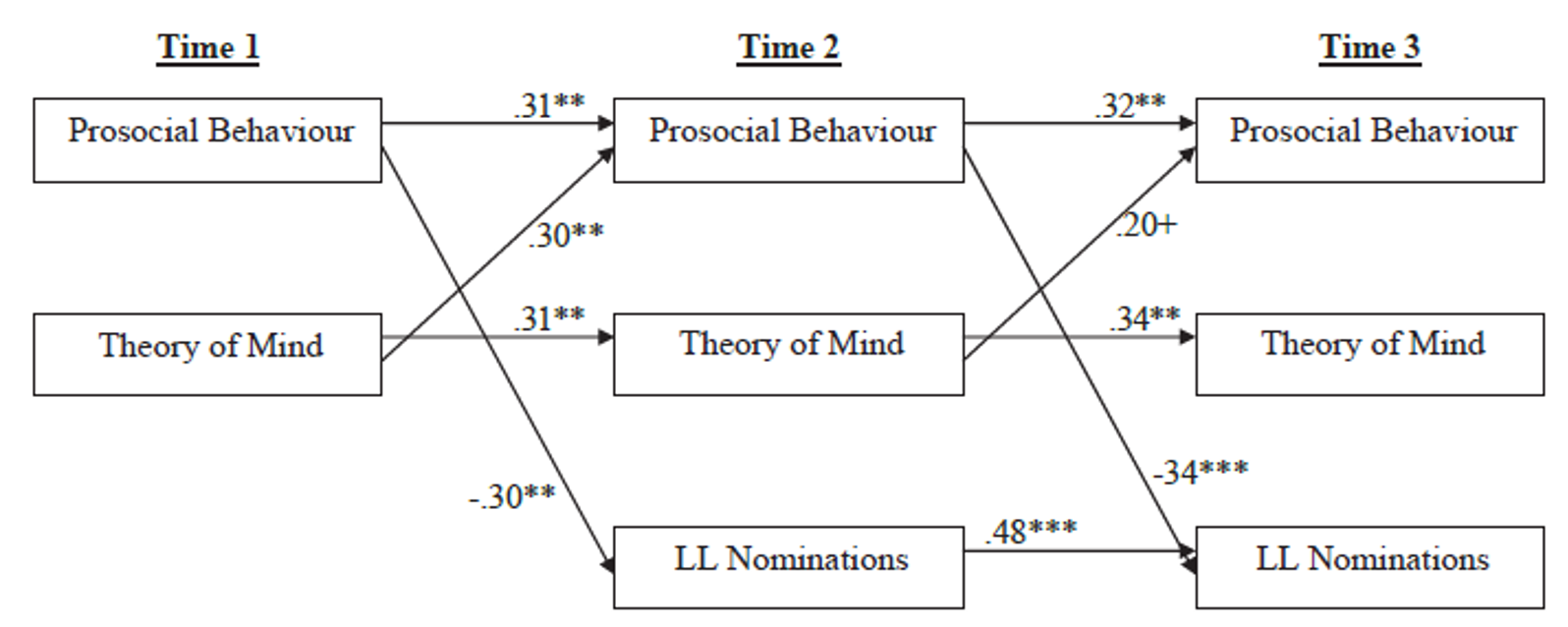
links between those who developed a good theory of mind early on (5 years) consistently had better theory of mind. also had better prosocial behaviours (could talk about other’s emotions) which linked to lower peer rejection. could better establish and maintain social relationships.
LL = least liked. also assessed most liked nominations and found positive correlation between ToM and most liked.
Autism & ToM
•Simon Baron-Cohen (1985): Sally-Ann task
–80% of autistic children did not take into account Sally’s false belief, even those with mental age above 4 years of age (while 5-year-old neurotypicals succeeded at this task)
–Deficit in ToM is not due to learning difficulties/general developmental delay (children with Down’s syndrome did not fail)
Theory: a majority of autistic children have a deficit in ToM
Smarties task
•Autistic children struggle in this task too, even if they have a verbal mental age above 4 years
•Problems with acknowledging beliefs (including own)
•ToM difficulties reported in naturalistic settings in autistic people