Lecture 7 -- Nematodirus spp and Nematodirus battus Overview
 Call Kai
 Learn
Learn Practice Test
 Spaced Repetition
 Match
Match Flashcards
 Knowt Play
1/19

There's no tags or description
Looks like no tags are added yet.
Name | Mastery | Learn | Test | Matching | Spaced | Call with Kai |
|---|
No analytics yet
Send a link to your students to track their progress
20 Terms
What is Nematodirus battus primarily known to affect?
Only affects lambs
P.S. Other nematodirus species affects sheep and cattle
Where are adult Nematodirus battus found?
Small intestine
What are the key morphological features of adult Nematodirus battus?
2cm long
White
Often found in group (Tangled like cotton wool)
Cephalic vesicle (Bubble like inflation over the head and neck)
Male: Bursa at tail end + Long, thin spicules
Female: Uterus contains large eggs (~150 µm, larger egg than typical trichostrongyles)
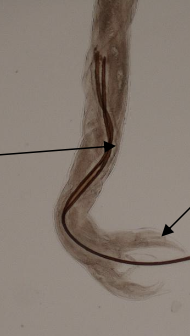
Which morphological features shown in this picture help identify the sex of Nematodirus?
Male
Long thin spicules and extend well beyond the worm
Presence of bursa at the tail end
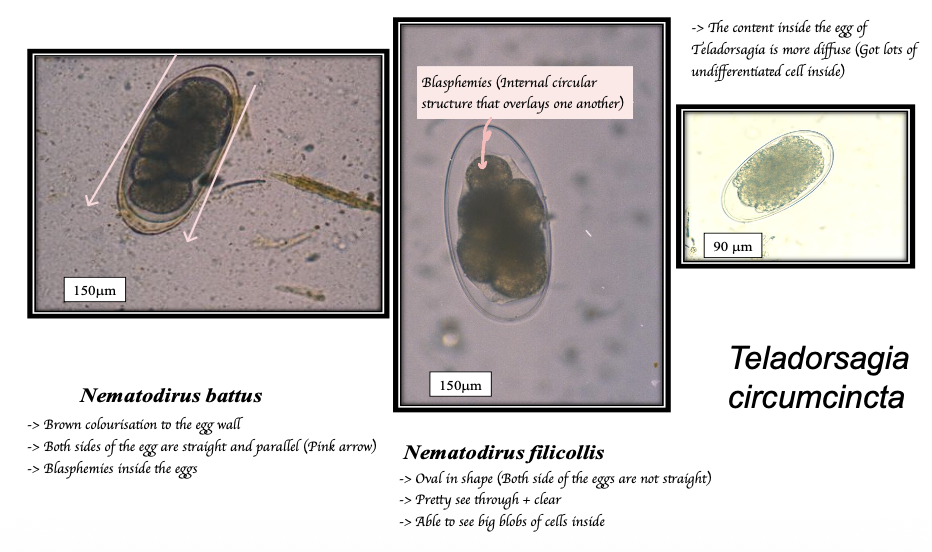
How can we differentiate Nematodirus eggs from trichostrongyle eggs?
Size:
Nematodirus - large (150 µm)
Trichostrongyle - small (90 µm)
Contents:
Nematodirus - internal circular structure
Trichostrongyle - more diffuse (More undifferentiated cell inside)
Shape:
Nematodirus - both sides of egg are straight and parallel
Trichostrongyle - more irregular and variable
Colouration:
Nematodirus - brown colourisation to egg wall
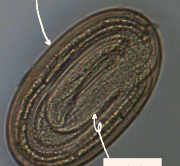
Which stage of larvae is this?
L3
Coiled
Summarize the life cycle of Nematodirus battus.
Step 1: Unembryonated eggs shed in faeces onto pasture
Step 2: L1, L2 and L3 develop inside the egg
Step 3: L3 overwinter in eggs on pasture (Important difference)
Step 4: L3 hatches and becomes infected in spring
Step 5: Lambs ingest L3 → L3 develops to L4 in the lumen of small intestine
Step 5: L4 burrows into mucosa of small intestine → L5 emerges and matures to adult → Males and females mate → Females lay eggs
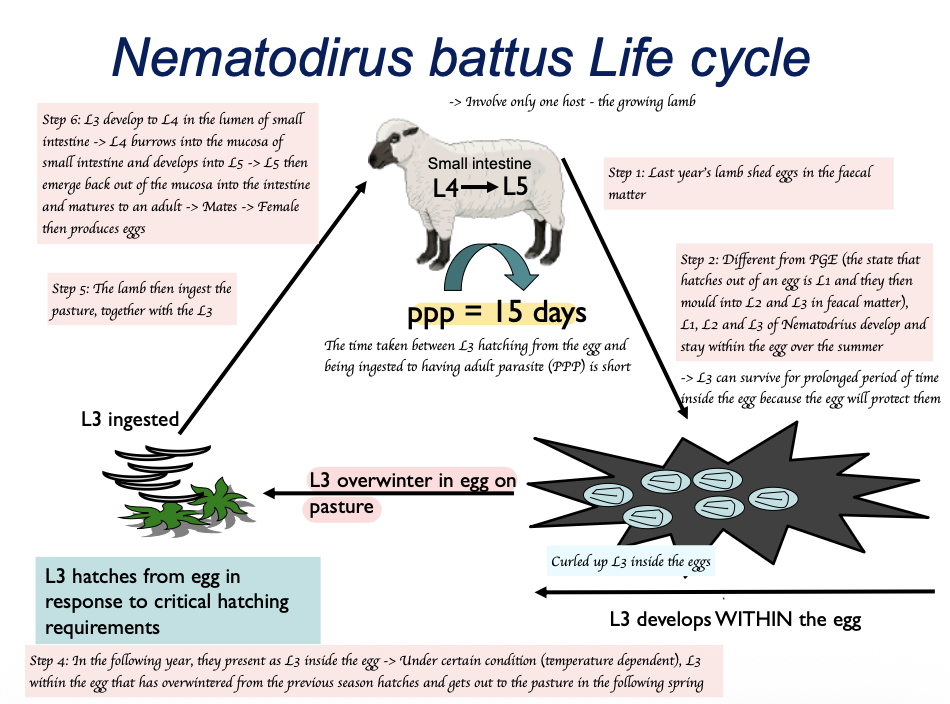
What is the pre-patent period for Nematodirus battus?
15 days
How do Nematodirus battus larvae cause intestinal damage?
Developing L5 destroy the small intestine mucosa → Break the villi in the small intestine → Villous atrophy → Fluid and nutrient absorption disrupted + Catarrhal enteritis
How does Nematodirosis differ from typical PGE in terms of worm burden?
Fewer worms are needed to cause disease
~2000 worms can produce clinical signs
What are the main clinical signs of Nematodirosis in lambs?
Sudden, explosive outbreak of acute watery diarrhoea
Inappetence and weight loss
Dehydration
Because they cannot absorbed fluid across small intestine due to damage of villi
Abdominal pain
Which lambs are most affected by Nematodirosis?
Young lambs 4-12 weeks old (Different from PGE, which affects older lambs)
What is considered a heavy worm burden based on faecal egg counts (FEC)?
>500 epg
What are the specific hatching requirements for Nematodirus battus?
Prolonged period of chill (<10 °C)
Followed by warming: mean day/night temperature ~10 °C
Example: UK → Prolonged period of chill + midnight temp.rises >10 degrees
When does mass hatching of L3 typically occur in the UK?
Spring
as the weather conditions meet the hatching requirement, mentioned on previous question
Key conditions for disease to occur?
Apart from the critical hatching requirement the cause L3 to hatch from last question…
Hatching must co-incide with presence of susceptible lambs = Animal is old enough to graze but before age immunity develops
If the eggs hatch very early before the lambs are old enough to graze, it may not cause disease because the larvae cannot live very long and they will die out
if the L3 hatch late when the lambs are older and have more competent immune response, they may not get the disease
Do ewes play an important role in Nematodirus battus epidemiology?
No (Contrast to PGE, where ewes play the important role)
Strong acquired immunity = Once an animal has been exposed to the parasite, its immune system responds so effectively + becomes resistant to future infections
How is pasture contaminated for the next season?
Lamb-to-lamb cycle
Eggs passed by last year’s lamb are seeding the parasite onto the pasture that potentially cause disease in the following year’s lamb
How is Nematodirus battus diagnosed in lambs?
Season: Usually May (spring)
Age: 4–12 week-old lambs
Clinical signs: Sudden watery diarrhoea, abdominal pain (colic), dehydration
Grazing history: Recent exposure to contaminated pastures with Nematodirus battus eggs and larvae?
How can Nematodirus battus infection be controlled in lambs?
Grazing management:
Don’t graze lambs on same pasture every year
If the pasture was grazed by lambs last year, we can put older animals on later in the season → Pick up larvae without disease → Reduce pasture contamination
Disease forecasting:
Since clinical factors drives the epidemiology for Nematodirus battus, use of climatic data can identify high-risk areas and timing
Anthelmintic treatment:
Prophylactic treatment of susceptible lambs in high-risk areas