Synapse/Transmission + Neuroplasticity (5 -6)
 Call Kai
 Learn
Learn Practice Test
 Spaced Repetition
 Match
Match Flashcards
 Knowt Play
1/114

There's no tags or description
Looks like no tags are added yet.
Name | Mastery | Learn | Test | Matching | Spaced | Call with Kai |
|---|
No analytics yet
Send a link to your students to track their progress
115 Terms
What are the three types of synapses?
axosomatic, axodendritic, axoaxonic
axosomatic synapse
axon terminal connects directly to the cell body (soma) of another neuron.
axodendritic synapse
axon terminal → dendrite
axoaxonic
axon terminal → another axon
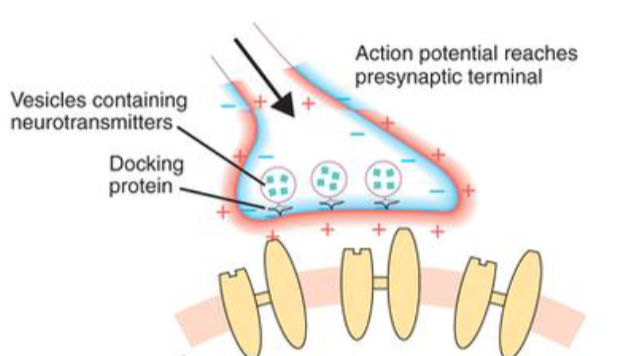
active chemical synapse
event 1
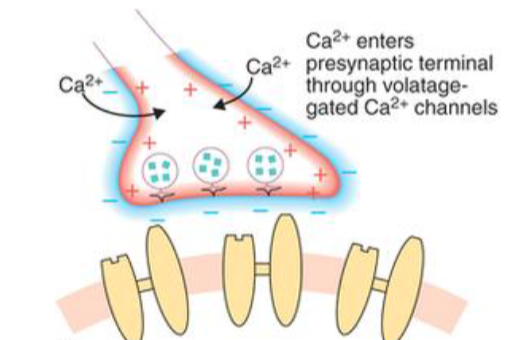
active chemical synapse
event 2
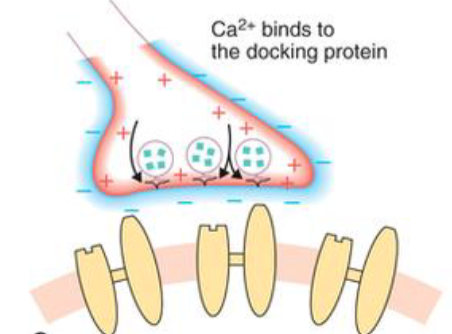
active chemical synapse
event 3
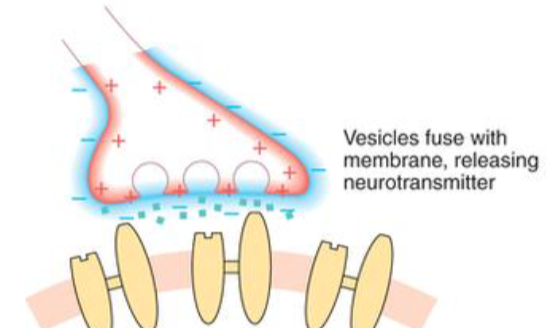
active chemical synapse
event 4
active chemical synapse
event 5
active chemical synapse
event 6
When AP arives at presynaptic terminal, neurotransmitterr vesicles connect with
docking protein
When neurotransmitter vesicles connect w/ docking proteins, the presynaptic terminal
membrane depolarizes
The presynaptic mem depolarizies and opens ________.
Ca2+ voltage-gated channels
What does Ca 2+ bind to?
docking protein
Vesicles fuse with ________ and release neurotransmitter into _______.
the membrane ; the cleft
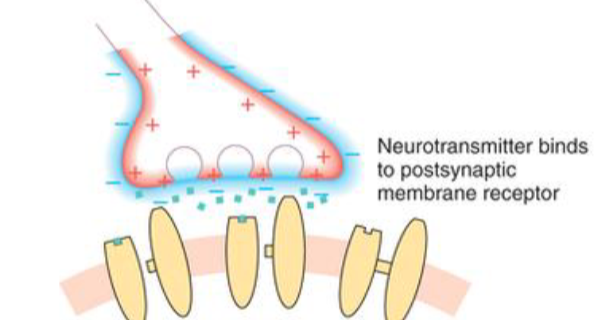
Neurotransmitter diffuses across the
the synaptic cleft
Neurotransmitter binds to
postsynaptic membrane receptor
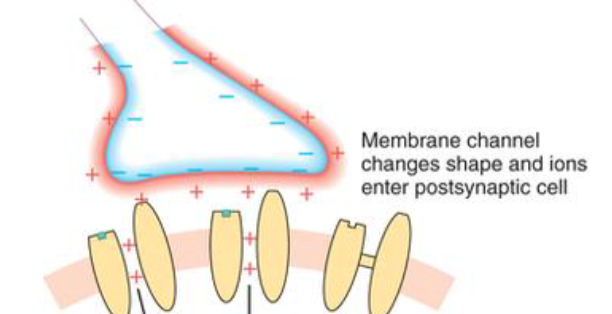
Membrane channel changes
shape and ions enter postsynaptic cell
What are neurotansmitters removed by on the presynaptic terminal?
reuptake transporters
_______ in the synaptic cleft can degrade neurotransmitters.
enzymes
Neurotransmitters can diffuse ____ of the synapse.
out
What can cause receptor inactivation?
Phosphorylation or other post-translational mods of mem receptors
_______ can be internalized.
membrane receptos
During presynaptic facilitation, _____ neurotransmitter is released
more
_____________ occurs when presynaptic axon neurotransmitter slightly depolarizes axon terminal of a second neuron
presynaptic facilitation
During presynaptic inhibition, _____ neurotransmitter is released
less
____________ occurs when neurotransmitter that slightly hyperpolarizes axonal region of a second neuron
Presynaptic inhibition
__________ are local changes in ion concentration across the postsynaptic membrane
Postsynaptic potentials
At the postsynaptic membrane, changes in the membrane potential are either
excitatory or inhibitory
Local depolarization is an ___________; Local hyperpolarization is an __________.
excitatory postsynaptic potential (EPSP); inhibitory postsynaptic potential (IPSP)
Summation of Postsynaptic Potentials
The process by which multiple postsynaptic potentials combine to produce a larger change in membrane potential, determining whether an action potential is triggered.
synaptic receptors can produce direct (________) or indirect (_________) actions
fast synaptic transmission; slow synaptic transmission
Which synaptic receptor action involves when the receptor and ion channel make up a single functional unit?
direct
Which synaptic receptor action involves using a cascade of intracellular molecules to activate ion channels or cause other changes within the postsynaptic neuron?
indirect
______________ are chemicals in presynaptic terminal that are released into the synaptic cleft to transmit information between neurons
Neurotransmitters
____________ are chemicals released into the extracellular fluid at a distance from the synaptic cleft.
Neuromodulators
Neuromodulators effects manifest
more slowly and usually act longer than effects at the synapse
Neurotrasmitters are _______ and _________.
local; specific
Neurotransmitters affects the postsynaptic neuron: directly, by
activating ion channels
Neurotransmitters affects the postsynaptic neuron indirectly by
activating proteins inside the postsynaptic neuron
What are the two types of neurotransmitters?
fast-acting and slow-acting
Fast-acting NT:
those that act directly (transmission requires less than 1/1000 of a second)
Slow-acting NT:
act indirectly (Transmission requires 1/10 of a second to minutes)
Neuromodulators have ___________.
more general release and impact (slower and longer effect)
Neuromodulators alter neural function by acting
at a distance away from synaptic cleft
How long can a neuromodulators last?
minutes to days
_____________ are drugs that bind to the receptor and mimic the effects of naturally occurring neurotransmitters/modulators
Agonist
___________ are drugs that prevent. the release of neurotransmitters/modulators or bind to the receptor and impede the effects of a naturally occurring transmitter/modulator.
Antagonists
Signaling between efferent nerve terminals and muscle cells can be disrupted by
disease
Lambert-Eaton syndrome
Antibodies destroy voltage-gated Ca2+ channels in the presynaptic terminal
Myasthenia gravis
antibodies (autoimmune) attack and destroy nicotinic receptors on muscle cells
Channelopathies
Diseases that involves dysfunction of ion channels
In some cases which pathology may cause epilepsy and migraines?
channelopathies
Neuroplasticity is the ability of
neurons to change their function, chemical profile, or structure
Neuronal structure involves
# synapses, dendrite branching, shape of postsynaptic membrane
Chemical profile involves
quantity and types of neurotransmitters
Functional/structural reorganization involves
one area substituting function for another area
The ability to reorganize neurons by forming new neural connections throughout life allows the brain to
respond to injury or new situations
Neuroplasticity is a general term used to encompass 3 chief mechanisms:
Habituation
Experience-dependent plasticity
Cellular recovery after injury
Habituation is a
temporary decrease in response to a repeated benign sensory stimulus
Habituation is a decrease and environmental decrease in the release and availability of _______ and ________.
excitatory neurotransmitters (e.g., glutamate)
free intracellular Ca2+
With prolonged repetition of stimulation, more permanent structural changes such as
DEC # of synapses / INC threshold for nts needed
Tactile defensiveness is abnormal sensitivity to touch so therapy includes
slowly introducing gentle stim / progressing to brisk stim
Therapy involving unilateral vestibular hypofunction consist of
practicing the movements that induce dizziness and nausea
Experience-Dependent Plasticity are complex processes involving
persistent, long-lasting changes
(in synapse strength/neural networks)
Learning =
Acquisition of knowledge or ability
Memory
Retention and storage of that knowledge or ability
__________ reflects the process we acquire knowledge; ___________ reflects the product of learning
learning; memory
Experience-Dependent Plasticity requires all of the following except
Growth of old synapses
Sleep is important for
motor learning consolidation
During initial stages of motor learning, large areas of the brain show
synaptic activity
As the task is repeated and learned, there is
a reduction in active brain regions.
Persistent, long-lasting changes of synaptic connections leads to
learning and new memory
What are two specific mechanisms involved in Experience-Dependent Plasticity?
LTP & LTD
LTP & LTD results in presynaptic changes in
neurotransmitter release
LTP & LTD results in postsynaptic changes in
receptor density and efficiency
Long-term potentiation and long-term depression can occur
simultaneously within a neural network
Long-Term Potentiation is best defined/understood as a type of
neuroplasticity in learning and declarative memory formation
LTP is the cellular mechanism for the formation of memory in the
temporal lobe (hippocampal gyrus)
In LTP, __________ synapses are converted to _______synapses
silent; active
In LTP, an increase in synaptic activity and metabolic changes increase
the efficiency of nerve cell firing
LTP synapse density involves repetitive stimuli that cause
synthesis / activation of new proteins that promote or inhibit growth of new synaptic connections
The result of LTP is
a maintained response and memory of specific, repetitive stimuli
Long-Term Depression =
receptor site removal from post-synaptic membrane (dendritic spine pruning)
LTD is a conversion of an _______synapse to a ______ synapse
active; silent
Where is Transcranial Magnetic Stimulation (TMS) applied to?
the motor cortex or other brain areas involved in motor learning
Transcranial Magnetic Stimulation (TMS) Can enhance or inhibit motor learning and memory formation, depending on
the experimental protocol
Astrocytes play an important role in
brain and SC plasticity
Neurons release neurotransmitters → stim astrocytes to release
gliotransmitters
Gliotransmitters modulate
neuronal activity
Gliotransmitters support ________ by moodulating
synaptogenesis;
NTS release / upstake
Injuries that damage or sever axons cause
degeneration but may not result in cell death
Injury that destroys the cell body of a neuron leads to
cell death
Neurons deprived of oxygen for a prolonged period (stroke/injury) will
DIE + NO REGENERATION
Excitotoxicity (Glutamate (Astrocytes)) may
add more damage
What drug provides significant neuroprotection for individuals with stroke, TBI, or neurodegenerative disease?
none known
In a PNS axonal injury (ex. polio) cells
can recover.
deprives input from damaged axons/attracts new inputs to maintain function
In a CNS axonal injury (sci, cva) cells
Cannot recover in the same way; research ongoing
Sever an axon: Wallerian (anterograde) Degeneration
distal portion dies and breaks into segments; no connection to nucleus
engulfed by microglia
Sever an axon: Retrograde (proximal) Degeneration /Central Chromatolysis - all are true except
Solution of nuclear chromatin