GEOG Exam 3 Content Review
 Call Kai
 Learn
Learn Practice Test
 Spaced Repetition
 Match
Match Flashcards
 Knowt Play
1/61

There's no tags or description
Looks like no tags are added yet.
Name | Mastery | Learn | Test | Matching | Spaced | Call with Kai |
|---|
No analytics yet
Send a link to your students to track their progress
62 Terms
Biosphere Levels
-Habitat
-Ecosystems/Ecoregions
-Biome
Individual, Population, Community
Individual: survival & reproduction, unit of natural selection
Population: Unit of evolution
Community: Interactions amongst populations
Ecosystem
Self-sustaining association of living plants & animals and their non-living physical environment
Ecoregions
areas where ecosystems are generally similar.
Fields of Study
-Ecology
-Biogeography
Ecology: study of relationships between organisms & their environment
Biogeography: study of distribution of plants & animals over space and time
Taxonomy
Classified by a Hierarchical system
Classification based on evolutionary relationships
First physical similarity, later genetic similarity
Put the following Kingdoms (6 total) in order:
Class
Order
Family
Species
Genius
Phylum
• Phylum,
• Class,
• Order,
• Family,
• Genus,
• Species
Scientific Binomial Names are always _______ or ______________
Italicized or underlined
Define the following:
Family, Genus, Species
Family
share a common ancestor in the geologic past from which they evolved
Genus (plural=genera)
hare a common ancestor in the recent geologic past
Species
most closely related
The biological species concept (3 parts)
Morphologically look similar/look alike
are capable of mating and producing viable offspring (who can go on to also reproduce)
Normally do so in the wild
While members of closely related species may be able to mate and produce offspring, the offspring are sterile
Types of Biodiversity
genetic diversity: variation of genes within species
species diversity: number of species in an ecosystem
ecosystem diversity: variety of ecosystems or habitats
Types of species
Endemic Species: unique to a defined geographic location
Native Species: either endemic or indigenous; may live in numerous locations
Introduced Species: living outside its native distributional range, which has arrived there
by human activity
Invasive Species: non-native/introduced to the ecosystem and causes/is likely to cause economic, environmental harm orharm to human health
biodiversity results in greater _______ = ability to recover from change
Resilience
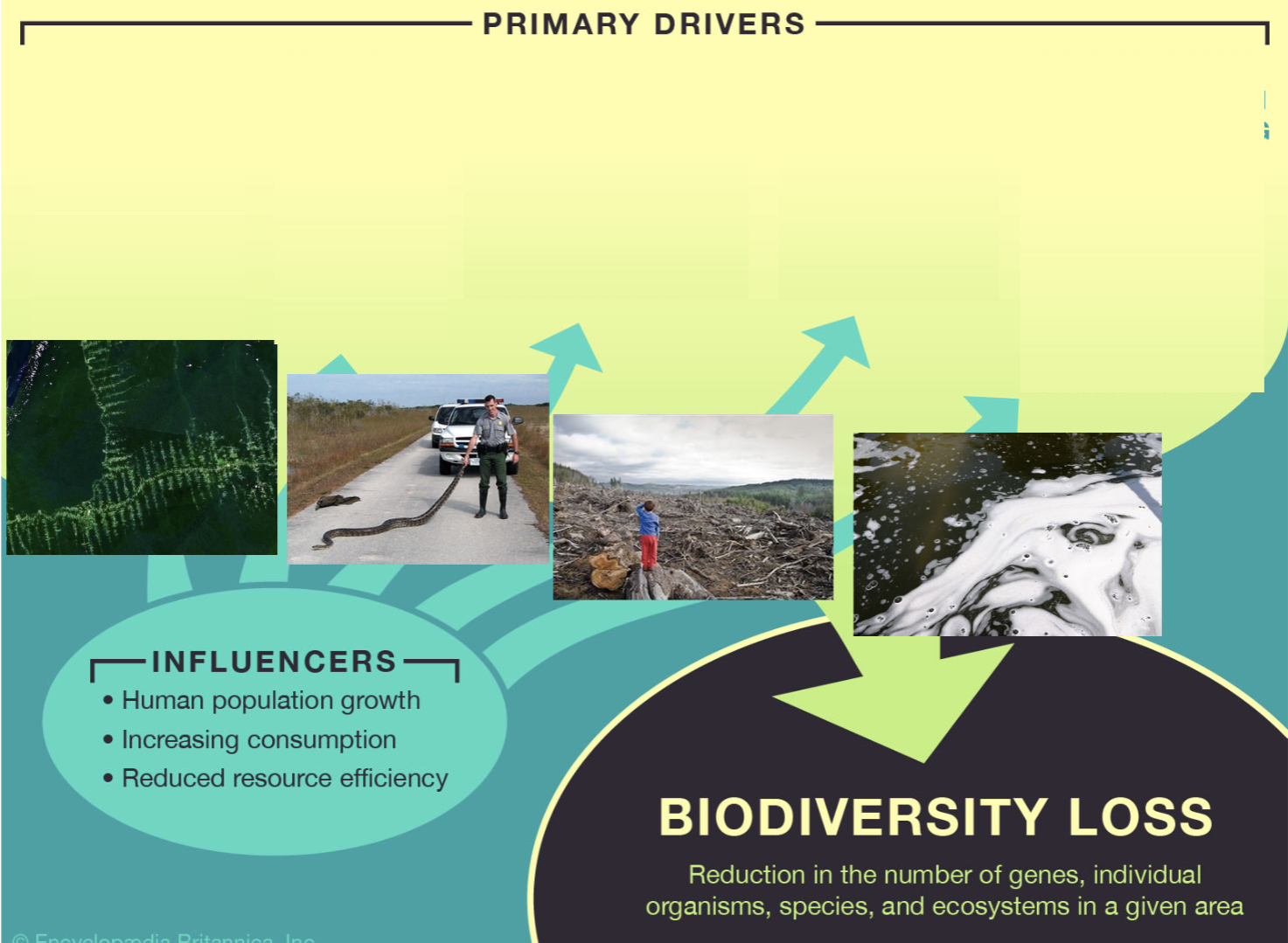
What are primary drivers of Biodiversity loss?
Habitat Loss
Invasive Species
Overexploitation
Pollution
Climate Change associated with global warming
Stenotopic
A species adapted to a narrow range of conditions
Eurytopic
A species adapted to a wide range of conditions
Abiotic
Non-living
Abiotic factors: SWATS
Soil
Water
Air
Temperature
Sunlight
Biotic Definitions, Roles, and Interactions
Biotic=Living
Roles
Producers
Consumers
Decomposers
Interactions
Predators/Prey
Competitors
Symbionts
Pathogens
Limiting Factor
Component that most inhibits biotic operations through either lack or excess
Niche
Function of a life form within its community
Symbiosis
overlapping relationships
Commensalism, Parasitism, and Mutualism
Commensalism: One is benefited
Parasitism: One is benefited, one is harmed
Mutualism: Both benefit
Trophic Level
position organism occupies in a food chain (what it eats and what eats it)
Producers (autotrophs)
“self feeders”, use solar energy & CO2 for food, always plants
Consumers: (heterotrophs)
“feed on others”, depend on producer
Primary consumers = _________
Secondary consumers = ___________
Tertiary consumers = _________
Primary consumers = herbivores
Secondary consumers = carnivores
Tertiary consumers = carnivores
Omnivores
Eat both plants and animals
Decomposers (fungi/bacteria & detritivores)
Feed on dead organic debris left by living processes
Food Chain Efficiency
Only ~10% of the energy consumed at one trophic level passes up the food chain to the next
Biological magnification of persistent toxins
Concentration of toxic substances (like pesticides or heavy metals) multiplies as they move up the food chain
Grassland Biome
Grassland biomes dominated by a single class of plant
Grass = a non-woody plant, containing a hollow stem for strength, bladed leaves for photosynthesis and a flowering bundled seed head for reproduction
• Evolved since end of Cretaceous, 66 million years ago
• >10,000 species today
Prior to human modifications, grasslands covered _____ to ______ of the
earth's land surface. Grasslands exist on every continent except ______
24 to 45%
Antarctica
Tropical Savanna Biomes
grasslands with interspersed trees
Tropical Savanna Biome Abiotic Characteristics
S) Tropical latitudes;high insolation
(T) Warm year-round
(W) Seasonal rainfall (9-150 cm; 4-60 in)
• Drought & fire are common
Mid Latitude Grassland Names in various continents
North America: Prairies
South America: Pampas
Eurasia: Steppes
Mid-Latitude Grasslands Abiotic Characteristics
(S) 25°-50° mid-latitudes; seasonal isolation
(T) Warm summers, cold winters
(W) Seasonal rainfall (25-75 cm; 10-30 in)
• Periodic drought & fire
Mollisols
• Thick organic A horizon
• Long-term addition of organic matter from grasses & roots
• High fertility ➡ productive agricultural soils
Mollisols Biotic Characteristics
Moderate Biodiversity
Grasslands are relatively simple in ________ but rich in ________. However, most areas of the prairie have experienced serious declines in ___________.
structure, # of species, biodiversity
Annual Grass Definition and Examples
Definition: Grow new from seed
Examples
Rice, Wheat, Oats and Corn
Prennial Grass Definition and Examples
Definition: Grow back from roots
Examples
Kentucky Bluegrass, Sugar Cane, Switchgrass
Native Prairie herbivores
bison
pronghorn
elk
deer
rabbits
mice
________ of most prairie plants are below the ground.
Some roots die each year and decompose ➡ carbon sink in soil.
2/3
Threats to Mid Latitudes and Tropical Savanna
Fire suppressions
Desertification
Solution to Fire Suppressions
Controlled burns
Solutions to Desertification
Mimic nature with planned grazing
“restorative ranching”?
Keystone Species
Definition: species that has a disproportionately large effect on the communities in which it occurs
Example: Prairie Dogs
Photosynthesis - Respiration = ______
Biomass
Biomass
Dry weight of organic material
Net Primary Productivity (NPP)
Net photosynthesis
Stored chemical energy
Fixed carbon per unit area per unit time
Biomass
Carbon Source
Anything that releases MORE carbon than it stores
Carbon Sink
Anything that absorbs MORE carbon than it releases
Short-term Carbon Cycles
can take months to centuries
Composting
Using decomposers to make soil
Soil is made of
Mineral particles
Air
Water
Organic matter (humus)
Plant roots
Living organisms
Soil Development
Weathering
Translocation
Physical/chemical movement by water
Organic Activity
Rooting: Plants
Bioturbation: Worms, rodents, insects, birds mixing soil
Decomposition: Fungi, Bacteria, Worms
Soil Development Steps
Rock begins to disintegrate by physical and chemical weathering
Plants facilitate weathering and add organic matter
Soil develops a layered structure, water moves dissolved minerals
Fully developed soil can support thick vegetation
Soil Formation Factors: CLORPT
CLimate
Organisms
Relief
Parent material
Time
Earthworms
Accidentally introduced by European settlers in 1800s
Altered forest soils and forest structure
Soil Classification: Soil Horizon
Soil layers, differences used to classify soils
Pedon
Description unit ~1m2 column from surface to bedrock
Soil Degradation
Human induced or natural processes that negatively affects soil functions (Accepting, storing, and recycling water, energy, and nutrients)
Erosion (Wind, water)
Chemical degradations (Contamination, Salination)
Physical Degradation (Compaction)
Biological Degradation (Loss of organic matter)