BIOL 1620 Module 3
 Call Kai
 Learn
Learn Practice Test
 Spaced Repetition
 Match
Match Flashcards
 Knowt Play
1/100

There's no tags or description
Looks like no tags are added yet.
Name | Mastery | Learn | Test | Matching | Spaced | Call with Kai |
|---|
No analytics yet
Send a link to your students to track their progress
101 Terms
What distinguishes fungi from animals?
Fungi - external digestion
Animals - Internal digestion
Chitin
A nitrogen-containing polysaccharide
exoskeleton of insects and crustaceans
Mycelium
The body of the fungus
composed of hyphae
Hyphae
long thin filaments with a large surface area for absoribing nutrients
Reproductive structure
fruiting body
How does the absorbtion of food work?
Enzymes are secreted outside the cell to digest large food particles into small molecules that can be absorbed.
Small organic molecules from digested food are imported through the cell wall.
The hyphae provide a high surface area for absorption.
Absorption of food at the tip of the hypha enables growth of the hypha.
Therefore, absorption of food is the mechanism that enables growth of the hyphae
Yeasts
A general term for fungi that grow as a single cell (no hyphae)
Derived Trait
Descended from ancestors of hyphae
What does fungal Hyphae do?
Extend the ammonium and phosphate nutrient uptake zones for plant roots within the soil
Break down animal and plant materials
Mycorrihzal fungi
Plant provides carbohydrates to the fungus
The fungus provides the plant with water and nutrients
Symbiotic relationship
Allows plants to grow larger by providing essential soil nutrients at a faster rate
Some plants will not grow without a mycorrhizal association
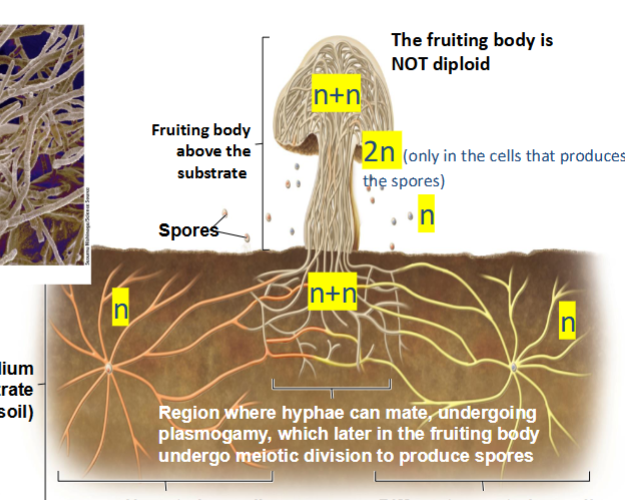
Describe the asexual and sexual life cycles in fungi
Asexual: involves dispersal of haploid spores
Sexual: involves fusion of the two mycelia and formation of a diploid zygote
Haplontic life cycle
What is the ploidy?
Basidiomycetes
34% of all fungi
Degrade lignin
Reproduce asexually and sexually
How is fungi used in our lives?
diet
yeasts
fermentation
mold
penicillin
infections
Lichen
Symbiosis betwene a fungus with either a cyanobacteria or an alga
How did fungi save the world?
Basideiomycete fungi digest lignin
allowed for the decay of wood a release of CO2 into atmosphere
reduced O2
Competition
-/-
Consumption
+/-
Commensalism
+/0
An interatcion in which one organism benefits and the other is unaffected
Mutaulism
+/+
An interaction in which both organisms benefit
Symbiosis
Any type of close, physical, long-term biological interaction between two species
endosymbiosis
inside, internal
Ectosymbiosis
(external) one lives on the surface
Parasitism
An interatcion in which one species benefits and the other is harmed, sometimes resulting in death
Facultative
Symbiosis occurs when the fitness of one partner in the relationship is not dependents of the presence of the other partner
Obligate
Occurs when the fitness of one partner in the relationship requires the presence of the other partner
Anatomy of Choanoflagellates
Flagellum
Microvilli
Cell Body
Nucleus
Phylum Porifera
The sponges
pump water equal to their own volume every five seconds
Retain carbon in the ecosystem
What is an animal? - 7
Eukaryotes
Multicellular
1 mobile stage
Internal digestion
Diplontic life cycle - sexual reproduction - 2n
Chemo-heterotrophs
Aerobic respiration
Cambrium Explosion - 5
the sudden rise in the diveristy of animal fossils
mobile borrowers, walkers & swimmers
macropredators
Swimming animals appeared
Shelled animals rapidly diversify
Characteristics of Ediacaran lifeforms, what was life like before the cambrium explosion? - 5
Sessile, slow moving
Feeds on microbial mat on ocean floor
Soft-bodied
No eyes or sesonry systems
filter feeders
Characteristics of Cambrium Lifeforms - 8, what was life like after cambrium explosion?
Active locomotion
Active predation
shells appear and diversify
Excoskeletons
bilateral symmetry
body segmentation
complex eyes
sensory systems
What sparked the cambrium explosion?
Change in enviromental conditions: more O2= more activity
Evolution of bilaterian developmental toolkit: Cephalization
changes in ecolosystem interactions: predation
Sturtian “snowball earth” hypothesis
Snowball earth thawed
increased erosion and weathering produced by the thaw
high concentration of minerals were washed into marine enviroments
Fostering massive and sustained algae growth
Hox Genes
Master control genes
determine what is turned on and off
Adaptive Radiation
Sudden appearance of related diverse species in the fossils record or inferred by phyolgenetic analysis
They are a monophyletic group
They speciated rapidly
They diversified ecologically into many niches
Anatomy
organisms phycial structure or from
Physiology
How the physical structures in an organism function
Form follows function
specialized forms lead to more efficient function for a given pressure
Advantagers of being larger
Anti-predator
energy reserves
locomotion speed / distance
better heat storage
Disadvantages of being larger
Greater energy needs
larger habitat size
harder to hide from predators
How does body size affect animal physiology?
Larger animals need more food than do smaller animals
Larger animals take longer to reproduce, develop, & mature
Larger animals tend to have longer lifespans
Smaller animals lose heat and water more rapidly
Adaptations that increase surface area
flattening
folding
branching
Surface Area/Volume
As size increases, surface area:volume ratio decreases
small animals have higher Basal Metabolic Rate than larger animals
Basil metabolic rate
the rate at which an animal consumes oxygen while at rest with an empty stomach, under normal tempatures and moisture conditions
Homeostasis
Stability in chemical and physical conditions within an organisms cells, tissues, and organs
Regulate
mainatin relatively constant internal conditions
Conform
organsism conform to their external enviroment
Sensor
a structure that senses some aspect of the external or internal environment
Intergrator
evaluates the incoming sensory information by comparing it to the set point and determining whether a response is necessary
effector
is any structure that helps restore the internal condition being monitored
Negative Feedback
Response is in opposite direction of the stimulus
Positive feedback
response is in the same direction as the stimulus
How does heat affect animal physiology?
Overheating can cause proteins to denature and cease functioning
High temperatures can lead to excessive water loss and dehydration
Low body temperatures can slow down enzyme function and energy production
Endotherm
produces adequate heat to warm its own tissue
ectrotherm
relies on heat gained from the enviorment
Homeotherms
keep their body tempature constant
Poikilotherms
allows their body tempature to chnage depending on enviromental conditions
Torpor
a temporary drop in body tempature
hibernation
a longer drop in body tempature
Key chordate characters
notocord
dorsal hollow nerve cord
pharynx and pharyngeal slits
post anal tail
notocord
provides flexible, structural support, and evolves into the vertebrae
2. a skeletal structure that can bend from side-to-side for swimming.
Dorsal hollow nerve cord
ultimately evolves into the spinal cord carrying nerves to and from the brain in vertebrates
pharynx and pharyngeal slits
gives rise to slits in fish
post anal tail
aids in swimming
musculoskeltal system devoted to locomotion
segmented muscles
makes swimming effective by allowing a awave of bending to travel from head down the body
countercurrent heat exchange
arterial blood warms venous blood as it flows back toward body
Early vertebrates had what? - 5
a distinct head and brain
sensory systems
respiratory system
chordate locomotor system
body skeleton system including jaw and vertebrate
Endycis
three or four layer cuticle which is periodiclly molted as the organism grows
Characteristics features of arthropod body plan - 5
jointed appendages
exoskeleton
compound eyes
open circulatory system
segmented body
Challeneges on land - 6
gravty
movement
radiation
dehydration
respiration
tempature
Major innovations of vertebrates on land
lungs
limbs
amniotic egg
Benefits of hard exoskeleton
provides support against gravity
reduces water loss
defends against UV
color helps thermoregulation
Trachel system
Anthropods, reduces water loss
gas exchange does not directly involve circulatory system
spermatophore
male drops a packet of sperm and female pick it up
Why are insects successfull?
Mouthparts: variety of feeding structures
Metamorphesis: can exploit two different enviorments,
Wings: increases mobility
coevolution and evolution of specialization: evolved specialized, coevelved relationships with angiosperms and herbivores and pollinators
proximate:
how it works? how it develops?
ultimate
why is it benificial? evolutionary history?
innate behavior
requires no learning
Evidence for why genes influence behavior
Single genes alter behavior
behavior (and morphology) can be altered rapidly by artifical selection
Populations with genetic and behavorial differences
Communication
A process in which a signal from one individual modifies the behavior of another individual
Accurate
Turthful, cooperative
Honest
signals quality during mate choice or aggressive threat displays, can’t be changed
Manipulation
dishonest communication that causes behavior in the reciever that reduces fitness, but it enhances sender fitness
sexual selection
natural selection on competition for mates
What makes a female a female?
females have big gametes
Intersexual selection
individuals of one sex prefer certain attributes or individuals of the other sex. Typically famale choice, mate choice
Intrasexual selection
Individuals of the same sex compete for access to mates of the other sex
typically male-male competition
competition between same sex individuals
Direct fights over females or resources
Mate guarding
sperm competition
Anisogamy
the evolution of sex differences in behavior and morphology
Sexual dimorphism
Refers to any trait that differs between males and females of the same species
Secondary sexual selection
characters found in one sex but not the other, and are not directly invoved in reproduction
Paternal care
feeding nestlings females benefit from males that help raise offspring
Hominin Characters - 9
bipedal posture
s-shaped spine
upright position of pelvis
legs positioned under body
adducted big toe
human-like hand proportions
big brow ridge
small canines
sexual dimorphism
Human (Homo) Characters - 9
long legs
short, weak arms
hairless
small face and jaw
big, protuberant nose
larger brain
less sexual dimorphism
small canines
large brow ridge
symbol markings
evidence of culture
Background extiction
average rate of extinction
occur when populations are reduced to zero because of
normal enviormental change
emerging disease
predation pressure
compeition with other species
mass extinction
rapid extinction of many diverse organisms around the world
results from extraordinary and sudden changes in the enviroment
The Great Dying
widespread volcanism by the siberian traps
sea of lava the area of the US
6th mass extinction
anthropocene
unofficial unit of geological time
human activity started to have a significant impact on the planets lcimate and ecosystems