W21 Objective Measurement of Eye Deviation
 Call Kai
 Learn
Learn Practice Test
 Spaced Repetition
 Match
Match Flashcards
 Knowt Play
1/16

There's no tags or description
Looks like no tags are added yet.
Name | Mastery | Learn | Test | Matching | Spaced | Call with Kai |
|---|
No analytics yet
Send a link to your students to track their progress
17 Terms
How is the presence of phoria (latent deviation) determined from the cover test?
Sensory fusion is prevented so that the fusional reflex cannot stimulate fusional vergence as the eye under the cover moves to the passive position
What are features of the cover test?
Routinely used, objective test, only test able to differentiate tropia from phoria
How do you set up the cover test?
Px wears distance correction if necessary
Px fixates on one letter above line of worst VA (use spotlight if VA is worse than 6/18)
Test px in primary gaze position
What is Stage 1 of the cover test?
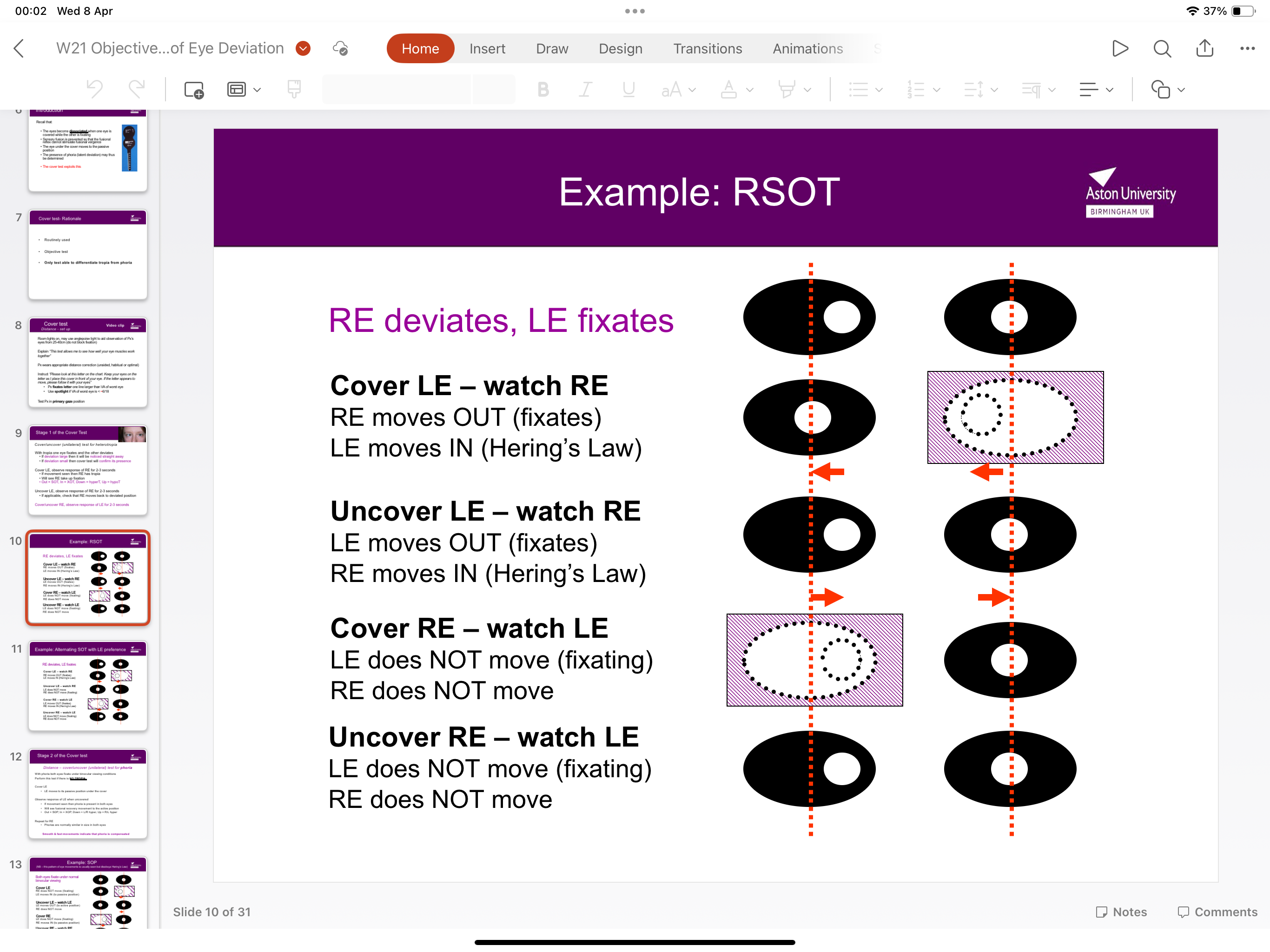
Cover/uncover unilateral test for heterotropia- covering the non-deviated eye prompts the deviated eye to move centrally
What is stage 2 of the cover test?
Cover/uncover test (unilateral) for phoria- perform this test if there is no tropia
What is seen in heterophoria?
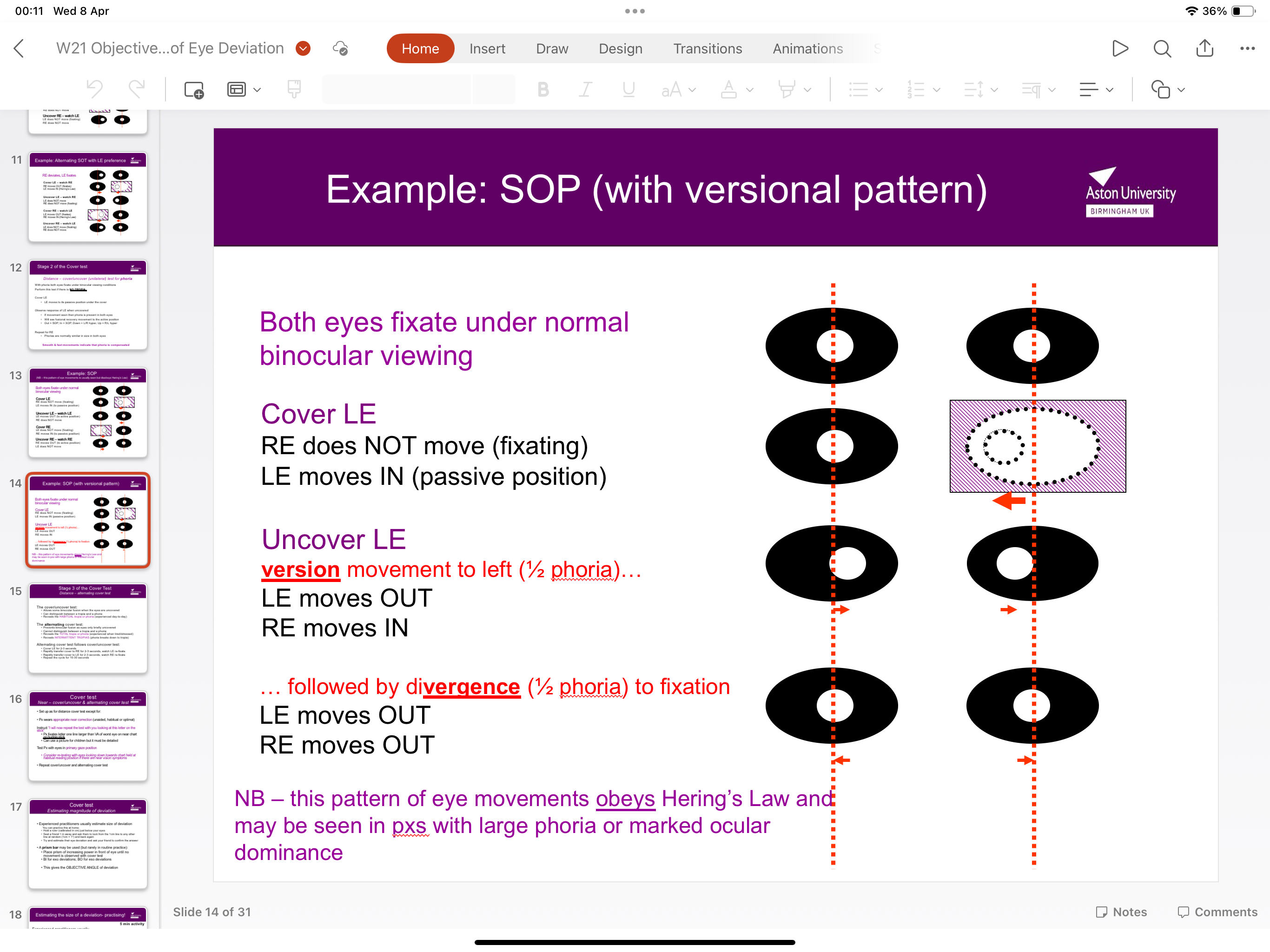
Herring’s law is disobeyed- both eyes fixate under normal binocular viewing but occluding prompts dissociation of covered eye to its passive position
What is a versional pattern?
When a big phoria is obeying Herring’s law- when the eye reverts to its original position, both eyes will wobble- a version movement (same) is seen, followed by vergence (different)
What is stage 3 of the cover test?
Alternating cover test- after covering one eye for a few secs, we rapidly swap and repeat, putting stress on the binocular vision system making tropia/phoria’s look larger/showing us the maximum size
How do we estimate magnitude of deviation when doing alternating cover test?
Place prism of increasing power in front of eye until no movement of eye is observed for cover test
Base in for exo deviations, base out for eso deviations
This gives us the objective angle of deviation
What value phoria’s are seen?
Phoria’s under 3 diopters are normally not visible to examiners- to pick up small deviations, ask px if target seems to move on alternating CT if no movement detected (NMD)
If yes, a small phoria (1-2) is present
SOP- against movement, XOP- with movement
What are objective tests done in young children who are unable to cooperate with prism test?
Bruckner test
Hirschberg test
Krimsky test
What is the method of the Bruckner test?
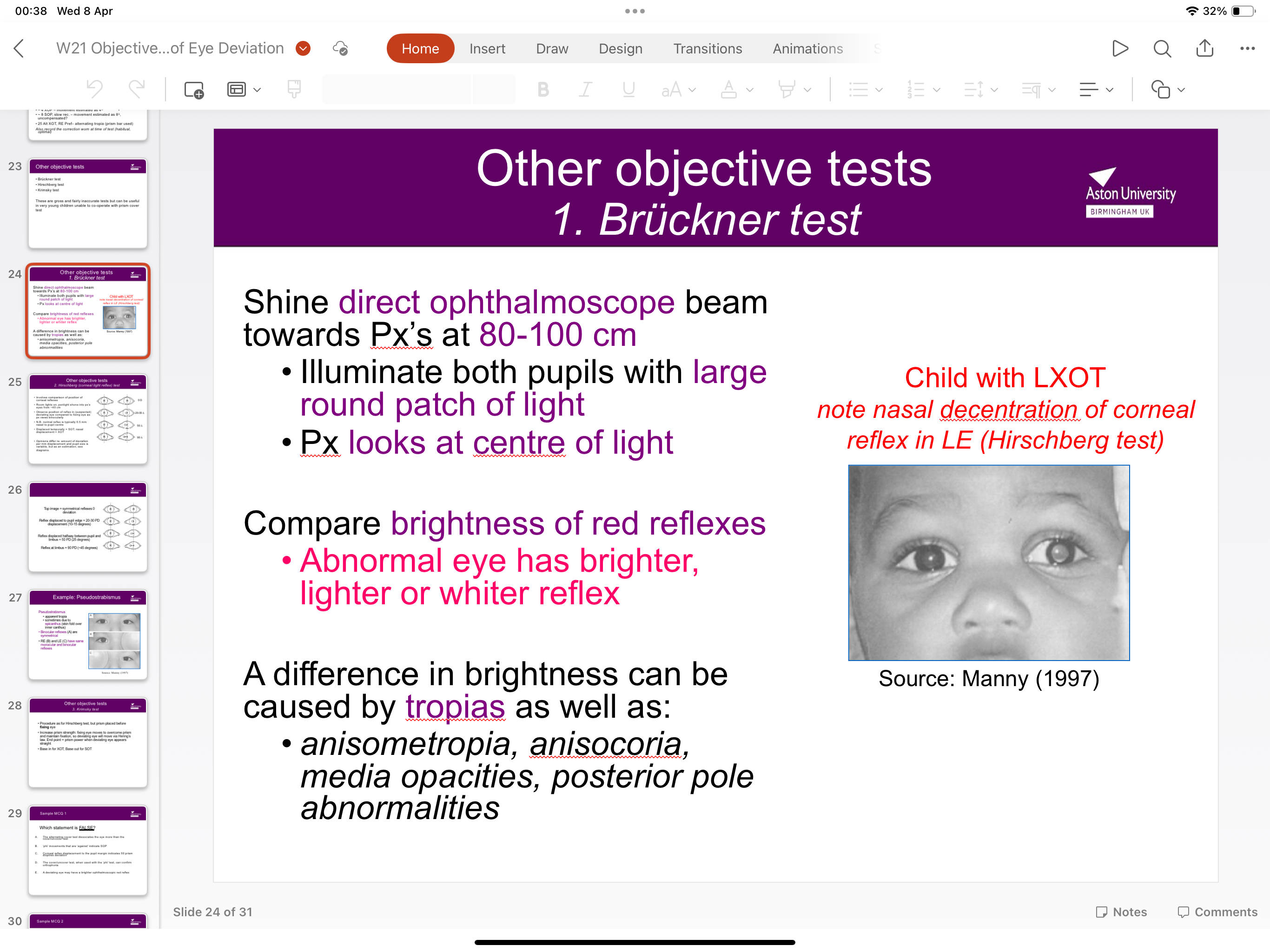
Shine direct ophthalmoscope 80-100cm from px eye
Illuminate both pupils with large patch of light as px focuses on centre of light
Compare brightness of red reflex- abnormal eye is brighter, lighter, or whiter
How is a difference in brightness caused in Bruckner’s test?
Anisometropia, media opacities, posterior pole abnormalities, aniscoria
What is the method of the Hirchsberg test (corneal light reflex test)?
Room lights on- shine pen torch at px eye at 40cm
Observe position of reflex in suspected deviated eye compared to fixated eye as px views binocularly
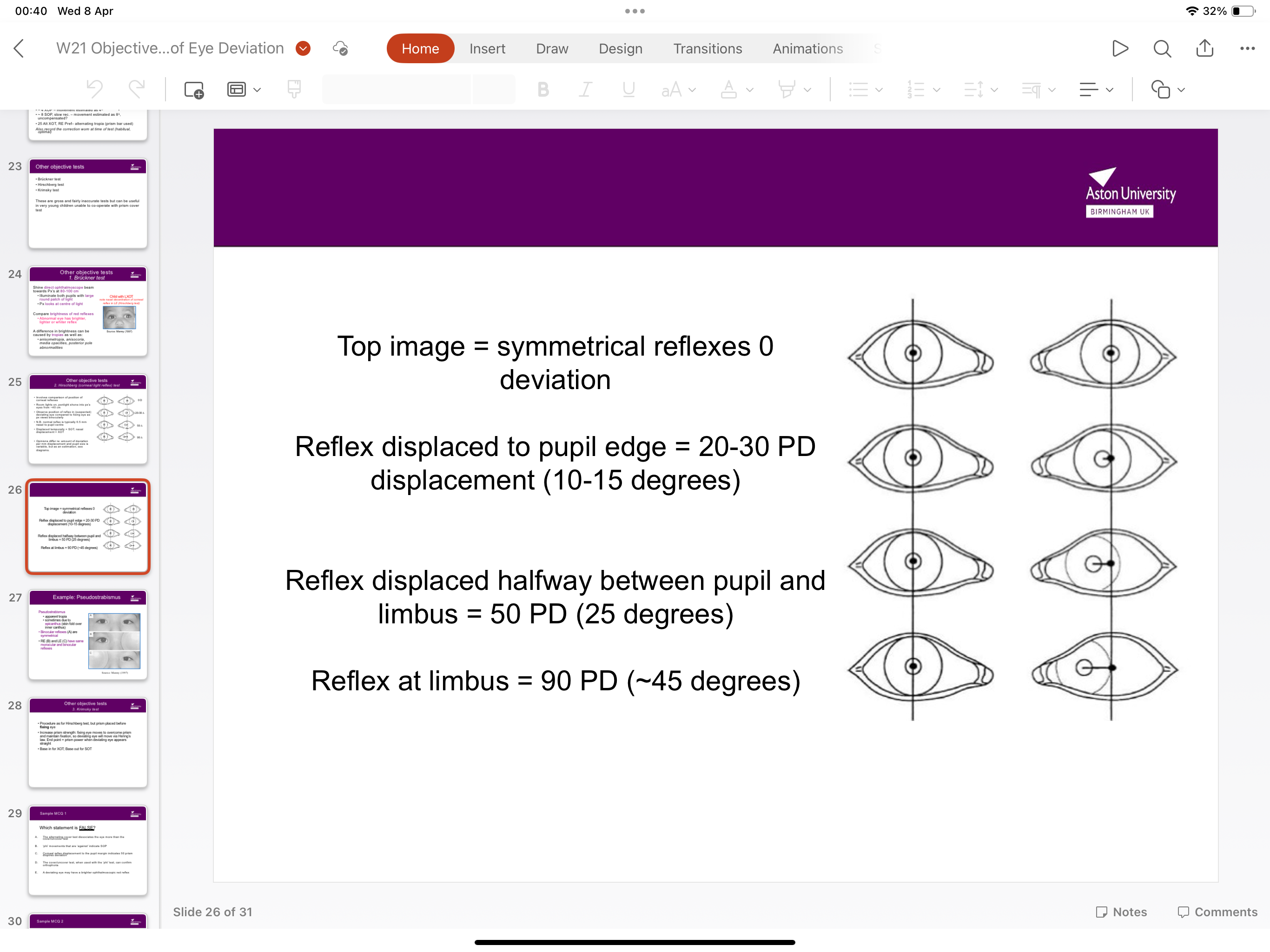
Displaced temporally (SOT), Nasal displacement (XOT)
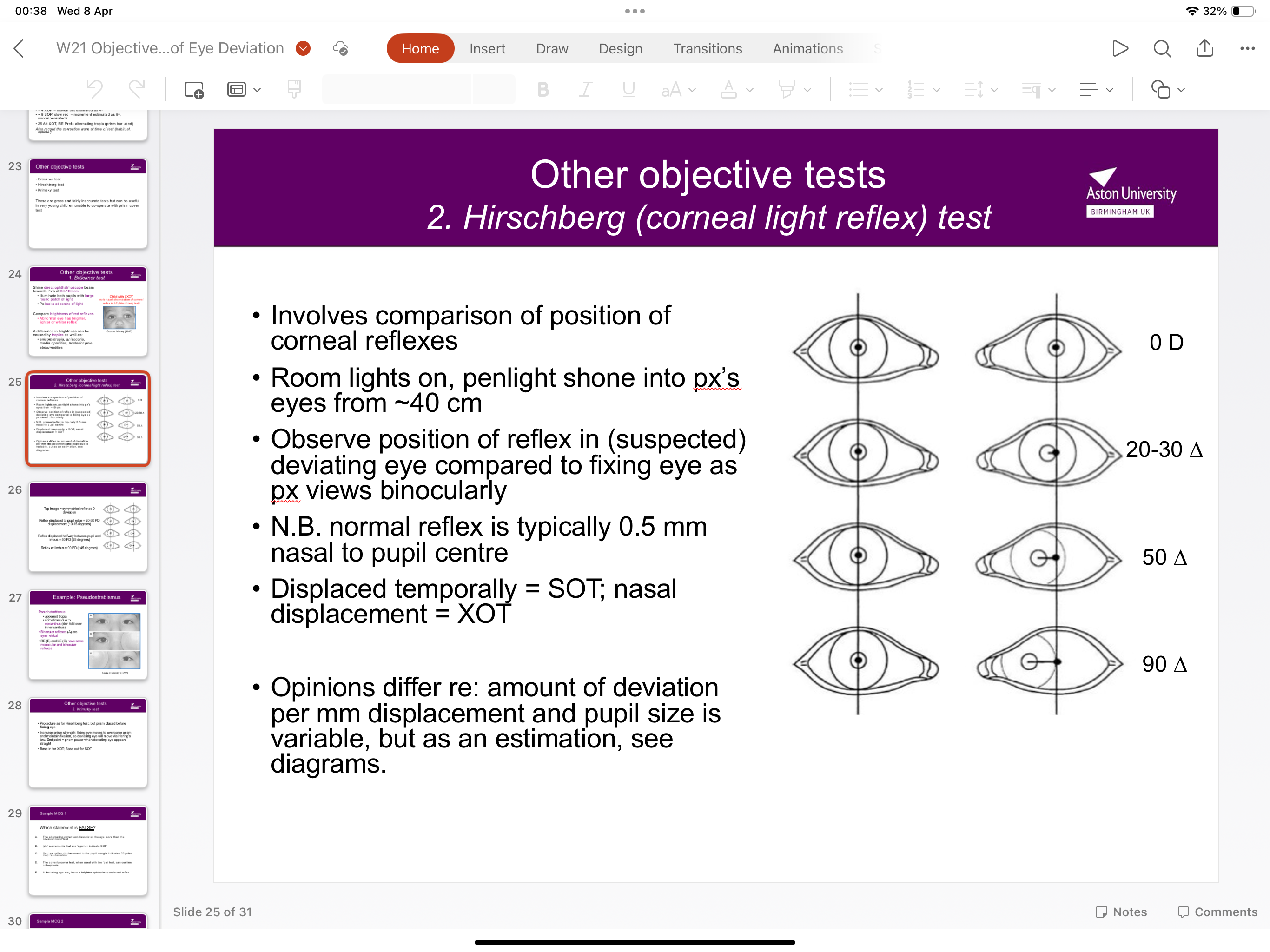
What are the results of the light corneal reflex test?
…
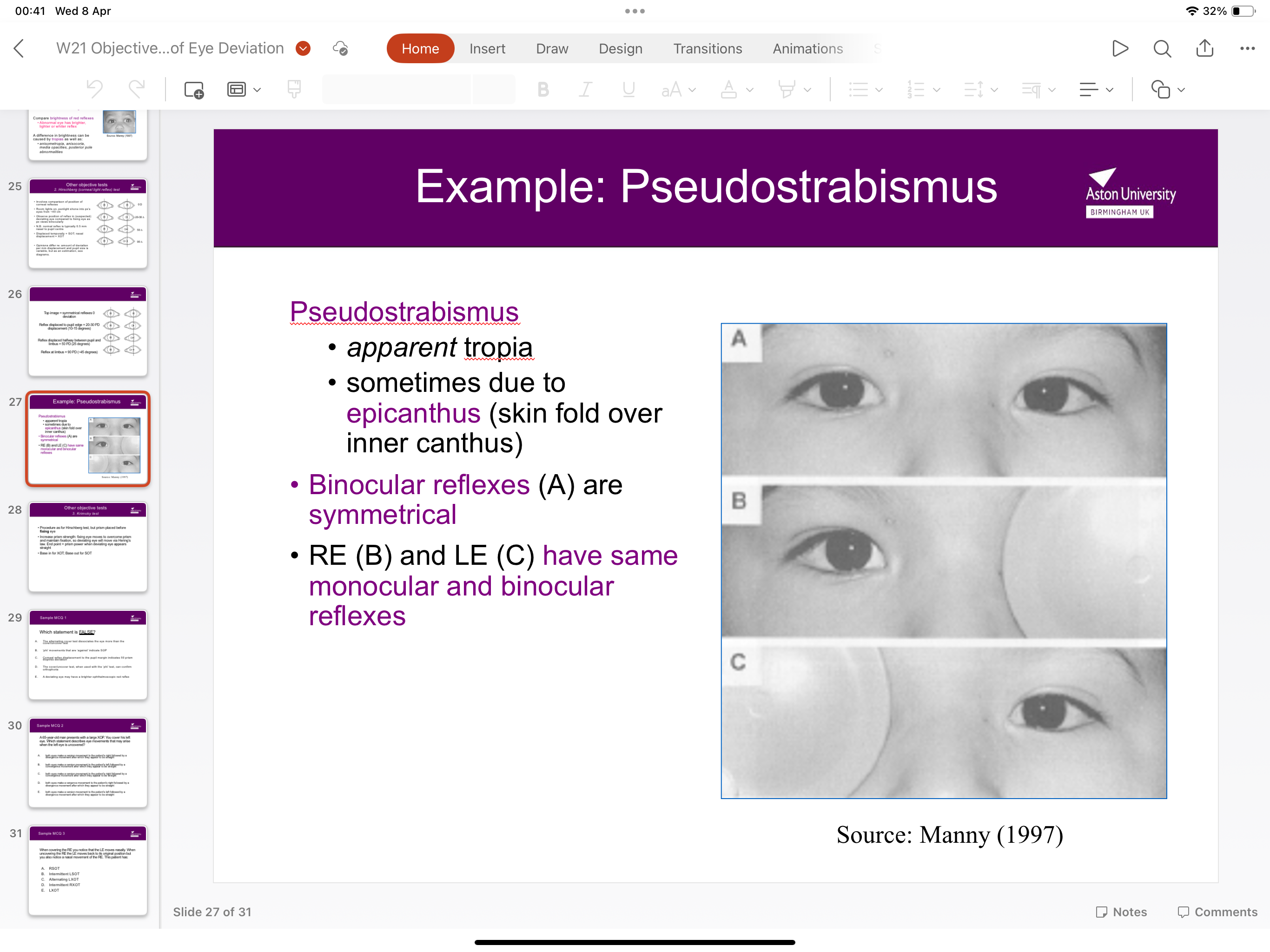
What is pseudostrabismus?
Apparent tropia- binocular reflexes are symmetrical as RE and LE have the same monocular and binocular reflexes
What is the Krimsky test?
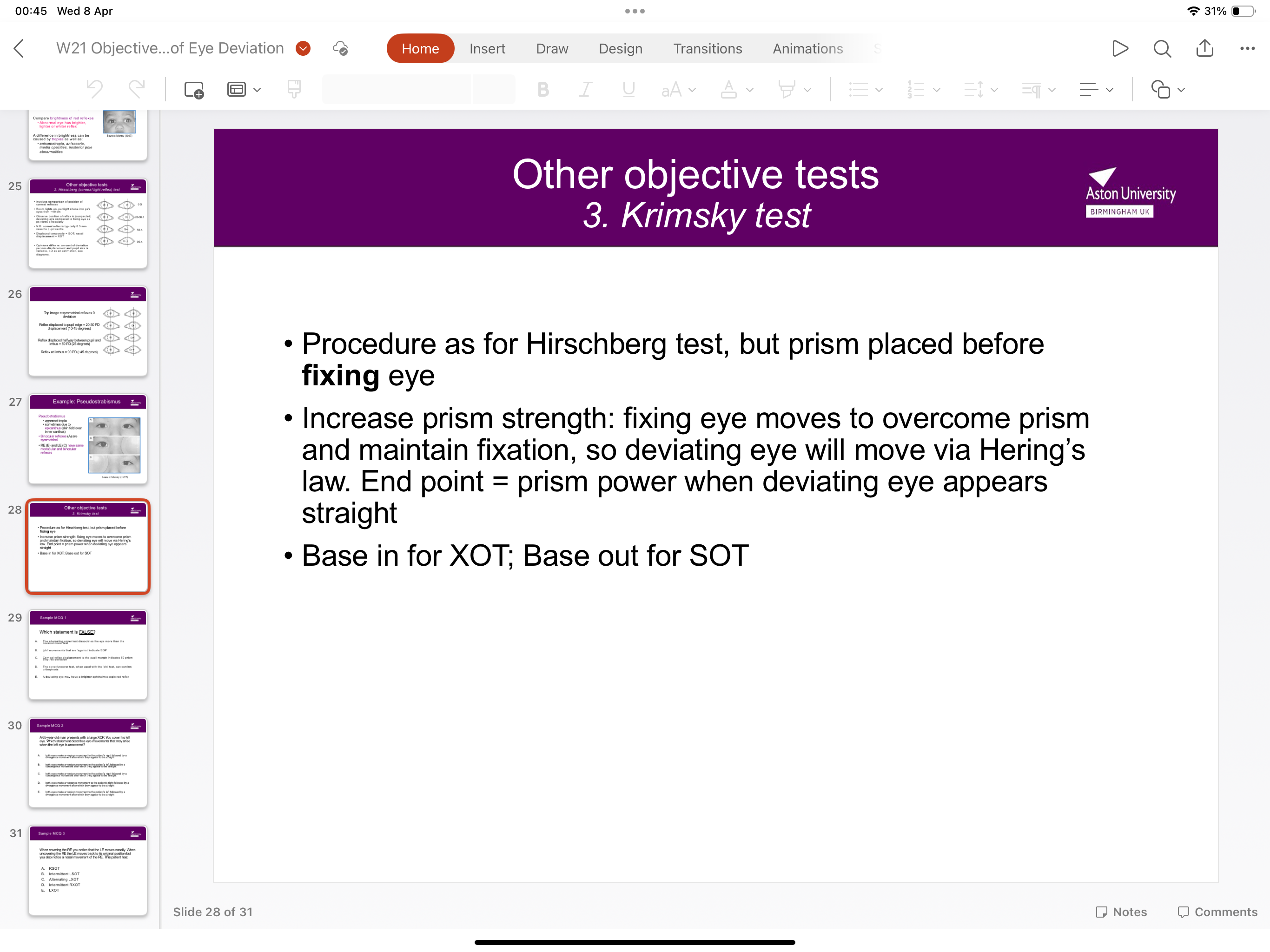
Same procedure for Hirschberg test but prism placed before fixing eye
Increasing prism strength makes the fixing eye move to maintain fixation so deviating eye will move via Herring’s law
End point is when the deviating eye appears straight
Base in for exotropia, base out of esotropia