Microbio: Module 2 - Bacterial Structures
 Call Kai
 Learn
Learn Practice Test
 Spaced Repetition
 Match
Match Flashcards
 Knowt Play
1/46

There's no tags or description
Looks like no tags are added yet.
Name | Mastery | Learn | Test | Matching | Spaced | Call with Kai |
|---|
No analytics yet
Send a link to your students to track their progress
47 Terms
Bacillus is rod shaped, coccus is spherical, spirilla is a rigid helix or wavy, spirochete is a flexible helix, and vibrio is curved
Distinguish between the various shapes and arrangements of bacterial cells
Gram positive has a thick peptidoglycan layer, stains purple, contains teichoic acids, no outer membranes, and is sensitive to penicillin; Gram negative has a thin peptidoglycan layer, stains pink/red, contains lipopolysaccharides, contains two membranes, and is not sensitive to penecillin
Compare and contrast Gram positive vs. Gram negative bacteria
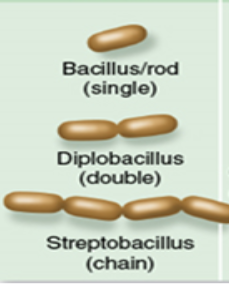
Bacillus
Rod-shaped
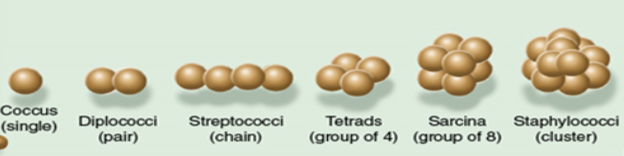
Coccus
Spherical

Spiral
Rigid helix or wavy

Spirochete
Flexible helix

Vibrio
Curved or comma shaped
capsule, cell wall, cell (outer) membrane
The bacterial envelope consists of the ______, _______, ______ _______
external
The envelope is ____ to cytoplasm
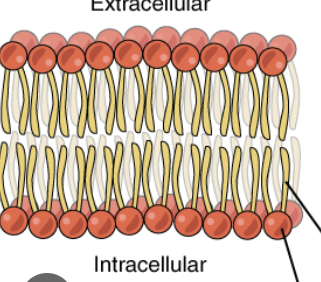
Plasma Membrane
Selectively permeable, has a phospholipid bilayer where there are hydrophilic heads and hydrophobic tails
Capsule
Can be easily removed by treating a culture with appropriate enzymes or by manipulating the presence of nutrients in the culture; is not integral to the life of the cell; the presence of one promotes virulence (the capacity to produce disease); also the presence of one interferes with phagocytosis
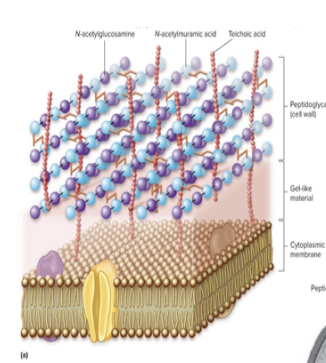
Gram Positive
Has a thick peptidoglycan layer, stains purple, contains teichoic acids but not lipopolysaccharide (LPS), no outer membrane, and is sensitive to penicillin (mostly)
Gram positive
Which contains teichoic acids? Gram positive or gram negative?
Gram positive
Which does not have an outer membrane? Gram positive or gram negative?
Gram positive
Which stains purple? Gram positive or gram negative?
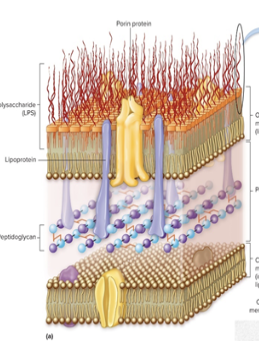
Gram Negative
Thin peptidoglycan layer, stain pink/red, contains lipopolysaccharides but not teichoic acids, contains two membranes, and is not sensitive to penicillin
Gram negative
Which has a thin peptidoglycan layer? Gram positive or gram negative?
Gram negative
Which stains pink? Gram positive or gram negative?
Gram negative
Which contains lipopolysaccharides? Gram positive or gram negative?
Gram positive
Which is sensitive to penicillin (mostly)? Gram positive or gram negative?
Cytoplasm
All of cell’s contents enclosed within plasma membrane; is the part of the cell enclosed within the plasma membrane and within it are numerous cellular constituents that function in cell growth and replication
Nucleoid
Region of cytoplasm containing chromosomal DNA; DNA rich area and is not defined by a membrane
Binary Fission
Bacteria replicate their DNA and divide by process of this
Plasmids
Small, circular, independently replicating pieces of dsDNA that are found in the cytoplasm of some bacteria and are independent of the chromosomal DNA
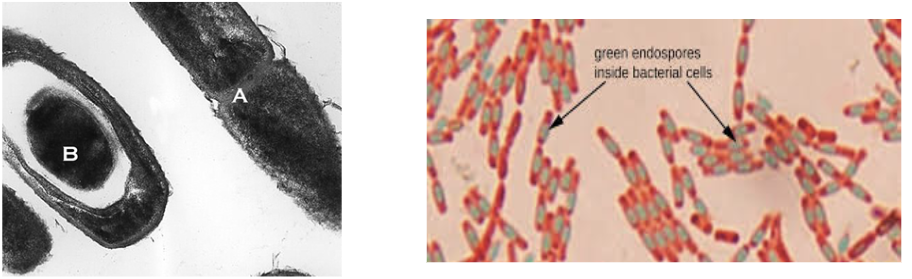
Endospore
Extremely hardy structures that are highly resistant to heat, drying, radiation, and a variety of chemical compounds
Flagella
Confer motility (movement), aids in chemotaxis, and has many arrangements (single, polar, bipolar, dispersed)
Chemotaxis
Movement towards attractant or away from repellant
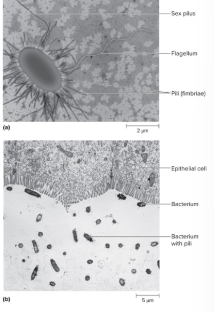
Pilli
Shorter, straighter, and thinner than flagella; function is adhesion to anchor for colonization of host cells and other surfaces; transmission of DNA by forming a bridge between donor and recipient bacterial cells
Colony
Visible masses of bacterial cells growing on an agar surface of solid bacteriological media, each presumably derived from a single cell or clone
Antigens
Components of microbes, usually protein structures, that are recognized as foreign by immune system and are targeted for destruction
Identify bacterial pathogens
What are metabolic tests used for?
To name bacteria, Genus should be capitalized and species should be lowercase and both must be italicized
Describe the correct way to name a bacterial species. What two taxonomical ranks are used and how are they written?
Capsule (slime layer), cell wall, and plasma membrane
What is the structure of the cell envelope?
Promote virulence
What is the function of the capsule for the cell envelope?
Confers structure and shape; provides tensile strength
What is the function of the cell wall for the cell envelope?
Controls selectively permeable movement of molecules into and out of the bacterium
What is the function of the plasma membrane for the cell envelope?
Nucleoid, plasmids, endospores, ribosome, chromosome, inclusion bodies
What is the structure of the cytoplasm?
DNA rich area not enclosed by a membrane
What is the function of the nucleoid in the cytoplasm?
Confers properties such as antibiotic resistance; encodes limited number of genes; expand genetic capability of host cell; transferable from donor to recipient bacteria
What is the function of plasmids in the cytoplasm?
Confers extreme resistance to environmental factors
What is the function of endospores in the cytoplasm?
Determinant of genetic traits
What is the function of chromosomes in the cytoplasm?
Double stranded DNA and is one or more circular or linear chromosomes
What is the structure of nucleoid?
Small and circular
What is the structure of plasmids?
Adhesion as an anchor for colonization of host cells and other surfaces and transmission of DNA via sex pilus by forming a bridge between donor and recipient bacterial cells
What is the function of pili?
Used for motility and aids in chemotaxis
What is the function of flagella?
Long, hollow, filament made of subunits called flagellin
What is the structure of flagella?
Prokaryotic ribosomes are present in the cytoplasm and are smaller than eukaryotic ribosomes; eukaryotic ribosomes are free in the cytoplasm and are present on the endoplasmic reticulum
Summarize the key differences between prokaryotic and eukaryotic ribosomes