Cog Sci of Smell - Neural Coding and Smell
 Call Kai
 Learn
Learn Practice Test
 Spaced Repetition
 Match
Match Flashcards
 Knowt Play
1/46

There's no tags or description
Looks like no tags are added yet.
Name | Mastery | Learn | Test | Matching | Spaced | Call with Kai |
|---|
No analytics yet
Send a link to your students to track their progress
47 Terms
Anything in the world can be represented using anything else
Basically: Anything that can be represented one way can be represented another way
such representations are alwsys imperfect
Anything that can be represented one way can be represented another way
You can represent ideas, concepts, etc
Examples of representations:
Words represent objects, actions, ideas, etc at some level of detail/abstraction
A physical photo, digital photo, and written name might all represent the same person
Neurons firing action potentials, releasing neurotransmitters, making certain connections, expressing certain proteins, etc. might all represent an object, action, ides, etc.
We don't know what neurons are doing to let use smell these certain things - nuerons firing action potentials
We don't know level of detail neurons operate on to make representation
Representations enable
storage of information and transformation of information via computation
Equations
Way of using logic (abstract, logical principles) to understand relationships
When you put x = “three cats" into an equation and solve it, you are transforming a representation of three cats
Your brain is a machine
understand the brain - means we can understand the mind better
Enables you to store and transform information about the world
We can study how it works to
A - understand minds better
B - figure out how to fix it when it breaks
Given that
Sensory organs feed information to the brain
Brain damage can disrupt sensory function
Sensory activity drives neural activity in the brain
You would expect that…
A particular sensory stimulus could evoke a particular pattern of neural activity in the brain that corresponds to a particular perception of the stimulus
Neural representation of sensory stimulus
The pattern of neural activity corresponding to a sensory stimulus
Neural encoding of a sensory stimulus
The process by which a sensory stimulus gets represented in the brain. This is highly variable across the senses.
Encoding
When it gets coded in brain
Diff codes - light, sound, smell
We have to figure out codes and understand how they are mutually intelligible so you can use all info you have in world at once
Encoding - the neurons that respond to a stimulus might represent
the location of a light in a visual field, or the frequency of a sound, or the identity of an odor. (simple examples)
Encoding - how the responding neurons act might represent
brightness of the light, or the intensity of the sound, or the concentration of the odor. (also simple examples)
One way to figure out - encoding
- May be firing a lot when stimulus is really bright or fire less when stimulus really bright - tell - Stronger odors induce more action potential, or inhibit action potential |
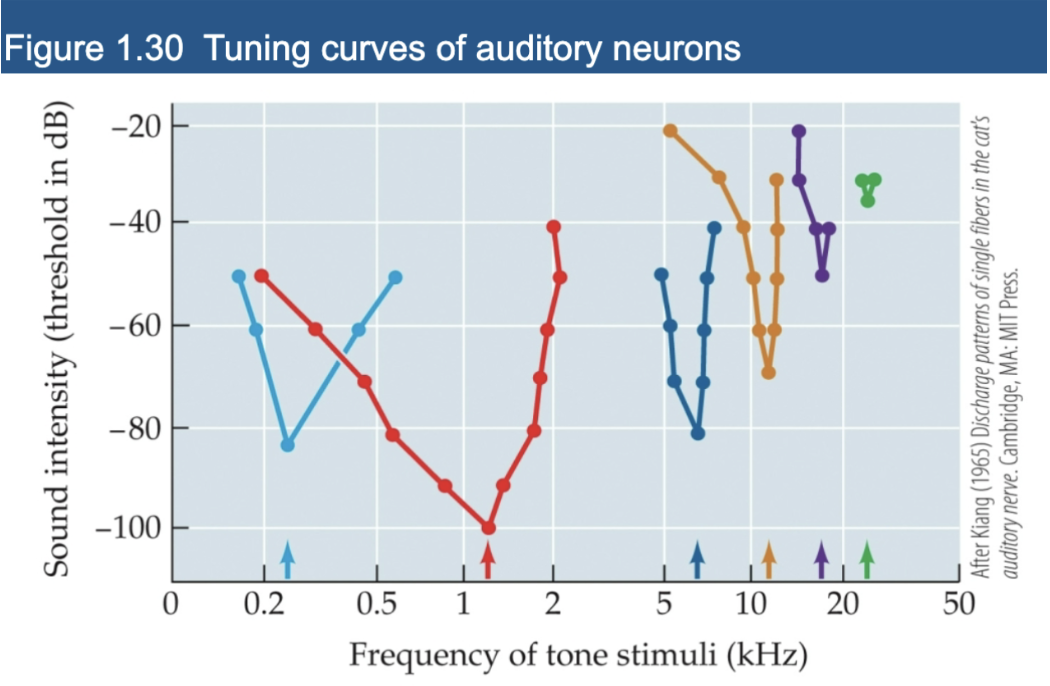
Tuning curves of auditory neurons
Neurons responding - sound intensity and frequency of stimuli
activity of neuron
Change tone of sound
see what happens/ which neurons respond
Asking - How loud does sound need to be to make a particular neuron respond?
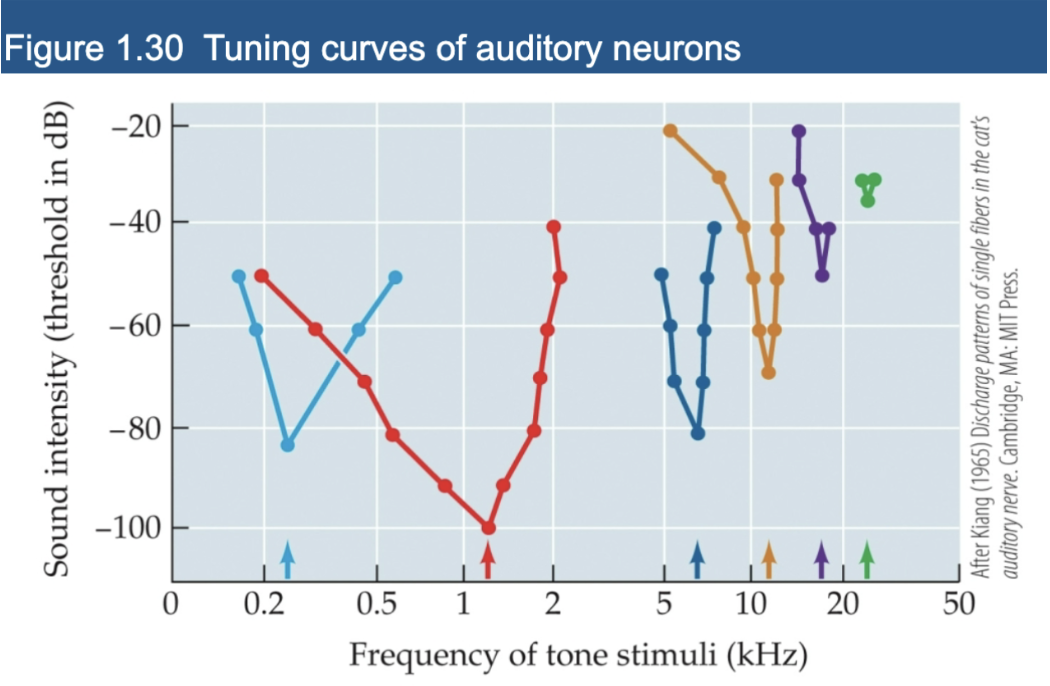
Activity of neuron
Change tone of sound
see what happens/ which neurons respond
Asking - How loud does sound need to be to make a particular neuron respond?
As they changes the frequency noticed they could use the quietest sound and still get response
Loudest sound it responded to: - 20 dB
This experiment demonstrates
The which and how of neural code
Even if you are only looking at one neuron - can know something ab frequency of sound out there - (also sound intensity)
Sound frequency - by watching the cells
- red - 1.3 kHz
- green - 22 kHz
- Yellow - 10.2 kHz
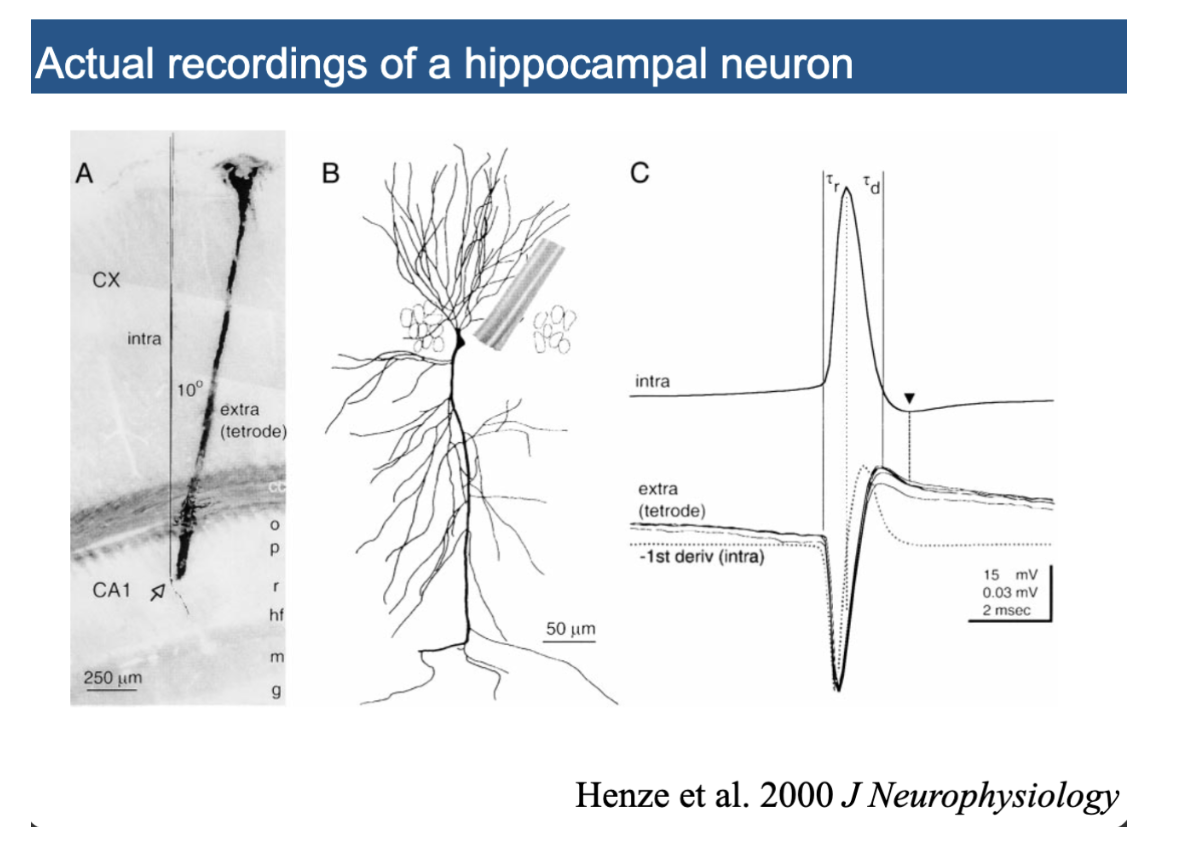
Actual recordings of hippocampal region - can watch across sounds to see as well
Neuron polarizes than depolarizes
Classic action potential - changes of voltages across membrane
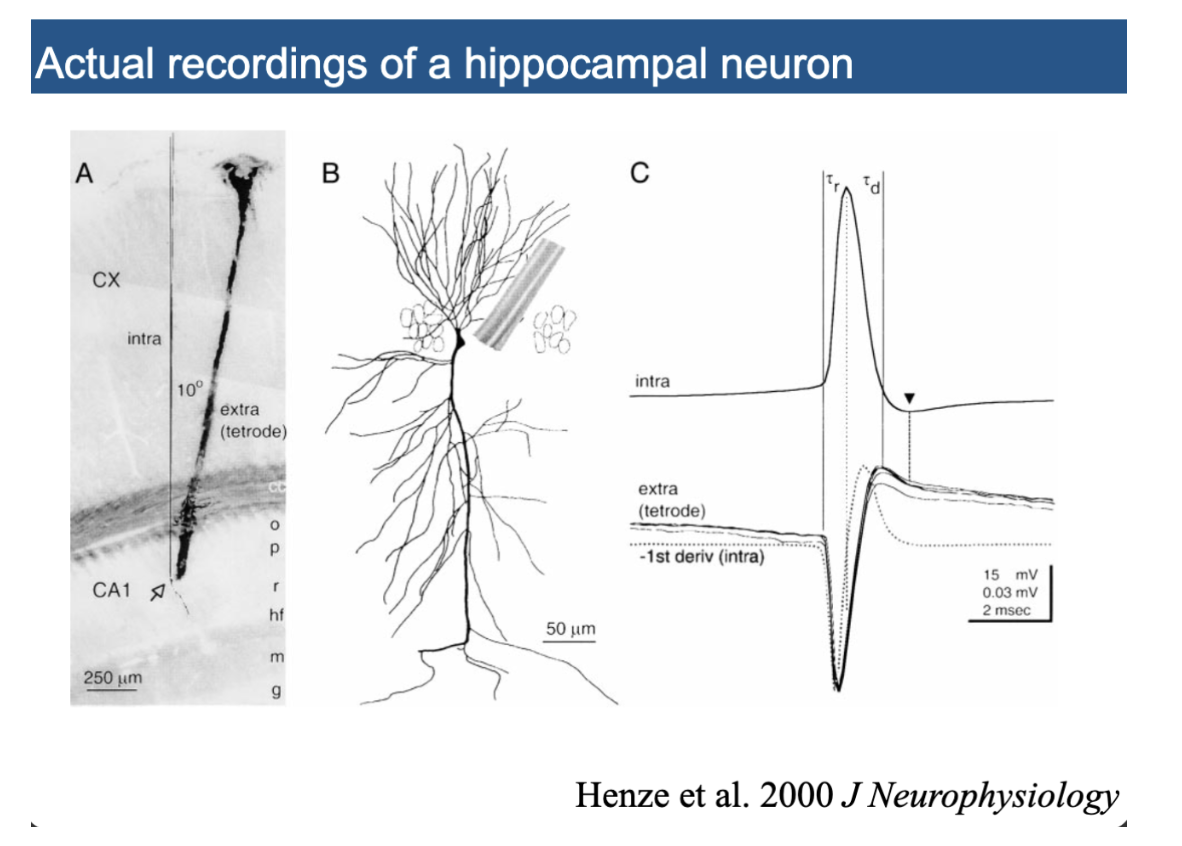
recordings of hippocampal region
What voltage looks like on the inside
Use Black dye to measure
Tree of neuron
Can record for intracellural electrode
If you poke a hole in neuron you kill it basically
Cant really do that if you want to measure it, so you keep cell on outside of brain - cut it open and have exposed
Tertrode
- type of electron recording used for electrophysiological recordings - assess neural activity
the difference between inside and outside of cell
polarization and hyperpolarization
2 problems - voltage - difference potential between 2 points
Electron on outside - doesn't see voltage on outside of brain
If the electron is only on the outside
0 between 2 places
Take wiring and screw in skull some place - Skull counted/defined as zero (earth)
Similar to plugs - one positive and one negative (+ and -) wires coming from there
Wire running from everything in your house to the earth - ground copper/cotton? wire in the middle -
Parts of electrodes recording the hippocampus - intercellular electrode
- inside cell to outside of cell
In cell - acc voltage change measured/percieved?
Parts of electrodes recording the hippocampus - extracellular electrode
End of electrode next to cell and skull/earth itself
Seeing ions leaving cell to go into neuron and returning when it repolarizes again - process of polarization
Outside of cell - watching current change which makes stuff happen in the cell
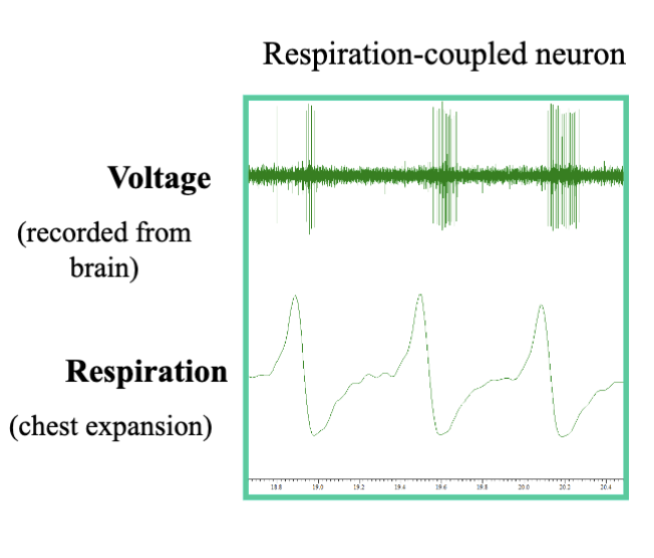
The actual recordings from the olfactory bulb show
olfactory system - the action potentials in olfactory system represent the change in a cell’s activity
Extracellular recordings - reference to skull and earth
green line - noise
each line/dot - an action potential
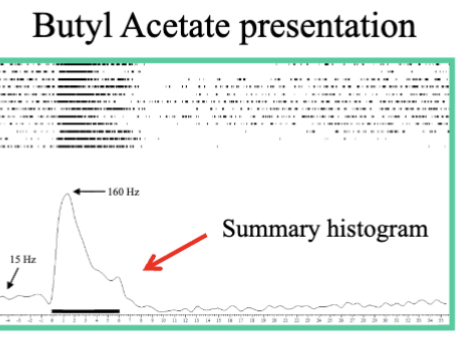
breakdown of Raster plot
Raster plot - each dot is a spike, each line is 1 odor presentation
Summary histogram - basically showing it graph style
each dot - spike
each line - 1 odor representation
Can look at how nose responds to smell to see what type of smell it is
Electron getting close to cell - start to hear tapping
Pick out individual spike sound
When odor gets presented to nose
Before odor presented - neuron tapping back and forth
Not when odor presented - goes brrr - fires lots of action potential
Cell also slows down even though odor is till there
Then it goes quiet slowly - to original rhythm and fire plate
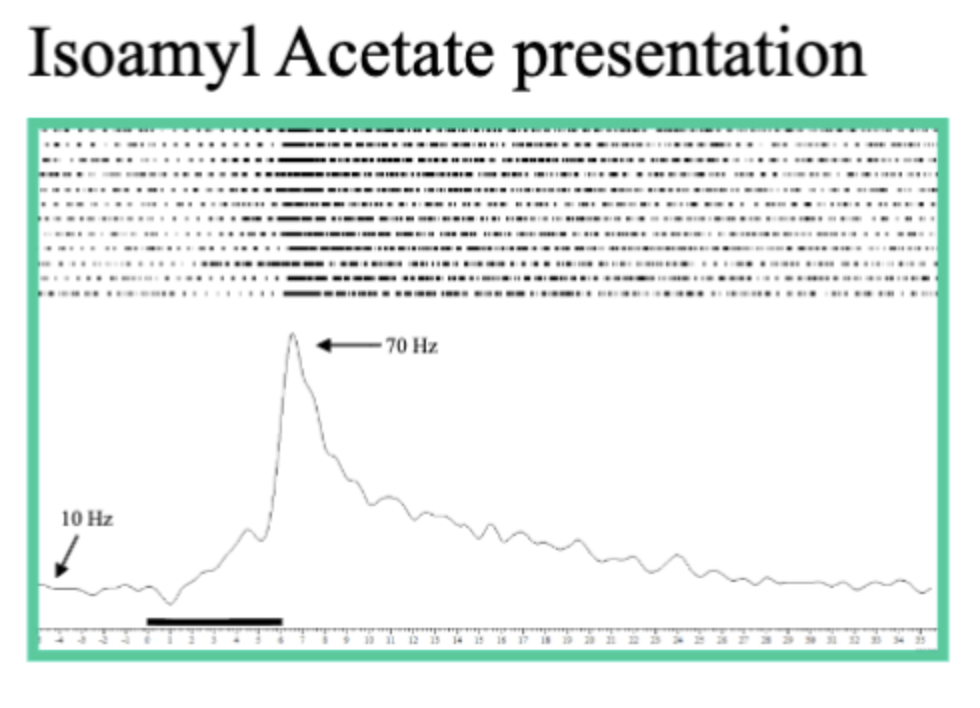
Neuron Pattern of activity - isoamyl acetate
When odor stops - increase in action potential
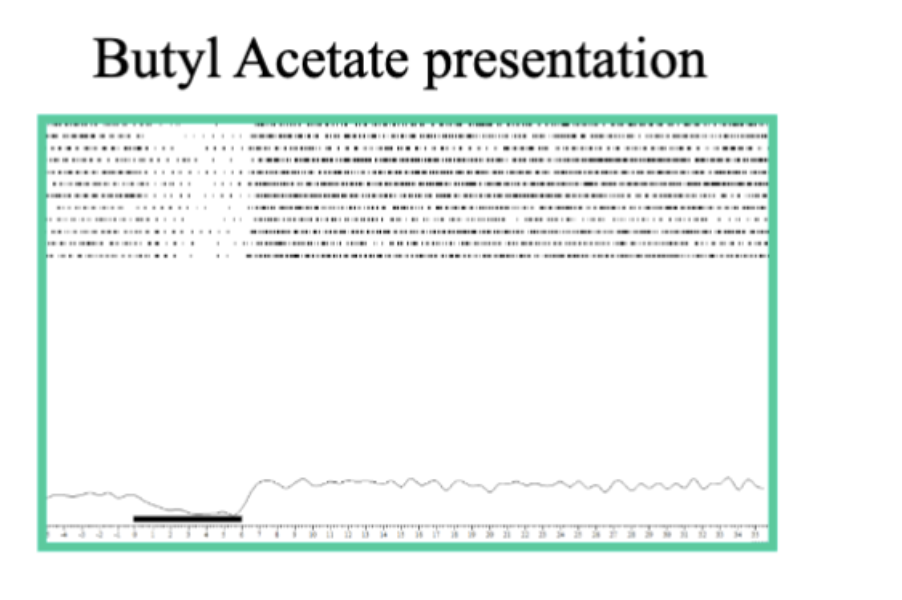
Neuron Pattern of activity - butyl acetate
fires, slows down, stops when it goes away
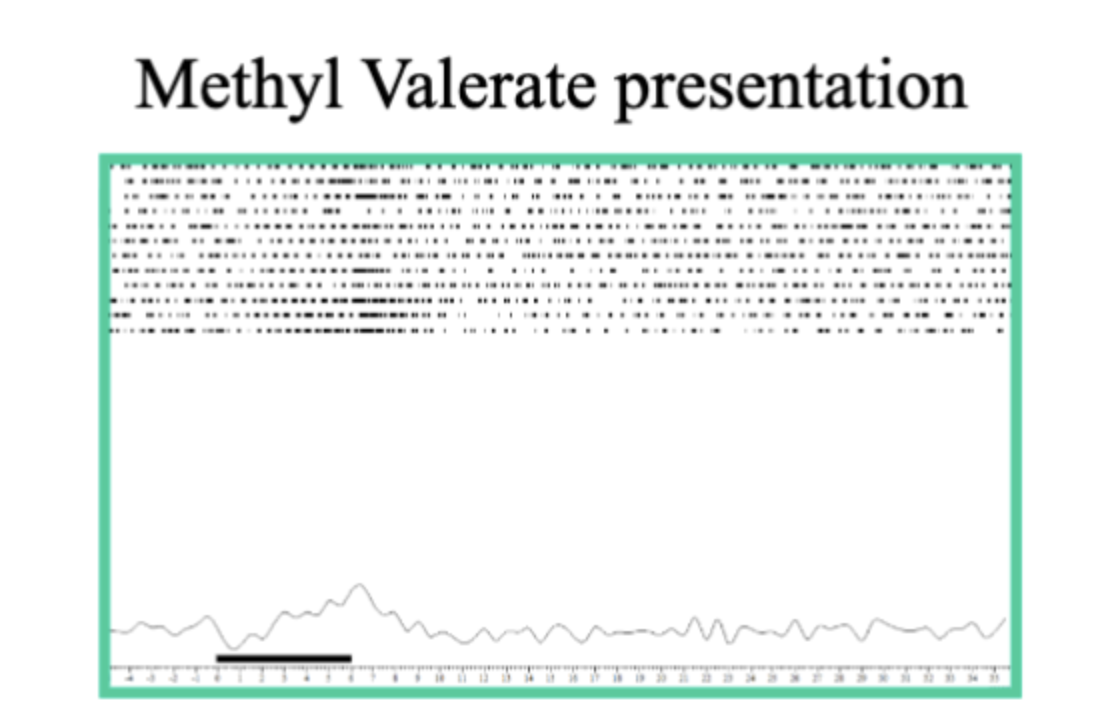
Neuron Pattern of activity - methyl valerate
Hesitate - fire a bunch
when methyl valerate goes away, stops
By looking at the olfactory bulb we could see how and when the smell was out there
Neuron does different things depending on odor, so by watching the neuron you could know what smell it was
Groups of neurons collectively firing code that actually means something - representation/code - Ex: Banana smell
Behaving differently before you present smell
Banana smell (Butyl acetate) when it started - neurons had maybe little bit of a pause
When it stopped = they always started firing like crazy - responds to ending of stimulus - though sometimes it started early = responses to absence
The brain does not know directly
what sensory stimulus is present
it only knows the pattern of neural activity the stimulus induces
This is what we use to decode the neural representation
The brain/mind decodes neural activity to
understand the world
Neuroscientists decode neural activity to
figure out how the representation works
if you can decode neural signal into sensory stimuli - (the sensory stimuli that evoked it)
the information about the stimuli must be present somehow
When you know neural activity but not reason for neural activity
Hit something with a baseball bat - could see size of dent after but not bat
Limitations of decoding approaches
The fact that scientists can decode info from neural activity doesn’t mean the brain is using that info or using it the same way
(The brain isn’t recoding from itself with electrodes or fMRI)
Not really learning about brain just engineering solution
Often we actually do the decoding using machine learning approaches that provide no insight into how the neurons are actually represent the world
In this case all we are proving is that the sensory information is “in there somewhere”
Which we already knew
Very rarely do we have
a system in which we can reasonably expect to be observing every neuron involved in a neural representation
or
to know every possible stimulus the brain could be representing.
Essentially all experiments are based on
partial codes for things we already knew (what stimulus we presented). It will be amazing when we start finding things in the code that we didn’t already know were there
Different physical aspects of stimulus represented separately - using different coding mechanisms or different neurons
Ex: Some neurons represent respiratory cycle in odor
- others only representing things recorded from brain
parallel processing in neurons
multiple aspects of stimulus are being considered at once
(instead of one after another, which would be slower)
specialization in neurons
different circuits or coding mechanisms are optimized for different things
(ex: separate processing of shape and movement in the visual system)
analysis of stimulus in neurons
the brain decomposes the stimulus into its constituent parts
Literally! Sounds and images get decomposed in the mathematical sense into their frequency and phase information via Fourier analysis
Different physical aspects of stimulus represented separately and using diff coding mechanisms
Parallel processing
Visual and spatial
Something is coming at you and you can get out of way before you know what it is
Speed, accuracy - emotion, certain smells - fine tune to needs and experience
What is being represented by odoes
The chemical structure of the stimulus
Compute something - what fractions of odor molecules respond that did certain things
The response of odor receptors
Timing of breathing- slow stimulus- more intense , Fast stimulus - less intense
Know both of those things - you can know what the stimulus is
The intensity of the stimulus (measured or computed?)
The chemical statistics of the world
Ex: odor molecules that are common - brain doesn't pay attention to - your house
The implications for the organism?
Implications - danger, attraction, spoiled food
Expected odors given the spatiotemporal context?
The difference between expected odors and actual odors
Stimulus timing? Sniffing?
Timing of access to stimulus - determined by stimulus but also by you
How to discriminate possibilities of odor representations
Decoding
Identifying odor chemistry - with which cell is responding, concentration, etc.
Odor information that narrows down possibilities
Experimental manipulation of representations