Unit 3 - Chromosomes
 Note
 Call Kai
 Learn
 Practice Test
 Spaced Repetition
 Match
 Flashcards
 Knowt Play
1/29

There's no tags or description
Looks like no tags are added yet.
30 Terms
cytoplasm
The cytoplasm is the jelly-like substance within a cell that surrounds the nucleus and contains organelles, where many cellular processes occur.
eukaryotic cells
The eukaryotes (/juːˈkærioʊts, -əts/)[3] are cellular organismsof the domain Eukaryota or Eukarya, which have a distinct cell nucleus (formed by a nuclear membrane), membrane-bound organelles and organization supported by a cytoskeleton. Extant eukaryotes are traditionally grouped into four kingdoms: animals, plants, fungi and protists.
nuclear membrane
made up of two lipid bilayer membranes that in eukaryotic cells surround the nucleus, which encloses the genetic material.
nucleic acids
They carry information in cells and make up genetic material. The two main classes of nucleic acids are deoxyribonucleic acid (DNA) and ribonucleic acid (RNA).

DNA (deoxyribonucleic acid)
A polymer composed of two polynucleotide chains that coil around each other to form a double helix. The polymer carries genetic instructions for the development, functioning, growth and reproduction of all known organisms and many viruses.

chromatin
complex of DNA and protein responsible for condensing and packaging chromosomal DNA. Chromatin is found in both bacterial and eukaryotic cells.

histones

proteins that act as spools that the DNA wraps around.
chromosome
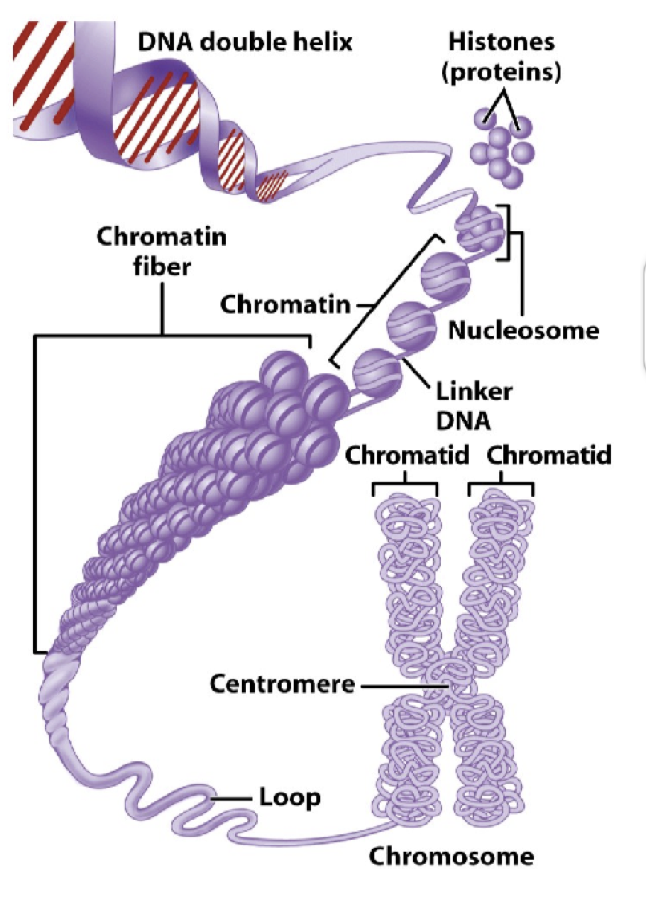
a package of DNA containing part of or all of the genetic material of an organism.
chromatids

When chromosomes duplicate during cell division, they form an X-shaped structure consisting of two identical chromatids. A chromatid can only be called such when still attached to its “sister”. When not attached, it’s just a chromosome.
centromere

joins chromatids
genes
Chromosomes are broken up into hundreds of segments called genes that code for specific traits.
locus (plur. -loci)
The location of where a gene is found on a chromosome is called the locus (plur. -loci).
alleles
different versions of alleles
rhesus factor
is a type of protein found on red blood cells. The surface of red blood cells contains markers that the immune system can recognize. If your blood cells have this protein, you are Rh positive.
telomeres
Chromosomes have specific non-coding sequences at either end known as telomeres. They protect the actual coding sequences of the chromosome from degradation. They’re are longer in children than adults and are shortened with each cell division. This is likely the reason why cloned animals are never quite as healthy as the original.
diploid
A cell that has two copies of each chromosome (ie., pairs) is said to be diploid (2n)

haploid
Some cells contain only one copy of each chromosome and are called haploid (n).

Does the number of chromosomes indicate organism complexity?
No, the number of chromosomes in an organism's genome does not relate to the complexity of the organism
what’s the difference between DNA, genes, and chromosomes?
DNA - an instruction manual for our body.
Genes - a section of DNA that contains a specific instruction.
Chromosomes - formed of long strands of DNA wrapped tightly around proteins, almost like coiled-up thread.
somatic cells
Cells in the body other than sperm and egg cells (which are called germ cells). In humans, somatic cells are diploid.
what does ‘n’ mean in the context of this unit?
N refers to the number of sets of chromosomes in a cell. For haploid cells "n" stands for 1n which have one set of chromosomes.
gametes
reproductive cell, or s-ex cell, is a haploid cell that fuses with another haploid cell during fertilization in organisms that reproduce s-exually. Female gametes are called ova or egg cells, and male gametes are called sperm.
polyploid
Some organisms are polyploid, where they possess more than two complete sets of chromosomes in their cells. For example, some plants are triploid (3n), tetraploid (4n) or even octoploid (8n).

Why do different organisms have different and seemingly unrelated numbers of chromosomes?
mistakes happen, and DNA and different kinds of organisms have responded to those mistakes in different ways.
random fusion
DNA sometimes gets damaged, which leaves strands of DNA dangling from their chromosomes.
Special repair proteins in the cell recognize the damage and diligently reconnect those strands,
Sometimes they connect the wrong ones together, and two chromosomes become fused.
It decreases the total number of chromosomes in the cell.
It doesn’t mean that any genetic information is lost; it’s just spooled up in fewer packages.
how do organisms gain extra chromosomes?
During meiosis, each chromosome in the parent cell is copied in the original, and its copies are pulled apart into separate sperm or egg cells.
Sometimes, the chromosomes and their copies don’t pull apart, and they end up both being drawn into the sex cell.
This doesn’t mean that any additional genetic information is there, just an extra set of copies.
offspring is produced
organsism like plants who self-fertilize also have this
germ cells
Germ cells produce gametes and are the only cells that can undergo meiosis as well as mitosis.
autosomes
chromosome pairs are similar-looking, but not identical, homologous chromosomes known as autosomes
sex chromosomes
Chromosome 23 in humans determines the sex of an individual (ie., X and Y). These are called sex chromosomes. XX = female. XY = male.
karyotype
Chromosomes can be identified by noting banding patterns, position of the centromeres and chromatid length. These features enable autosomes and sex chromosomes to be matched to a microscopic image of them. Such an image of the chromosomes that an individual possesses is called a karyotype and is often used in identifying chromosomal disorders.