Unit 3 - Chromosomes
#cb2157
#e5f6f6
#4f9494
Introduction
Intro
As a cell grows in size, the volume of its cytoplasm increases at a faster rate than the surface of its cellular membrane. In other words, if a cell continued to grow, its membrane would be too small to meet its metabolic needs. It stands to reason then that cells must stop growing once they reach a size. New growth must come from the addition of new cells, but how is this accomplished?
History
Until the mid-1800s, most scientists accepted that living organisms could arise from non-living matter. This was called the theory of spontaneous generation. In 1855, Rudolph Virchow became the first scientist to publish the conclusion that new cells only arise from the division of other cells. In 1879, Walther Flemming used synthetic clothing dye to stain a piece of animal tissue. The stain was picked up by a substance in the nucleus (ie., genetic material). After several years of observation, he offered the first accurate description of the life cycle of cells and the process by which they divide.
Organization of Genetic Material
Intro
All eukaryotic cells have a true nucleus bound by a nuclear membrane. This is where the cell’s genetic material is found, and it’s composed of nucleic acids called DNA (deoxyribonucleic acid), which govern the processes of heredity in organisms.

Nucleic Acids
Large biomolecules that are crucial in all cells and viruses. They are composed of nucleotides, which are the monomer components: a 5-carbon sugar, a phosphate group, and a nitrogenous base. The two main classes of nucleic acids are deoxyribonucleic acid (DNA) and ribonucleic acid (RNA). If the sugar is ribose, the polymer is RNA; if the sugar is deoxyribose, a variant of ribose, the polymer is DNA. They carry information in cells and make up genetic material. These acids are very common in all living things, where they create, encode, and store information in every living cell of every life form on Earth. In turn, they send and express that information inside and outside the cell nucleus.

Chromatin
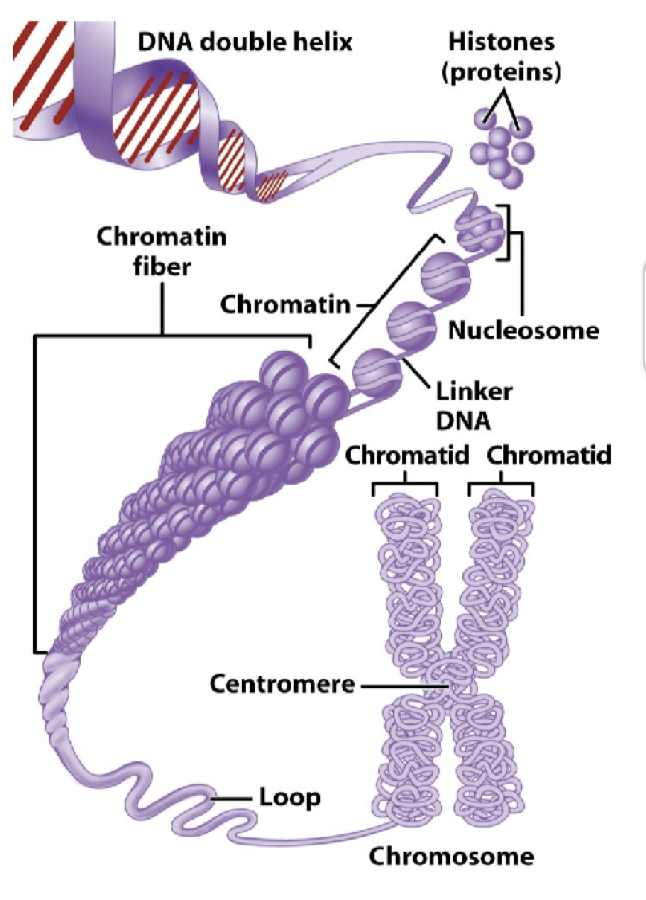
When the cell is not dividing, genetic material forms long, thin and intertwined strands called chromatin. A chief component of chromatin is histones, which are proteins that act as spools that the DNA wraps around. Without histones, each human chromosome would be roughly 1.9 meters in length.
Chromosomes
Intro
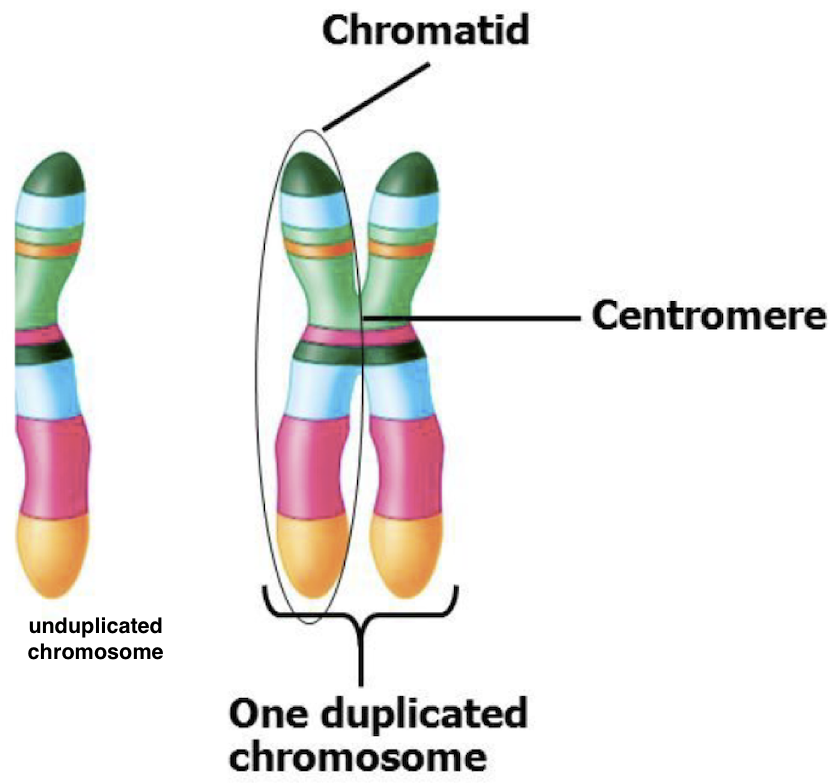
During cell division, chromatin condenses into thick, shortened strands called chromosomes. When chromosomes duplicate during cell division, they form an X-shaped structure consisting of two identical chromatids. These chromatids are joined together by a centromere. A chromatid can only be called such when still attached to its “sister”. When not attached, it’s just a chromosome. However, for whatever reason, chromosomes are most often depicted in books and on the internet in their chromatid form.
Genes and Alleles
Chromosomes are broken up into hundreds of segments called genes that code for specific traits. The location of where a gene is found on a chromosome is called the locus (plur. -loci). Although pairs of homologous chromosomes carry the same genes, they have different versions of them called alleles. For example, chromosome 9 has the gene for blood type. Both homologous chromosomes have the blood typing gene at the same locus, but they may have different alleles (either A, B or O) of the blood typing gene. Combinations of different alleles at this locus will lead to one of the four human blood types: A, B, AB or O. Be aware that the rhesus factor (ie., positive or negative blood types) is controlled by genes on chromosome 1.
Telomeres
Chromosomes have specific non-coding sequences at either end known as telomeres. It’s widely believed they perform the same function as the aglets on your shoelaces. In this case, they protect the actual coding sequences of the chromosome from degradation. Telomeres are longer in children than adults and are shortened with each cell division. This is likely the reason why cloned animals are never quite as healthy as the original.
Diploid, Haploid, and Polyploid
A cell that has two copies of each chromosome (ie., pairs) is said to be diploid (2n). Some cells contain only one copy of each chromosome and are called haploid (n). In humans, 2n = 46 chromosomes (ie., somatic cells) & n = 23 chromosomes (i.e., gametes, reproductive cells such as sperm and eggs). In ants, 2n = 2. In gorillas, 2n = 48. In shrimp, 2n = 254. Some organisms are polyploid, where they possess more than two complete sets of chromosomes in their cells. For example, some plants are triploid (3n), tetraploid (4n) or even octoploid (8n).

Human Chromosomes

Human somatic (ie., body) cells have 46 chromosomes arranged into 23 pairs (ie., one from each parent): 22 of these pairs are similar-looking, but not identical, homologous chromosomes known as autosomes. They are numbered 1 through 22. The remaining pair are the ones that determine the sex of an individual (ie., X and Y). These are called sex chromosomes. XX = female. XY = male. These chromosomes can be identified by noting banding patterns, position of the centromeres and chromatid length. These features enable autosomes and sex chromosomes to be matched to a microscopic image of them. Such an image of the chromosomes that an individual possesses is called a karyotype and is often used in identifying chromosomal disorders.
Why do Plants Have More Chromosomes than Us?
Intro
Why do different organisms have different and seemingly unrelated numbers of chromosomes? Like how did a species of ant end up with only two chromosomes, while a species of fern has more than 1,000? Why do we have 46, and the chimps, our closest genetic relatives, have 48? The short answer is mistakes happen, and in this case DNA and different kinds of organisms have responded to those mistakes in different ways.
Random Fusion
DNA sometimes gets damaged, which leaves strands of DNA dangling from their chromosomes. When this happens, special repair proteins in the cell recognize the damage and industriously reconnect those strands, but sometimes they connect the wrong ones together, and two chromosomes become fused. This is known as random fusion, which decreases the total number of chromosomes in the cell. It doesn’t mean that any genetic information is lost; it’s just spooled up in fewer packages. For example, the chromosomes of humans and chimps are nearly the same except for a human chromosome number two, which looks remarkably like two chimp chromosomes that got stuck together.
Extra Chromosomes
Another kind of mistake can happen during the type of cell division that makes sex cells, called meiosis. Typically, during meiosis, each chromosome in the parent cell is copied in the original, and its copies are pulled apart into separate sperm or egg cells. Sometimes, the chromosomes and their copies don’t pull apart, and they end up both getting drawn into the sex cell. This doesn’t mean that any additional genetic information is there, just an extra set of copies. Now you take a couple of these sperm or eggs with extra chromosomes and make a baby with them; usually, they’re still viable, and so offspring have more chromosomes than their parent. Organisms like plants that can self-fertilize wind up with extra chromosomes because of this; others have had this happen a lot because they’ve been around for a really long time, like ferns.