[PHARMACOGNOSY] Alkaloids
 Call Kai
 Learn
Learn Practice Test
 Spaced Repetition
 Match
Match Flashcards
 Knowt Play
1/182

There's no tags or description
Looks like no tags are added yet.
Name | Mastery | Learn | Test | Matching | Spaced | Call with Kai |
|---|
No analytics yet
Send a link to your students to track their progress
183 Terms
e. All alkaloids are basic
NOT ALL alkaloids are basic.
True about alkaloids except:
a. Bitter
b. They contain nitrogen usually in heterocyclic ring
c. Most of them are physiologically active even in small amounts
d. Almost all are poisonous
e. All alkaloids are basic
f. None
d. a and b
Colchicine
Piperine
Non-basic alkaloids:
a. Colchicine
b. Piperine
c. Caffeine
d. a and b
e. All
c. Na2CO3 - Sodium carbonate
To convert an alkaloid salt into a free base, which of the following should be added?
a. NaCl
b. NaOH
c. Na2CO3
d. NaHCO3
e. None
Alkaloids are mostly solids. The following are the liquid alkaloids except:
a. Coniine
b. Arecoline
c. Nicotine
d. Sparteine
e. None
a. Coniine
Coniium maculatum
Poison hemlock
a. Coniine
b. Arecoline
c. Nicotine
d. Sparteine
d. Sparteine
Scotch broom
Cystisus scoparius
a. Coniine
b. Arecoline
c. Nicotine
d. Sparteine
a. Free alkaloids
Soluble in ether and chloroform
a. Free alkaloids
b. Alkaloidal salts
b. Alkaloidal salts
Highly insoluble precipitates in heavy metals.
a. Free alkaloids
b. Alkaloidal salts
a. Alkali
Alkaloidal salt + ______ = Free base
a. Alkali
b. Acid
b. Acid
Free base + ___________ = Alkaloidal salt
a. Alkali
b. Acid
b. Alkaloidal salts
Polar form of alkaloids.
a. Free
b. Alkaloidal salts
a. Free
Non polar form of alkaloids.
a. Free
b. Alkaloidal salts
a. True alkaloids
Derived from amino acids and have heterocyclic ring with nitrogen.
a. True alkaloids
b. Protoalkaloids
c. Pseudoalkaloids
b. Protoalkaloids
Derived from amino acids but do not have heterocyclic ring with nitrogen.
a. True alkaloids
b. Protoalkaloids
c. Pseudoalkaloids
c. Pseudoalkaloids
Not derived from amino acids but have heterocyclic ring with nitrogen.
a. True alkaloids
b. Protoalkaloids
c. Pseudoalkaloids
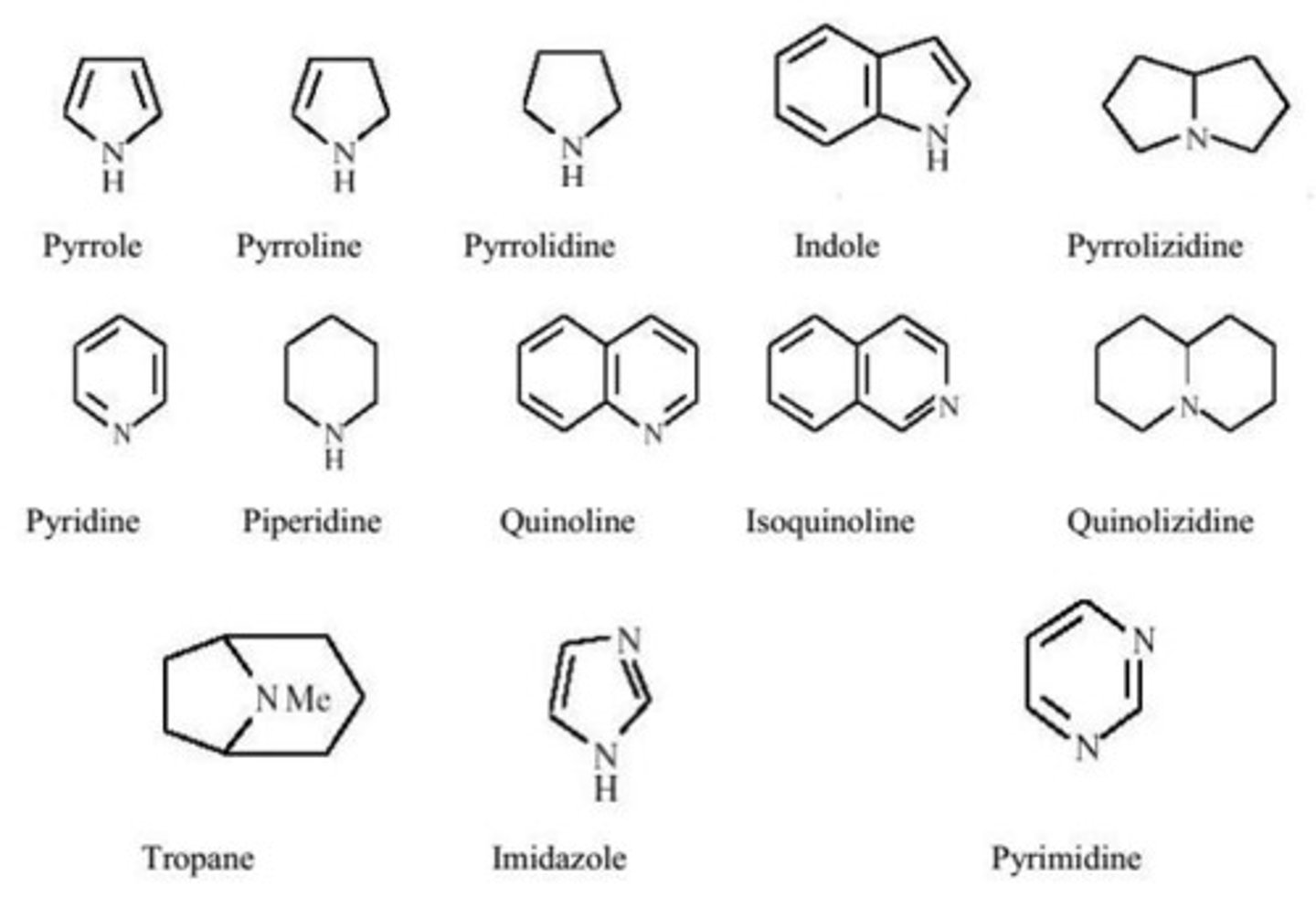
a. True
Types of alkaloids.
Pyridine-piperidine
Tropane
Quinoline
Isoquinoline
Indole
Imidazole
Steroid
Terpenoid
Alkaloidal amine
Purine
a. True
b. False
e. None
Alkaloidal precipitants can be all of the following except:
a. Reagents that form double salts
b. Reagents containing halogens
c. Organic acids
d. Oxygenated high molecular weight acids
e. None
e. Wagner's reagent - This is IODINE CONTAINING alkaloidal reagent.
Alkaloidal reagents that form double salts except:
a. Dragendorff's reagent
b. Mayer's reagent
c. Gold chloride
d. Valser's reagent
e. Wagner's reagent
f. None
b. Mayer's reagent -
Ma-MeKI
Mercuric Potassium Iodide
a. Dragendorff's reagent
b. Mayer's reagent
c. Gold chloride
d. Valser's reagent
a. Dragendorff's reagent
Potassium Bismuth Iodide
a. Dragendorff's reagent
b. Mayer's reagent
c. Gold chloride
d. Valser's reagent
d. Valser's reagent
KI and HgI
a. Dragendorff's reagent
b. Mayer's reagent
c. Gold chloride
d. Valser's reagent
e. Wagner's reagent
e. Wagner's reagent
Halogen containing but do not form double salt.
a. Dragendorff's reagent
b. Mayer's reagent
c. Gold chloride
d. Valser's reagent
e. Wagner's reagent
e. Wagner's reagent
Iodine in Potassium Iodide
a. Dragendorff's reagent
b. Mayer's reagent
c. Gold chloride
d. Valser's reagent
e. Wagner's reagent
c. Bouchdart's reagent
Most sensitive alkaloidal reagent composed of Iodine in KI.
a. Dragendorff's reagent
b. Mayer's reagent
c. Bouchdart's reagent
d. Valser's reagent
e. Wagner's reagent
a, Marme's reagent
K Cd Iodine
a. Marme's reagent
b. Bouchdart's reagent
c. Hager's reagent
d. Sonnenschein's reagent
e. Scheibler's reagent
c. Hager's reagent
Picric acid which is an organic acid alkaloidal reagent
a. Marme's reagent
b. Bouchdart's reagent
c. Hager's reagent
d. Sonnenschein's reagent
e. Scheibler's reagent
d. a and b
Tannic acid
Picric acid
Organics acids that can be used as alkaloidal reagent.
a. Tannic acid
b. Picric acid
c. Tartaric acid
d. a and b
e. All
e. All
Alkaloidal reagents that are oxygenated HMW acids.
a. Sonnenschein's reagent
b. Scheibler's reagent
c. Silicotungestic acid
d. a and b
e. All
d. Sonnenschein's reagent
Phosphomolybdic acid
a. Marme's reagent
b. Bouchdart's reagent
c. Hager's reagent
d. Sonnenschein's reagent
e. Scheibler's reagent
e. Scheibler's reagent
Phosphotungstic acid
a. Marme's reagent
b. Bouchdart's reagent
c. Hager's reagent
d. Sonnenschein's reagent
e. Scheibler's reagent
a. True
Chemical tests for alkaloids.
Dragendorff's Test
Mayer's Test
Wagner's Test
Hager's Test
Tannic Acid Test
Ammonia Reineckate Test
a. True
b. False
a. Dragendorff's test
Positive result: formation of orangish red color
a. Dragendorff's Test
b. Mayer's Test
c. Wagner's Test
d. Hager's Test
e. Tannic Acid Test
b. Mayer's test
Positive result: formation of creamy-white precipitate
a. Dragendorff's Test
b. Mayer's Test
c. Wagner's Test
d. Hager's Test
e. Tannic Acid Test
c. Wagner's test
Positive result: formation of reddish-brown precipitate
a. Dragendorff's Test
b. Mayer's Test
c. Wagner's Test
d. Hager's Test
e. Tannic Acid Test
d. Hager's test
Positive result: formation of crystalline yellow precipitate
a. Dragendorff's Test
b. Mayer's Test
c. Wagner's Test
d. Hager's Test
e. Tannic Acid Test
e. Tannic Acid Test
Positive result: formation of buff colored precipitate
a. Dragendorff's Test
b. Mayer's Test
c. Wagner's Test
d. Hager's Test
e. Tannic Acid Test
f. Ammonia Reineckate test
Positive result: formation of pink flocculent precipitate
a. Dragendorff's Test
b. Mayer's Test
c. Wagner's Test
d. Hager's Test
e. Tannic Acid Test
f. Ammonia Reineckate test
a. I, II, III
PYRIDINE-PIPERIDINE ALKALOIDS
I. Nicotine
II. Arecoline
III. Lobeline
a. I, II, III
b. I, II
c. I, III
d. III, IV
a. Nicotine
Leaves of Nicotiana tabacum
CNS stimulant, smoking deterrent
Gum (Nicoret); Patch (Nicoderm)
a. Nicotine
b. Arecoline
c. Lobeline
a. Nicotine
Used as temporary aid for the cessation of cigarette smoking and is available as transdermal patches.
a. Nicotine
b. Arecoline
c. Lobeline
e. None
PYRIDINE-PIPERIDINE ALKALOIDS except:
a. Arecoline
b. Lobeline
c. Piperine
d. Coniine
e. None
a. Arecoline
Areca/Areca Nut/Betel nut
Areca catechu
CNS stimulant
Anthelmintic
Tannin content causes esophageal cancer or oral cancer
a. Arecoline
b. Lobeline
c. Piperine
d. Coniine
a. Arecoline
Alkaloid present in betel nut which ca cause esophageal cancer.
a. Arecoline
b. Lobeline
c. Piperine
d. Coniine
b. Lobeline
Lobelia/Indian Tobacco
Lobelia inflata
CNS stimulant
Smoking deterrent
Respiratory stimulant, used in asthma preparation
a. Arecoline
b. Lobeline
c. Piperine
d. Coniine
b. Lobeline
Alkaloid smoking deterrent found in Indian tobacco.
a. Arecoline
b. Lobeline
c. Piperine
d. Coniine
c. Piperine
Pepper
Piper nigrum
Treatment gonorrhea/chronic bronchitis
a. Arecoline
b. Lobeline
c. Piperine
d. Coniine
d. Coniine
Antispasmodic, sedative, anodyne alkaloid found in poison hemlock.
a. Arecoline
b. Lobeline
c. Piperine
d. Coniine
e. None
TROPANE ALKALOIDS except:
a. Scopolamine
b. Cocaine
c. Atropine
d. Mandragorine
e. None
a. True
TROPANE ALKALOIDS sources:
Henbane
Belladona
Stramonium
Duboisa
Withania
Mandragora
a. True
b. False
e. None
Duboisia myoporoides and Withania somnifera are major commercial source.
Commercial source of atropine except:
a. Hyoscyamus niger
b. Hyoscyamus muticus
c. Duboisia myoporoides
d. Withania somnifera
e. None
c. Duboisia myoporoides
Main commercial source of atropine.
a. Hyoscyamus niger
b. Hyoscyamus muticus
c. Duboisia myoporoides
d. Withania somnifera
e. All
True about tropane alkaloids:
a. From Solanaceae family except cocaine
b. Tropane ring is from arginine and ornitine
c. Tropic acid is from phenylalanine
d. a and b
e. All
b. Cocaine
Tropane alkaloids that is not from Solanaceae family but from Erythroxylaceae instead.
a. Scopolamine
b. Cocaine
c. Atropine
d. Mandragorine
c. Scopolamine
First transdermal made.
a. Nicotine
b. Lobeline
c. Scopolamine
d. Hyoscine
b. Belladona
Atropa belladonna
Contains atropine
• Parasympathetic
• Adjunct in treatment of peptic ulcer
• Spasmolytic agent
• Antidote for physostigmine and organophosphate insecticides
a. Henbane
b. Belladona
c. Stramonium
d. Duboisa
e. Withania
f. Mandragora
a. Henbane
Hyoscyamus niger
Hog + Bean
• Toxic to swine
• Anticholinergic
a. Henbane
b. Belladona
c. Stramonium
d. Duboisa
e. Withania
f. Mandragora
c. Stramonium
Jimson Weed, Jamestown Weed, Talumpunay, Thorn apple
Datura stramonium, Datura metel
Contain scopolamine aka hyoscine
• Treatment of asthma (vapor)
• Treatment of motion sickness
a. Henbane
b. Belladona
c. Stramonium
d. Duboisa
e. Withania
f. Mandragora
e. All
Brompton's cocktail is a preparation used for terminal cancer containing:
a. Morphine/Heroin
b. Cocaine
c. High% alcohol
d. a and b
e. All
d. Duboisa
Duboisia myoporoides
• Treatment of motion sickness, stomach disorders
• Treatment of side effects of cancer therapy
• Antispasmodic, analgesic
a. Henbane
b. Belladona
c. Stramonium
d. Duboisa
e. Withania
f. Mandragora
e. Withania
Indian ginseng, Winter cherry
Withania somnifera
• Sedative
a. Henbane
b. Belladona
c. Stramonium
d. Duboisa
e. Withania
f. Mandragora
f. Mandragora
“Satan’s apple”, European mandrake
Mandragora officinarum
Contains mandragorine:
• Emetic
• Most popular anesthetic during the middle ages
• In the Elizabethan age it was still being used as a narcotic
a. Henbane
b. Belladona
c. Stramonium
d. Duboisa
e. Withania
f. Mandragora
f. Mandragora
Satan's apple
a. Henbane
b. Belladona
c. Stramonium
d. Duboisa
e. Withania
f. Mandragora
e. All
Cocaine:
a. Pyschoactive
b. Psychomotor stimulant with a strong abuse potential
c. Vasoconstrictor and local anesthetic
d. a and b
e. All
a. Erythroxylum coca
Huanoco, Bolinian Cocaine
Erythroxylum coca - more pleasant preferred effect
a. Erythroxylum coca
b. Erythroxylum truxillense
b. Erythroxylum truxillense
Truxillo, Peruvian Cocaine
a. Erythroxylum coca
b. Erythroxylum truxillense
a. Scopolamine
Alkaloid used to reduce rigidity and tremors for those suffering from Parkinson's disease.
a. Scopolamine
b. Cocaine
c. Atropine
d. Mandragorine
c. Atropine
Racemized hyoscyamine during extraction.
a. Scopolamine
b. Cocaine
c. Atropine
d. Mandragorine
e. Quinine
Principal cinchona alkaloid employed therapeutically as anti-protozoal drug.
a. Scopolamine
b. Cocaine
c. Atropine
d. Mandragorine
e. Quinine
a. Thalleioquin
Reaction is used to identify quinine.
a. Thealleioquin
b. Borntrager
c. Valser
d. Frasch
d. Cinchonism
Overdose of Peruvian bark results in temporary loss of hearing and impaired sight commonly known as:
a. Alcoholism
b. Cinchonism
c. Solecism
e. All
QUINOLINE ALKALOIDS sources:
a. Cinchona
b. Peruvian bark
c. Quina
d. a and b
e. All
b. Red cinchona
Cinchona succirubra
a. Yellow cinchona
b. Red cinchona
a. Yellow cinchona
Cinchona calisaya
a. Yellow cinchona
b. Red cinchona
e. All
Cinchonism:
a. Tinnitus
b. Headache
c. Confusion
d. a and b
e. All
a. Remijia purdieana - Cuprea
Commercial source of quinidine.
a. Remijia purdieana
b. Erythroxylum truxillense
c. Duboisa myoporoides
d. Datura metel
a. Quinine
Antimalarial
a. Quinine
b. Quinidine
c. Cinchotannic acid
d. All
b. Quinidine
Anti arrhythmic
a. Quinine
b. Quinidine
c. Cinchotannic acid
d. All
c. Cinchotannic acid
Condensed tannin.
a. Quinine
b. Quinidine
c. Cinchotannic acid
d. All
b. Emerald green
Thalleioquin reaction include Br2 TS + NH3 TS which will result to:
a. Yellow green
b. Emerald green
c. Dark green
d. Blue green
a. Quinine
Template for synthetic anti-malarials such as quinacrine, chloroquine and mefloquine.
a. Quinine
b. Quinidine
c. Cinchotannic acid
b. Quinidine
An isomer of quinine used to treat type I-cardiac arrhythmias.
a. Quinine
b. Quinidine
c. Cinchotannic acid
f. None
ISOQUINOLINE ALKALOIDS except:
a. Emetine
b. Saguinarine
c. Tubocurarine
d. Opium
e. Hydrastine/Berberine
f. None
f. None
ISOQUINOLINE ALKALOIDS sources except:
a. Ipecac
b. Bloodroot
c. Curare
d. Opium
e. Golden seal
f. None
b. Tyrosine
Precursor of isoquinoline.
a. Tryptophan
b. Tyrosine
c. Isoleucine
d. Lysine
a. Ipecac
Cephaelis ipecacuanha
Contain emetine or methylcephaeline
• Emetic
a. Ipecac
b. Bloodroot
c. Curare
d. Opium
a. Emetine
Ipecac syrup is used for the treatment of drug overdose and in certain poisoning and it has the active isoquinoline alkaloid known as.
a. Emetine
b. Methylcephaeline
c. Sanguinarine
d. Tubocurarine
e. Opium
a. Fluid extract
Ipecac that is 14 times stronger than the liquid syrup form.
a. Fluid extract
b. Dover's powder
c. Paregoric
d. Laudanum
c. Paregoric
Camphorated opium tincture.
a. Fluid extract
b. Dover's powder
c. Paregoric
d. Laudanum
b. Dover's powder
Ipecac + opium
a. Fluid extract
b. Dover's powder
c. Paregoric
d. Laudanum
b. Dover's powder
Diaphoretic
a. Fluid extract
b. Dover's powder
c. Paregoric
d. Laudanum
d. Laudanum
Deodorized opium tincture
a. Fluid extract
b. Dover's powder
c. Paregoric
d. Laudanum
d. Laudanum
Opium tincture 10%
More potent than paregoric
a. Fluid extract
b. Dover's powder
c. Paregoric
d. Laudanum
b. Bloodroot
Sanguinaria canadensis
Contain saguinarine
• Stimulating expectorant and emetic
a. Ipecac
b. Bloodroot
c. Curare
d. Opium poppy
c. Curare
South American arrow poison
Strychnos castelnae
Contain tubocurarine
• Skeletal muscle relaxant
a. Ipecac
b. Bloodroot
c. Curare
d. Opium
e. Hydrastis
c. Curare
Standardization include head drop assay in rabbits wherein there is determined least amount of drug capable of producing muscle relaxation so that head of animal drops in a characteristic manner.
a. Ipecac
b. Bloodroot
c. Curare
d. Opium
e. Hydrastis
a. Mice and rabbits
Official test animal used to assay curare alkaloids by the "head drop" cross-over method wherein animals and control group are used in alternate base.
a. Mice and rabbits
b. Pigs
c. Cats
d. Lizards
d. a and b
Pot
Calabash
Strychnos castelnaei
a. Pot
b. Calabash
c. Tube
d. a and b
e. b and c
f. All
c. Tube
Chondrodendron tomentosum
a. Pot
b. Calabash
c. Tube
d. a and b
e. b and c
f. All
d. Opium
Papaver somniferum
a. Ipecac
b. Bloodroot
c. Curare
d. Opium
e. Hydrastis
a. True
Opium Alkaloids
Morphine
Codeine
Heroin
Papaverine
Hydromorphine
Apomorphine
Narcotine/Noscapine
a. True
b. False