Electrochemistry and Nuclear Chemistry
 Call Kai
 Learn
Learn Practice Test
 Spaced Repetition
 Match
Match Flashcards
 Knowt Play
1/38

There's no tags or description
Looks like no tags are added yet.
Name | Mastery | Learn | Test | Matching | Spaced | Call with Kai |
|---|
No analytics yet
Send a link to your students to track their progress
39 Terms
OIL RIG
Oxidation is loss
Reduction is gain
Reduction/oxidation potential
Reduction potential: tendency to acquire electrons
Oxidation potential: tendency to lose electrons
Reduction in terms of O and H
Losing bonds to more EN atoms like O
Gaining bonds to less EN atoms like H
Oxidation in terms of O and H
Gaining bonds to more EN atoms like O
Losing bonds to less EN atoms like H
Oxidation number
More positive=more hungry for electrons
Rules:
-Oxidation state of any element in neutral state = 0
-Sum of oxidation states equals overall charge on molecule
-Group 1 metals have +1
-Group 2 metals +2
-Fluorine -1
-Oxygen -2
-H is +1 when bonded to more EN atom than H, -1 when less EN
-Halogens -1 and atoms of oxygen family -2
Inorganic compounds ranking
Think about oxidation states and least oxidized less oxygen
Least positive=most reduced
Most positive=least reduced
Transition metals like Mn variable charge so that is what you are checking!
K2MnO4 K2=2+ and so MnO4 has to be -2 and O4=-8 so Mn=+6
Organic compounds
CO2, CH2, HCOOH etc.
No oxidation states!
Think about how many bonds to oxygen
Greater amount of bonds to oxygen is more oxidized!
Oxidizing/reducing agent
Oxidizing agent: Cause others to become oxidized it itself is REDUCED
Neutral non metals. MOx (MnO4-) (CrO3)
Reducing agent: Cause others to become reduced it itself is OXIDIZED
H2 and neutral non metals like MeHx (LiAlH4 and NaBH4)
Reduction potentials
Table given
They are for the reactants
Strongest oxidizing agent=best at being reduced to most positive reduction potential
Strongest reducing agents=best at being oxidized, most negative reduction potential because will be REVERSED sign, looking at products!
Spontaneous
Ecell>0 positive
Ecell=
Ecell=Ered + E ox
AN OX RED CAT
Anode=oxidation
Cathode=reduction
deltaG=
-nFEcell
Ecell>0 than deltaG<0 so spontaneous
n=moles of electrons transferred
Reduction potential rule
If spontaneous subsequent molecules needs thigher reduction potential than what came before it
Example: Coating Zn2+ with Cu2+ know that it is spontaneous therefore know that Cu2+ has to have higher reduction potential! Elemental copper coating it
For a reaction to happen spontaneously, the "coating" or substance doing the oxidizing must have a higher reduction potential than the substance being oxidized.
Different problem example
Stainless steel is an alloy made by mixing iron with low percentages of carbon and chromium. The Cr forms a thin, protective layer of chromium(II) oxide on the surface of the metal. Which of the following regarding the relative reduction potentials (E°) of metallic ions must be true?
Cr goes to Cr3+ so oxidized so lower reduction potential
Time based calculations
2 A for 2 minutes, moles of Cu2+ can be plated out F=100,000 C/mol
1A=C/s!!!!
2 min (60 sec/1 min) (2C/S) (1mol/100,000 C) (1 mol Cu2+/2 mol e-)
All cells must consist of
Two or more electrodes (anode + cathode)
An electrolyte salt bridge or electrolyte solution (balance charge build up)
Circuit to connect
Galvanic means…
Spontaneous
NO external power source
Electrolytic means…
Non spontaneous
POWER source needed
Galvanic cell (new battery)
Anode (-) oxidation
Cathode (+) reduction
*Note + and - does not mean charge just an assignment
Electrons flowing from A to C
Current opposite of electron flow
Where do cations and anions flow?
Cations flow to CATHODE
Anions flow to ANODE
Electrolytic cell (DEAD battery)
Ecell=0
Equilibrium
Electrolytic cell (recharging battery)
Everything flipped from galvanic cell
+ and - assignments match sides of power source battery
Cathode and anode flipped so now cathode - and anode +
Cathode vs anode
Cathode
RED CAT
Cations flow
Plating
+ galvanic and -electrolytic
Anode
AN OX
Anions flow
Pitting
- galvanic + electrolytic
Think in galvanic cell think anode is oxidation which means they are losing and leaving behind electrons so - and cathode is reduction so gaining electrons and +
Example: Cu + 2Ag+ to Cu2+ + 2 Ag
Cu to Cu2+ is oxidation Cu anode (solids)
and Ag+ to Ag is reduction Ag cathode (solids)
Reverse changes so Cu cathode and Ag anode
Cell in equilibrium
E cell =0
E=Estandard state-RT/nF lnQ
Non zero standard cell potential
Estandard=RT/nF lnK
Redox titrations
Equivalence point (weighted average E sample + Etirant)is the exact moment when the amount of oxidizing or reducing titrant added is chemically equivalent (stoichiometrically equal) to the amount of analyte in the sample
Half equivalence point=E sample
Mid after equivalence point is E tirant
Example: 0.1 M tirant eq point is 50 L then 0.1 M (50 L) = moles than can know how many moles of each thing!
A and Z
A=Proton + neutron (mass number)
Z=Protons (atomic number)
Alpha decay
A=A-4
Z=Z-2
Very large nuclei
Least dangerous
Beta decay
A=same
Z=+1
Not enough protons
Nuclei with high neutron/proton ratio
More dangerous
Positron emission
A=same
Z=Z-1
Too many protons
Proton/neutron ratio high
Electron capture
Absorbed ny nucleus
Same as positron
A=same
Z=Z-1
P/N ratio high too many protons
Daughter vs parent
Daughter always more stable (less energy) than parent!!!
Gamma decay
-Nuclear rxns
-Most dangerous
Same A and Z just goes from Dy* to Dy
*=higher energy
Just about energy
Deutron
1 proton and 1 neutron
2H or D
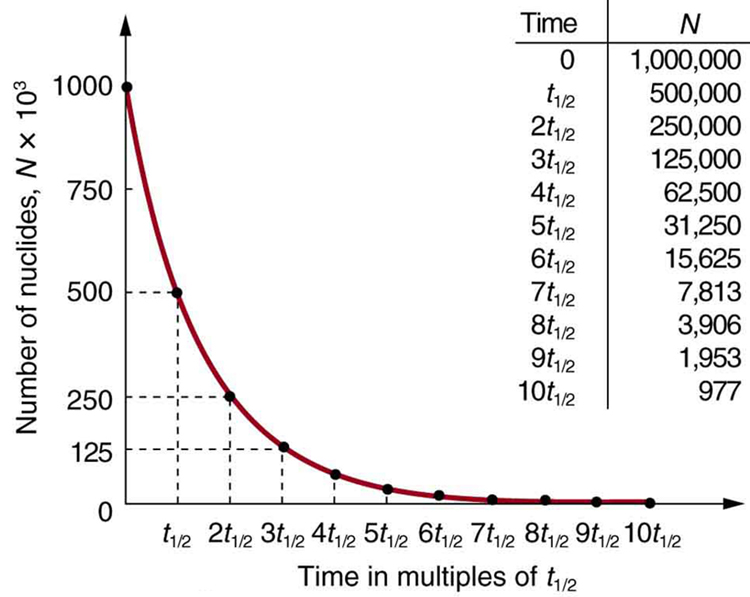
Half lives
Longer half lives are safer
Past 10 half lives considered safe
t1/2=7 days 10% orginal amount \
Days % left
0 100%
7 50%
14 25%
21 12.5%
28 6.25%
10% between 21-28 days
Nuclear reactions exothermic not reversible, all about stability!
Energy released in terms of bonding energy
deltaE=BEparent-BEdaughter(s)
BE is given
Sample over time radioactive decay