international law
 Call Kai
 Learn
Learn Practice Test
 Spaced Repetition
 Match
Match Flashcards
 Knowt Play
1/23

There's no tags or description
Looks like no tags are added yet.
Name | Mastery | Learn | Test | Matching | Spaced | Call with Kai |
|---|
No analytics yet
Send a link to your students to track their progress
24 Terms
what is international law
Law that governs relations between nation states developed through diplomatic relationships and agreements/treaties/conventions.
What does sovereignty mean?
The ability for a state to make rules and have the power to enforce them.
What does the International law cover?
covers areas of human rights and minising conlifct/disspute→ overall world peace
UN internvention can be argued to be a breach of soverign rights or an international obligation
state soverignty acts as a dilemma for internatoinal law as nation states have the right to refuse participation→ no world gov, the UN is a mix of soverign states→ INT law is voluntary
Features of nation state
A nation state can have its own laws because it is an independent state that has sovereignty. A state can be defined as: territory, effective government, permanent population, ability to enter international negotiation
When does international law become domestic law?
sign→ ratify→ enacted (after royal assent it is enforcable and active in society). A document will only become a treaty if all parties have the intention of being bound by the provisions and obligations and sign. The treaty onoy becomes binding on a state when the state ratifies it.
What are the main sources of internal law
customs, declaratoins, treaties, legal decisions, legal writings
How are human rights protected under Int Law
United Nations Charter
International Bill of Rights made up of 3 documents (signed by 130 coutnries)
UN Universal Declaration of Human Rights (1948)
Int’l covenant on economics, social and cultural rights (1966)
Int’l convenant on civil and poitical rights.
Examples of Breaches of International law
failure to honour treaty
employ armed forces against another state
violating a territorial soverignty of another state
What is International Customary Law?
Rule that has been established because of it has a long tradition
One issue with Int customary law?
May be too slow is a rapidly changing world
2 examples of INt Customary Law.
Sea laws state that flying after 11pm in Aus airspace is prohibited
Captain giving assistence to another vessel when distress
what are the legal decisions (2)?
International Criminal Courts and International Court of Justice
What is the Int Criminal Court
jurisdiction (rome statue 2002, int document which gives the ICJ jurisdiction, not part of UN) is to resolve disputes that arise from non-complience of treaties and war crimes
What is International Court of Justice
Int court, where precedents can be used to assist a judge in their ruling of a decision.
deals with disputes between nation
treaties have been amended ans have evolved as a result of ICJ ruling
cases can also be heard in adhoc (temporary tribunals)
Legal wiriting- link instruments and writings
shifted from natural law (derived from God)- churches used to make law
by late 19C law shifted to positive law (generated by parliament, monarchs, courts)
this meant laws and treaties became more important than natural law legal writing
Intergovernmental Organisation
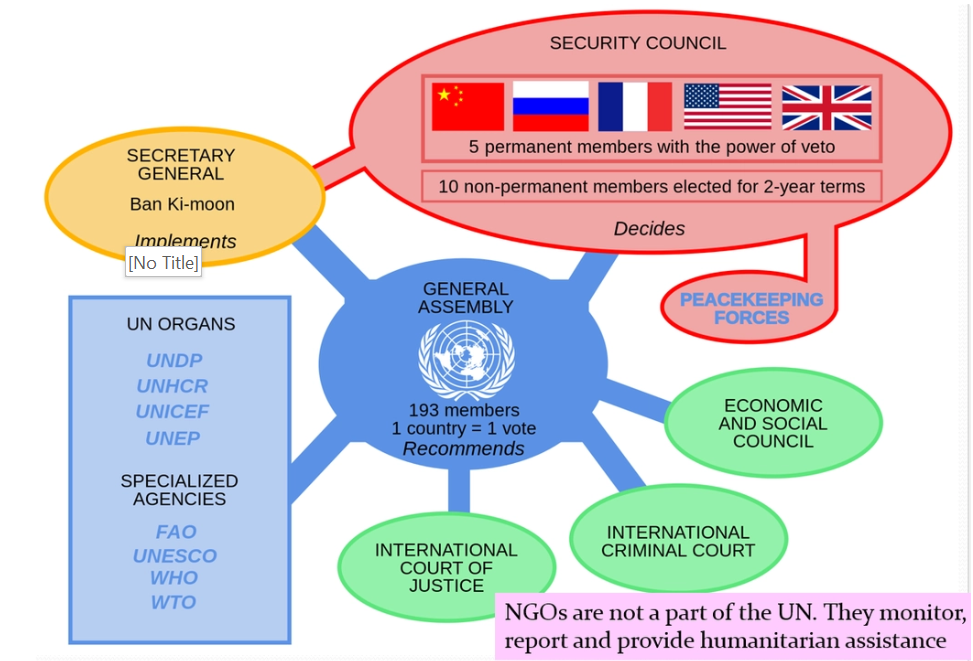
What two intergovernmetnal organiations make up the the cheif organisation involved in international law?
The UN: General assembly and Security Council
Features of General Assembly
main body of UN made up of all member states (193)
is the main forum for multilateral discussions on all Int matters covered by the UN Charter
legal committee (6 committee) reviews the Comissions reports and considers the reccommendations and may organiase a conference to draw up a convention based on those recconmendations, which the member state then votes upon
features of the Secuity Council
made up of the 5 permanent members with veto power: China, Russia, France, UK, USA and 10 non-permanent members that last for 2yr terms
main role: peace-keeping missions + the most powerful part of the United Nations, responsible for maintaining world peace and security and has the final say
able to investiage disputes that could lead to conflict, can issue economic sanctions against nation states to persuade them to change their policies or prevent/stop agression, can send ‘peacekeeping’ troops to seperate oposing forces and to reduce tension.
veto power (considered one of the fundamental weaknesses of the strutcure of the Secuturity Council): if one of the permament members vote against the resolution, then it is not carried.
Features of Courts and Tribunas (ICC, ICJ)
ICJ: the primary judicial body of the UN est in 1945: principle activities are to settle disputes submitted to it by states and to give advisory opinions on legal questions submitted by the General Assembly, the Security Council or other bodies as permitted by the general assembly.
can only hear disputes if the nations involved accept the jurisfiction of the court
Legal disputes or advisory proceedings
ICC: a treaty signed by 121 states est the ICC as a permanent court in which individuals can be tried for massatrocity crimes such as genocide, war crimes and crimes against humanity
Features of IGOs
created by states through multilateral treaties that act like a constitution in that the states parties are consenting to be bound by the treaty that sets up the agenicies, functions and purposes of the organisations,
many are subsidiary agencies of the UN; others have been formed to make collective decisions about the international issues such as refugees, tarriffs or wealth
e.g International Labour Organisation
Featurs of NGOs
associations based on common interests and aims, and which have no connection with any government
contribute to a wide range of areas, from world peace, disaster relief and environmental protection to promoting education and alleviating poverty.
e.g Amnesty International, a ‘global movement of over 7milll people committed to defending those who are denied justice or freedom.
How does Aus effectively apply Int Law?
countries sign and ratify international documents→ encact domestic legislation to comply with Int treaties. However, compluance with treaties is limited due to state sovereignty
Australia is party to two treaties: International Covenant on Civil and Political Rights (ICCPR) and the Convention on the Rights of the Child (CRC) both of which have been ratified by Australia.
the ICCPR requires Australia to protect fundamental freedoms, e.g right to freedom of speech, fair trials etc. Aus is required to ensure that any person whose rights are violated has an effective remedy, and must prohibit arbitrary detention and ensure humane treatment of those depreived of liberty
Australian Human Rights Commission Act 1986 (Cth): This act explicitly defines "human rights" to include the rights enumerated in the ICCPR (included as Schedule 2), allowing the Commission to inquire into acts or practices that may violate these rights.
How does Aus fail in some areas on Int law?
Convention Relating to the Status of Refygees (1951)→ Migration Act 1958 (cwlth)
Migration Act 1958 (cwlth)
s 189 – Detention of unlawful non-citizens: Requires that any person in Australia who is an unlawful non-citizen must be detained.
s 196 – Duration of detention: States that an unlawful non-citizen must remain in immigration detention until they are removed, deported, or granted a visa.
s 197C – Removal regardless of protection obligations: Provides that an officer must remove an unlawful non-citizen as soon as reasonably practicable, even if Australia owes non-refoulement obligations (like protection claims).
Australia’s Treatment of Asylum Seekers
Aus implemented a policy of mandatory detenion of those who attempt illegal entry
Chu Kheng Lim v Minister ethnic Affairs (1991): Aus could not justify detaining aslym seekers and violated ICCPR- compensation for the aslym seekers
more than 300 afgani refugees where refused entry to Christmas island→ new restrictions on asylum seekers have been enacted.
s 189 + s 196 → can lead to indefinite detention, which international law may see as “arbitrary” if not properly reviewed or justified.
s 197C → requires removal even if a person claims protection, which may risk sending someone back to danger (refoulement risk).
Christmas Island Interview- conditions
children are in hot and human prisons
children draw pictures asking for ‘freedom and help’, they are behind bars, and identify themselves as their secuirity numbers not their names
waiting long periods for food
detainees view it like a prison
“hellish prison camp without a crime committed”, “i feel that i am an animal”, “Aust put people in a systematic torture and this place is no more than a normal prison”
state sovertinety makes us non compliant