Science Test: Ecology
 Call Kai
 Learn
Learn Practice Test
 Spaced Repetition
 Match
Match Flashcards
 Knowt Play
1/51

There's no tags or description
Looks like no tags are added yet.
Name | Mastery | Learn | Test | Matching | Spaced | Call with Kai |
|---|
No analytics yet
Send a link to your students to track their progress
52 Terms
What are the parts of an ecosystem?
abiotic factors and biotic factors
Biotic factors
the living parts of an organism, like animals and plants
Abiotic factors
The non-living aspects of an organism, like rocks or temperature
Organism
An individual living thing
Species
A group of similar organisms (of a species) that can breed and produce fertile offspring.
Population
group of individuals of the same species that live in the same area
Community
all the different populations of various species that live and interact in the same geographical area at the same time
Ecosystem
A biological community of interacting organisms and their physical environment.
Biosphere
the global ecological system encompassing all living organisms and the physical environments with which they interact
Photosynthesis
Conversion of light energy from the sun into chemical energy by plants.
Formula: 6CO2 + 6H2O + sunlight --> C6H12O6 + 6O2
- Carbon dioxide + water + sunlight --> Glucose + Oxygen
Cellular Respiration
the process by which cells break down sugar (glucose) and oxygen to release usable energy, producing carbon dioxide and water as byproducts
Formula: C6H12O6 + 6O2 --> 6CO2 + 6H2O + ATP
- Glucose + Oxygen -> Carbon dioxide + Water + ATP
Food Chain
series of steps in an ecosystem in which organisms transfer energy by eating and being eaten
Ex: grass --> grasshopper --> sparrow --> snake --> eagle
Food web
a complex network of interconnected food chains. It represents energy flow more accurately because most organisms have multiple food sources
Trophic Levels
the position an organism occupies in a food chain. They are as follows (in order):
- producer, primary consumer, secondary consumer, and tertiary consumer
Keystone species
a species on which other species in an ecosystem largely depend, such that if it were removed the ecosystem would change drastically
Ex: Otters, elephants, panthers, gray wolves
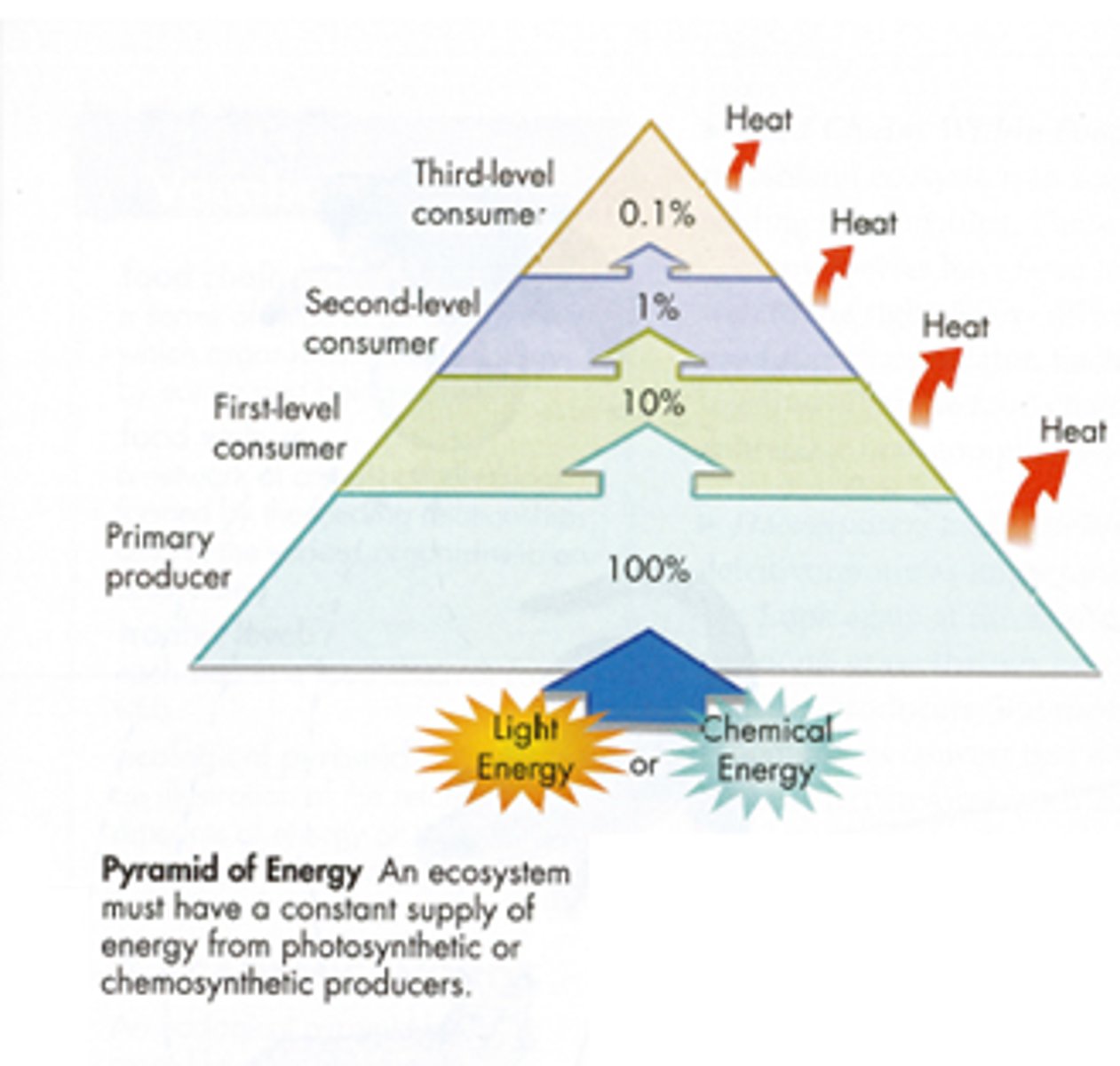
The Energy Pyramid
Shows the amount of energy that moves from one feeding level to another in a food web. Energy is lost as it moves up through trophic levels, primarily as heat
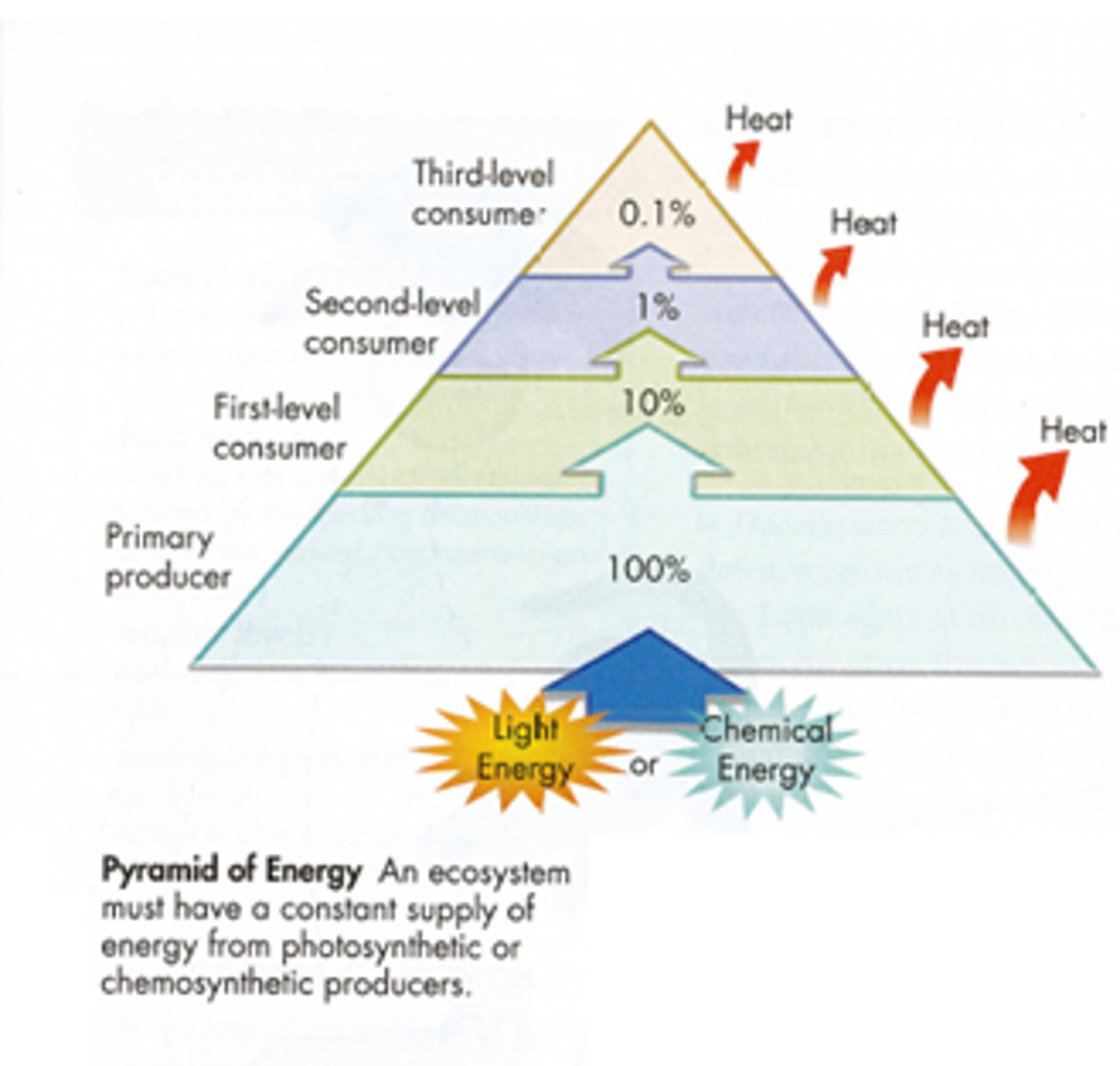
10% Rule:
only about 10% of the energy at one trophic level is passed on to the next level
ex: 10,000% (P) --> 1,000% (C1) --> 100% (C2) --> 10% (C3)
Why is energy lost as it moves up the pyramid?
Enegry is lost as it moves up the pyramid because it goes into the atmosphere through things like cellular respiration and heat and detritus (poop)
Biomass:
the total mass of living tissue within a given trophic level. Higher levels usually have less biomass
Autotroph/Producer:
An organism that makes its own food
Heterotroph:
An organism that cannot make its own food
Consumer: (same thing as heterotroph)
An organism that obtains energy by feeding on other organisms
Decomposer:
An organism that breaks down wastes and dead organisms
Why do all levels give energy to the decomposers?
all levels give energy to the decomposers because they break down organisms/organic matter at any level.
What are limiting factors?
factors that limit the growth of a population. They ultimately determine an ecosystem's carrying capacity. They are things like:
- Food, competition, habitat, climate, water, disease, climate change, and natural disasters
Predation:
An interaction in which one organism kills another for food.
Parasitism:
A relationship in which one organism benefits and the other is harmed
Mutualism:
A relationship between two species in which both species benefit
Commensalism:
one organism benefits and the other is unaffected
Carrying capacity:
the maximum number of individuals of a species that an environment can sustainably support
What happens to a population when it exceeds its carrying capacity?
Individuals will die as they are running out of resources; also there is increased competition
Logistic growth:
when a population grows quickly and then levels off at the carrying capacity
Exponential growth:
Population growth that is unhindered because of the abundance of resources for an ever-increasing population.
Bottom up control:
Driven by the availability of food and resources at the bottom. e.g., more grass --> more rabbits --> more foxes
Top down control:
Driven by predation from the top of the food chain. e.g., fewer wolves --> more rabbits --> less grass
Niche Partitioning:
species evolve to use different resources or use them at different times to avoid competition
Matter:
matter is recycled through the Earth's systems rather than being used up
Water cycle:
involves evaporation (water evaporating from oceans and rivers), transpiration (evaporation from plants), condensation (cloud), and precipitation (rain or snow)
Carbon cycle:
the movement of carbon from the nonliving environment into living things and back
- driven by photosynthesis and cellular respiration
What are ways that carbon enters the atmosphere?
Carbon enters the atmosphere through things like respiration, decay, combustion, and fossil fuels
What are the ways carbon is taken out of the atmosphere?
Carbon exits the atmosphere through photosynthesis and carbon also carbon sinks into water and rock deposits
Nitrogen cycle:
The transfer of nitrogen from the atmosphere to the soil, to living organisms, and back to the atmosphere. Bacteria fix nitrogen from the air into a form plants can use
What ways is nitrogen removed from the atmosphere?
lightning, and nitrogen fixing bacteria found in plants (mostly legumes)
What ways does nitrogen enter the atmosphere?
through the process of denitrification, where specific soil and water bacteria break down ammonia nitrogen compounds (like nitrates) to obtain oxygen. As a result, they release harmless nitrogen gas back into the air
What 2 biological molecules are nitrogen used for?
nitrogen is used for proteins and nucleic acids (DNA)
Biodiversity:
The amount of biological or living diversity per unit area. It includes the concepts of species diversity, habitat diversity and genetic diversity.
Why is biodiversity important?
biodiversity is important b'c it helps to stabilize ecosystems, increases their productivity, provides the genetic foundation for our food, and even supplies clean air, water, and medicines
What are threats to biodiversity?
habitat destruction, invasive species, pollution, population growth, climate change, overexploitation
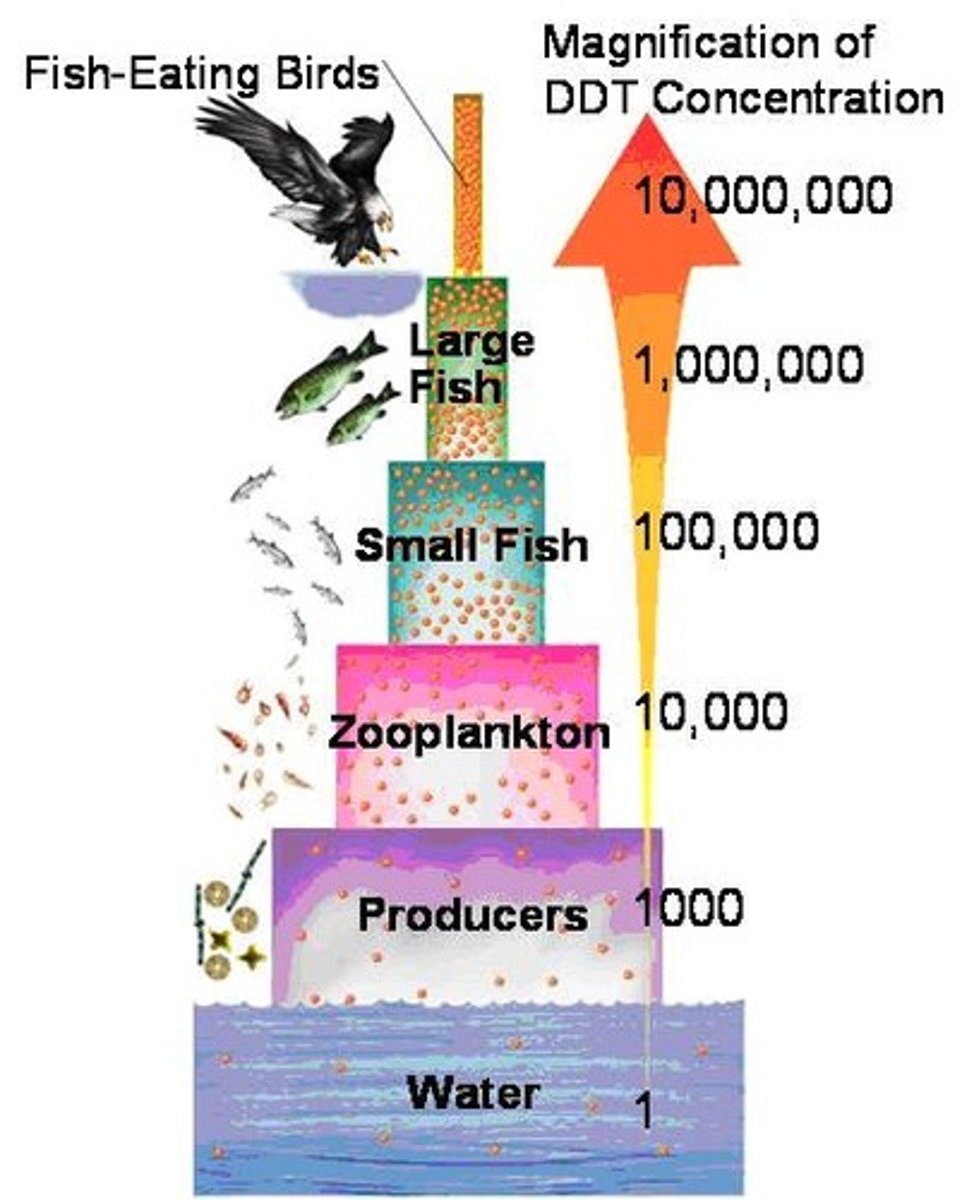
Biomagnification:
The increase in chemical concentration in animal tissues as the chemical moves up the food chain
How does the carbon cycle connect with climate change?
The carbon cycle connects directly to climate change through the movement of carbon dioxide (CO2) between the atmosphere, oceans, and land. When the natural balance is disrupted—such as by human emissions and deforestation (CO2) builds up in the atmosphere, acting like a greenhouse that traps heat and drives global warming
How does climate change affect the environment?
Climate change alters ecosystems globally through sea levels rising, floods, extreme weather, food issues, and health
Why is deforestation so bad for climate change?
it releases massive amounts of carbon dioxide into the atmosphere and permanently destroys the natural "sinks" that absorb greenhouse gases