[BIOCHEMISTRY] Nucleic Acids p2
 Call Kai
 Learn
Learn Practice Test
 Spaced Repetition
 Match
Match Flashcards
 Knowt Play
1/40

There's no tags or description
Looks like no tags are added yet.
Name | Mastery | Learn | Test | Matching | Spaced | Call with Kai |
|---|
No analytics yet
Send a link to your students to track their progress
41 Terms
c. Both
Gene expression:
a. Transcription
b. Translation
c. Both
d. None of these
a. Transcription
RNA synthesis
a. Transcription
b. Translation
b. Translation
Protein synthesis
a. Transcription
b. Translation
a. I, II, III, IV
True about RNA synthesis:
I. RNA polymerase initiate the synthesis of new chain wherein primer is not required.
II. DNA is copied in 3′ to 5′ direction, and the RNA chain grows in the 5' to 3' direction.
III. Promoter region which is a part of DNA that exhibits consensus sequence is mecessary
IV. A sigma factor recognize the promoter region
a. I, II, III, IV
b. I, II, III
c. I, II, III, IV
d. I, II, III, IV
a. Promoter region
Part of the DNA that exhibits sequence.
a. Promoter region
b. Sigma factor
c. Primase
d. Cofactor
b. Sigma factor
Recognize promoter region.
a. Promoter region
b. Sigma factor
c. Primase
d. Cofactor
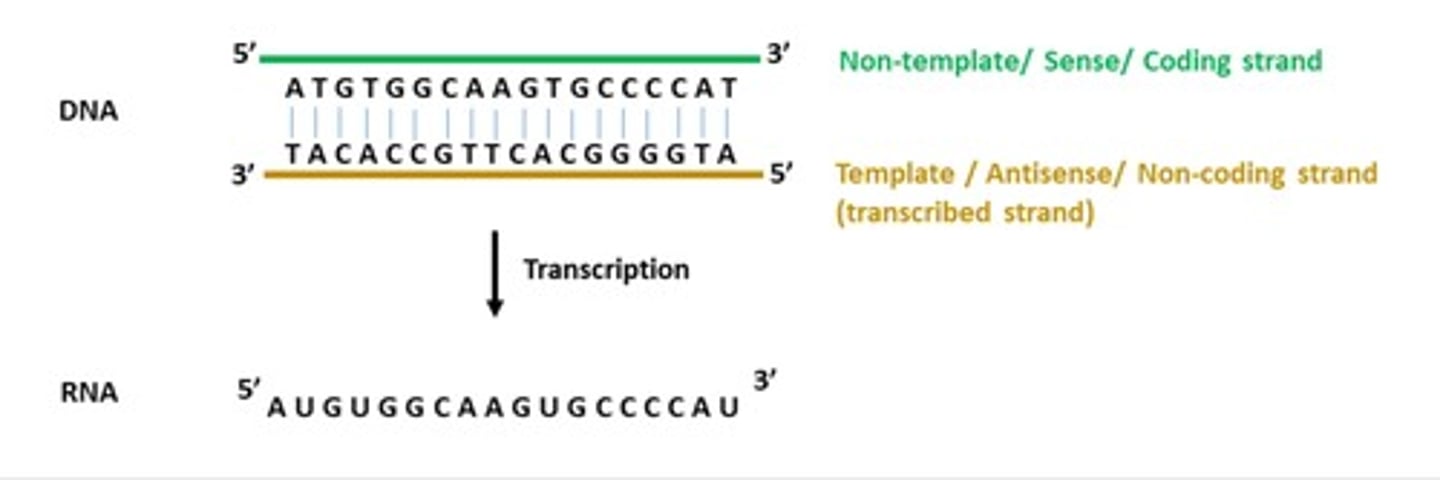
b. DNA template strand
Antisense or the non-coding strand
a. DNA non template strand
b. DNA template strand
e. All
DNA non-template or complementary strand:
a. Sense or Coding strand
b. Contain the same sequence as the RNA that is transcribed, except that the DNA will contain thymine (T), and RNA uracil (U)
c. 5' to 3' direction
d. a and c
e. All
a. 5' to 3'
Primary RNA transcript has the direction:
a. 5' to 3'
b. 3' to 5'
e. All
RNA polymerase of E. coli:
a. Has 5 subunits (α2ββ′) which form the core enzyme.
b. The sigma factor (σ) is the 5th subunit which is required for the initiation of RNA synthesis
c. Genes contain a promoter region to which RNA polymerase binds
d. b and c
e. All
e. All
Bacterial RNA promoter region.
a. TATAAT
b. TTGACA
c. TATA
d. a and b
e. All
d. a and b - TATAAT is also known as TATA
Pribnow or TATA box which is 10 bases upstream (before) from the start point of transcription.
a. TATAAT
b. TATA
c. TTGACA
d. a and b
e. All
b. TTGACA
Usually upstream from the Pribnow box, about 35 nucleotides from the start point of transcription.
a. TATAAT
b. TTGACA
c. TATA
e. q (rho) factor
Aids in the termination of some transcripts wherein it binds to the transcript as it is being synthesized, and with the aid of energy obtained from the hydrolysis of ATP, it pulls the transcript off of the template to be released into the cytoplasm.
a. Promoter region
b. Sigma factor
c. Primase
d. Cofactor
e. q (rho) factor
a. Rho-independent termination
Termination that occurs in a region in which the transcript forms a hairpin loop that precedes a number of U residues.
a. Rho-independent termination
b. Rho-dependent termination
e. None
True about prokaryotic RNA synthesis except:
a. mRNA is the primary transcript that is translated as it is being transcribed
b. E. coli mRNA has short half life, degraded in minutes
c. rRNA is produced initially as a large transcript that is cleaved; 16S rRNA in the 30S ribosomal subunit; 23S and 5S rRNAs in the 50S ribosomal subunit
d. tRNA is produced from larger transcripts that are cleaved
e. None
a. True
Eukaryotic genes that produce mRNA contain a basal promoter region and promoters contain a number of conserved sequences.
a. True
b. False
e. All
Eukaryotic basal promoter region conserved sequence:
a. TATA box
b. CAAT box
c. GC rich box
d. a and b
e. All
a. TATA
TATATAA or Hogness box which is located about 25 base pairs upstream (-25) from the transcription start site.
a. TATA box
b. CAAT box
c. GC rich box
b. CAAT box
Frequently found about 70 base pairs upstream from the start site.
a. TATA box
b. CAAT box
c. GC rich box
c. GC rich box
Often occur between -40 and -110.
a. TATA box
b. CAAT box
c. GC rich box
a. Enhancers
DNA sequences that function in the stimulation of the transcription rate.
a. Enhancers
b. Silencers
b. Silencers
Inhibit transcription.
a. Enhancers
b. Silencers
b. Heterogenous nuclear RNA
Large primary RNA transcript produce by RNA polymerase II which still contains exons and introns initially produced by RNA Polymerase II.
a. ssBP
b. Heterogenous nuclear RNA
c. Homogenous nuclear RNA
b. Exons
Sequences within a transcript that appear in the mature mRNA.
a. Introns
b. Exons
a. Introns
Sequences within the primary transcript that are removed and do not appear in the mature mRNA.
a. Introns
b. Exons
a. AAUAAA in hnRNA
Signal for the cleavage of the hnRNA and addition of the poly(A) tail by poly(A) polymerase.
a. AAUAAA in hnRNA
b. UUAUUU in hnRNA
c. UAG, UGA, UAA
d. AUG
e. None
True about maturing processes or hnRNA except:
a. ATP serves as the precursor, and no template is required
b. Splicing reactions is the removal of introns and joining of the exons
c. Some hnRNAs contain 50 or more exons that must be spliced correctly to produce functional mRNA
d. Other hnRNAs can have no introns
e. None
e. All
Post transcriptional modification of eukaryotic transcription involving mRNA:
a. Addition of methylguanosine triphosphate on the 5' CAP
b. Addition of polyA tail on the 3'
c. Splicing is necessary to remove introns and connect exons through the spliceosome
d. a and b
e. All
a. True
Genetic code is the collection of codons that specify all the amino acids found in proteins.
a. True
b. False
a. Codon
Sequence of 3 bases (triplet) in mRNA (5′ to 3′) that specifies a particular amino acid.
a. Codon
b. Anticodon
e. None
Characteristic of genetic code except:
a. The genetic code is degenerate and redundant wherein one amino acid can be encoded by different codons.
b. The genetic code is non overlapping wherein each nucleotide is used only once beginning with a start codon (AUG) near the 5′ end of the mRNA and ending with a termination (stop) codon (UGA, UAG, or uAA) near the 3′ end
c. The code is commaless wherein there are no breaks or markers to distinguish one codon from the next.
d. The code is nearly universal meaning the same codon specifies the same amino acid in almost all species studied
e. None
d. AUG
The start codon which determines the reading frame.
a. UAG
b. UGA
c. UAA
d. AUG
a. Initiation
The ribosome binds to the mRNA at the start codon (AUG) that is recognized only by the initiator tRNA.
a. Initiation
b. Elongation
c. Termination
b. Elongation
Complexes, composed of an amino acid linked to tRNA, sequentially bind to the appropriate codon in mRNA by forming complementary base pairs with the tRNA anticodon; the ribosome moves from codon to codon along the mRNA.
a. Initiation
b. Elongation
c. Termination
c. Termination
A release factor binds to the stop codon, terminating translation and releasing the complete polypeptide from the ribosome.
a. Initiation
b. Elongation
c. Termination
a. Rifampicin
Binds to the beta subunit of prokaryotic RNA pol (selectively toxic). It prevents chain growth beyond 3 nucleotides.
a. Rifampicin
b. Dactinomycin
c. Streptomycin
d. Tetracycline
b. Dactinomycin
Antineoplastic which intercalates between the DNA bases and inhibits transcription initiation and elongation.
a. Rifampicin
b. Dactinomycin
c. Streptomycin
d. Tetracycline
f. None
Antibiotics that are translation inhibitors except
a. Aminoglycosides
b. Tetracycline
c. Chloramphenicol
d. Erythromycin
e. Lincosamides
f. None
b. Tetracycline
Prevents binding of aminoacyl-tRNA to the A site.
a. Aminoglycosides
b. Tetracycline
c. Chloramphenicol
d. Erythromycin
e. Lincosamides
c. Chloramphenicol
Inhibits the prokaryotic peptidyltransferase; block 50s subunit.
a. Aminoglycosides
b. Tetracycline
c. Chloramphenicol