AP PSYCH UNIT 1
 Call Kai
 Learn
Learn Practice Test
 Spaced Repetition
 Match
Match Flashcards
 Knowt Play
1/169

There's no tags or description
Looks like no tags are added yet.
Name | Mastery | Learn | Test | Matching | Spaced | Call with Kai | Chat |
|---|
No analytics yet
Send a link to your students to track their progress
170 Terms
What is heredity?
The predisposed characteristics that influence an individual’s physical, behavioral, and mental traits and processes.
What is nurture?
The external factors that an individual experiences, such as a person’s family, friend groups, school, work, and other societal factors.
Evolutionary Psychology
The focus on natural selection, passing down of genes, and how many behaviours and mental processes came from ancestors.
Who heavily influenced evolutionary psychology?
Charles darwin heavily influenced evolutionary psychology.
What is eugenics?
Improving the genetic quality of the human population by promoting the reproduction of individuals with desirable traits and discouraging or preventing reproduction among those with traits deemed undesirable.
What is heritability?
The mathematical measure to estimate how much variation there is in a population related to its genes.
What does it mean if the heritability of a trait is 0.7?
70% of variations in the trait is caused by genetics, and 30% is caused by environment.
What is the range of heritability?
From 0 to 1
What is epigenetics?
The examination of how the environment and a person’s behaviours affects a person’s genes and how they work.
What is plasticity?
Plasticity is when the brain changes and builds new neural pathways in response to a person’s experiences.
How do researchers study the impact of heredity and the environment?
Twin studies, adoption studies, and family studies.
What was the Swedish adoption twin study?
The study focused on aging, and was a long-term study that focused on how genetics and the environment affected aging. It used separated twins and normal twins. There was a focus on health, heredity, and cognitive abilities.
What can the nervous system be broken up into?
It can be broken up into the central and peripheral nervous system.
What is the central nervous system made up of?
The brain and spinal cord.
What is the brain responsible for?
It is responsible for controlling motor functions, thinking, emotions, and regulating body functions.
What does the spinal cord do?
The spinal cord connects the brain to the rest of the body.
What is the peripheral nervous system made up of?
Different nerves that branch off from the brain and spine.
What does the peripheral nervous system do?
Connects the system to the brain and spinal cord, other wise known as the CNS.
What are afferent neurons?
Known also as sensory neurons, these neurons send signals from sensory receptor to the central nervous system. Basically, from the peripheral nervous system to the central nervous system.
What are efferent neurons?
They send neurons from the central nervous system to the peripheral nervous system.
Ways to memorize neurons?
Afferent approaches the brain (peripheral to central), Efferent exits the brain (central to peripheral)
What is the peripheral nervous system made up of specifically?
The somatic nervous system and the autonomic nervous system.
What is the somatic nervous system?
Known as the skeletal nervous system, includes skeletal muscle movements and five senses. (Think somatic = sensory, both start with S) Concious movements. Who doesn’t like to listen to music?
What does the autonomic nervous system do?
Controls involuntary activities. Allows for homeostasis.
What is the autonomic nervous system split up into?
The sympathetic system and parasympathetic.
What does the sympathetic division do?
Otherwise known as flight or fight response (Think: Sympathy, sympathy equals strong emotion, strong emotions in fight or flight) Gets body mobilized and ready for action. Makes heart beat faster, eyes dilate, increased breathing, and slows digestion.
What does the parasympathetic division do?
Rest and digest. Slows heart rate, increase digestion, helps focus on storing energy. Basically cats.
What are neurons?
Basic functional unit of the nervous system.
How do neurons communicate?
Communicate through electrical impulses and send chemical signals to send information throughout the body.
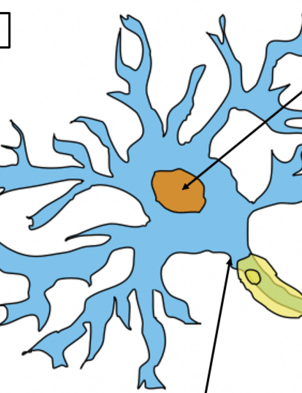
What is this?
The soma, or the cell body of a neuron.
Where is the nucleus located in the neuron cell?
The nucleus is located in the soma, or cell body, of the neuron.
What does the nucleus contain?
The nucleus contains the genetic material that allows the neuron to function.
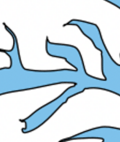
What is this?
The dendrite.
What do dendrites do?
Receive chemical information from adjacent neurons through receptor sites.
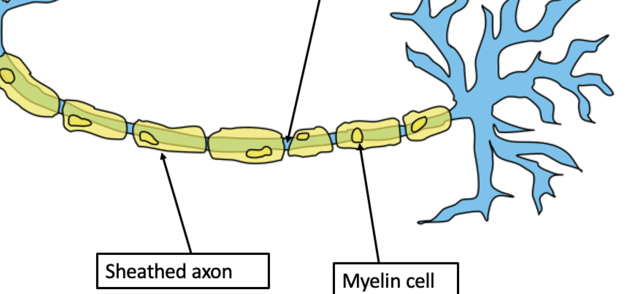
What is this?
The axon fiber, the longest part of the neuron.
What does the axon fiber do?
Carries signal away from soma, and out through the neuron’s terminal.
What is the axon protected by?
The gal cell, or the Schwann cell.
What produces the myelin sheath?
The Schwann cell.
What does the myelin sheath do?
Protect axon from being damaged
What does Schwann cell control?
How fast an action potential can travel down an axon.
What are the gaps in-between the Myelin sheath?
The nodes of Ranvier.
What do the nodes of ranvier do?
The nodes of Ranvier promote continuing action potential.
What happens when a signal reaches the axon terminal?
Neurotransmitters are releaed into the synaptic gap, or synaptic cleft.
What are nociceptors?
They are pain receptors. (NOCI: The nose hurts to get punched in)
What are interneurons?
Neurons within the brain and spinal cord (CNS) communicate internally (inter) and connect sensory neurons to motor neurons, known as efferent neurons.
What is a reflex arc?
A nerve pathway that allows the body to respond to a stimulus without thinking.
What do glial cells do?
Provide support for neurons, help hold neurons together. Insulate neurons, which allow for signal transmission. Faciliate communication between neurons, transport nutrients, and waste products. (Glee makes you happy, lets you get through the day.)
What is the all-or-nothing principle?
States that a neuron will only fire if a threshold is met.
What is threshold?
The minimum amount of stimulation required for a neuron to fire and send an action potential.
What is a refractory period in neurons?
A brief period in which a neuron cannot fire again. (Re.)
What is the tiny gap between neurons?
The synapse.
What are the two types of synapses?
There are chemical and electrical synapses.
What do chemical synapses do?
Use neurotransmitters to send messages through the nervous system.
Where do neurotransmitters travel from?
The presynaptic terminal, and postsynaptic terminal.
What is the presynaptic neuron?
The presynaptic neuron converts the electrical signal into a chemical and sends neurotransmitters into synaptic gap. (prE: electrical into chemical)
What is the postsynaptic neuron?
Transmitters accepted in dendrite of receiving neuron, (Attatched to the soma/cell body.) Post means after.
What is the process of taking excess neurotransmitters left in the synaptic gap?
Reuptake.
What are excitatory neurotransmitters?
Neurotransmitters that increase the likelihood that a neuron will fire an action potential. (It’s excited, excited of the higher the chances.)
What are inhibitory neurotransmitters?
Decrease the likelihood that a neuron will fire an action potential.
What is hyperpolarization?
The inside of a neuron becomes more negative, moving the neuron away from the threshold or intensity level needed for an action potential. (Polarizaiton makes it easier for people to see the negative and move away from threshold of what is bad for them, connect this to neurons.)
What is multiple sclerosis?
Myelin Sheath is damaged, resulting in the disruption of the transmission signals. (Erosis, Erosion of Myelin Sheath, Erosion leads to harder transportation between countries, therefore in psych context, it could be disruption of what…?) Symptoms of muscle weakness, coordination problems, and fatigue. (Because it’s harder for brain to communicate signals needed for movement due to the damage of the protection around the axon which sends information)
What is mysthenia gravis?
An autoimmune disorder that affects the communication between nerves and muscles. (Mys, miscommunication, miscommunication between nerves and muscles, n and m in mysnthia) Antibodies block or destroy receptors, (if no receptors to send receptors for the movement, there will be muscle weakness, and fatigue)
What is acetylcholine?
Acetycholine enables muscle action, learning, and helps with memory. (ace sounds like race, you need muscle action to run a race. Ace, to ace your test you need to learn and have good memory. Ace and Race.)
What is substance P?
Helps with transmititng pain from periphery nervous system to central nervous system. (P=pain)
What does dopamine do?
Helps with movement, learning, attention, and emotions. (Lack of leads to parkinsons and issues with controlling movement, too much leads to schizophrenia)
What does seritonin do?
Impacts an individual’s hunger, sleep, arousal, and mood. (Lack of this leads to depression, which causes disruptions in appetite, sleep, and an overall sad mood.)
What does norepinephrine do?
Increases blood pressure, heart, rate, and helps with the body’s fight or flight response. (Think, periphery system, autonomic system, sympathetic response) (long word needs alterness, alterness is needed in fight or flight)
What does glutamate do?
(too much gluten causes stomach, worst stomach ache will be memorable and a learning experience) Impacts long term memory and learning
What does Gaba do?
GABA helps with sleep, movement, and nervous system.
What does the endocrine system do?
Slower moving compared to the nervous system. Helps regulate different biological processes
What is adrenaline also known as?
Also known as epinephrine. (Epi, epic, epic is huge event, something that causes fight or flight will be a huge event)
What does Leptin do?
Tells the body to stop eating. (Lent is a fast done by Catholics during easter, what sounds similar to that?)
What does cherelin do?
The hunger hormone. (chre sounds like share, you share food)
What is oxytocin?
The love hormone. (Oxy, everyone loves oxygen!)
What are psychoactive drugs?
Purposefully alter an individua;’s perception, consiousness, or mood. Broken down into stimulants,
What do stimulants do?
Excite and promote neural activity. Give individual energy, reduce appetite, and cause irritability. (Stimulate. They stimulate the individual, causing more energy, and reducing appetite (increase in sympathetic nervous system?))
What do depressants do?
Reduce neutral activity, drowsiness, muscle relaxation, and lowered breathing. (Depression makes you tired, what might these types of drugs be called?)
What are examples of depressants?
Alchohol or sleeping pills. Lots of people feel sleepy after drinking alcohol.
What are hallucinogens?
Drugs that cause individuals to sense things
What are examples of hallucinogens?
Marijuana, pyote, and LSD. (pyo, pythons) (Greened out, green could be a hallucination)
What are opioids?
Function as depressants, but so addictive they have their own category. Pain relief.
Examples of opioids?
Morephine, heroin, or oxycodin. (More, people want more, hero saves you from pain, no oxygen can feel painful.)
Examples of stimulants?
Coffee, nicotine, or cocaine. (Coffee stimulates you, cocaine, nicotine, co in nicotine sounds like cocaine)
What do agonists do?
Increase effectiveness of a neurotransmitter. Increase production or increase effects. Can do this through blocking re-uptake, which would cause brain to make more of a transmitter. (Agonist, agony, agony is an increase of pain,)
What do antagonists do?
Decrease effectiveness or production of neurotransmitters. Block receptors from presynaptic axon terminal, or bind to postsynaptic and block intended neurotransmitter.)
Examples of antagonists
Anti-Psychotics, block dopamine, alcohol.
Examples of agonists
Anti-Depressants, Anti-Anxiety medication such as Xanax
What does the brain stem include?
The brain stem includes the medulla oblongata, pons, and midbrain.
What does the medulla do?
Controls heart rate, breathing, blood pressure, and digestion. (La has a steady rhythm when song, what else does?)
What does the pons do?
Connects cerebrum and cerebellum, plays an important role in sleep (ons, on sleep)
What does the cerebellum control?
Balance, procedural learning, and muscle movement. (Bel, balance, double ll for learning, u for procedural)

What is this part of the brain?
The cerebellum (Bel, Below)
What is the reticular activating system?
A bundle of nerves that run through the brainstem (Rect, behind, behind inside brain stem) Helps control sleep, (active, inactive when sleep) RAS, rise and shine
What is the limbic system?
The hypothalamus, hippocampus, thalamus, and amygdala. (Hypo, hippo, thala, gala)
What does the limbic system have a major role in?
Emotion, learning, memory, and motivation. You learn about limbs in biology class, and in biology class you might have no motivation to learn, and emotion filled memories.
What does the thalamus receive?
Sensory information. (Mus, Music, music is auditory sense) Except for smell
What does the hypothalamus do?
Helps maintain homeostasis. (Hypo, hypo homeo)
Pituatary gland
Basically the brain of all glands
What does the amygadla do?
Involved in emotion, (a, anger)
What is the cerebral cortex made out of?
Frontal lobe, Parietal lobe, and Occipital lobe, and Temporal. (FPOT, Flower Pot, flower pot in cc)