BIO + chem OAT Test Prep Day 4
 Call Kai
 Learn
Learn Practice Test
 Spaced Repetition
 Match
Match Flashcards
 Knowt Play
1/43

Earn XP
Description and Tags
Photosynthesis!!!
Name | Mastery | Learn | Test | Matching | Spaced | Call with Kai |
|---|
No analytics yet
Send a link to your students to track their progress
44 Terms
Heterotrophs
Obtain energy by consuming food
Autotrophs
Make their own food
because of photosynthesis
Plants are photoautotrophs
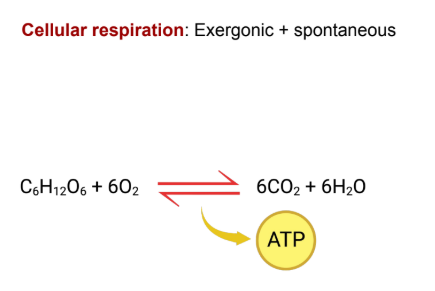
Cellular respiration ~ a review
Give me the formula for cellular respiration
What kind of reaction is it? (endergonic, exergonic, spontaneous, nonspontaneous)
Exergonic
Spontaneous
Photsynthesis
Give me the formula for photosynthesis
What kind of reaction is it? (endergonic, exergonic, spontaneous, nonspontaneous)
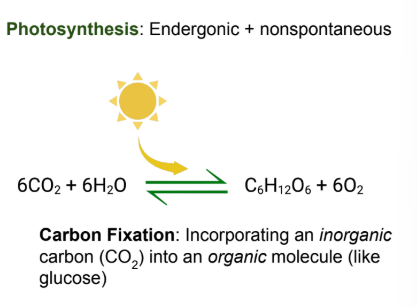
What is carbon fixation
Carbon Fixation: Incorporating an inorganic carbon (CO2 ) into an organic molecule like glucose,
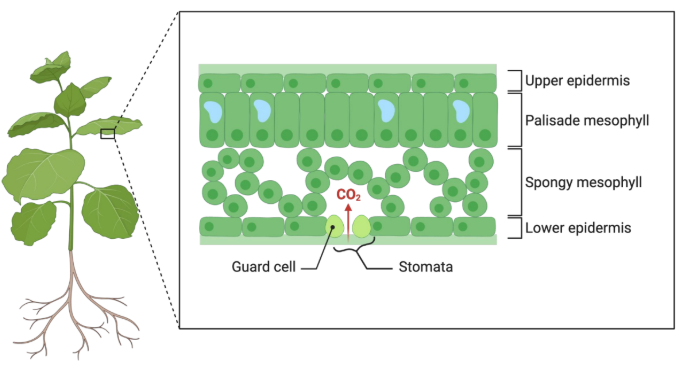
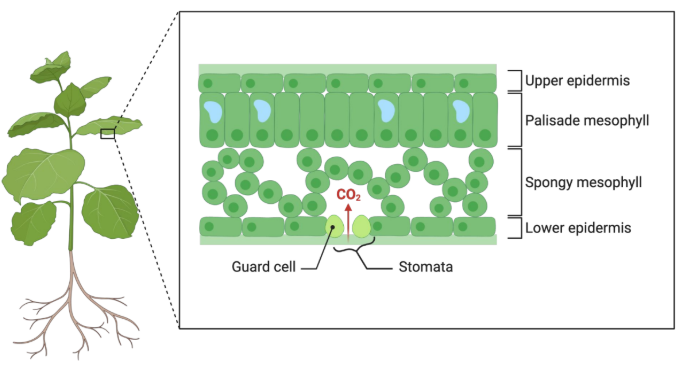
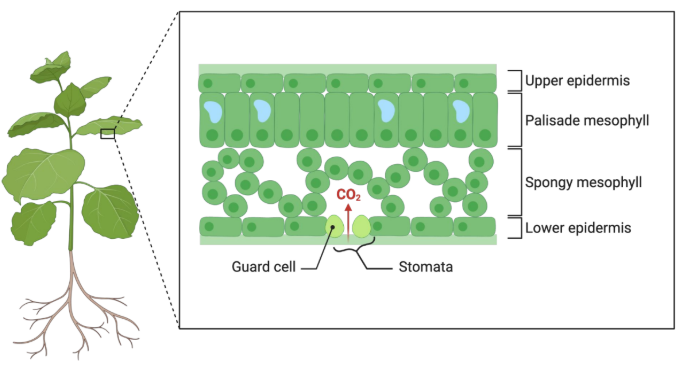
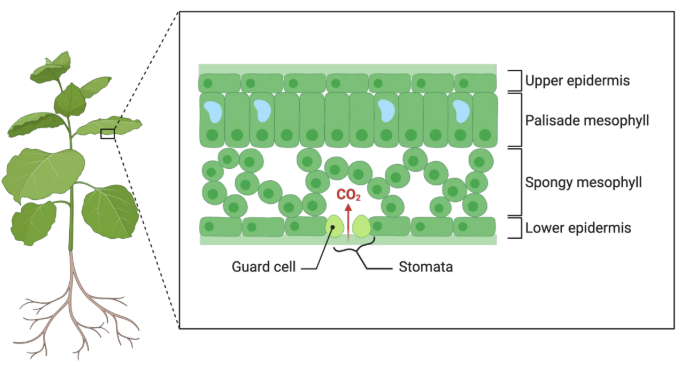
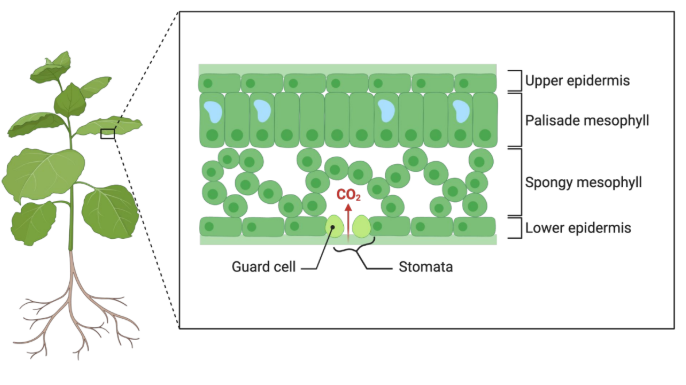
Leaf Anatomy
Give me the layers of the tissue (there are 5)
Epidermis
Palisade Mesophyll
Spongy Mesophyll
Stomata
Guard Cells
Epidermis (plant cell)
Function
Provides protection and prevents water loss
Palisade Mesophyll
Many chloroplasts, major site of photosynthesis
Spongy Mesophyll
Loose arrangement allows for gas exchange
Stomata
Pores for gas exchange
Guard Cells:
Regulate opening/closing of stomata
Chloroplast Structures
Outside
Fluid inside
Membranes that undergo reaction
Inside the membranes that do reactions
Outer + Inner membrane:
Stroma:
Thylakoid:
Lumen
Membranes (plants)
Outer + Inner membrane:
Each made of phospholipid bilayers
Stroma
Stroma: Fluid within chloroplast, site of Calvin cycle
Thylakoid
Thylakoid: Membranes within the stroma, site of light-dependent reactions. A “stack” of thylakoids is called a granum
Lumen
Lumen: Inside of the thylakoid, accumulates H+ ions (↑acidity)
Granum
Stack of thylakoids
Light dependent Reactions in plants
Where do they occur
What do they need
What do they create
What are these reactions?
Light dependent reactions
Take place in thylakoid
Need light energy
Provide ATP and NADPH for light independent reactions
Consist of:
Non-cyclic photophosphorylation
Cyclic photophosphorylation
Light independent Reactions in plants
Where do they occur
What do they need
What do they create
What are these reactions?
Take place in stroma
Don’t directly use light energy
Fix carbon in order to form glucose
Consists of:
Calvin cycle
What are photosystems?
What are the examples of photosystems?
What kind of molecules are in photosystems?
What kind of lights do these systems reflect and absorb?
Protein complexes containing pigments such as chlorophyll and carotenoids
Chlorophyll absorbs blue and red light, reflects green light
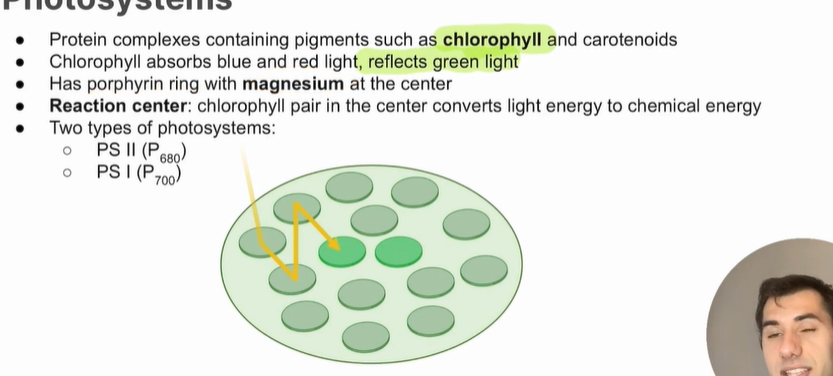
What structure do photosystems have?
What are the two types of photosystem
What is a reaction center in the photosystem?
Has porphyrin ring with magnesium at the center
Reaction center: chlorophyll pair in the center converts light energy to chemical energy, otherwise, they would just bounce around in the photosystem chlorophylls
Two types of photosystems:
PS II (P680)
PS I (P700)
Non-Cyclic Phosphorylation
What kind of reaction is it (light dependent or independent)?
Light Dependent
Non-Cyclic Phosphorylation Steps 1 - 6
Photolysis: light energy used to split water; electrons (e-) passed to PS II, protons (H+) remain in lumen
Electrons in reaction center excited by light energy; passed to electron acceptor (EA) and enter the first electron transport chain (ETC)
Electrons undergo a series of redox reactions in the first ETC, protons are pumped from stroma to lumen
4. Electrons reach reaction center of PS I, where they are re-energized with light and passed to another EA, entering the second ETC
The second electron transport chain leads to NADP+ reductase, which reduces NADP+ to NADPH
6. Protons accumulate in the lumen to form an electrochemical gradient; ATP synthase uses proton flow to produce ATP
Cyclic Phosphorylation Steps
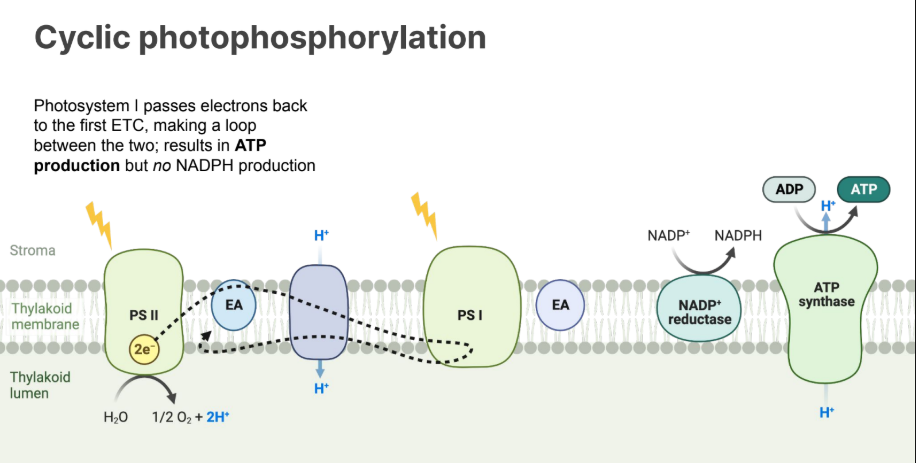
Photosystem I passes electrons back to the first ETC, making a loop between the two; results in ATP production but no NADPH productions
Keep pumping H+ and breaking down H20
Calvin Cycle:
What kind or reaction is it (light, no light)
Where does it occur
What does it do
Light independent
Do not directly use light
Fix carbon in order to form glucose
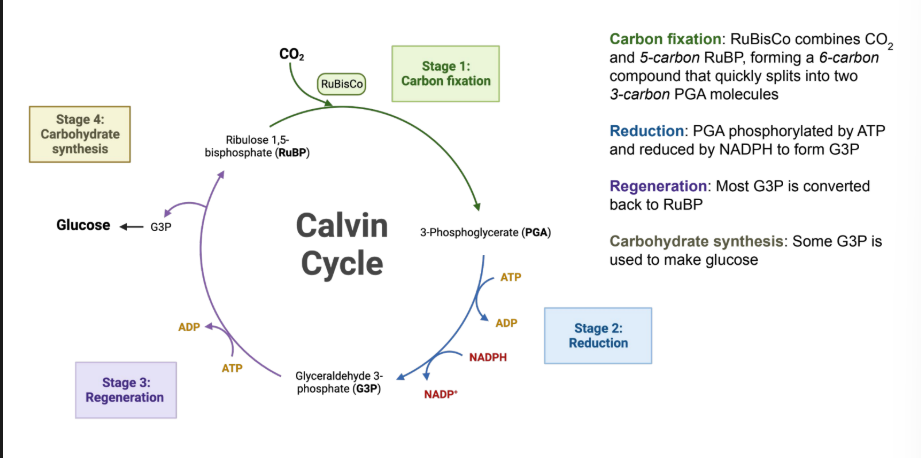
Steps of the Calvin Cycle
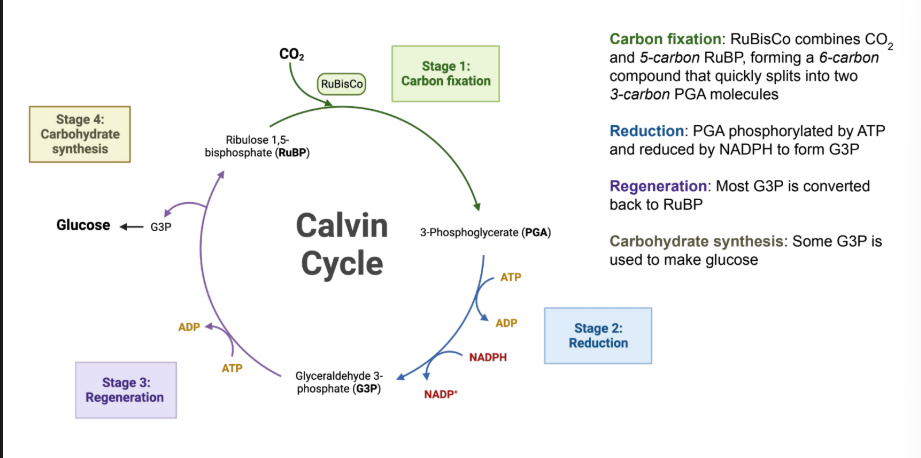
Stage 1: Carbon fixation:
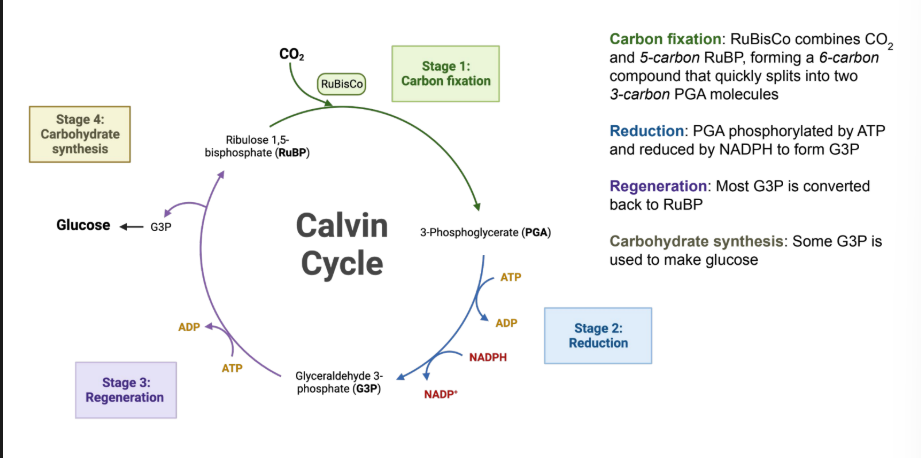
Stage 2: Reduction:
Stage 3: Regeneration:
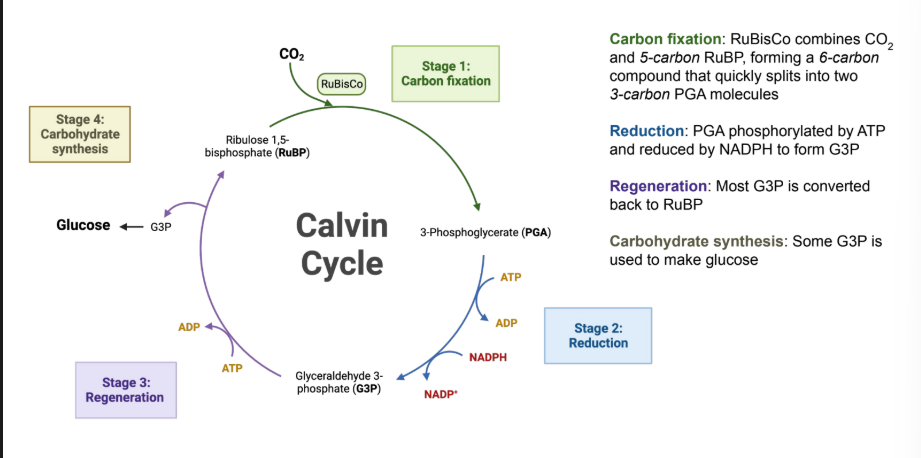
Stage 4: Carbohydrate synthesis:
stage 1 of the calvin cycle
Stage 1: Carbon fixation: RuBisCo combines CO2 and 5-carbon RuBP, forming a 6-carbon compound that quickly splits into two 3-carbon PGA molecules
Stage 2 of the Calvin cycle
Stage 2: Reduction: PGA phosphorylated by ATP
and reduced by NADPH to form G3P
Stage 3 of the calvin cycle
Stage 3: Regeneration: Most G3P is converted back to RuBP
Stage 4 of the calvin cycle
Stage 4: Carbohydrate synthesis: Some G3P is
used to make glucose
Photorespiration
RuBisCo can also react with O2
Results in production of PGA and phosphoglycolate (2-carbon molecule)
Phosphoglycolate must be shuttled through peroxisome and mitochondria for conversion into PGA
This wastes energy and fixed carbons - net benefit of photosynthesis is lost!
Hot and dry conditions encourage stomata closure, leading to oxygen accumulation and increased photorespiration
Also known as C2 photosynthesis
C2 Photosynthesis
RuBisCo can also react with O2
Results in production of PGA and phosphoglycolate (2-carbon molecule)
Phosphoglycolate must be shuttled through peroxisome and mitochondria for conversion into PGA
This wastes energy and fixed carbons - net benefit of photosynthesis is lost!
Hot and dry conditions encourage stomata closure, leading to oxygen accumulation and increased photorespiration
Also known as Photorespiration
C3 Photosynthesis
Fixation of CO2 to form 3-carbon molecule (PGA)
~90% of plants do this
Hot and dry conditions encourage stomata closure and increase photorespiration (C2 photosynthesis)
C4 Photosynthesis
Purpose
● C4 and CAM photosynthesis are evolutionary adaptations that aim to reduce photorespiration in plants inhabiting tough environments
C4 photosynthesis
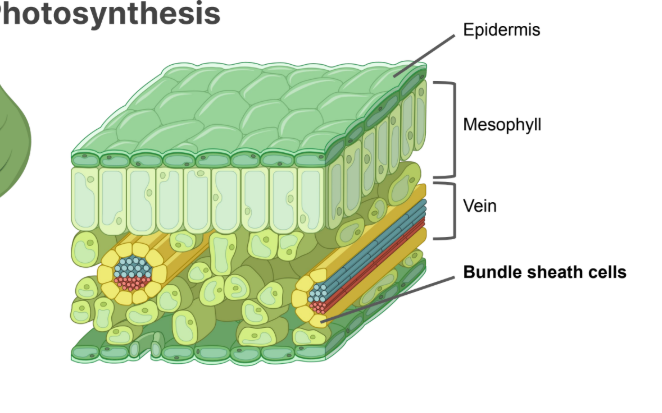
1. PEP carboxylase fixes CO2 to three-carbon PEP molecule, producing four-carbon oxaloacetate, which is then converted to malate
—-Mesophylll———————
Malate transferred to bundle sheath cells: ↓[O2] (WAY LESS O2)
Malate decarboxylated to form CO2 and pyruvate
CO2 fixed by RuBisCo to undergo Calvin cycle, pyruvate shuttled back to mesophyll and converted back to PEP
CORN EXAMPLE
C4 Photosynthesis Structures (4) also, name the two main areas.
Bundle Sheath cells and mesophylls
CAM Photosynthesis (Crassuacean Acid Metabolism)
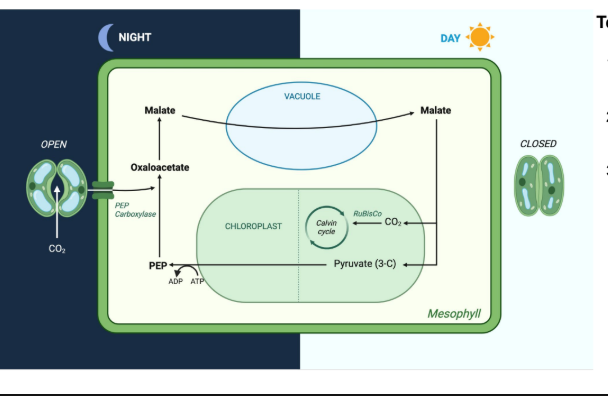
Stomata closed during the day to prevent transpiration (water evaporation)
Stomata open at night, CO2 converted to malate (like in C4 ) and stored in vacuoles
During day malate is decarboxylated to release CO2 for photosynthesis, while pyruvate that is converted back to PEP
EX PINEAPPLE
Phosphoglycolate
Produced when Rubisco interacts O2, formed alongside PGA.
HAS TO BE BROKEN DOWN EVENTUALLY INTO PGA. BUT to do so it has to go to the peroxisome or mitochondria. HUGE ENERGY LOSS
How many Calvin cycle cycles does it take to make one glucose?
6
Alkali Metals
Low ionization energy (super easy to remove an electron from them)
Very reactive with water