Chapter 3: Intro to Prokaryotic Cells
 Call Kai
 Learn
Learn Practice Test
 Spaced Repetition
 Match
Match Flashcards
 Knowt Play
1/36

There's no tags or description
Looks like no tags are added yet.
Name | Mastery | Learn | Test | Matching | Spaced | Call with Kai |
|---|
No analytics yet
Send a link to your students to track their progress
37 Terms
Name two prokaryotic domains
archaea and bacteria
Do prokaryotic organisms contain membrane-bound organelles?
lack membrane bound organelles and nucleus
Are prokaryotes multicellular, unicellular, or can they be both?
unicellular
What does it mean if a bacterium is pleomorphic? What advantage does it give the microbe?
can take different forms/shapes, enhances survival and important for transmission to new human host
How do most prokaryotes obtain nutrients?
diffusion
Describe prokaryote shapes and arrangements
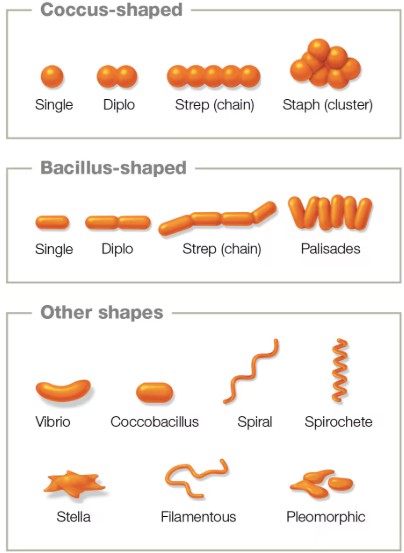
What reproduction process is used by most prokaryotes? Is the process sexual or asexual?
asexually through binary fission
Describe the basic structure of a cell’s plasma membrane (cytoplasmic membrane, cell membrane)? What is its main function?
outer boundary surrounding all cells, controls movements of nutrients, water, etc by being selectively permeable
Most prokaryotic cells possess a protective structure called a cell wall. In respective to prokaryote cell plasma membranes, where is the cell wall located?
lies just inside the plasma membrane
What is the core component of bacterial cell walls?
peptidoglycan(murein)
What is the core component of archaea cell walls?
one or more layers of pseudopeptidoglycan(pseudomurein)
Gram-negative bacteria have a thin layer of peptidoglycan that is surrounded by an outer membrane. What glycolipid enriches the outer membrane?
lipopolysaccharide
Which part of lipopolysaccharide is an endotoxin?
lipid portion
Where in the body would you find enteric bacteria?
intestinal tract of mammals
What is the physical reason why Gram-negative bacteria are not as susceptible to penicillin as Gram-positive organisms are?
penicillin targets peptidoglycan construction, gram-meg cells have thin later of peptidoglycan and the outer membrane adds protection they are less sensitive
Which two genera are the best-known examples of acid-fast bacteria?
Genera Nocardia and Mycobacterium
Even though the reaction is weak, are acid-fast organisms considered Gram-positive or Gram-negative?
Gram-positive
Which bacterial genus lacks cell walls?
Mycoplasma
What is the difference between L-forms and Mycoplasma?
Mycoplasma are wall-less through out their life cycle
L-forms are bacteria that had a cell wall then lost it
What is diffusion? Is it an active or passive process?
passive movement of substances from areas of high concentration to areas of low concentration
What is the difference between simple diffusion and facilitated diffusion?
simple diffusion - does not require assistance from transporters or carriers
facilitated diffusion - moves substances along their concentration gradient with the help of one more transport proteins in the plasma membrane, proteins are specific
What is osmosis? Is it an active or passive process?
water moves from area low solute concentration to an area of a higher solute concentration, passive
What is the function of flagella?
to help the bacteria move, motility
Define chemotaxis
movement of a cell in response to a chemical stimulus
Define phototaxis
movement of a cell in response to light
What is the function of fimbriae?
extrude from the cell surface to help prokaryote stuck to surfaces or each other
What is the function of pili?
used to adhere to surfaces, move, and aid in gene transfer through conjugation
What are two ways that a bacterial capsule increase pathogenicity of the bacteria?
promotes adhesion to host tissues and provides some protection against host immune cells by interfering with phagocytosis
What is the main molecule contained in the nucleoid region of a bacteria?
DNA
What is the function of ribosomes?
build proteins by linking amino acids together
How are prokaryotic ribosomes different than eukaryotic ribosomes?
prokaryotic ribosomes have lower overall mass and diameter than eukaruyotic
What is the sedimentation rate of complete prokaryotic and complete eukaryotic ribosomes?
prokaryotic - 70S
eukaryotic - 80S
With complete ribosome sedimentation in mind, what property of chloroplasts and mitochondria support the endosymbiotic theory?
the larger eukaryotic evolved from the smaller but similar prokaryote
What is the function of a prokaryotic cytoskeleton?
structure and support, organize cell division(binary fission), directs the construction of the cell wall, and provides an overall general organization for biochemical processes
What are inclusion bodies and what is their function
distinct collection of substances inside prokaryotic cells, storage reserves for nutrients, energy, or building blocks
How do endospores differ from vegetative cells?
endospores are inactive structures while vegetative cells are actively growing
Name three genera that contain the most medically relevant species that produce endospores
Bacillus, Clostridium, and Clostridioides