PROTEIN & ENZYMES - PART 3
 Call Kai
 Learn
Learn Practice Test
 Spaced Repetition
 Match
Match Flashcards
 Knowt Play
1/56

There's no tags or description
Looks like no tags are added yet.
Name | Mastery | Learn | Test | Matching | Spaced | Call with Kai |
|---|
No analytics yet
Send a link to your students to track their progress
57 Terms
c. Redox
[EXAMPLE OF ENZYMES]
EC1 Oxidoreductase reaction type
a. Hydrolysis
b. Transfer
c. Redox
d. Isomerization
b. Alcohol dehydrogenase
[EXAMPLE OF ENZYMES]
Enzyme that converts ethanol to ethanal (acetaldehyde)
a. Aldehyde dehydrogenase
b. Alcohol dehydrogenase
c. DHF reductase
d. Carbonic anhydrase
c. Oxidation
[EXAMPLE OF ENZYMES]
Addition of O
a. Reduction
b. Hydrolysis
c. Oxidation
d. Isomerization
d. Reduction
[EXAMPLE OF ENZYMES]
Addition of H
a. Oxidation
b. Hydrolysis
c. Transfer
d. Reduction
c. DHF reductase
[EXAMPLE OF ENZYMES]
Enzyme that converts dihydrofolate (DHF) to Tetrahydrofolate
a. Alcohol dehydrogenase
b. Hexokinase
c. DHF reductase
d. Phosphoglucomutase
a. Phosphate
[EXAMPLE OF ENZYMES]
EC2 Transferase example reaction transfers this group
a. Phosphate
b. Methyl
c. Amino
d. Acetyl
c. Hexokinase
[EXAMPLE OF ENZYMES]
Enzyme that converts glucose + ATP to glucose-PO4 + ADP
a. Phosphoglucomutase
b. Sucrase
c. Hexokinase
d. Protease
b. Protease
[EXAMPLE OF ENZYMES]
Enzyme that converts protein to amino acids
a. Sucrase
b. Protease
c. Hexokinase
d. Carbonic anhydrase
c. Sucrase
[EXAMPLE OF ENZYMES]
Enzyme that converts sucrose to glucose and fructose
a. Protease
b. Hexokinase
c. Sucrase
d. Phosphoglucomutase
c. Carbonic anhydrase
[EXAMPLE OF ENZYMES]
Enzyme that converts H2CO3 (carbonic acid) to H2O + CO2
a. Histidine decarboxylase
b. Phosphoglucomutase
c. Carbonic anhydrase
d. HMG-CoA synthase
d. Histidine decarboxylase
[EXAMPLE OF ENZYMES]
Enzyme that converts histidine (amino acid) to histamine
a. Carbonic anhydrase
b. HMG-CoA synthase
c. Phosphoglucomutase
d. Histidine decarboxylase
b. Phosphoglucomutase
[EXAMPLE OF ENZYMES]
Enzyme that converts glucose 6-PO4 to glucose-1-PO4
a. Histidine decarboxylase
b. Phosphoglucomutase
c. Hexokinase
d. Carbonic anhydrase
b. HMG-CoA synthase
[EXAMPLE OF ENZYMES]
Enzyme that converts 3x acetyl-CoA to HMG-CoA
a. Sucrase
b. HMG-CoA synthase
c. Carbonic anhydrase
d. Hexokinase
a. True
[ENZYME KINETICS]
Enzymes are SPECIFIC and SATURABLE
a. True
b. False
a. True
[ENZYME KINETICS]
Increase substrate = increase enzyme activity
a. True
b. False
a. True
[ENZYME KINETICS]
Enzyme Kinetics follows first-order kinetics
a. True
b. False
a. True
[ENZYME KINETICS]
When all enzymes become occupied at some point, the graph shifts to Zero-order kinetics
a. True
b. False
c. Maximum velocity (Vmax)
[ENZYME KINETICS]
Highest attainable velocity of a substrate for an enzyme
a. Michaelis constant (Km)
b. Optimum velocity
c. Maximum velocity (Vmax)
d. Initial velocity
![<p>[ENZYME KINETICS]</p><p>Highest attainable velocity of a substrate for an enzyme</p><p class="font-claude-response-body break-words whitespace-normal">a. Michaelis constant (Km)<br>b. Optimum velocity<br>c. Maximum velocity (Vmax)<br>d. Initial velocity</p>](https://assets.knowt.com/user-attachments/80708884-d87e-42c6-a60e-83e94ca00c3d.png)
c. Michaelis constant (Km)
[ENZYME KINETICS]
Substrate concentration [S] needed to reach half of Vmax
a. Maximum velocity (Vmax)
b. Optimum pH
c. Michaelis constant (Km)
d. Optimum temperature
![<p>[ENZYME KINETICS]</p><p>Substrate concentration [S] needed to reach half of Vmax</p><p class="font-claude-response-body break-words whitespace-normal">a. Maximum velocity (Vmax)<br>b. Optimum pH<br>c. Michaelis constant (Km)<br>d. Optimum temperature</p>](https://assets.knowt.com/user-attachments/2abf9eed-e4d0-4bc3-97ee-6e85f515fb14.png)
d. Michaelis constant (Km)
[ENZYME KINETICS]
The amount of substrate required to get the 50% of Vmax
a. Maximum velocity (Vmax)
b. Optimum temperature
c. Optimum pH
d. Michaelis constant (Km)
![<p>[ENZYME KINETICS]</p><p>The amount of substrate required to get the 50% of Vmax</p><p class="font-claude-response-body break-words whitespace-normal">a. Maximum velocity (Vmax)<br>b. Optimum temperature<br>c. Optimum pH<br>d. Michaelis constant (Km)</p>](https://assets.knowt.com/user-attachments/5568c78d-4af4-4401-a5fd-adfa29c8bfa3.png)
c. Affinity
[ENZYME KINETICS]
Km measures this
a. Velocity
b. Concentration
c. Affinity
d. Inhibition
![<p>[ENZYME KINETICS]</p><p>Km measures this</p><p class="font-claude-response-body break-words whitespace-normal">a. Velocity<br>b. Concentration<br>c. Affinity<br>d. Inhibition</p>](https://assets.knowt.com/user-attachments/3876aca7-fda9-4448-b7a0-9b93ce0a0389.png)
b. Affinity
[ENZYME KINETICS]
Ease of binding between the enzyme and substrate
a. Vmax
b. Affinity
c. Km
d. Inhibition constant
![<p>[ENZYME KINETICS]</p><p>Ease of binding between the enzyme and substrate</p><p class="font-claude-response-body break-words whitespace-normal">a. Vmax<br>b. Affinity<br>c. Km<br>d. Inhibition constant</p>](https://assets.knowt.com/user-attachments/73e7926d-3ab1-4bf8-bd19-5a8203b8fb43.png)
c. ↑Km = ↓Affinity
[ENZYME KINETICS]
Relationship between Km and Affinity
a. ↑Km = ↑Affinity
b. ↓Km = ↓Affinity
c. ↑Km = ↓Affinity
d. Km has no relation to Affinity
![<p>[ENZYME KINETICS]</p><p>Relationship between Km and Affinity</p><p class="font-claude-response-body break-words whitespace-normal">a. ↑Km = ↑Affinity<br>b. ↓Km = ↓Affinity<br>c. ↑Km = ↓Affinity<br>d. Km has no relation to Affinity</p>](https://assets.knowt.com/user-attachments/2cccd451-af9f-491f-9c0e-102cd9b9cd12.png)
c. KmD > KmT
[ENZYME KINETICS]
Relationship between KmD and KmT shown in the graph
a. KmD = KmT
b. KmD < KmT
c. KmD > KmT
d. No relationship
![<p>[ENZYME KINETICS]</p><p>Relationship between KmD and KmT shown in the graph</p><p class="font-claude-response-body break-words whitespace-normal">a. KmD = KmT<br>b. KmD < KmT<br>c. KmD > KmT<br>d. No relationship</p>](https://assets.knowt.com/user-attachments/a076040e-a7c3-4b0e-b425-e66dc407dcc3.png)
c. AffT > AffD
[ENZYME KINETICS]
Relationship between AffT and AffD shown in the graph
a. AffT < AffD
b. AffT = AffD
c. AffT > AffD
d. No relationship
![<p>[ENZYME KINETICS]</p><p>Relationship between AffT and AffD shown in the graph</p><p class="font-claude-response-body break-words whitespace-normal">a. AffT < AffD<br>b. AffT = AffD<br>c. AffT > AffD<br>d. No relationship</p>](https://assets.knowt.com/user-attachments/39f9b7b0-5eac-4156-a991-e2af30c3ba3f.png)
a. True
[ENZYME KINETICS]
The Enzyme activity [V] is not just affected by the amount of substrate. It can also be affected by pH and temperature
a. True
b. False
b. Optimum pH and optimum temperature
[ENZYME KINETICS]
Values where the enzyme activity peaks are called _______
a. Km and Vmax
b. Optimum pH and optimum temperature
c. First-order and zero-order kinetics
d. Active site and binding site
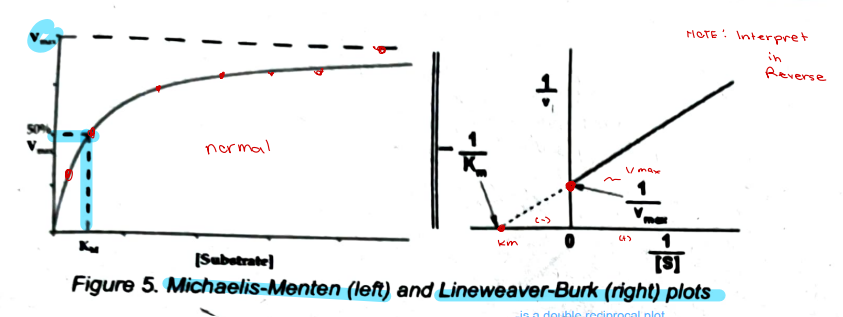
[ENZYME KINETICS]
Figure 5. Michaelis-Menten (left) and Lineweaver-Burk (right) plots.
c. Michaelis-Menten plot
[ENZYME KINETICS]
The plot showing [Substrate] vs velocity in a hyperbolic curve
a. Lineweaver-Burk plot
b. Hill plot
c. Michaelis-Menten plot
d. Scatchard plot
![<p>[ENZYME KINETICS]</p><p>The plot showing [Substrate] vs velocity in a hyperbolic curve</p><p class="font-claude-response-body break-words whitespace-normal">a. Lineweaver-Burk plot<br>b. Hill plot<br>c. Michaelis-Menten plot<br>d. Scatchard plot</p>](https://assets.knowt.com/user-attachments/5993bf7f-8e41-45e6-bcdb-fb54fbf3288b.png)
c. Lineweaver-Burk plot
[ENZYME KINETICS]
A double reciprocal plot
a. Michaelis-Menten plot
b. Hill plot
c. Lineweaver-Burk plot
d. Eadie-Hofstee plot
b. Inhibitors
[ENZYME KINETICS]
In the world of pharmacy, many enzymes serve as targets of medicinal drugs. For most cases, the drugs want to stop them. Such drugs are best called
a. Activators
b. Inhibitors
c. Cofactors
d. Substrates
Competitive Inhibition
Noncompetitive Inhibition
Uncompetitive Inhibition
Types of Inhibition [3]
a. Competitive Inhibition
[TYPES OF INHIBITION]
Type of inhibition that targets active site
a. Competitive Inhibition
b. Noncompetitive Inhibition
c. Uncompetitive Inhibition
b. Noncompetitive Inhibition
[TYPES OF INHIBITION]
Type of inhibition that targets allosteric site whether the enzyme is alone (ES) or with the substrate (ES)
a. Competitive Inhibition
b. Noncompetitive Inhibition
c. Uncompetitive Inhibition
c. Uncompetitive Inhibition
[TYPES OF INHIBITION]
Type of inhibition that targets allosteric site only when the ES complex is established
a. Competitive Inhibition
b. Noncompetitive Inhibition
c. Uncompetitive Inhibition
a. True
[TYPES OF INHIBITION]
The inhibitors can also be identified based on how they alter Michaelis and Lineweaver Plots
a. True
b False
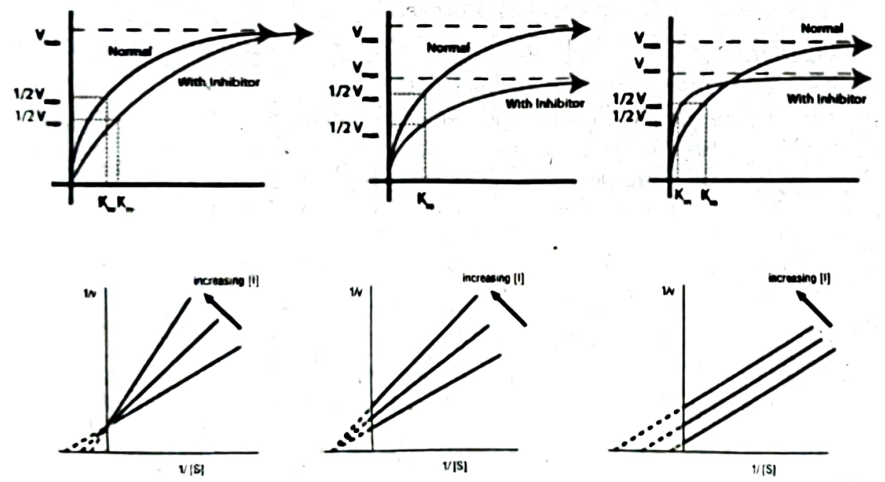
[TYPES OF INHIBITION]
Figure 6: Different Types of Inhibition
a. Competitive Inhibition
[TYPES OF INHIBITION]
Type of inhibition where Vmax is SAME and Km is INCREASED
a. Competitive Inhibition
b. Noncompetitive Inhibition
c. Uncompetitive Inhibition
b. Noncompetitive Inhibition
[TYPES OF INHIBITION]
Type of inhibition where Vmax is DECREASD and Km is SAME
a. Competitive Inhibition
b. Noncompetitive Inhibition
c. Uncompetitive Inhibition
c. Uncompetitive Inhibition
[TYPES OF INHIBITION]
Type of inhibition where both Vmax and Km are DECREASED
a. Competitive Inhibition
b. Noncompetitive Inhibition
c. Uncompetitive Inhibition
c. Lipase
[ENZYMES WITH CLINICAL RELEVANCE]
Hydrolyzes fats
a. Amylase
b. Trypsin
c. Lipase
d. Lactate dehydrogenase
b. Amylase
[ENZYMES WITH CLINICAL RELEVANCE]
Hydrolyzes starch
a. Lipase
b. Amylase
c. Trypsin
d. Creatine kinase
d. Trypsin
[ENZYMES WITH CLINICAL RELEVANCE]
Hydrolyzes proteins
a. Lipase
b. Amylase
c. Alkaline phosphatase
d. Trypsin
b. Alkaline phosphatase (ALP)
[ENZYMES WITH CLINICAL RELEVANCE]
Hydrolyzes esters at alkaline pH
a. Acid phosphatase (ACP)
b. Alkaline phosphatase (ALP)
c. Lactate dehydrogenase (LDH)
d. Creatine kinase (CK)
c. Acid phosphatase (ACP)
[ENZYMES WITH CLINICAL RELEVANCE]
Hydrolyzes esters at acidic pH
a. Alkaline phosphatase (ALP)
b. Lactate dehydrogenase (LDH)
c. Acid phosphatase (ACP)
d. Creatine kinase (CK)
d. Lactate dehydrogenase (LDH)
[ENZYMES WITH CLINICAL RELEVANCE]
Converts lactate to pyruvate
a. Creatine kinase (CK)
b. Acid phosphatase (ACP)
c. Transaminases (AST, ALT)
d. Lactate dehydrogenase (LDH)
b. Creatine kinase (CK)
[ENZYMES WITH CLINICAL RELEVANCE]
Adds phosphate to creatine
a. Lactate dehydrogenase (LDH)
b. Creatine kinase (CK)
c. Alkaline phosphatase (ALP)
d. Transaminases (AST, ALT)
d. Transaminases (AST, ALT)
[ENZYMES WITH CLINICAL RELEVANCE]
Interconverts amino acids to keto acids and vice-versa
a. Creatine kinase (CK)
b. Lactate dehydrogenase (LDH)
c. Acid phosphatase (ACP)
d. Transaminases (AST, ALT)
b. Pancreatic disease, others
[ENZYMES WITH CLINICAL RELEVANCE]
Common implication (high) of lipase, amylase, and trypsin
a. Bone disease
b. Pancreatic disease, others
c. Prostate cancer
d. Myocardial infarct (MI) or heart failure
a. Bone disease
[ENZYMES WITH CLINICAL RELEVANCE]
Common implication (high) of alkaline phosphatase (ALP)
a. Bone disease
b. Pancreatic disease
c. Prostate cancer
d. Myocardial infarct (MI)
c. Prostate cancer
[ENZYMES WITH CLINICAL RELEVANCE]
Common implication (high) of acid phosphatase (ACP)
a. Bone disease
b. Myocardial infarct (MI)
c. Prostate cancer
d. Liver function test
b. Myocardial infarct (MI) or heart failure
[ENZYMES WITH CLINICAL RELEVANCE]
Common implication (high) of lactate dehydrogenase (LDH)
a. Bone disease
b. Myocardial infarct (MI) or heart failure
c. Prostate cancer
d. Pancreatic disease
c. Muscle/heart
[ENZYMES WITH CLINICAL RELEVANCE]
CK-MM isoenzyme is associated with this organ(s)
a. Brain
b. Heart only
c. Muscle/heart
d. Liver
b. Heart
[ENZYMES WITH CLINICAL RELEVANCE]
CK-MB isoenzyme is associated with this organ
a. Muscle
b. Heart
c. Brain
d. Liver
d. Brain
[ENZYMES WITH CLINICAL RELEVANCE]
CK-BB isoenzyme is associated with this organ
a. Heart
b. Muscle
c. Liver
d. Brain
c. Liver (liver function test)
[ENZYMES WITH CLINICAL RELEVANCE]
When both AST and ALT are high, this indicates
a. Myocardial infarct
b. Bone disease
c. Liver (liver function test)
d. Prostate cancer
d. Myocardial infarct (MI)
[ENZYMES WITH CLINICAL RELEVANCE]
When AST is high alone, this indicates
a. Liver function test
b. Bone disease
c. Prostate cancer
d. Myocardial infarct (MI)