Wound Care & injury Recognition
 Call Kai
 Learn
Learn Practice Test
 Spaced Repetition
 Match
Match Flashcards
 Knowt Play
1/65

There's no tags or description
Looks like no tags are added yet.
Name | Mastery | Learn | Test | Matching | Spaced | Call with Kai |
|---|
No analytics yet
Send a link to your students to track their progress
66 Terms
OSHA 1991
blood-borne pathogen focus
CDC: 2007
focus on body isolation through the use of PPE
When bleeding occurs
Removal of athlete from the field of play.
Assess the source of the bleed.
Control the bleed.
Clean the area. Including the jersey.
Provide appropriate treatment to protect the wound, the injured athlete and the other participants.
Handwashing
Hands and other skin surfaces that come in contact with blood or other body fluids should be washed immediately with soap and water.
Anti-germicidal agents can also be used but handwashing should be done when available to do so.
Hands should be washed between each treatment to decrease the chance of infection or transmission.
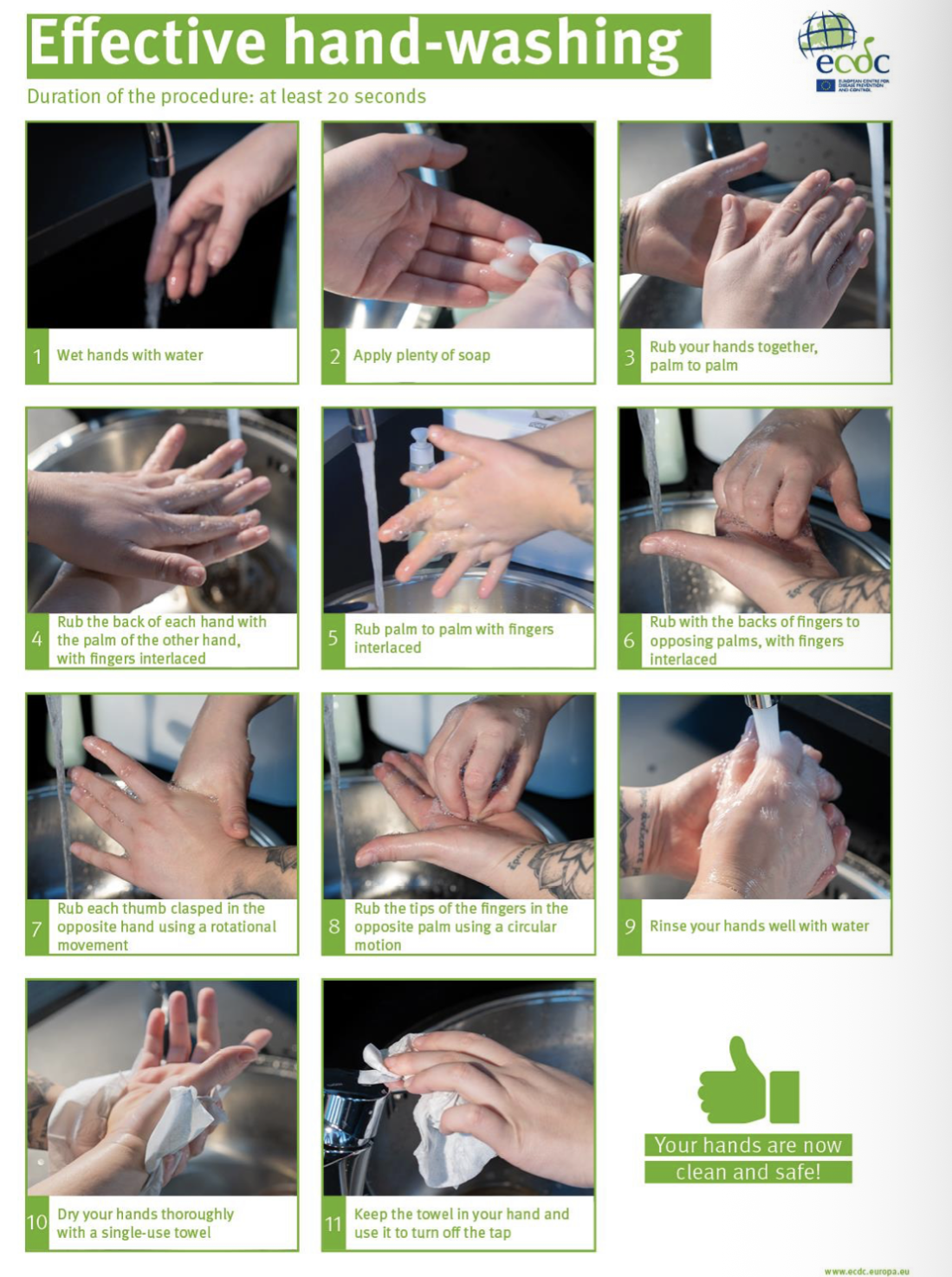
Effective hand washing steps
Wet hands with water
Apply plenty of soap
Rub your hands together, palm to palm
Rub the back of each hand with the palm of the other hand, with fingers interlaced
Rub palm to palm with fingers interlaced
Rub with the backs of fingers to opposing palms, with fingers interlaced
Rub each thumb clasped in the opposite hand using a rotational movement
Rub the tips of the fingers in the opposite palm using a circular motion
Rinse your hands well with water
Dry your hands thoroughly with a single-use towel
Keep the towel in your hand and use it to turn off the tap
Effective hand-washing
Personal Protective Equipment (PPE)
Disposable gloves, non-absorbent gowns, facemask/shield, goggles, disposable face shields for CPR.
Gloves:
Must be used when handling any potentially infectious materials.
Recommended use of non-latex, latex free vinyl or nitrile rubber gloves.
Gloves should always be removed carefully after use and disposed of properly.
Steps to remove gloves
On removal of the first glove, be careful not to touch your skin with any part of the contaminated glove. To do this, using the external surface as a shield, hook the gloved fingers of one hand at the wrist of the other glove ...
... and pull the glove down towards the fingers.
Once the first glove is removed, hold it in the gloved hand
To remove the second glove and avoid contact with the contaminated glove, place fingers into the inside surface of the glove (close to wrist) and pull down over the fingers
When both gloves are removed, touch only the surface close to the wrist.
Dispose of the gloves in the clinical waste bin - if gloves are heavily soiled removed and place gloves into the clinical waste bin separately.
Decontaminate your hands. This is imperative in order to reduce cross-contamination.
MSK Assessment and Management
Ax decisions
Immediate Tx
Detailed Hx:
Observation:
“Palpation”
SHARP
Immediate Tx
POLICE (PRICE, PIER, RICE, RICES)
Cryokinetics
Police
Protection, Optimal Loading, Ice, Compression, and Elevation.
Protect (P)
discontinuing activity
Taping, wraping, splinting, slinging
Optimal loading (O)
After 24-48 hours
Start loading the joint
Weight bearing, movements
Icing (I)
20 minutes (crushed ice)
Chemical pack = need wet barrier between skin
Compress (c)
Compress the injury
towards the heart (lower body)
Elevate
as much as you can
How long before you can do optimal loading
24-48 hours after injury
Why do we use crushed ice
you can put it directly onto the skin
the water barrier prevents frostbite
How we wrap ice to the skin
Compression
flexy wrap
Tensor bandage
How long ice stay on (first part)
20 minutes
The four ice sensations
3-5 minutes
Cold
Burn
Ache
Numb
Elevate how much and long
6-8 inches
Horseshoe pad (Foam)
reduce swelling around the area
Wrap over w/ tensor wrap (overlap by half) - compression
24-48 hours
No weight on ankle (crutches)
MSK Assessment “Remember to!!”
Document everything related to the injury
Detailed Hx:
MOI (events leading up to the injury)
Was anything heard at the time of injury(snaps, cracks, pop?)
Pain (severity ?/10; type; location)
Observation:
Compare to the other side (checking for asymmetry)
Obvious deformity, swelling, discoloration
“Palpation“
can be done very lightly to feel for temperature changes
SHARP
is an acronym used to evaluate inflammation:
SHARP
S – swelling (evaluate symetrically)
H – heat (must touch and compare sides)
A – altered function (reported/asked)
R – rubor (redness, discoloration)
P – pain (severity, type, location)
S (sharp)
swelling (evaluate symetrically)
H (sharp)
heat (must touch and compare sides)
A (sharp)
altered function (reported/asked)
R (sharp)
rubor (redness, discoloration)
P (sharp)
pain (severity, type, location)
What is important to consider sharp
Always evaluating bilaterally to identify asymmetry.
Goals and treatment in acute care
Protect the injury from further damage.
Reduce secondary injury (from acute inflammatory response)
Control pain
Control swelling
Cryokinetics
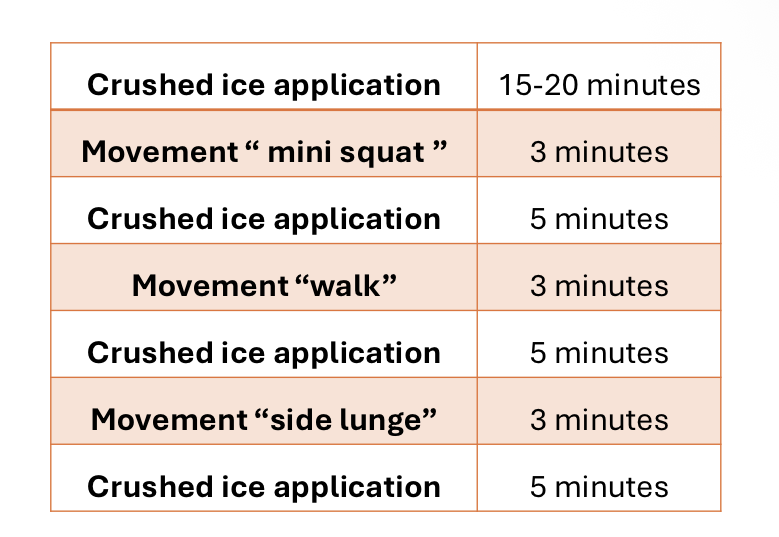
Cryokinetics (steps)
Crushed ice application | 15-20 minutes |
Movement " mini squat" | 3 minutes |
Crushed ice application | 5 minutes |
Movement "walk" | 3 minutes |
Crushed ice application | 5 minutes |
Movement "side lunge" | 3 minutes |
Crushed ice application | 5 minutes |
When treating what do you want to do (important)
a functional test
wiggle toes
What toe touching
Cap refill
Skin trauma
Blisters (open/closed)
Wounds
Cleaning, debridement, dressing
Are sutures needed
Bleeding nose
Wounds
Abrasions
Lacerations
Supplies (Abrasions)
Zinc Oxide
Non-Stick Pad
Pre-Wrap
Elastic Tape
Athletic tape (keep elastic tape down)
Abrasions (treatment)
clean area
Put zinc oxide over the wound
Put non stick pad overtop
Wrap pre-wrap over non-stick pad
Secure with elastic tape
Athletic tape end (keep elastic tape down)
Lacerations
Deeper lacerations or incisions may require manual closure using sutures, if underlying tissues such as fat, tendons, bone or vessels are exposed.
Supplies (Lacerations)
skin tuffner
Q-tip
Sutures
Bandage/pad
Hyperflex
Lacerations (treatment)
clean area
Apply skin tuffner around area w/ q-tip
Suture the wound
Put bandage over (must cover)
Hyperflex each side
elastic tape (optional)
Blisters (open/closed)
Formed by friction and shearing forces on the superficial skin
As friction delaminates tissues the space between layers is filled with fluid.
Open
Closed
Supplies (Open Blister)
Second Skin
Hyperflex
Elastic Tape
Athletic tape (keep elastic tape down)
Open blister (treatment)
Second skin on top of blister (remove plastic film one side only)
Hyperflex over second skin
Wrap overtop with elastic tape
Athletic tape end (keep elastic tape down)
Supplies (Closed Blister)
Zinc Oxide
Pad (cut it to size, hole in middle)
Elastic tape
Athletic tape (keep elastic tape down)
Closed blister (Treatment)
zinc oxide on the blister
Cut & Put a pad overtop (w/ hole to go around)
Wrap overtop with elastic tape
Athletic tape end (keep elastic tape down)
Bleeding nose
Typically occur from trauma.
Must evaluate other issues from the trauma:
Must evaluate other issues from the trauma: (bleeding nose)
R/O concussion
Evaluate nose and surrounding area for fracture
Supplies (Bleeding Nose)
Gause
Rhino Rocket
Bleeding nose (Treatment)
lean forward
Gause and squeeze nose (5 minutes)
Rhino rocket (if continues)
Go to hospital (if continues for longer 15 minutes)
Skin Trauma – cleaning techniques
Irrigation:
Scrubbing & Swabbing:
Soaking:
Debridement:
Irrigation:
controlled flow of a solution across the wound bed is the preferred cleansing technique for open traumatic wounds.
Scrubbing & Swabbing:
involves direct contact of a soft brush or sterile gauze, with tissues, to remove debris and bacteria.
Soaking
immersion of the body, part in wound into a tub or container of a cleansing solution to hydrate and loosen contaminants.
Debridem
removal of necrotic tissue, foreign bodies/debris, and bacteria from the wound bed by way of scrubbing.
Puncture (Definition)
A type of wound caused by a sharp object penetrating the skin, which can lead to serious infection risks.
referred immediately to physician
Lacerations (Definition)
A type of wound resulting from the tearing of skin or soft tissues, often characterized by jagged edges and a high risk of infection.
sharp or pointed object
Incisions (definition)
A type of wound caused by a clean, smooth cut through the skin or soft tissue, usually created by a sharp instrument such as a knife, resulting in well-defined edges.
Avulsions (definition)
A type of wound where tissue is forcibly detached from the body, often causing heavy bleeding and requiring immediate medical attention for potential reattachment.
Bruise (definition) {ecchymosis}
injury to the soft tissue characterized by localized bleeding under the skin due to ruptured blood vessels. This results in a discoloration that typically appears black and blue, accompanied by swelling and tenderness
POLICE method
Compressive blunt force