week 6 biophysics
 Call Kai
 Learn
Learn Practice Test
 Spaced Repetition
 Match
Match Flashcards
 Knowt Play
1/30

There's no tags or description
Looks like no tags are added yet.
Name | Mastery | Learn | Test | Matching | Spaced | Call with Kai |
|---|
No analytics yet
Send a link to your students to track their progress
31 Terms
What is gait and what is gait analysis used for?
Gait is the pattern of limb movement during locomotion. Gait analysis is its systematic study of the gait of a subject using different methods in order to: diagnose and treat conditions, track treatment impact after illness or surgery, performance enhancement in sports, assess fall risk.
What is the gait cycle and how is it divided?
The gait cycle is the full cycle where one limb goes through from initial heel contact to next heel contact by the same foot and is divided into stance phase and swing phase. Stance phase (60% of gait cycle time): limb in contact with ground to maintain balance. Swing phase (40% of gait cycle time): limb moves forward and consists of the initial swing (acceleration), mid-swing, terminal swing (deceleration).
What does normal vs abnormal gait look like on an accelerometer?
Normal: large positive y-axis peak at heel strike; constant y = negative g during mid-stance.
Abnormal: e.g. idiopathic toe walking — habitual, no neuromuscular/orthopaedic disorder, walk on heels if prompted. Vestibular issues — balance issues lead to gait and balance problems.
What are the calf muscles relevant to gait and what do they do?
Gastrocnemius: running and jumping (not walking); plantar flexion of foot.
Soleus: walking and running; important for balance; acts as skeletal muscle pump.
What are the conditions for equilibrium and balance?
Net force = 0 AND net torque = 0 required for equilibrium. Lower centre of gravity = better balance. Centre of mass must be over a stable base.
What is the centre of gravity/centre of mass?
The centre of mass is the point at which gravitational force may be taken to act. Total torque = 0 at this point. Walking: COM vaults up after heel strike, reaches highest point at mid-stance, then swings down; then no aerial phase (inverted pendulum). Running: COM falls down after heel strike, reaches lowest point at mid-stance, springs back up, whole-body aerial phase (pogo stick/spring, more compliant).
Describe the three classes of levers in the body.
First class: fulcrum between resistance and force — can provide a mechanical advantage (more output force), used to create a larger movement.
Second class: load between effort and fulcrum — always mechanical advantage; smaller effort moves larger load (e.g. lower leg with fulcrum at toes; wheelbarrow).
Third class: effort between fulcrum and load — mechanical disadvantage but greater range of movement and speed due to when an output force is applied, it is over a greater distance than the input force; very common in the body.
How does the position of the effort arm affect mechanical advantage in levers?
Far Away (Long Effort Arm): if the input force (effort) is applied far away from the fulcrum relative to the load, the effort arm is longer than the load arm. This results in a high mechanical advantage, making it easier to lift a heavy load with less effort.
Close Together (Short Effort Arm): if the input force (effort) is applied close to the fulcrum, the effort arm is shorter than the load arm. This results in a low mechanical advantage (less than 1), meaning you must apply more force than the load actually weighs, typically done to increase speed or range of motion rather than lifting force.
The load arm — the distance from the fulcrum to the load — is short. According to the law of the lever, a shorter load arm requires less effort to move a larger load. Result: high mechanical advantage (greater than 1).
What are the regions and components of the skeletal system?
Axial and appendicular skeleton. Components: cartilage, bones, joints.
What is the periosteum?
Outer covering of bone except at joint surfaces. Tough connective tissue membrane. Highly vascularised so many blood vessels pass through it to supply the bone. Contains nerves so it is sensitive and pain from fractures comes from here. Important for bone growth in thickness and for bone repair.
What is articular cartilage?
Covers the ends of bones at joints. Not covered by periosteum. Provides a smooth, low friction surface so bones do not rub directly against each other. Reduces wear and tear during movement.
What is the endosteum?
Thin membrane lining the inside of bones. Lines the medullary cavity which is the central cavity of long bones. Also lines internal spaces of spongy trabecular bone. Contains bone forming and bone resorbing cells involved in bone remodelling.
What is the medullary cavity?
Hollow central cavity of long bones. Contains yellow bone marrow which is mainly fat storage in adults.
What is compact cortical bone and how is it structured?
Dense and strong, thus stronger than trabecular bone under tension. Forms the outer layer of bones. Provides structural strength and support. Organised into osteons (Haversian systems). Each osteon contains a central (Haversian) canal which has blood vessels, nerves, and lymph vessels that supply the bone. Around the central canal are concentric rings of bone called lamellae. Lamellae are layers of bone matrix arranged in rings around the canal. Collagen fibres in each lamella are arranged in one direction, and adjacent lamellae have fibres oriented in different directions, which increases strength by resisting stress from multiple directions. Osteocytes (bone cells) sit in lacunae between the lamellae. Osteocytes connect to each other and to the central canal through tiny channels called canaliculi. This network allows nutrients and waste to move between blood vessels in the central canal and bone cells in the lacunae.
What is trabecular (cancellous) bone and how is it structured?
Porous honeycomb-like structure. Less dense than compact bone thus weaker under tension. Found mainly at the ends of long bones (epiphyses). Does not contain osteons. Instead, it is made of trabeculae (rod or plate-like structures of bone). Spaces between trabeculae are filled with bone marrow. The trabeculae are arranged according to lines of mechanical stress. This makes it strong in directions where force is applied while remaining lightweight. It is highly adaptable and remodels in response to changes in load and activity.
What are the regions of a long bone?
Diaphysis: shaft of the long bone; mainly compact bone; surrounds the medullary cavity. Epiphysis (proximal and distal): ends of the long bone; mostly spongy bone with a thin layer of compact bone covering. Metaphysis: region between the diaphysis and epiphysis; contains the growth plate in developing bones where bone lengthening occurs.
What is the composition of bone?
Bone contains cells and an extracellular matrix. About 30 percent of bone weight comes from collagen. Collagen provides flexibility and tensile strength. The remaining portion is inorganic material, mainly calcium phosphate crystals. These minerals provide hardness and resistance to compression.
What are the mechanical properties of bone and what determines them?
Stiffness: ability to counter deformation under applied load. Strength: ability to resist fracture. Both determined by mineral content; strong correlation between bone density and strength. Toughness enhanced by Haversian remodelling, skeletal mass, density, microstructure, geometry. Bones are more resistant to tension rather than compression.
What are the types of stress?
Tensile: force applied to each end pulling apart; ΔL positive.
Compressive: force applied compressing; ΔL negative — bones generally more resistant to tension than compression.
Shear: force applied to surface causing sliding deformation.
Bulk: pressure applied; volume strain = ΔV / V₀. Bulk stress relates to the application of a force over all an object's surface.
What are the elastic moduli and what do they measure?
Young's modulus (E) = Stress / Strain (axial loading).
Tells us how elastic something is.
Strain is proportional to the stress for the system.
When sample X is stretched and released, it returns to its original shape and no energy is lost. Elastic material = deformation is fully reversible and no energy is permanently lost.
When sample K is compressed, the applied force is proportional to the resulting fractional compression.
Stress = E × Strain. Since stress = Force/Area, and Area is constant, Force is proportional to Strain. So yes, force is proportional to strain (fractional compression).
Shear modulus (G) = Shear stress / Shear strain.
Bulk modulus (B) = Bulk stress / Volume strain. Bulk stress relates to the application of a force over all an object's surface.
What are the known values for bone's elastic modulus and strength, and how do biological vs building materials compare?
Bone: E = 9 × 10⁹ N·m⁻²; ultimate compressive strength = 170 × 10⁶ N·m⁻². Normal body weight stress on femur is roughly 1–2 × 10⁶ Pa. Biological materials: E approximately 10⁵ to 10⁷ N·m⁻²; building materials: E approximately 1–20 × 10¹⁰ N·m⁻².
What is anisotropy and heterogeneity of bone?
Anisotropy: mechanical properties vary with direction of stress.
Heterogeneity: elastic properties not uniform across all locations. Determined by water, mineral, and collagen content.
What is Poisson's ratio?
ν = transverse strain / axial strain. Describes how much a material expands when compressed or contracts when stretched.
What is the skeletal response to mechanical stress (modelling and remodelling)?
Below minimum threshold: osteoclasts resorb bone.
Above maximum threshold: osteoblasts form new bone.
Between thresholds: no osteogenic activity.
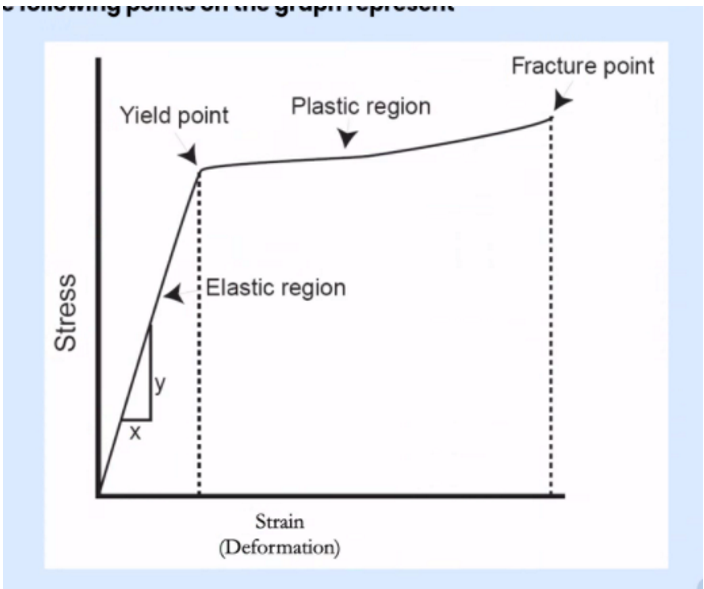
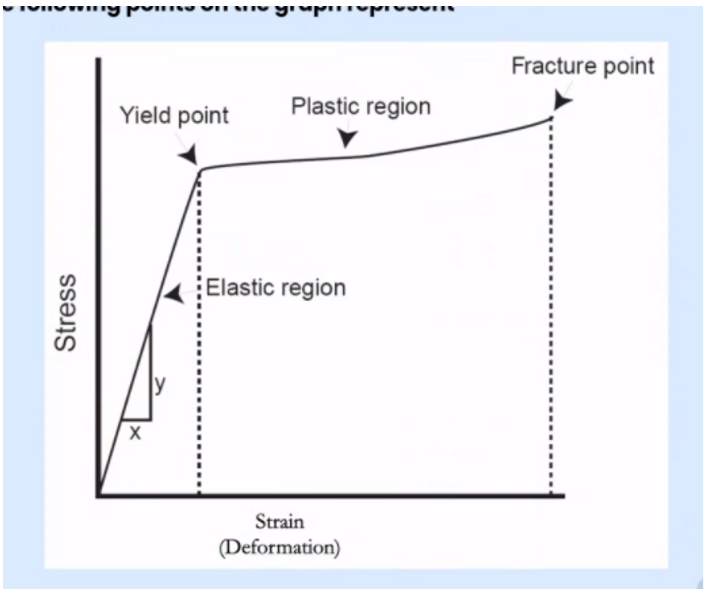
What do the following points on a stress-strain graph represent: elastic region, yield point, plastic region, and fracture point?
The elastic region is where deformation is reversible when stress is removed. The yield point is where the material transitions from elastic to plastic behaviour. The plastic region is where deformation is non-reversible. The fracture point is where the material breaks.
How do compact bone and trabecular bone compare in long bones?
Compact bone: forms the outer layer; yes to osteons (have concentric lamellae containing osteocytes and a central canal containing blood vessels); density is dense; Young's modulus is higher (stiffer). Trabecular bone: does not form the outer layer; no osteons; density is low; Young's modulus is less.
What are the definitions of stress, tensile stress, compressive stress, shear stress, and bulk stress?
Stress: force per unit area applied to a material; causes deformation; units: N m⁻² or Pa.
Tensile stress: stretching force per unit area; lengthens molecular bonds. Compressive stress: compressing force per unit area; shortens intermolecular bonds.
Shear stress: shear force per unit area; causes two parts of a material to slide across each other via a force parallel to the dividing plane.
Bulk stress: force per unit area applied perpendicular to the surface in three dimensions; equal in magnitude to applied surface pressure; negative for a compressive force.