cogs 14A post-miderm content
 Call Kai
 Learn
Learn Practice Test
 Spaced Repetition
 Match
Match Flashcards
 Knowt Play
1/109

There's no tags or description
Looks like no tags are added yet.
Name | Mastery | Learn | Test | Matching | Spaced | Call with Kai |
|---|
No analytics yet
Send a link to your students to track their progress
110 Terms
requirements of a between-groups design experiment (2)
groups being compared must be equivalent before the independent variable is manipulated
experimental design must be free of confounds
sampling bias
participants are chosen in such a way that they do not represent the population as a whole
could affect the external validity of the experiment
sampling error
the mismatch between sample statistics and the population parameters they estimate
will always be present
occurs due to inherent variability in the population
ensures that sample statistics will not match each other exactly
pre-screening
sometimes we ______ participants on important characteristics
goal: create a more uniform sample that includes fewer extraneous variables
limits ecological validity
selection bias + solution
occurs when the researcher makes non-random assignment which may lead to systematic differences, or if a participant selects the group they’re in
large sample sizes help smooth out effects of some non-random assignment
solution: attempt a time-series design; try a matched, non-equivalent control group
experimenter bias
the researcher’s expectations (or interests) may affect how the experimenter interprets behavior in the experiment; influences measurement of the dependent variable
demand characteristics
the participant picks up some cue that leads them to perform differently, changing the outcome of the dependent variable
participants may change their behavior to please or thwart the experimenter
can use filler trials to distract participants, or give a complicated task + only measure the data of interest
single-blind procedure
either the participant or experimenter don’t know the condition they’re in
double-blind procedure
neither the participant nor the experimenter know the experimental conditions; this will limit any systematic bias in behavior or treatment
different treatment of groups
the two groups must go through the same experimental procedure (protocol) for it to be a valid comparison
instructions, setting, task, and other factors must match each other to avoid confounds
different experimenters might work with different experimental groups, affecting performance in the groups differently
instrumentation effects
occur when the instrument used to record the dependent variable changes in accuracy or sensitivity over time
subject attrition + solution
people can leave in-progress experiments
non-sytematic, systematic
solution: no solution :(
non-systematic attrition
reasons unrelated to the study; equally likely in each group
systematic attrition
reasons related to a specific condition; perhaps only strongly motivated people finish one condition
ceiling effect
all scores are near the top of the measurement scale
floor effect
all scores are near the bottom of the scale
between-groups design: advantages
different groups of people are exposed to only one level of independent variable each; causal effects + comparisons are straight-forward
participating in only one condition lessens chance of attrition
may be the only option when impractical to run participants in multiple conditions
between-groups design: disadvantages
for each condition (level of independent variable), you need an additional group of participants
demand characteristics may be different for each group
keeping the groups independent may lead to different treatment
people in the groups may be very different; the subject variables may widely vary between groups; may become nuisance variables; adds error variance
primary characteristics of within-groups design
all participants experience all levels of the independent variable; each participant is their own control
reduces error variability by eliminating inherent differences in the subject variables
fewer participants are required than between-groups designs; important for work with patients or expensive studies
statistical tests subtract the common variability → decreases the chance of a Type II error
pretest-posttest design
participant performs a task, dependent measure is collected; treatment applied; participant performs the task again; the second measure is compared with the first
repeated-measures design
participants undergo all conditions (levels of independent variable), in any order; collect measures to each stimulus
mixed design
aka cross-over repeated measures design, includes a between-groups comparison (and a within-subjects design)
disadvantages of within-groups designs
demand characteristics
carryover effects
practice effects
fatigue effects
carryover effects
aka order effects, includes practice effects + fatigue effects
practice effects
as you perform a task more, you get better at it. early trials may be worse than later trials, especially on hard tasks.
fatigue effects
as participants perform a boring task, they may lose attention & get progressively worse
linear practice effects
improvement changes gradually over time; to control for this, you would need to counterbalance your conditions.
non-linear practice effects
improvement changes quickly at the beginning as participants learn the task; may flatten; can be controlled by using practice trials before starting the main experiment
history effects + solution
experiments that last several days can be interrupted by life events outside of the experiment
coincidental, but can be a real problem if repeated measures are done in a specific order
solution: time-series design
maturation effects + solution
people may change their behavior over time due to physical changes (e.g. growth, learning, getting hungry, etc.)
solution: similar, nonequivalent control group; time-series design
testing effect
participants may get better scores bc they are used to the experiment + task through habituation
solution: similar, nonequivalent control group; time-series design
counterbalancing
to lessen the impact of some carryover effects + time-related confounds, you can balance the order in which different conditions are presented to different participants
complete within-subjects design
typically used for 2-3 levels of independent variable. all possible orders of conditions are presented to participants.
incomplete within-subjects design
typically used for more than 3 levels of independent variable or studies with lots of possible stimuli. each participant receives a unique order, but does not receive all possible orders of conditions
pre-experimental design
don’t/can’t randomly assign people to groups; may be no control group.
people self-select.
e.g. can use a simple pretest-posttest comparison of the mortality rate before + after the program was instituted.
regression toward the mean + solution
if the first measure was extreme, the next measure is likely to be less extreme (closer to the mean)
solution: time-series design, matched non-equivalent control group
distinguishing true experiments, pre-experiments, quasi-experiments
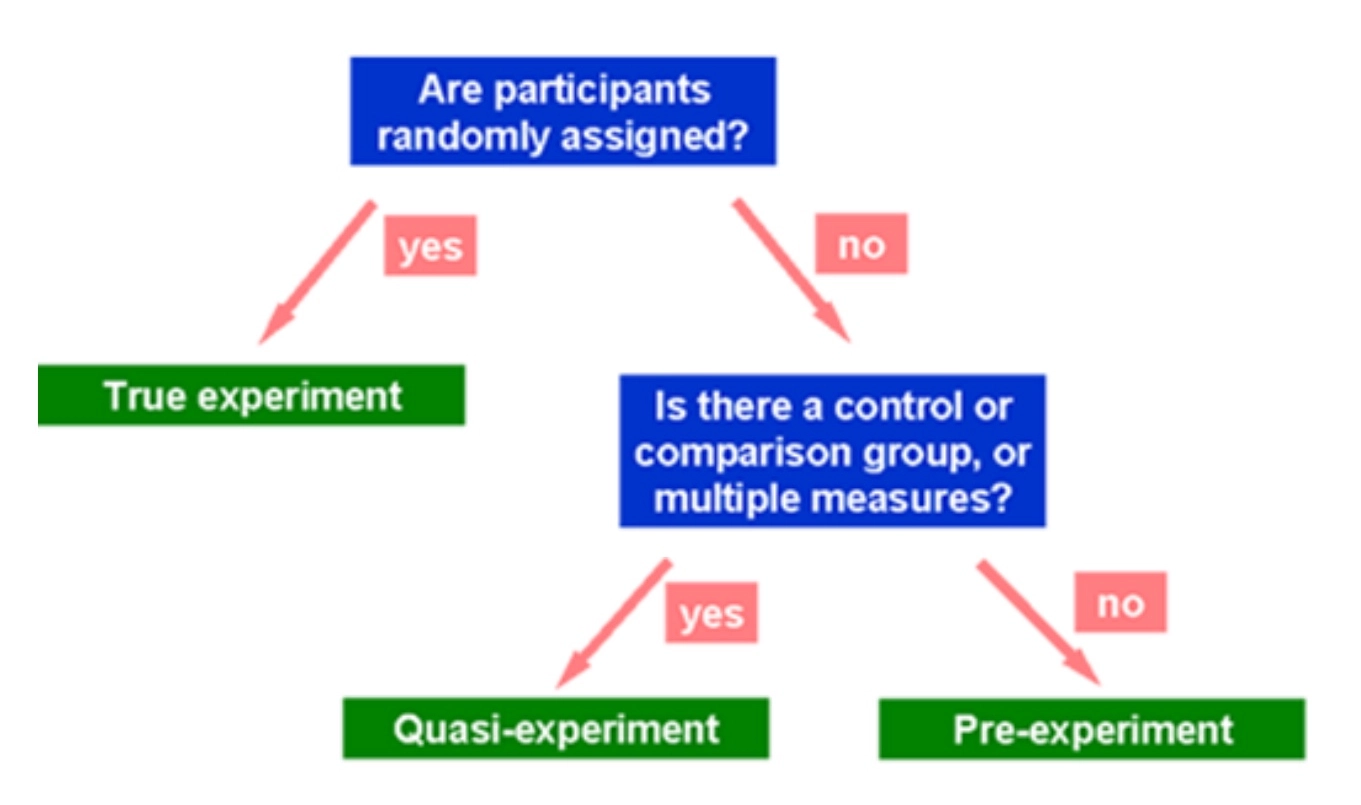
quasi-experimental designs
allow you to compare the result of a manipulation of the independent variable with a different group of people
control group should be similar, but assignment to the treatment & control groups was not random
single time-series design
several repeated measures taken before + after the independent variable is manipulated
many factors are the same at each time point
no control group present
multiple time-series design
several measures taken before + after the independent variable is manipulated
similar control group presented for comparison
provides more supporting evidence that the treatment had an effect
lacks random assignment → can’t make causal claims
interaction of selection bias with other confound + solution
in non-equivalent control group design, perhaps one group is more affected by a confound than the other
solution: multiple time-series
factorial design
an experimental design that simultaneously examines the effects of 2+ independent variables (factors) on a dependent variable
null (H0) vs. alternate (H1) hypotheses for a described experiment
null (H0): μ1 = μ2 = μ3 = μn
H1: The null [any of the nulls] is false.
one-factor ANOVA
one independent variable
main effect
significant difference between groups
average the value of two levels + see if they differ
interactions
condition affects dependent variable differently in different conditions/groups
parallel lines indicate no interaction
factorial design (e.g. 2×2)
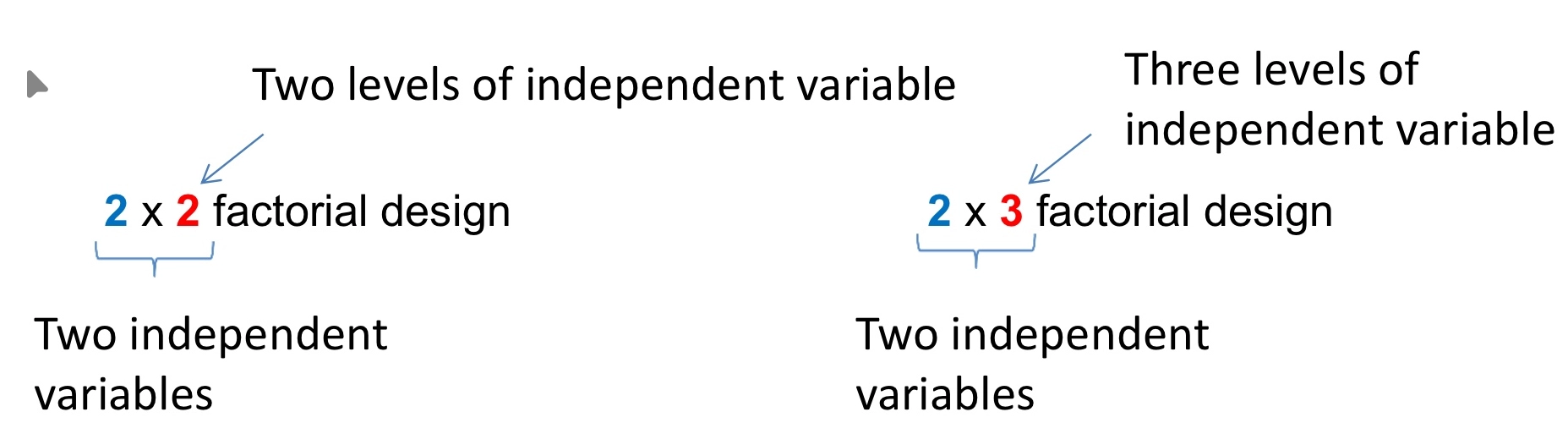
factorial designs > multiple comparisons of two levels of a single independent variable
when you run more statistical tests, you risk a false alarm each time; more tests → more false alarms
how adding a subject variable (e.g. sex) in factorial designs can be very important to basic science
explicit between-groups comparisons using a subject variable can find potential differences
avoids missed opportunities to find differences that may have important clinical effects
longitudinal studies
collect data at multiple points in time (within-subjects design). the goal is to observe patterns of change over a long period of development [time as an independent variable]
cross-sectional studies
collect data at one point in time. data may come from many different age groups (between-groups design). excellent for exploratory + descriptive studies [age as a subject variable]
advantages of cross-sectional studies
cost-efficient
fewer logistics problems
disadvantages of cross-sectional studies
can only find differences in groups; no causal explanations
cohort effects may emerge: differences due to how the age groups developed separately, not in how they aged
cohort effects
differences due to how the age groups developed separately, not in how they aged
advantages of longitudinal studies
understanding causal processes
more in-depth understanding of complex behaviors + processes
disadvantages of longitudinal studies
resource intensive
logistically difficult
problem of attrition
trend studies
examines changes within the general population over time; e.g. census studies + polls
cohort studies
examines a more specific population as those individuals change over time; within-subjects designs
prospective research
begin with a sample + follow them over time
retrospective research
may go through old records + reconstruct activities of cohorts over time
could also ask participants to recall their past (more susceptible to subjective errors)
how longitudinal studies are more useful for evaluating clinical interventions in a population
many different dependent measures can be measured over time
may suggest interventions to improve performance or delay onset of age-related pathologies
most aging studies are _____
cross-sectional
traits of research in natural settings
lack of control often requires using the descriptive method
researchers observe participants in natural environment using many methods
surprising results may help generate new hypotheses
very high ecological validity; can be used to confirm results from lab
traits of research in laboratory settings
precise control over variables using the experimental method
groups can be compared on the same task
artificial tasks can be used to probe specific causal relationships
lower ecological validity
naturalistic observations
researcher remains unobtrusive
covert
overt
desensitization
habituation
covert operations
allow for the least amount of potential disruptions
overt observations
require great care in order to not change the nature of the monitored behavior
desensitization
habituation
desensitization
researcher gets progressively close to participants; decrease fight-or-flight response
habituation
repeated exposure used until presence no longer affects behavior at all
participant observations
researcher becomes part of the group being observed
disguised
undisguised
disguised participant observations
subjects are blind to the researcher’s role
undisguised participant studies
researcher joins the group studied, but is recognized as an outsider
ethnography falls into this category
traits + advantages + disadvantages of a field experiment
researcher studies the phenomenon of interest in ‘real life’ scenarios
often the only way to get the information
allows for causal inference + ecological validity
problems of internal validity
potential problems with observational studies done in natural settings
ethical issues over lack of free, informed consent; may be issues with potential harm
observational studies (except field experiments) don’t allow causal inferences; strictly correlational
presence of observers may influence behavior, distorting ecological validity
observer may make biased observations
Rosenhan pseudopatient experiment
mental hospital disguised participant study; subject to bias…
Hawthorne effect
participants may change their behavior if they know they’re being observed
reactivity in the participant’s behavior may be due to demand characteristics (guessing what the observer wants) or hiding socially sensitive responses. threatens internal validity of the approach
expectacy effects
conscious or unconscious beliefs + preferences that may affect how dependent variables are recorded + interpreted
ecological validity
naturalistic observation > participant observation > field experiment > lab experiment
control of extraneous variables
lab experiment > field experiment > naturalistic + participant observation
interobserver reliability
the degree of consistency obtained between observers
narrative records
tend to be more qualitative + have a broader scope
no restrictions on pre-defined types of behaviors; good when looking for new or spontaneous observations (generating hypotheses)
often need some type of data reduction (coding)
checklists
focus on more specific behaviors that have been operationally defined
focus on a small set of behaviors; good for gathering data in a field experiment (evaluating a hypothesis)
don’t require as much data reduction, but are limited in what they can measure
technology-mediated advanced methods
may use specific devices or techniques developed for the specific research issue
may augment use of narrative records (or checklists)
primarily uses specialized technology to capture something specific about the situation
may also use technology to trigger + record certain behaviors; can be longitudinal if you track users over time
time sampling
take observational measurements at systematic or random times that are most representative of the group being studied
best for continuous behaviors
event sampling
random or systematic sampling of events that include specific behaviors of interest
situational sampling
observations of an operationally defined situation are made in different settings + circumstances
note how the situation can occur in a number of places
reactive measures
procedures where taking measurements may influence a participant’s behavior
non-reactive measures
collected in the absence of the participant + should have no effect on behavior that already happened
can be done in physical trace studies or archival data investigations
physical trace studies
look at physical evidence left behind as a result of behaviors or activities
accretion measures
erosion measures
accretion measures
examine the build-up of material over time that results from a behavior
erosion measures
based on the wearing down of material through use
natural trace measures
occur without any action being taken by the researcher
controlled trace measures
are put in place by the researcher to specifically measure some activity
e.g. installing a carpet that wears down easily
selective survival
not all traces/behaviors may be equally represented over time
traces or products may degrade over time; we only see what survived
selective deposit
different populations may be more or less likely to leave behind traces
e.g. campsite use: need to note that more experienced campers leave behind fewer traces
archival data study
previously recorded information is the focus of analysis
continuous (running) records
items that are updated on a regular or scheduled basis
discontinuous records
sporadic or unique
records
items that were intended for the use of others at the time of creation
documents
items that were generally intended for personal use only. typically not considered public documents