Vectors
 Call Kai
 Learn
Learn Practice Test
 Spaced Repetition
 Match
Match Flashcards
 Knowt Play
1/15

Earn XP
Description and Tags
Formulae/methods for first year university vectors. No matrices.
Name | Mastery | Learn | Test | Matching | Spaced | Call with Kai |
|---|
No analytics yet
Send a link to your students to track their progress
16 Terms
dot product calculation
in R2, (a1b1 + a2b2)
where u = (a1, a2), v = (b1, b2)
What is a level curve?
Any (multivariable) function for which
f(x,y)=c where c is a constant.
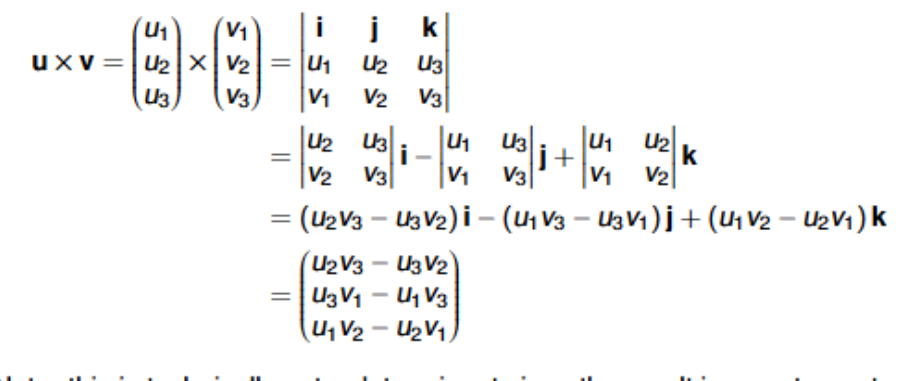
cross product calculation in R3
Calculate determinant of the matrix, for x,y,z.
What property does the cross product have?
The cross product is orthogonal to both/all vectors that are crossed.
i.e. a x b is orthogonal to a and b
What does it mean for vectors to be orthogonal? What about a vector orthogonal to a plane?
Vectors are perpendicular to each other.
Vector is perpendicular to the plane.
Formula for area of a triangle?
A=21∣∣a×b∣∣
What is the scalar triple product (formula)?
u⋅(v×w)
How do I calculate the volume of a parallelepiped
Magnitude of triple scalar product
∣u⋅(v×w)∣
What is a parallelepiped?
A 3D parallelogram
unit vector for i, j, k
i^=(1,0,0),j^=(0,1,0),k^=(0,0,1)
How to determine if two vectors are orthogonal
If the dot product of two vectors is 0, the vectors are orthogonal to each other.
What is the implicit equation of a line? (also known as cartesian here)
ax + by + c = 0
How can we find the implicit equation of a line from vectors?
For v = (v1, v2)
vx = (-v2, v1) (this is orthogonal to v)
(r−p)⋅vX=0
What is the parametric equation of a line
r=p+λv where p is the position vector of a point P on the line and v is a direction vector.

What is the equation of a plane?
A plane has a parametric equation (found the same way as for a line). A plane has a vector orthogonal to it, n.
The implicit equation of the plane is given by
(r−p)⋅n=0
We can set n as u x v, where u and v are both parallel to the plane.
Properties of the gradient (∇)
perpendicular to level curve
∣∇f∣ is equal to the maximum rate of directional change
-∣∇f∣ is equal to the minimum rate of directional change