Intro to Leadership
 Call Kai
 Learn
Learn Practice Test
 Spaced Repetition
 Match
Match Flashcards
 Knowt Play
1/58

There's no tags or description
Looks like no tags are added yet.
Name | Mastery | Learn | Test | Matching | Spaced | Call with Kai |
|---|
No analytics yet
Send a link to your students to track their progress
59 Terms
What is leadership?
- A process of social influence, which maximizes the efforts of others, towards the achievement of a goal
- Social influence
- Others (not necessarily direct reports)
- Goal-oriented
- Many styles and paths, not specific traits alone
What is leadership NOT?
- Has nothing to do with seniority, hierarchy, or position (NOT titles)
- Nothing to do with personal attributes alone
- Leadership is NOT management
- Not just someone who has followers: lacking other traits
- Does not only translate vision into a reality: the goal matters
- Leadership is not just influence: not comprehensive
What are positive universal leadership attributes?
- Trustworthy, just, intelligent, informed
- Foresighted, plans ahead
- Builds confidence, motivational
- Win-win problem solver
- Administratively skilled
- Excellence-oriented, dynamic
- Decisive, communicative, coordinator
- Honest, encouraging, dependable
- Effective bargainer
- Team builder
What are negative universal leadership attributes?
- Loner, insecure, asocial
- Irritable
- Ruthless, dictatorial
- Non-explicit
- Lack empathy
- Non-cooperative
- Egocentric/narcissistic
What is the dark side of leadership?
- Excessive use of power, control or influence
- Authoritarian or oppressive
- Toxic
- Leave followers worse off than found them
- Violate basic human rights of others
- Playing to followers' basest fears
How does the approach that leadership is a trait view leadership?
- Distinguishing quality
- Innate, not learned
- Ex. confidence, decisiveness, outgoing
- Leaders are born, not made
How does the approach that leadership is a skill/ability view leadership?
- Competency developed to accomplish a task effectively
- Can get better with practice
- Natural or learned capacity
- Ex. public speaking, organizing meetings, restaurant managing, fundraising process
How does the behavioral approach view leadership?
- What leaders do
- Task vs. relationship/people behavior types: each has a relative strength (ex. prepare agenda vs. help people to feel included
- Ex. country club vs. authoritarian
What are task behaviors?
- Specific roles and tasks
- Schedules work
- Sets performance standards
- Develops procedures
What are people/relationship behaviors?
- Is friendly and supportive
- Shows trust and confidence in subordinates
- Shows concern for subordinates' welfare
- Gives recognition to subordinates for accomplishments
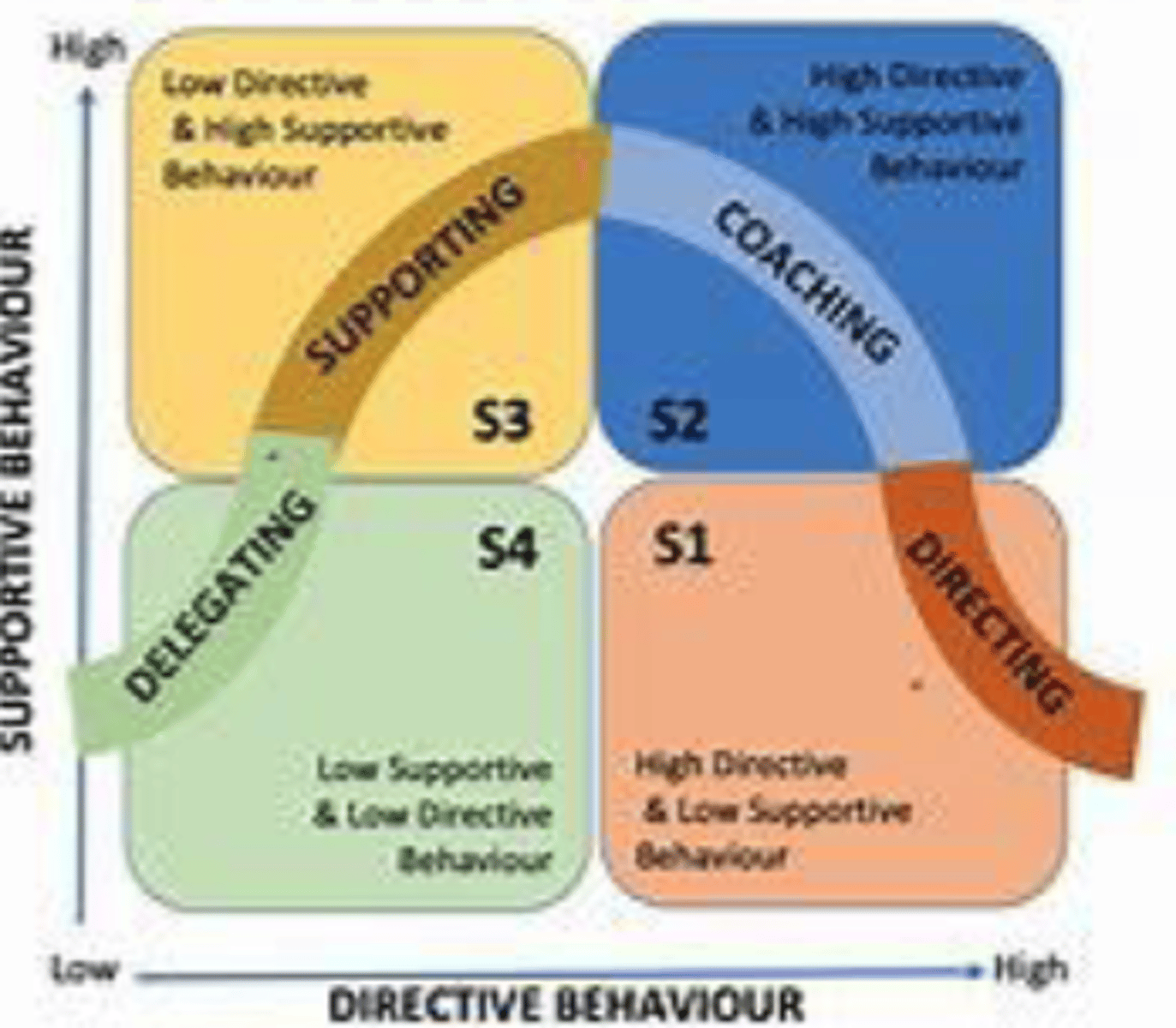
How does the situational approach view leadership?
- Different approach depending on the situation
- Directive vs. supportive dimensions
- Depends on leadership style of leader and developmental level of followers
- Different situations need different leadership
- Based on situation, not on leader
- Ex. beginners may need more directive than experienced workers
What are the 3 leadership theories?
- Theory U
- Path-goal theory
- Leader-member exchange theory (LMX)
What is Theory U?
- Change management method and a framework for change
- Developed by Otto Scharmer
- Delves into the process of becoming aware and applies to all levels of systems change
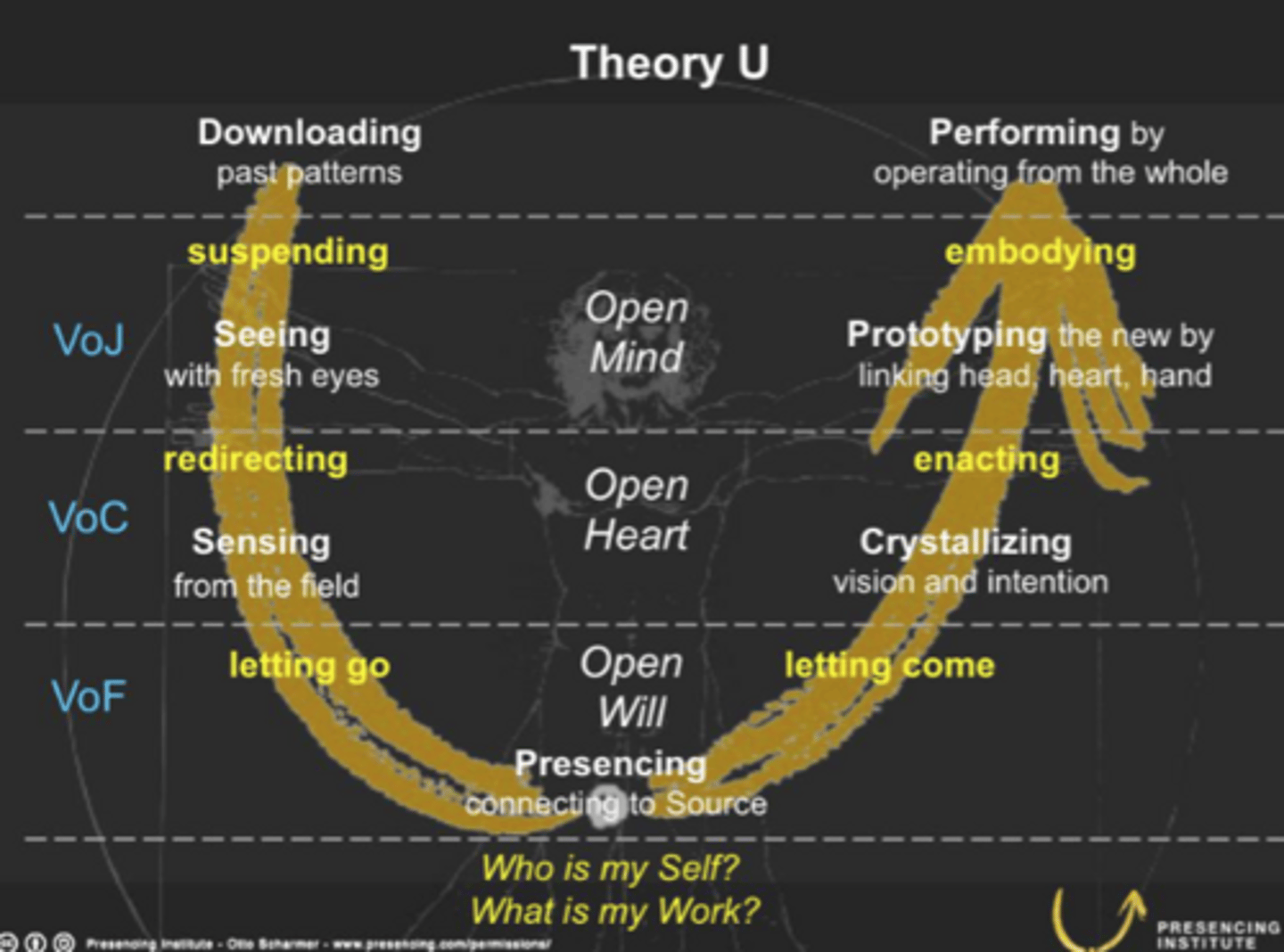
What are key aspects of Theory U?
1. Co-sensing the field of change
2. Presencing inspiration and common will
3. Co-initiating common intent
4. Co-creating strategic microcosms
5. Co-evolving through innovations
What does co-sensing the field of change refer to in Theory U?
- Going to places with the most potential and listening with an open mind and heart
- Connecting deeply to the world around us
What does presencing inspiration and common will refer to in Theory U?
Letting go of our old ego and self, making space for our highest future possibility
What does co-initiating common intent refer to in Theory U?
Finding shared purpose and intention
What does co-creating strategic microcosms refer to in Theory U?
We prototype the new by doing, exploring the future possibilities
What does co-evolving through innovations refer to in Theory U?
By creating ecosystems that facilitate seeing and acting from the whole, we evolve collectively toward an emerging future
What are the 7 essential Theory U leadership capacities?
1. Holding space: creating a container for deep listening and dialogue
2. Seeing with fresh eyes: shifting perspectives to uncover blind spots
3. Empathetic conversation: engaging in dialogue that fosters understanding
4. Prototyping: experimenting with new approaches
5. Creating shared vision: aligning around a common purpose
6. Building networks: connecting diverse stakeholders
7. Leading from the emerging future: guiding action based on collective wisdom
What is Path-goal theory?
- Attention on followers' motivational needs
- Can address followers' motivation, engagement, satisfaction, performance, and intent to stay
- Designed to explain how leaders can help followers along the path to their goals by selecting specific behaviors that are best suited to followers' needs and to the work situation
- Can be: directive, supportive, participative, achievement-oriented
What is Path-goal theory based on?
- Follower characteristics: need for affiliation, preferences for structure, desire for control, self-perceived level of task ability
- Task characteristics: tasks that are unclear and ambiguous, weak formal authority system in work setting, primary workgroup norms are weak or non-supportive
According to Path-goal theory, what follower vs. task characteristics are associated with directive leadership behaviors?
- Provides structure
- Follower characteristics: dogmatic, authoritarian
- Task characteristics: ambiguous, unclear rules, complex
According to Path-goal theory, what follower vs. task characteristics are associated with supportive leadership behaviors?
- Provides nurturance
- Follower characteristics: unsatisfied, need for affiliation, need for human touch
- Task characteristics: repetitive, unchallenging, mundane
According to Path-goal theory, what follower vs. task characteristics are associated with participative leadership behaviors?
- Provides involvement
- Follower characteristics: autonomous, need for control/clarity
- Task characteristics: ambiguous, unclear, unstructured
According to Path-goal theory, what follower vs. task characteristics are associated with achievement-oriented leadership behaviors?
- Provides challenges
- Follower characteristics: high expectations, need to excel
- Task characteristics: ambiguous, challenging, complex
What is leader-member exchange theory (LMX)?
- Centered on interactions between leaders and followers
- Based on individual relationships
How many phases of leadership development are there in the LMX theory?
- 3
- Phase 1: Stranger
- Phase 2: Acquaintance
- Phase 3: Mature partnership
In the LMX theory, what occurs in Phase 1?
- Stranger
- Scripted roles
- One way influence
- Low quality exchanges
- Self interest
- Time
In the LMX theory, what occurs in Phase 2?
- Acquaintance
- Tested roles
- Mixed influence
- Medium quality exchanges
- Self and other interests
- Time
In the LMX theory, what occurs in Phase 3?
- Mature partnership
- Negotiated roles
- Reciprocal influence
- High quality exchanges
- Group interests
- Time
How many stages of affective processes and development are there in the LMX theory?
- 3
- Stage 1: Role taking
- Stage 2: Role making
- Stage 3: Role routinization
In the LMX theory, what occurs in Stage 1?
- LMX development: leader initiates possibility of LMX relationship
- Key affective process: leader emotional expressions are affective events
- Level: individual
In the LMX theory, what occurs in Stage 2?
- LMX development: series of dyadic affective events shapes LMX quality
- Key affective process: leader and members share affect (entrainment)
- Level: dyadic
In the LMX theory, what occurs in Stage 3?
- LMX development: stable relationship disrupted by LMX differentiation
- Key affective process: LMX relationship can change based on LMX differentiation
- Level: group
What are the 10 different leadership styles?
- Authoritarian
- Democratic
- Laissez-faire
- Transformational
- Authentic
- Servant
- Adaptive
- Inclusive
- Collective
- Ethical
What is the authoritarian leadership style?
- Theory X
- Perceive that followers need direction
- Don't encourage communication among group members, just talk to them
- Give praise and criticism freely, based on their own standards, not objective
- Common and necessary style in many situation
What outcomes are associated with the authoritarian leadership style?
- Efficient and productive
- Give direction and clarity to people's work and accomplish more in a shorter period
- Fosters dependence, submissiveness and loss of individuality
- Can become abusive
What is the democratic leadership style?
- Theory Y
- Treat followers as fully capable of doing work on their own
- Work with followers: guides rather than directors
- Give suggestions without intent to change them
- Make sure everyone is heard
- Promote communication between group members
What outcomes are associated with the democratic leadership style?
- Greater group member satisfaction,commitment and cohesiveness
- More friendliness, mutual praise, group mindedness
- Stronger worker motivation and greater creativity
- Group members participate more and are more committed to group decisions
- Takes more time and commitment from the leader
- Work is not as efficient as with authoritarian leader
What is the laissez-faire leadership style?
- Nominal leader with minimal influence (non-leadership)
- "Hands-off" toward followers, laid back
- May be interim or place-holder
- Outcomes: little is accomplished, can be chaotic, productivity goes down
Who are examples of laissez-faire leaders?
- Ronald Reagan
- Queen Victoria
- Steve Jobs
What is the transformational leadership style?
- Changes and transforms people
- Concerned with emotions, values, ethics, standards and long-term goals
- Assesses followers' motives, satisfying their needs and treating them as full human beings
- Involves an exceptional form of influence that moves followers to accomplish more than what is usually expected of them
What is authentic leadership?
- Whether the leader is genuine/real
- Theory still in development
What are the 8 components of authentic leadership?
- Purpose: have a real sense of what they are about and where they are going (live and lead by their values)
- Strong relationships/connections to others: more transparent leaders, loyalty and commitment from followers
- Self-discipline: carry out work in accordance with their values (remain cool, calm, and consistent when stressed)
- Compassion and heart: sensitive to the plight of others
- Self-awareness: have a clear sense of who they are and what they stand for
- Internalized moral perspective: use their internal and moral standards and values to guide their behavior rather than outside pressures
- Balanced processing: ability to analyze information objectively and explore other people's opinions before making a decision
- Relational transparency: being open and honest in presenting one's true self to others
What positive psychological capacities are associated with authentic leadership?
- Confidence, resilience
- Hope, optimism
What are the characteristics of authentic leadership?
- Creativity, curiosity, cultivability (spiritual)
- Communication, charisma
- Integrity, courage, conviction
- Competence, common sense
What is the servant leadership style?
- Natural feeling that one wants to serve first
- From point of view of leader
- Leadership must first and foremost meet the needs of others
What are characteristics of servant leaders?
- Listening, empathy, healing
- Awareness, persuasion, conceptualization, foresight
- Stewardship, commitment to growth of people, building community
What is the adaptive leadership style?
- How leaders encourage people to adapt
- Prepare and encourage people to deal with change
- Stresses the behaviors of the leader in relation to the work of followers in their situations
- Assisting people who need to confront tough problems
What are behaviors of adaptive leaders?
- Get on the balcony (find perspective in difficult situation)
- Identify the adaptive challenge
- Regulate distress
- Maintain disciplined attention
- Shift problem-solving back to the people involved
- Be open to dissident voices from below
What is the inclusive leadership style?
- Create environment in which differences are valued and can be incorporated into to main work of an organization to enhance strategies, processes, and overall effectiveness
- Relatively new type of leadership
- Characteristics: pro-diversity beliefs, see and analyze situations in different ways, agreeableness/openness
What is the collective leadership style?
A group of people with diverse skills and experience working toward shared goals while sharing decision making and working collaboratively
What is the ethical leadership style?
- Broad set of ethical viewpoints, multifaceted
- Concerned with kinds of values and morals an individual or a society finds desirable or appropriate
- Pre-conventional, conventional, and post-conventional morality divided into 6 stages
Which stages of ethical leadership fall under pre-conventional morality?
- Stage 1: Obedience and Punishment - based on consequences
- Stage 2: Individualism and Exchange - exchanging favors
Which stages of ethical leadership fall under conventional morality?
- Stage 3: Interpersonal Accord and Conformity - try to behave like a good person
- Stage 4: Maintaining the social order - for society to function need to obey laws and respect authority
Which stages of ethical leadership fall under post-conventional morality?
- Stage 5: Social Contract and Individual Rights - a good society supports values such as liberty and life and fair procedures for changing laws
- Stage 6: Universal Principles - internalized universal principles of justice that apply to everyone
What are the principles of ethical leadership?
- Respects others
- Serves others
- Shows justice
- Manifests honesty
- Builds community
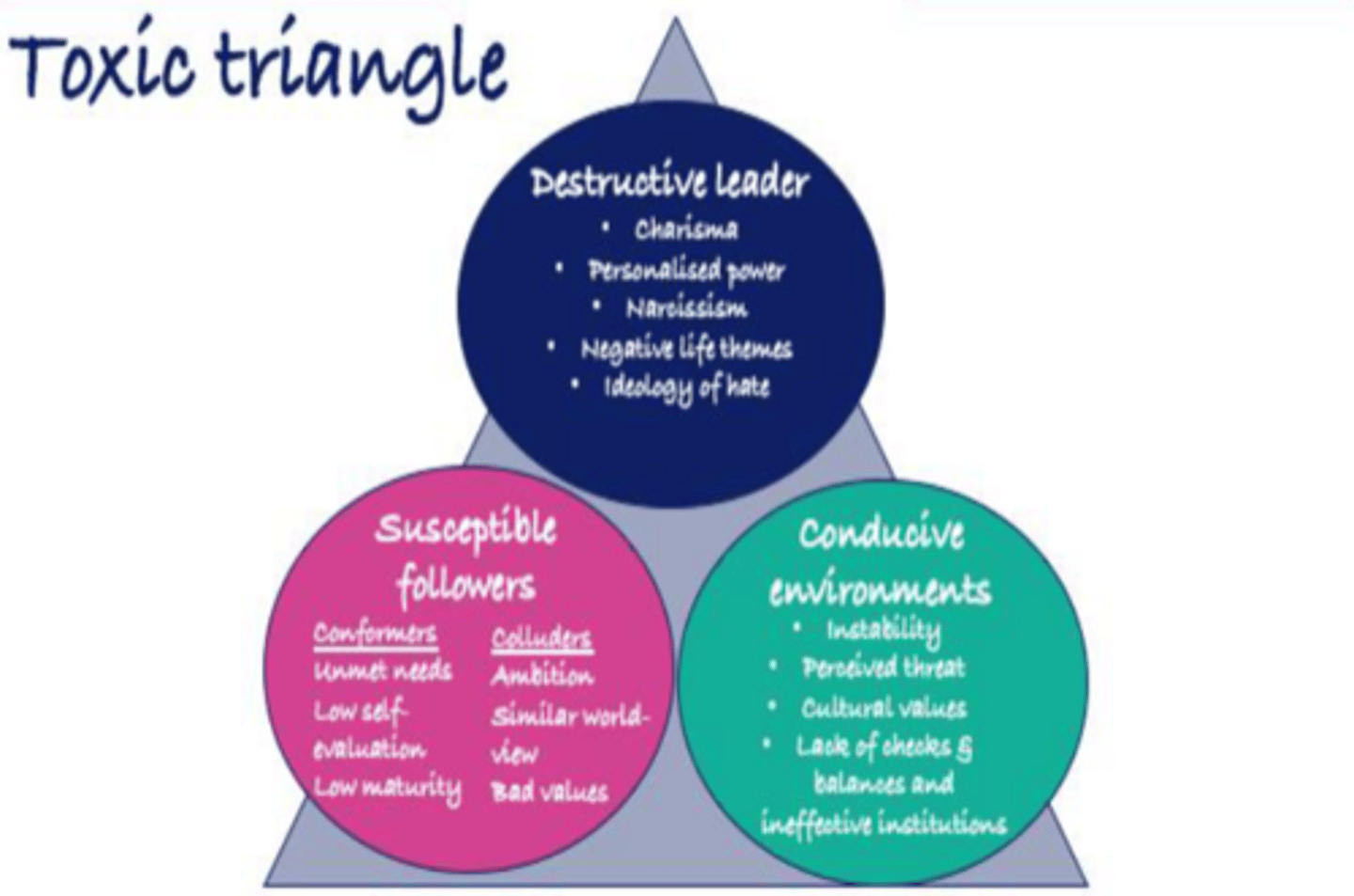
What makes up a toxic triangle?
- Destructive leaders
- Susceptible followers
- Conducive environments