1.5: The market mechanism, market failure and govt. intervention
 Call Kai
 Learn
Learn Practice Test
 Spaced Repetition
 Match
Match Flashcards
 Knowt Play
1/14

There's no tags or description
Looks like no tags are added yet.
Name | Mastery | Learn | Test | Matching | Spaced | Call with Kai |
|---|
No analytics yet
Send a link to your students to track their progress
15 Terms
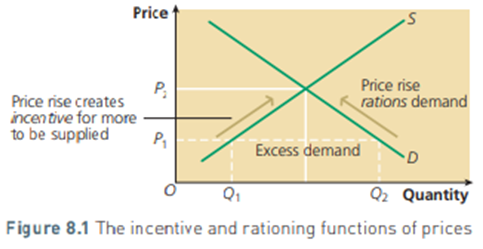
How do the 4 function of prices allocate resources?
Signalling - Prices provide information (e.g. quality and scarcity) for buyers and sellers to plan their activities.
Incentive - Relative prices create incentives for people to alter their economic behaviour (e.g. supply more).
Rationing - Prices allocate scarce resources to consumers who value them most highly and are able to pay for them.
Allocation - Directs resources away from markets with excess supply, towards markets with excess demand.
What problem does the price function solve?
Solves the basic economic problem of scarcity arising from the conflict of unlimited wants and finite resources
How does Adam Smith’s ‘invisible hand’ influences decision-making?
If the market is highly competitive, both firms and consumers will passively accept market prices set by the interaction of supply and demand.
What are the advantages and disadvantages to this price mechanism?
Advantages (free-market view):
Promotes consumer sovereignty
Efficient allocation of resources
Disadvantages (inteventionist view):
Possible producer sovereignty in imperfectly competitive markets (monopolies)
Can lead to market failures
What is market failure?
What types of market failure are there?
How can the 4 functions of prices indicate market failure?
Occurs when a market leads to a misallocation of resources.
Partial market failure – market produces at the wrong quantity
Complete market failure – market does not exist
In general, there is market failure when one or more of the price functions break down.
What are private goods, public goods and quasi-public goods?
Private goods - Excludable and rival
e.g. cheese from a cheese shop
Public goods - Non-excludable and non-rival
e.g. listening to a radio broadcast
Quasi-public goods - Partially excludable and partially rival
e.g. roads
What can cause a change in these goods from one to another?
Technological change
e.g. television broadcasting is now excludable
What is the problem with public goods?
How can this be corrected?
‘Free-rider’ problem - users can benefit without contributing/paying (due to non-excludability)
Producers won’t profit, so there is no incentive to produce
Missing markets/complete market failure
Govt. provision
Charity/Philanthropy (voluntary provision)
Open-source software e.g. Wikipedia
What are externalities?
When do they exist?
Link externalities to property rights
Spill-over effects of consumption or production decisions on third parties
When there is a divergence between private and social costs and benefits.
Market price does not reflect the full costs/benefits to society
Externalities make property rights (exclusive authority to determine how a resource is used) disappear
‘Free-rider’ problem occurs
What are the types of externalities?
What are the costs of these externalities?
Positive externalities – Spill-over effects that increases the welfare of third parties
Providers cannot charge a price on free-riders (market failure)
Negative externalities – Spill-over effects that reduce the welfare of third parties or impose costs to society
Unwilling free-riders cannot charge a price on the provider (market failure)
These costs can be the costs of prevention or the costs of mitigation
What are production externalities?
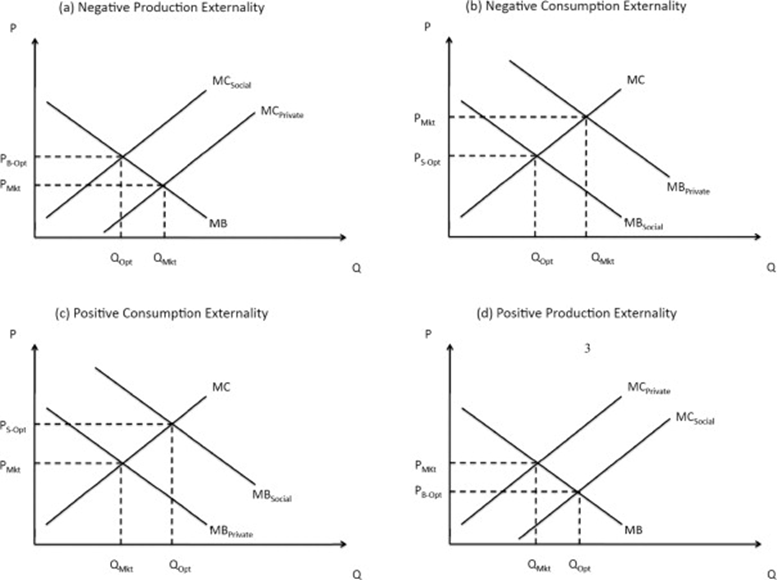
Production externalities
Externalities generated from producing a good or service
Represented in the form of an impact on costs, thus a different supply curve
Negative production externalities (a.k.a. external cost)
Welfare-reducing effects generated from producing a good or service
Represented as imposing extra costs on society. (supply shifts left)
e.g. Costs of mitigating pollution from power stations
Unwilling people affected cannot charge the power station for the pollution
Positive production externalities (a.k.a. external benefits)
Welfare-increasing effects generated from producing a good or service
Represented as imposing less costs on society. (supply shifts right)
e.g. the benefit of firm training employees received by a firm who employ those employees later on
The original firm cannot charge the next firm for the skill of the employees

What are consumptioijn externalilties?
Consumption externalities
Externalities generated from consuming a good or service
Represented in the form of an impact on benefits, thus a different demand curve
Negative consumption externalities
Welfare-reducing effects generated from consuming a good or service
Represented as extra costs on society (demand shifts left)
e.g. the ringing of mobile phones in a cinema disrupting pleasure
Unwilling audience cannot charge a price on the mobile phone users
Positive consumption externalities
Welfare-increasing effects generated from consuming a good or service
Represented as extra benefits on society (demand shifts right)
e.g. the benefit of having more educated workers to society
The schools cannot charge a price on society for the skilled workers

Explain all 4 of these exernalities diagrammatically
How do production externalities lead to over and underproduction?
Overproduction of goods with negative externalities in production
Prices underestimate costs of production, wrong incentives, too much of the good ends up being produced
Underproduction of goods with positive externalities in production
Prices overestimate the costs of production, wrong incentives, too little of the good ends up being produced
How do consumption externalities lead to over and underconsumption?
In the same way