Social Psych Exam 3
 Call Kai
 Learn
Learn Practice Test
 Spaced Repetition
 Match
Match Flashcards
 Knowt Play
1/56

Earn XP
Description and Tags
Ch 10-13
Name | Mastery | Learn | Test | Matching | Spaced | Call with Kai |
|---|
No analytics yet
Send a link to your students to track their progress
57 Terms
Aggression
Physical/verbal behavior meant to hurt someone
Hostile vs. Instrumental
Hostile: Injury is the goal
Instrumental: Injury is a means to a goal
Physical vs. Social
Physical: action with intent to cause bodily harm
Social: intended to damage social relations.
How do we measure aggression
Self report surveys
methods of violence
behaviors in lab
behavior in real world
Aggression is evolutionary:
gain resources and mate
higher test = higher aggro
Frustration-Aggression Theory
Frustration = blocked goal, blocked goal triggers aggression
Happens when frustration is UNJUSTIFIED
Relative deprivation is a frustration: perceived unfairness creates anger
Social Learning Theory
We learn aggression through seeing others.
Bobo doll: kid sees guy punch doll, kid also is aggressive to doll.
Displacement of Aggression
When we can’t express anger, we turn to a scapegoat
Aversive influences for aggression
Hot temps
Physical pain
Social pain
Influence of Aggressive Cues
Firearm = longer shock delivered (firearm aggressive cue)
badminton racket = shorter shock (racket neutral cue)
Group Influence of Aggression
ie. Riots, mobs, bullying groups, groups administer harsher punishments.
Deindividuation
Diffusion of Responsibility
Social contagion
Influence of Violence in Media
Watching aggressive models:
desensitizes to violence
teaches aggressive behaviors
develops positive attitudes towards aggression
Longitudinal and Experimental evidence for violence in Media (Robertson and Coyne studies)
Longitudinal: Watching TV ages 5-15 predicted criminal conviction by age 36
Experimental: Watching movie with violence = longer noise blast and more critical.
Catharsis
People release anger thru aggression, usually towards objects
Catharsis is ineffective; punching bag actually raised aggression vs sitting quietly.
Using Social Learning to Lower Aggression
Reward non-aggressive behavior
consume prosocial media
learn how to resolve conflict / regulate emotions
Physical Features in Attraction
Averaged faces attractive bc: symmetrical (implies better health and fertility)
Beauty standards change over time / cultures
Men = Physical, Women = Social status but still show preference for physical.
The Matching Phenomenon
We tend to pair with ppl of similar desirability
Physical Attractiveness Stereotype
Attractive ppl are seen as better:
Nicer
Outgoing
Happier
Smarter
Successful
media portrays beauty as good too.
Proximity in Attractiveness
We like those who are near us.
More interaction = more chances to interact and grow attraction.
Mere exposure effect plays a role.
Reciprocity in Attraction
We like people who like us
When A is told B likes them, mutual liking from both parties rose.
Similarity and Complementarity in Attraction
We like similar people:
Validation/reassurance
Easier interactions
Fits into social network
Social approval
Acceptance
Complementarity: we like people that are instrumental to our goals, we can use our partners for our goals
Why do matching algorithms not work
perceived similarity is a better predictor for compatibility instead of calculations
Misattribution of arousal leads to attraction
ppl mistake physical arousal for romantic arousal. Bridge experiment: dangerous bridge mistaken for attraction
Importance of relationships for health
Mental and physical well-being
Interpersonal Model of Intimacy
Share personal stuff, feel understood and validated, and become closer after.
Fast Friends Paradigm
Efficient way to foster relationships
mutual self disclosure, identifying similarities, and creating group identity
Attachment and the Working Model of Self
Working model sets beliefs about relationships
Leads to types of attachment.
High and Low Anxious/Avoidant Attachment
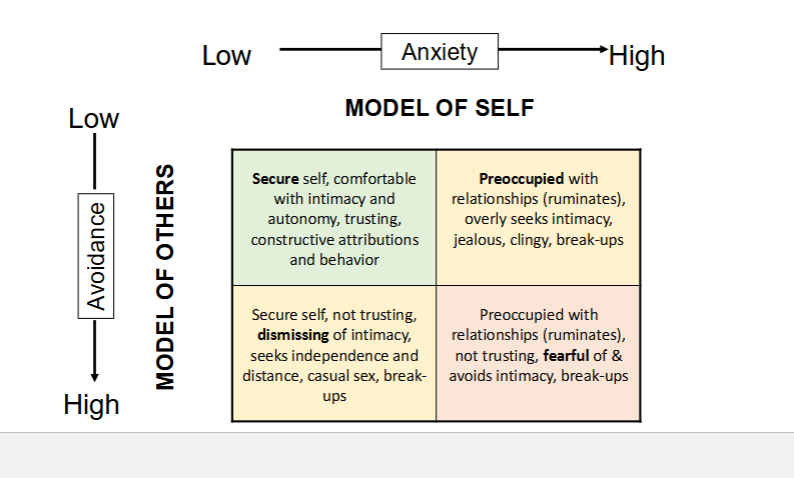
Novel Activities in Maintaining Relationships
Misattribution of Arousal
Avoids Boredom
Expands the self
How Prosocial Behavior Influences Happiness
Dunn etal. found spending on others made people happier
Universal because evolutionary.
Prosocial Behavior and Happiness Feedback Loop
Feel good, do good, feel even better.
Why Sad vs. Happy People Help
Happy: Feel good, do good
Sad: Negative state relief
1984 study: helping is a self-serving mechanism.
Social Exchange Theory
Shows ppl do things to minimize cost and max reward.
If reward > cost, likely going to help.
Norms and Prosocial Behavior
Social norms: people help bc social expectations
Reciprocity norms: help bc you’ve been helped.
Attributions in Helping
External: person can’t control it so you help. (empathy)
Internal: Person can control it so less likely.
Altruism
Helping despite no benefit
Altriusm likely when empathy is high.
Motives to reduce own distress. Empathy creates oneness = egoistic helping.
Bystander Effect
ppl are less likely to help if they see other bystanders.
Kitty Genovese was murdered despite 38 witnesses. Sparked research.
Steps to Intervene in an Emergency NIAKD
Notice
Interpret as emergency
Assume responsibility
Know how to help
Decide to help
Time Pressure in Emergencies
No rush = more helping
Bigger rush = less helping
Pluralistic Ignorance in Emergencies
Alone: high report rate of smoke in room
3 group: medium reporting
Confederate: no reporting
Diffusion of Responsibility in Emergencies
ppl less likely to take action when others available.
How to Increase Helping
Make it clear that help is needed
Single someone out to help
Tell them what to do
“I need your help!! You, in the jacket! Call 911!!”
Persuasion and Social Learning in Helping
Personalized appeals: (request that feels bad to refuse, eye contact, stating one’s name)
Prosocial modeling and learning by doing
Conflict
Perceived incompatibility of actions / goals
Peace
State of low hostility and mutually beneficial relationships
Social Dilemmas/Traps
Conflicting parties with separate interests = mutually destructive behavior
Prisoner’s Dilemma
Two ppl know the benefit of cooperation but both confess bc they want max personal benefit
Tragedy of the Commons
Individuals/groups consume common good to depletion.
Why do Social Traps Create Conflict
Fundamental Attribution Error
Evolving motives (from extrinsic to intrinsic as conflict persists)
Zero-sum beliefs: if one wins, one must lose.
Competition and Perceived Injustice
Competition: limited resources / perceived threat
Perceived injustice: causes anger nstuff idk
Mirror-Image Misperceptions
Perceived incompatibility of goals
Each side thinks of the other as bad.
Intergroup Contact for Peace
Happens when:
Equal status
Common goal (superordinate)
cooperation
support from norms / authority
Superordinate Goals and Cooperation in Peacemaking
Cooperation towards common goal = decreased aggression
Outcomes of Intellectual Humility
Awareness that ur beliefs can be wrong
Leads to:
scrutiny of misinformation
openness to opposing views
cooperative behavior
How to Exercise Intellectual Humility
Distance from the issue
Explain how things work
Be open to different views
Be willing to change ur own views
Constructive Communication
Paraphrase: check if ur understanding right
Acknowledge how the other guy feels
Avoid criticizing. Use “I” statements
Ideal Partner Preferences and Attraction
Predicts attraction when looking at the abstract (High Construal)
schematic traits like “funny” or “ambitious”
Does NOT predict when face-to-face. (Low construal)
Concrete details like their laugh.