Chem EOC 2 Study Guide
 Call Kai
 Learn
Learn Practice Test
 Spaced Repetition
 Match
Match Flashcards
 Knowt Play
1/61

Earn XP
Description and Tags
Name | Mastery | Learn | Test | Matching | Spaced | Call with Kai |
|---|
No analytics yet
Send a link to your students to track their progress
62 Terms
Diffusion
Molecules move from a region of higher concentration to a region of lower concentration until concentration is uniform.
Diffusion Example
Spray perfume and the molecules eventually diffuse equally around the room
Effusion
Gas escapes through a tiny hole in its container
Effusion Example
Air slowly escapes out of a small hole in a balloon
Condensation
Water vapor cools into water.
Graham's Law Formula
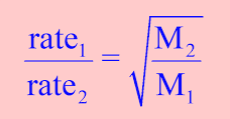
In Graham's Law Formula, what does M represent?
M=Molar Mass
Lighter Molar Mass = (Faster/Slower) Effusion
Faster
Combined Gas Law
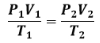
Ideal Gas Law
PV = nRT
Dalton's Law
Ptotal=P1+P2+P3…
Relative Humidity Formula
Actual/Saturated x100
Isobaric
Constant Pressure
Isochoric
Constant Volume
Isothermal
Constant Temperature
Catalyst
Lowers energy needed to start a reaction
Go memorize the Solubility Rules
Avogadro's Number
6.02 x 10^23
Limiting Reagent
Reactant that determines how much product can be formed
Excess Reagent
Any reagent not used up in a reactant
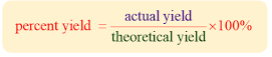
Theoretical Yield
Balanced chemical equation is used to calculate amount of product in a reaction (The thing that is SUPPOSED to happen, theoretically, if nothing goes wrong)
Percent Yield
Molar Gas Volume (L)
22.4
1 atm of K =
273.15 K
break space!
Make Some Tea
Bond Enthalpy
The amount of energy required to break one mole of a bond
Exothermic
Releases Energy
Endothermic
Absorbs energy
H = products - reactants
H = products - reactants
Forming Bonds is ___thermic
exothermic
Breaking Bonds is ___thermic
endothermic
Breaking a bond (absorbs/releases) energy
Absorbs
Forming a bond (absorbs/releases) energy
Releases
Activation Energy
Minimum energy particles need to react
For a reaction to occur, particles must…
Collide, have enough activation energy, have proper orientation
Increase concentration of reactant shifts the reaction to the…
Right
Increase pressure causes shift to the…
side with the least moles
Acids produce (H+ or OH-)
H+
Bases produce (H+ or OH-)
OH-
Acids (accept/donate) H+
donate
Bases (accept/donate) H+
accept
Base component ________ added acid
neutralizes
Acid component ________ added base
neutralizes
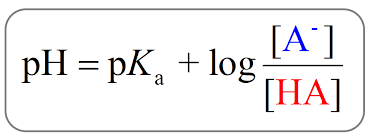
Buffer Composition: Weak acid and its _________ ____
conjugate base [A]
Buffer Composition: Weak base and its _________ ____
conjugate acid [HA]
Henderson-Hasselbalch Equation (pH=)
Strong Acid + Strong Base
neutral titration
Weak Acid + Strong Base
basic titration
Gibb's Free Energy Formula

unfavorable = (spon/nonspon)
non spontaneous
favorable (spon/nonspon)
spontaneous
unfavorable = (exo/endo)
endothermic
favorable = (exo/endo)
exothermic
H > 0
endothermic (+)
H < 0
exothermic (-)
Reactants + Heat --> Products
Endothermic
Reactants --> Heat + Products
Exothermic
REVIEW OTHER STUDY GUIDE FOR EOC 1
ok
pKa log formula
pKa = -log(Ka)
What does A- stand for?
Weak Acid
What does HA stand for?
Conjugate base of the corresponding A- weak acid