terms & basic concepts in drrm (mod #1)
 Call Kai
 Learn
Learn Practice Test
 Spaced Repetition
 Match
Match Flashcards
 Knowt Play
1/42

Earn XP
Description and Tags
🍂
Name | Mastery | Learn | Test | Matching | Spaced | Call with Kai | Chat |
|---|
No analytics yet
Send a link to your students to track their progress
43 Terms
hazard
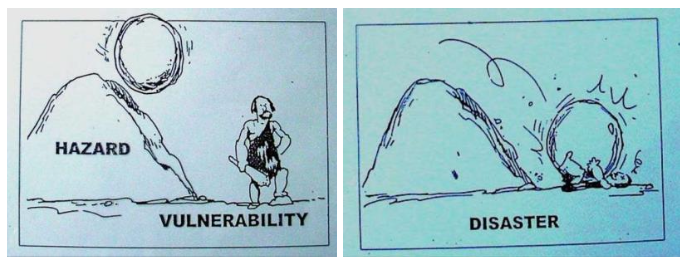
a dangerous phenomenon, substance, human activity or condition that may cause loss of life, injury or other health impacts, property damage, loss of livelihoods and services, social & economic disruption, or environmental damage
earthquake, landslide, tsunami, windstorm, wave or surge, flood or drought
give examples of hazards
disaster
serious disruption of the functioning of a community or a society involving widespread human, material, economic, or environmental losses & impacts which exceeds the ability of the affected community or society to cope using its own resources
False; should be disasters
TRUE OR FALSE:
Hazards can be due to natural or man-made events that causes disruption in its social structure and prevention of the fulfillment of all or some of the affected community’s essential functions.
False; do not always
TRUE OR FALSE:
Hazards always lead to disasters.
disaster impact
OTHER TERMS:
actual hazard event and its immediate consequences requiring extraordinary response
disaster mitigation
OTHER TERMS:
act of preventing or minimizing the adverse effects of disaster
ex. construction of typhoon-resistant or earthquake-resistant structures; and locating human settlements away from high risk areas
emergency
OTHER TERMS:
any situation in which the life of a community is threatened unless immediate and appropriate action is taken
preparedness measures
OTHER TERMS:
activities and measures taken before and between hazard events to warn against them and to ensure an effective response
ex. functional EWS, evacuation drills, fire suppression skills, first aid & light search and rescue; stockpiling of food, water and supplies ahead of the hazard/disaster
reconstruction, BUILD-BACK-BETTER
OTHER TERMS:
activities done after a disaster to bring about higher quality of life & security against disaster; should follow the principle of _____________;
long-term goals
recovery
OTHER TERMS:
decisions & actions taken after a disaster with a view to restore or improve the pre-disaster living conditions of the stricken community, while encouraging & facilitating necessary adjustments to reduce disaster risks;
restoring basic functions of life (short to medium-term)
relief
OTHER TERMS:
act of helping or alleviating the conditions of persons who are suffering from the effects of disaster;
short-term
resilience
OTHER TERMS:
ability to anticipate and minimize disaster risks of natural and man-made hazards, maintain its functions during an emergency, recover from shocks
response
OTHER TERMS:
implementing what are called for by the preparedness plans to save lives and prevent further damage in a disaster or emergency situation;
autonomous or planned
autonomous response
TYPE OF RESPONSE:
seeking shelter from strong winds accompanying a typhoon
planned response
TYPE OF RESPONSE:
evacuating to higher grounds due to an impending flood
risk
OTHER TERMS:
expected number of lives lost, persons injured, damage to property and
disruption of economic activity due to natural or man-made hazard event;
the expected degree of loss due to a particular hazardous event
risk
OTHER TERMS:
refers to the elements at risk (population, buildings and civil engr. works, economic activities, public services, utilities and infrastructure, etc., at risk in a given area)
disaster risk
OTHER TERMS:
combined function of the characteristics and frequency of hazards, the degree to which communities are exposed, and the degree of their vulnerability or resilience
risk assessment/analysis
OTHER TERMS:
method to determine the nature and extent of risk by analyzing potential hazards and evaluating existing conditions of vulnerability that could pose a potential threat or harm to people, property, livelihood and the environment on which they depend
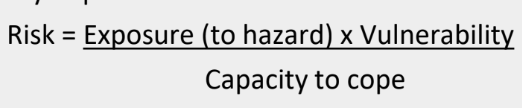
risk = (exposure to hazard x vulnerability)/capacity to cope
this is the equation for risk made by the United Nations International Strategy for Disaster Reduction (UNISDR)
technological hazards
OTHER TERMS:
these dangers may cause the loss of life or injury, property damage, social and economic disruption or environmental degradation
ex. transport accidents, industrial explosions & fires, nuclear accidents
vulnerability
OTHER TERMS:
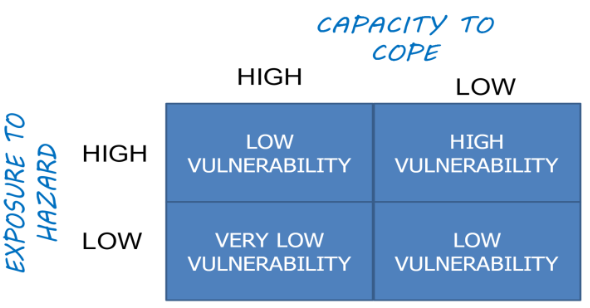
condition that result from several factors that increase the chances of a community being unable to cope with an emergency;
potential to suffer harm, related to the capacity to anticipate a hazard, resist it & recover from its impact
vulnerability & resilience
OTHER TERMS:
Both ________ and _______ are determined by physical, environmental, social, economic, political, cultural and institutional factors
disasters
CONCEPTS:
these are emergencies that cannot be handled by those affected without outside assistance;
disaster, 10, 100, international, state of emergency
CRED considers an event as a disaster if
____ or more people were killed;
or if ____ or more people were affected;
or a call for _______ assistance has been made;
and/or a ________ has been declare
NOTE: this is dependent on the scale of analysis (e.g. global, regional, national, local, community, household)
Center for Research in the Epidemiology of a Disaster
meaning of CRED
hazard occurrence
ESSENTIAL COMPONENTS IN DETERMINING RISKS:
refers to the likelihood of experiencing a natural, technological or manmade hazard at a given location or region;
quantifying hazard probability involves assessing not only the probability of occurrence but also the magnitude
elements at risk
ESSENTIAL COMPONENTS IN DETERMINING RISKS:
refers to the need for identification and inventory of people or school buildings or other elements which would be affected by the hazard if it occurs, and when required, estimating their economic value
vulnerability of the elements at risk
ESSENTIAL COMPONENTS IN DETERMINING RISKS:
asks how affected the school buildings or school children or other elements would be if they were to experience some levels of hazard impact?
concept of vulnerability
CONCEPTS:
propensity of a system to experience harm due to exposure to a hazard;
describes factors or constraints of an economic, social, physical or geographic nature which reduces the ability to prepare for and cope with the impacts of hazards
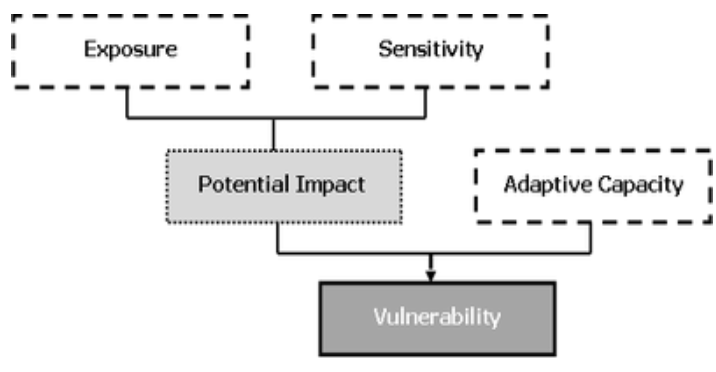
exposure
UNDER CONCEPT OF VULNERABILITY:
a.k.a. hazard specific vulnerability;
risks the local community is facing and how much a community is stressed;
severity of the stress is often measured by:
how much (magnitude),
how often (frequency)
for how long (duration),
where (spatial extent) a hazard event occurs
magnitude, frequency, duration, and spatial extent
4 things by which severity of the stress is often measured by
sensitivity, setting
UNDER CONCEPT OF VULNERABILITY:
a.k.a. ______ specific vulnerability;
inherent setting characs. which contribute to the general susceptibility of the area
sensitivity or setting specific vulnerability
UNDER CONCEPT OF VULNERABILITY:
how much the hazard affects the community;
involves the social, economic and environmental factors, which increase susceptibility of a community to the impact of hazards
adaptive capacity
UNDER CONCEPT OF VULNERABILITY:
ability of a system to adjust to hazards in order to moderate potential damages, take advantage of opportunities, or cope with consequences; resources, means and strengths possessed by persons, communities, societies which enable them to cope, withstand, prepare for, prevent, mitigate & quickly recover from disaster
includes issues of social capital, governance and coping experience
coping mechanisms
UNDER CONCEPT OF VULNERABILITY:
refer to actions resorted to by individuals or groups in face of adverse effects of a disaster in order to survive/withstand and move towards normalization
vulnerable sectors of society
those who face higher exposure to disaster risk and poverty
ex. women, children, elderly, differently abled people, ethnic minorities
risk
HOW HAZARDS TURN INTO DISASTERS?
probability of harmful consequences, or expected loss of lives, people injured, livelihoods, disruption of economic activities and damages to the environment as a result of interactions between natural or human induced hazards and vulnerable/capable conditions.
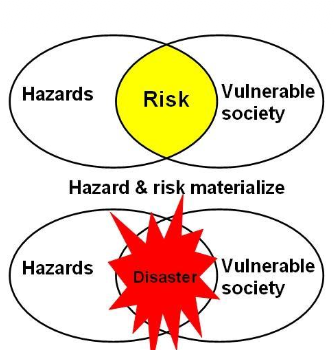
vulnerability
HOW HAZARDS TURN INTO DISASTERS?
comprises conditions determined by physical, social, economic, and environmental factors or processes, which increase the susceptibility of a community, school, or certain area in a locality to the impact of hazards.
capacities
HOW HAZARDS TURN INTO DISASTERS?
positive resources and abilities which are helpful to individuals, families and community
disaster risk management
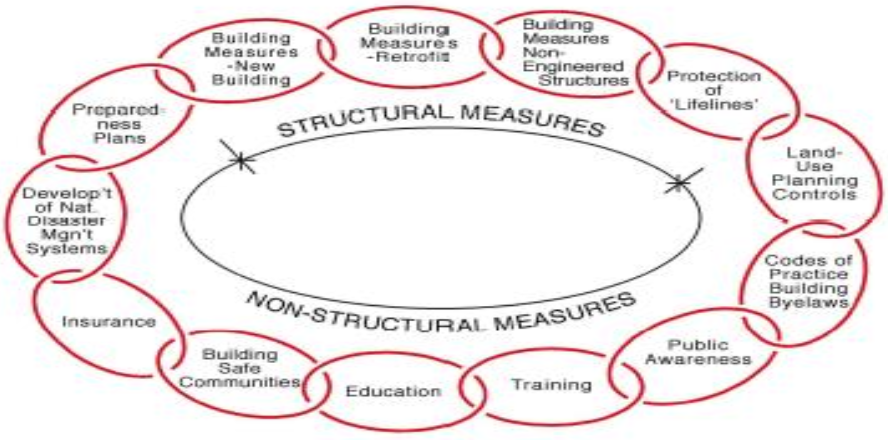
this involves identification, assessment and management of potential threats;
combination of actions, processes and attitudes necessary for minimizing underlying factors of vulnerability, improving preparedness and building resilience & enables an uninterrupted development trajectory of the communities and continued access to basic services
True
TRUE OR FALSE:
Risk management measures are far less expensive compared with the cost of loss of lives and the cost of managing its consequences