Marketing
 Call Kai
 Learn
Learn Practice Test
 Spaced Repetition
 Match
Match Flashcards
 Knowt Play
1/43

Earn XP
Description and Tags
Week 5 Determining which segments to target through evaluation
Name | Mastery | Learn | Test | Matching | Spaced | Call with Kai |
|---|
No analytics yet
Send a link to your students to track their progress
44 Terms
Determining which segments to target through evaluation
Size and growth
Is this segment the right size?
Will it be profitable and is it a growing segment for our firm?
Structural attractiveness
Can we access and compete in this market?
How different do the marketing mixes need to be to satisfy the differing needs of the various segments? If very different, then does the organisation have the required capabilities to target more than one segment?
Can we communicate and reach consumers in this segment?
Can we deliver the product to the consumers in this segment?
Company objectives and resources
Does this segment match our firm's organisational capabilities and objectives?
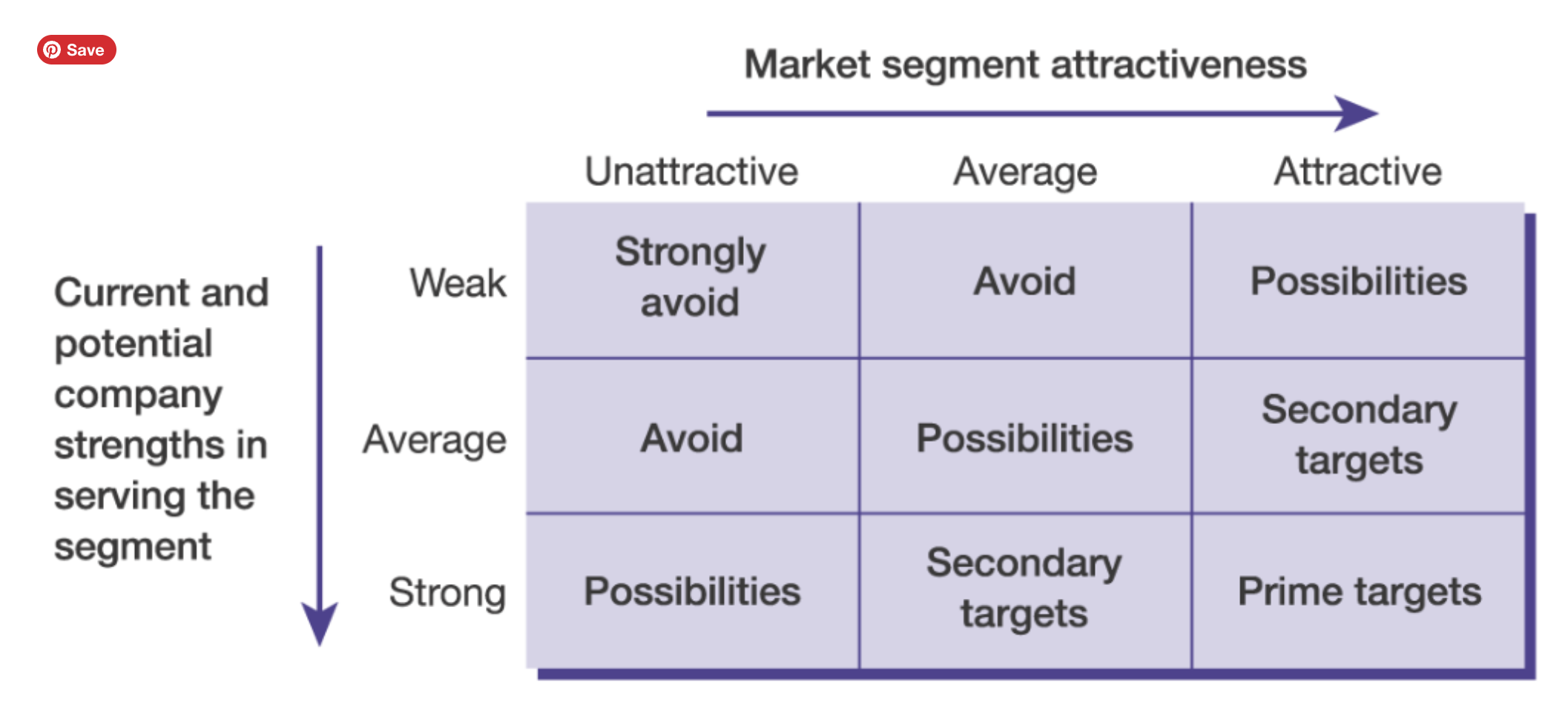
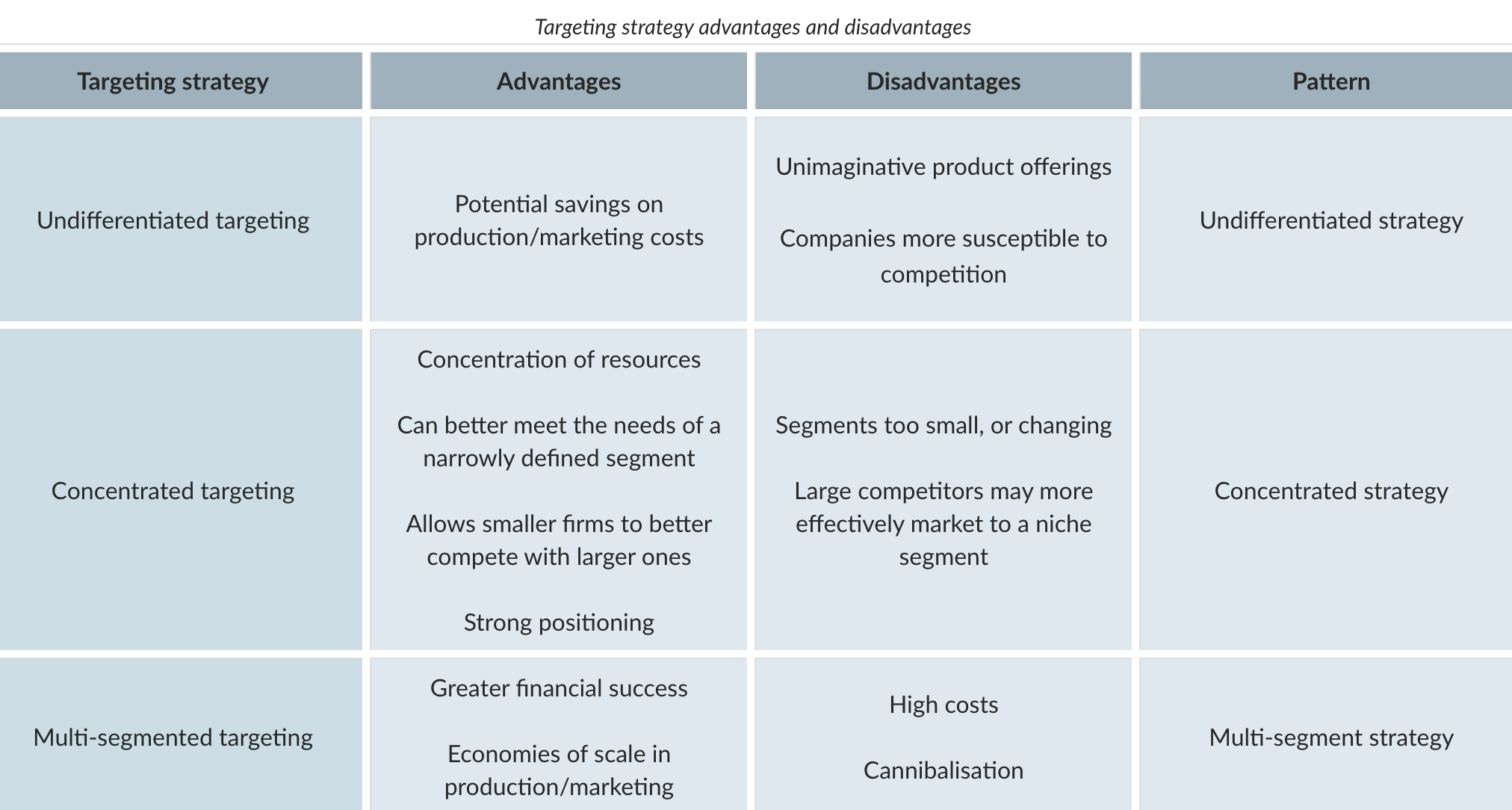
Types of Target Markets
Undifferentiated - The market is viewed as one big entity with no individual segments and thus requires a single marketing mix
Concentrated Targeting - This is used to select one niche segment for targeting marketing efforts
Multi-Segmented Targeting - A strategy that chooses two or more well-defined market segments and develops a distinct marketing mix for each.
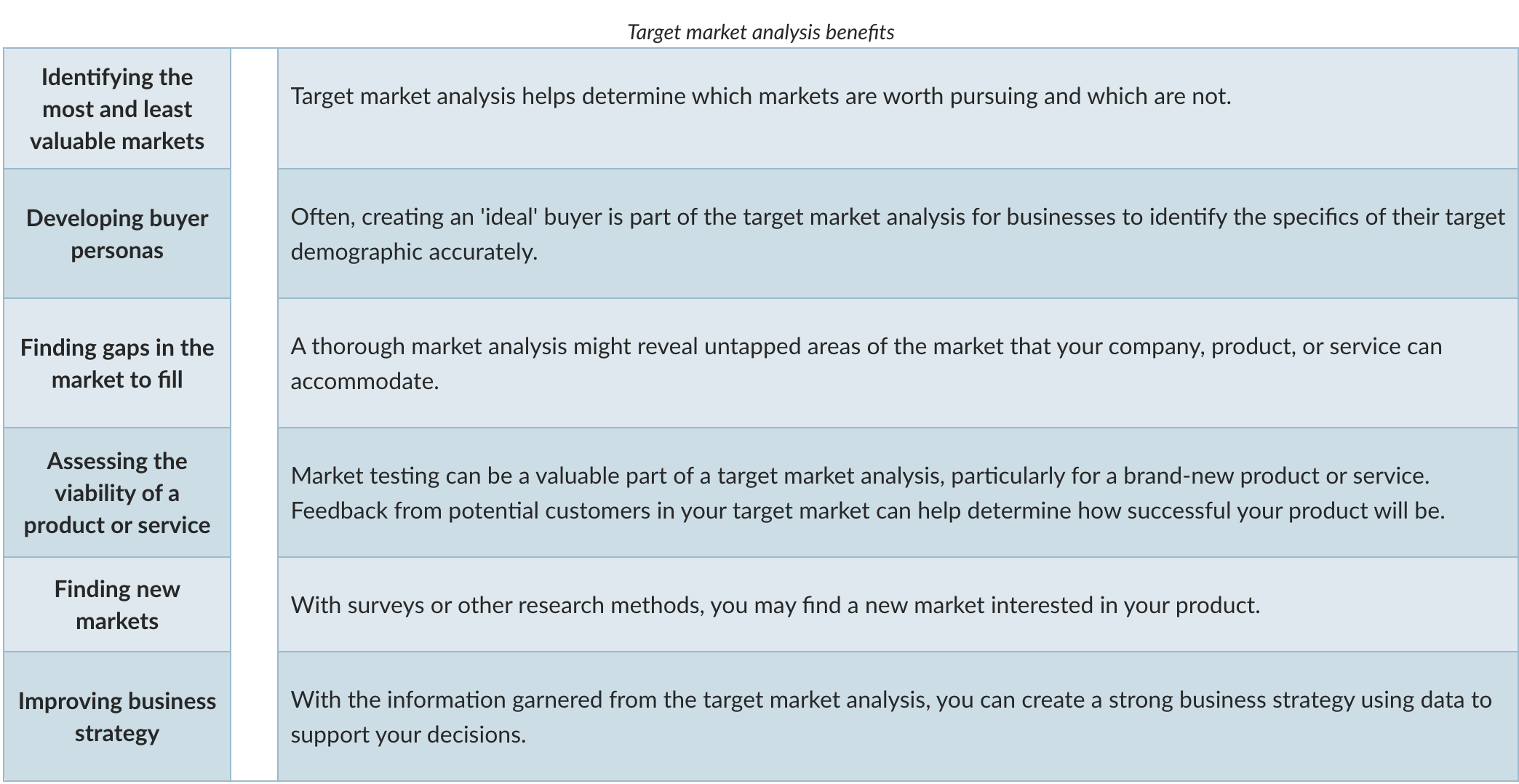
Target market analysis
A target market analysis is a systematic and comprehensive assessment that allows you to identify important characteristics of your target market and group them into categories based on those characteristics.
How to do Positioning
identifying sources of competitive advantage
choosing which to apply (and to which parts of the target market)
selecting the overall positioning strategy (that is the value proposition)
communicating and delivering that value proposition (via the marketing mix).
Positioning
The process of developing a specific marketing mix to influence current and potential customers' overall perception of a brand, product line or organisation, and the place the products hold inside their mind.
Position
The place a product, brand or groups of products hold in the consumers' mind in relation to similar products. 'Position' is sometimes confused with the 'Place' part of the 4Ps. You need to put the physical idea of positioning out of your head when talking about target marketing.
Product Differenciation
A positioning strategy that some organisations use to to distinguish their products from those of their competitors. Product (or brand) differentiation refers to how the product is able to be distinguished from other products—what attributes set it apart? In target marketing, competitive advantage is gained when a product is differentiated in some way—so much so that it is positioned in consumers' mind in a way that reflects it, can offer superior value compared to alternatives. Some bases for differentiation include product, services, channel, people or image.
Differenciation
Product, e.g. example features, performance, durability, conformance, reliability, reparability, styles, designs.
Service, e.g. delivery, installation, customer training, consulting, maintenance, other services such as warranty and guarantee.
Personnel, e.g. competence, hospitality, credibility, trustworthiness, responsiveness, communications.
Image, e.g. symbols, printed media, audio/visual media, atmosphere, sponsorship.
Points of Parity (POP)
The attributes that approximately match those offered by the competition
Points of Differenciation (POD)
The key attributes that give your product a competitive advatage of the competition
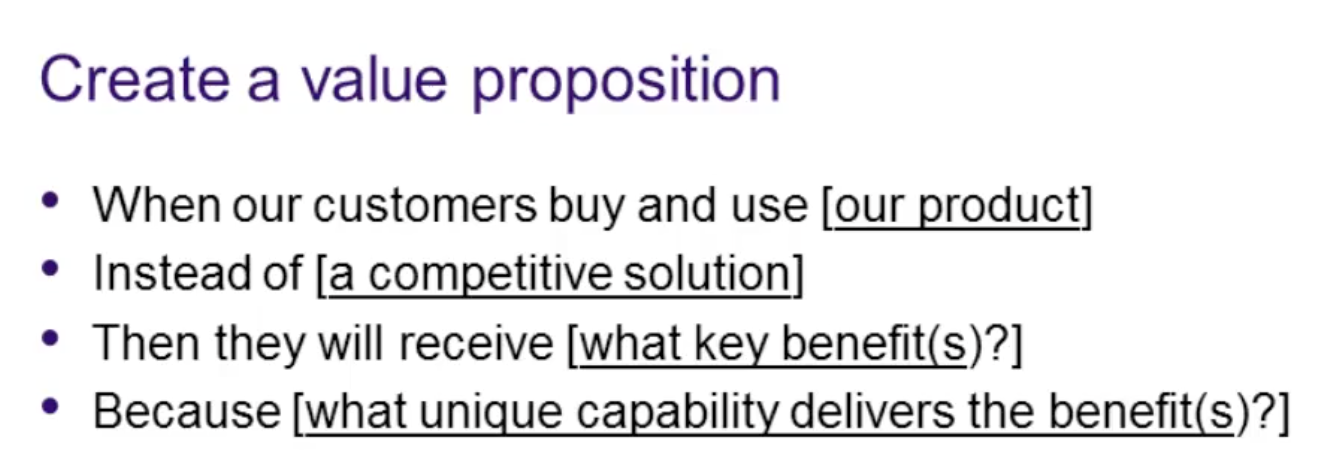
Value Proposition Framework
a statement articulating specific benefits a company is offering its target market
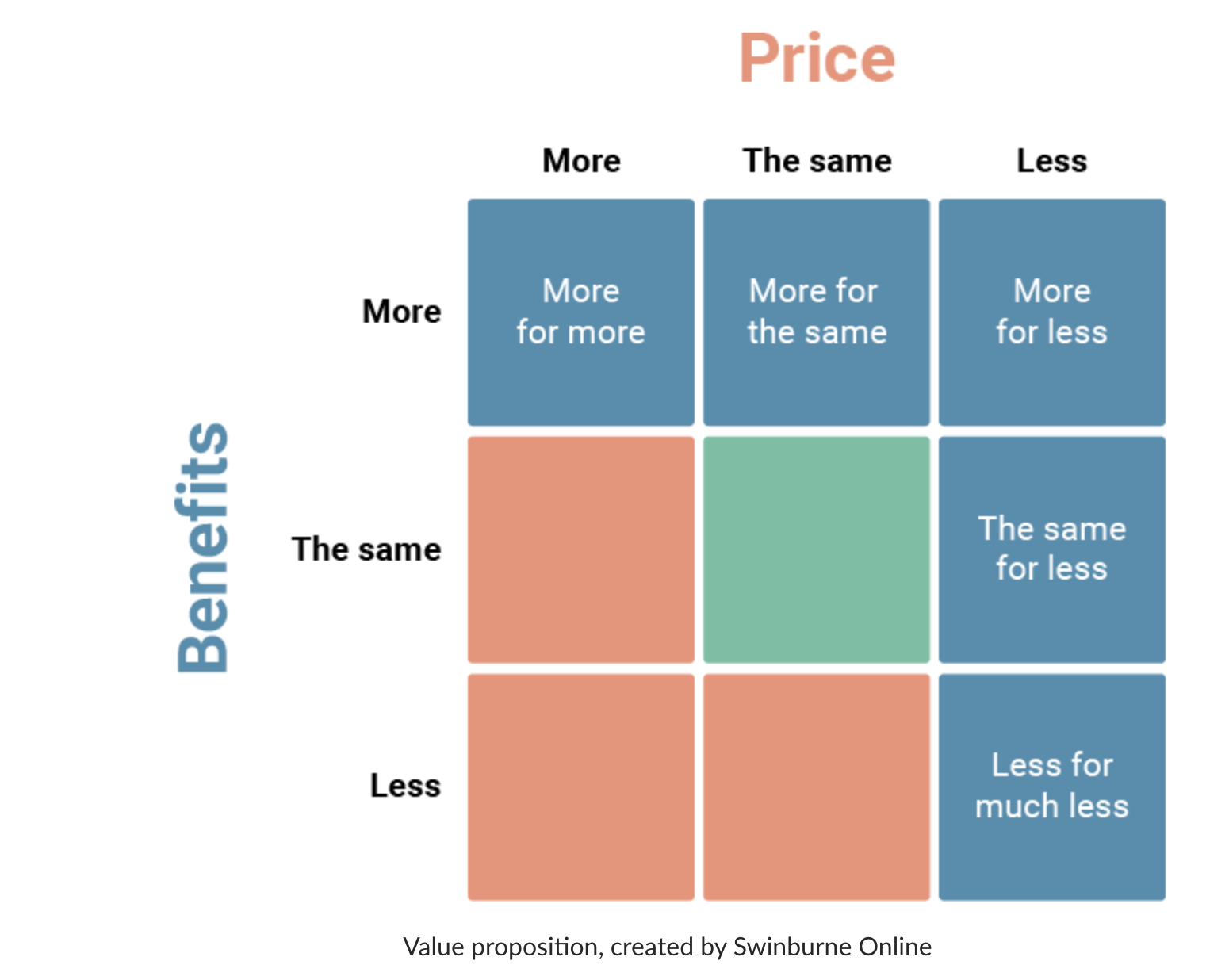
Template for creating a value proposition
Unique selling proposition
A unique selling proposition, or USP, is focused on finding the factor that differentiates your product and/or service from the competition
How to figure out your UPS
Put yourself in your customer's shoes. You need to take a step back. We know that you know your business case is a great idea. But if you take your team's emotional attachment to the idea away, would you, as a customer, pay for it? Why? Why not? Your reasons for not buying may help you refine your USP.
Know what motivates your customers' behaviour and buying decisions. Are these motivations desires (that you create) or an actual need?
Uncover the real reasons customers buy your product instead of a competitor's. The best place to get your answers is from your customers—understand why customers buy from them and use that to fuel reasons why customers would buy from your client.
Elements of a Positioning Statement
Target audience, i.e. who do you want to serve?
Frame of reference, i.e. what category are you in?
Point of difference, i.e. what is your most compelling benefit that others don’t have? And what problem does it solve for the customer?
Price, i.e. what is the target customer willing to pay?
Reason to believe, i.e. what is your proof? This last step is optional.
Example: Positioning statement
'To [target customer], this [brand within the X category] is [product features] that will [solve the target customer’s life problems], brought to you by [evidence/support claims] at a [price you consider to be good value].'
Marketing information systems (MIS)
Marketing information systems gather everyday information about environmental marketing developments to generate and validate actionable customer and market insights. They help to assess information needs; develop the required information and also help decision-makers use the information effectively.
Market Research
Marketing research links the consumer, customer and public to the marketer through information. It is used to identify and define marketing opportunities and problems; generate, refine and evaluate marketing actions; monitor market performance, and improve understanding of the marketing process.
Market Research Process
Defining the Problem and Research Objectives
Exploratory: objectives are simply designed to explore certain topics to uncover some insights.
Descriptive: objectives relate to estimating the sizes and other characteristics of certain groups of people.
Causal: testing a new advertisement to figure out whether it changed attitudes about the product would be an example of causal research as it seeks to investigate whether the advertisement would cause a particular effect (or change).
Developing the Research Plan
Collecting secondary data is often a very early part of the research planning process. You were introduced to the concept of secondary sources in previous weeks, but make sure you take note of the definition of secondary data and that of its counterpart, primary data.
Secondary data includes information that has been collected for a different purpose but can be applied to the research problem being explored, e.g. Census data. Primary data is collected directly for the research project, e.g. survey, focus group.
Implementing the Research Plan
The process of collecting and analysing data may be done 'in-house' or by a marketing research agency.
Care needs to be taken to avoid errors and biases creeping into the data or analysis.
Interpreting and Reporting the Findings
The data that is collected and analysed are simply the raw ingredients of marketing research. To become knowledge and aid to decision-making, it needs to be analysed, interpreted, and put into a form where it can be applied. And importantly, the findings must be presented in a manner that will make sense to the managers who need to apply it.
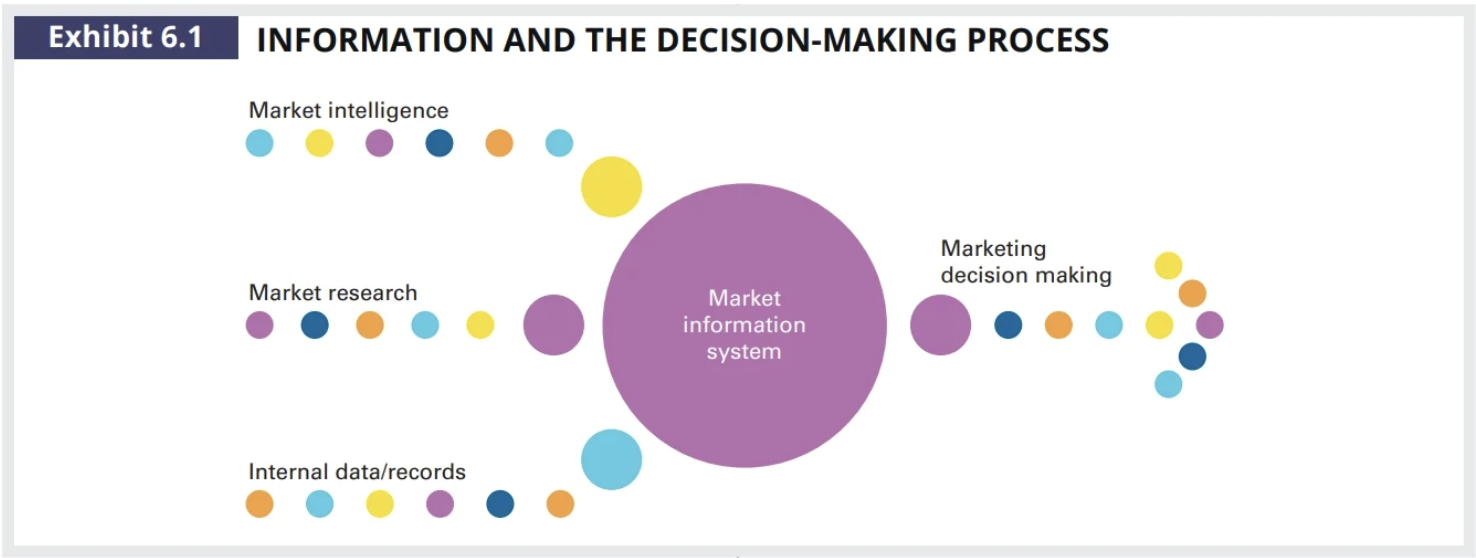
Market Information System (MIS)
A set of procedures and methods for the regular and planned collection, analysis and presentation of information for marketing decisions
Marketing Intelligence
Everyday information about developments in the marketing environment that managers use to prepare and adjust marketing plans
INFORMATION AND THE DECISION-MAKING PROCESS
Database Marketing
Creating a large, computerised file of current and potential customers’ profiles and purchase patterns for marketing purposes.
Social Media Feedback
The capture and interrogation of free-forming commentary regarding an organisation’s brands and products.
Behavioural Economics
A review of people’s rational and irrational behaviour to better understand their buying behaviour.
Market Research
The process of planning, collecting and analysing relevant data to gain insight or support marketing decision making.
Marketing Research
The process of improving decision making related to identifying and solving problems and opportunities in marketing.
Market Research Roles
• Its descriptive role includes gathering and presenting factual statements. For example, what is the historical sales trend in the industry? What are consumers’ attitudes towards a product and its advertising?
• Its diagnostic role includes explaining data; for example, what is the impact on sales of a change in the package design?
• Its predictive function is to address ‘what-if’ questions; for example, how can the researcher use descriptive and diagnostic research to predict the results of a planned marketing decision?
Market Research Advantages
• It improves the quality of decision making. • It allows managers to trace problems. • It will enable managers to focus on the importance of keeping customers.
• It assists managers in better understanding the marketplace and alerts them to marketplace trends.
• It helps managers gauge the perceived value of their goods and services and the level of customer satisfaction
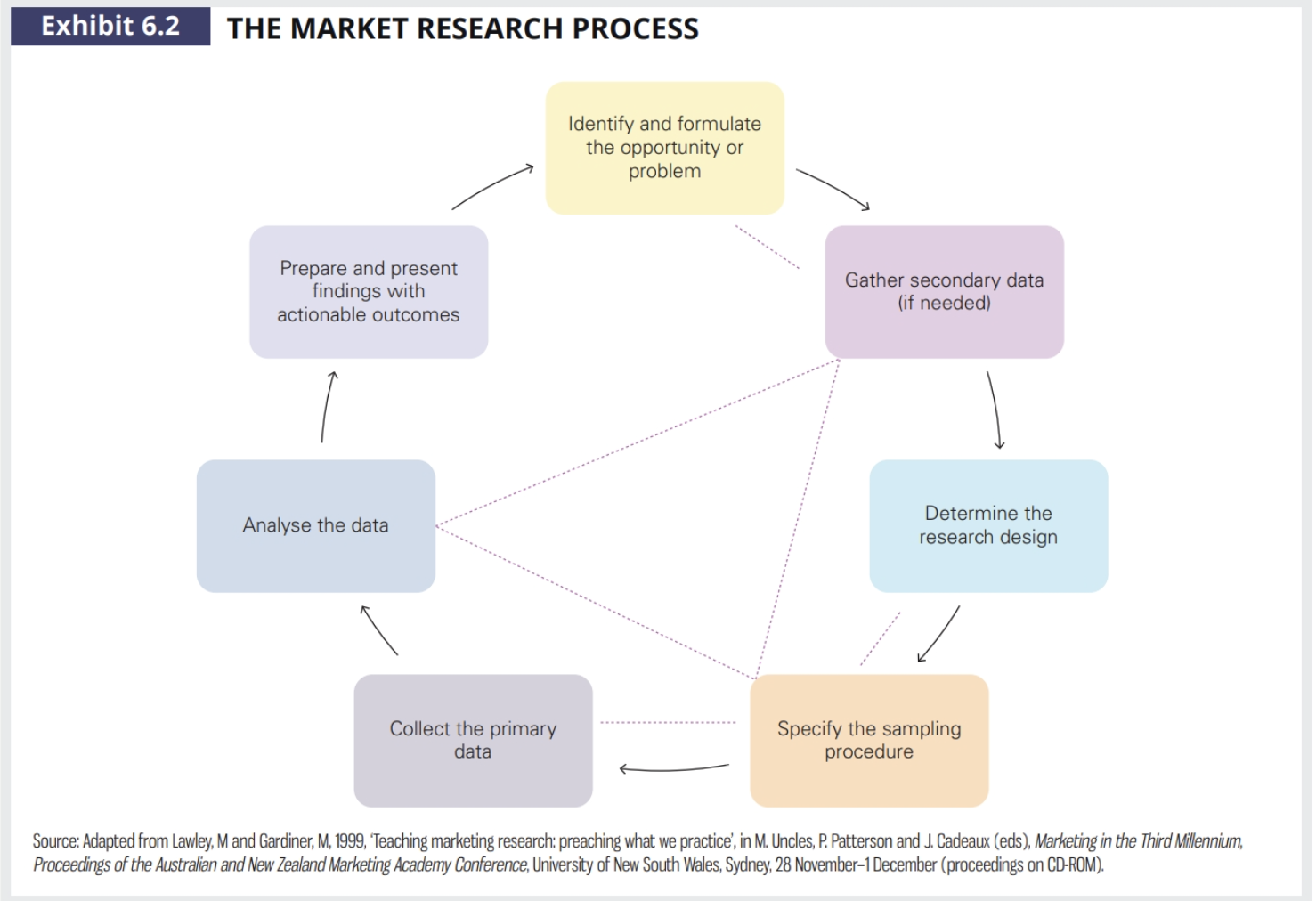
Market Research Process
1 Defining the marketing problem
2 Gathering secondary data
3 Planning the research design
4 Sampling
5 Collecting data
6 Analysing data
7 Presenting findings with recommendations
Market Research Problem
Determining what information is needed and how to obtain that information efficiently and effectively
Market Research Objective
Specific information needed to solve a market research problem. The objective should provide insightful decision-making information.
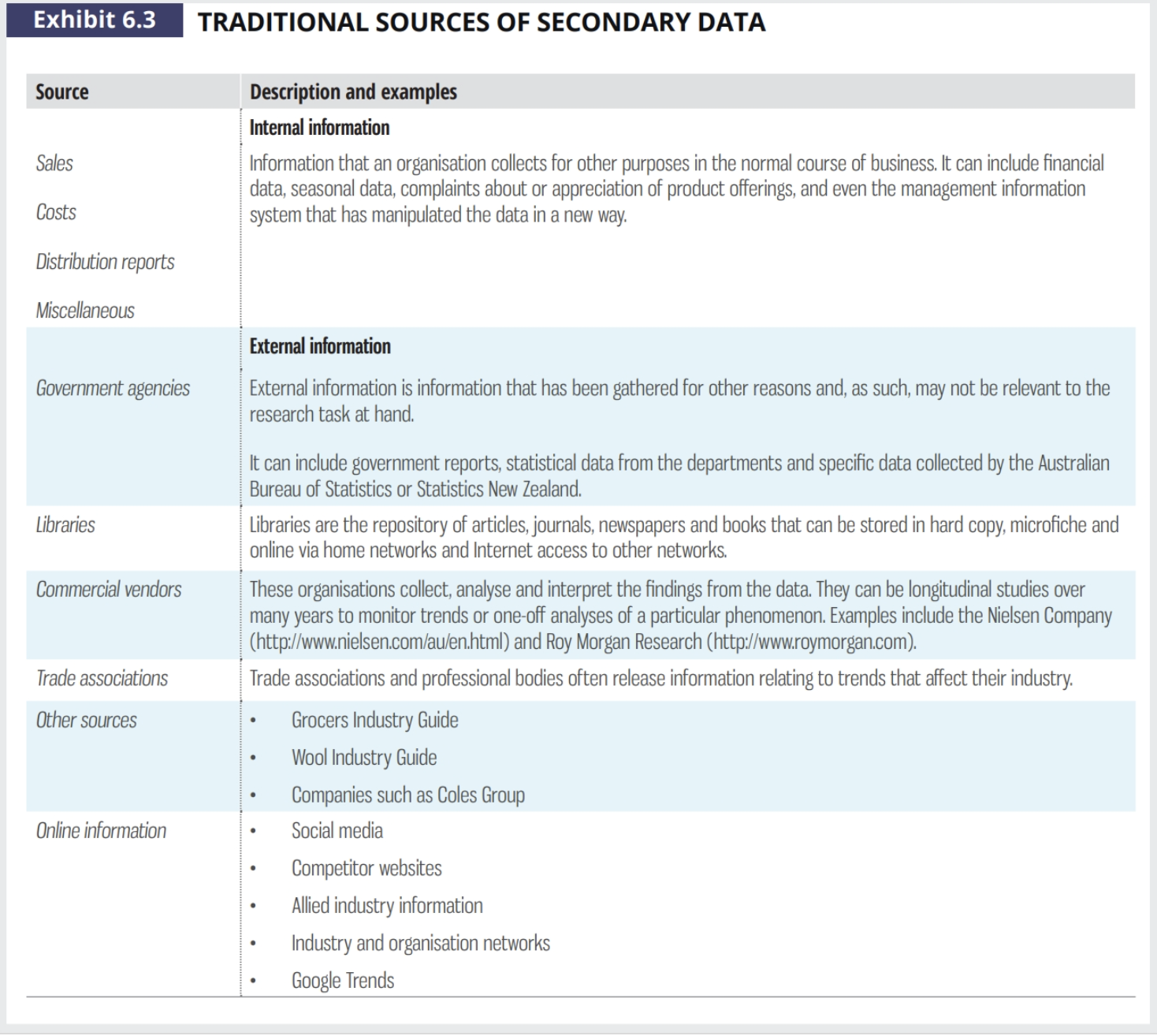
Secondary Data
Data previously collected for any purpose other than the one at hand
TRADITIONAL SOURCES OF SECONDARY DATA
Research Design
The research program plan, specifying the research questions, the how and when for data gathering, and how the data will be analysed.
Primary Data
Information collected for the first time, which can be used for solving the problem under investigation
Survey Research
The most popular technique for gathering primary data, in which a researcher interacts with people to obtain facts, opinions and attitudes.
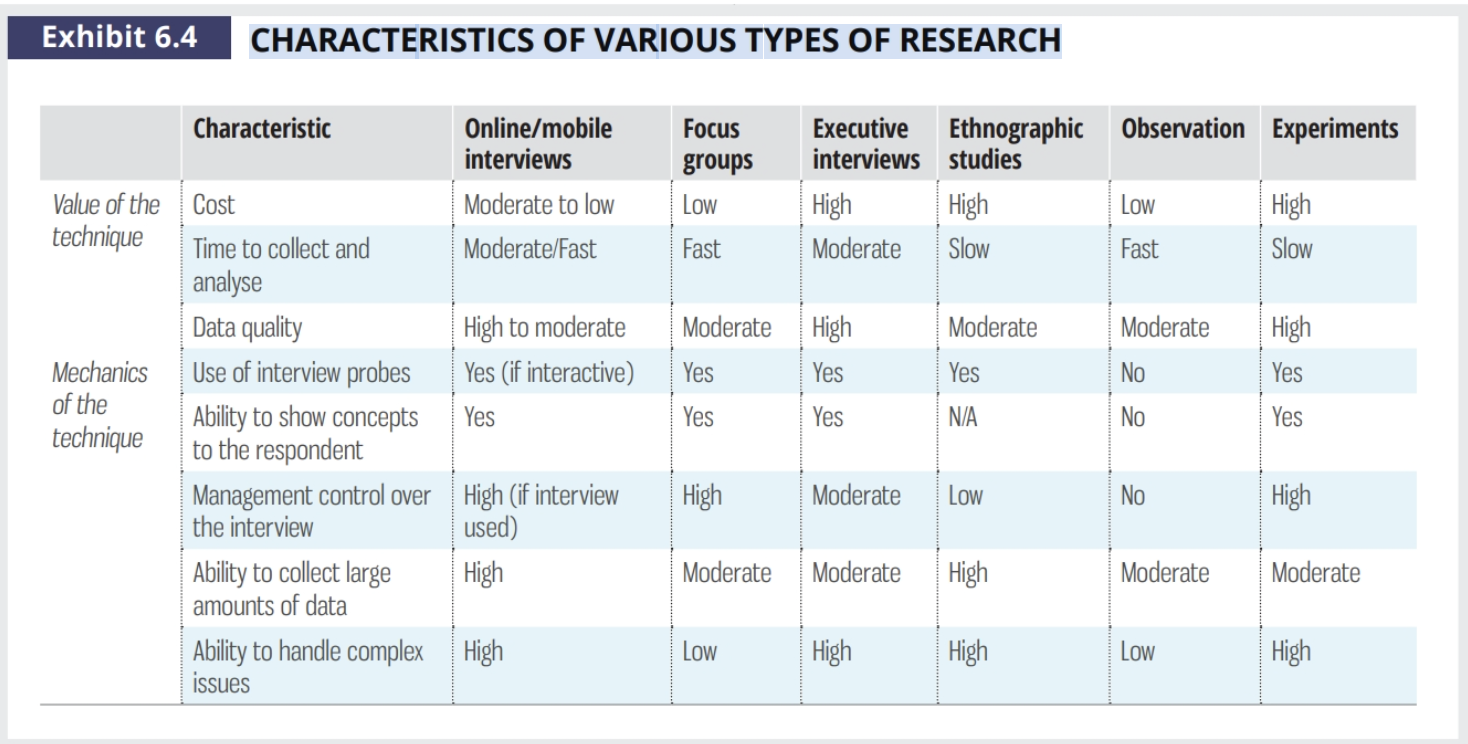
CHARACTERISTICS OF VARIOUS TYPES OF RESEARCH
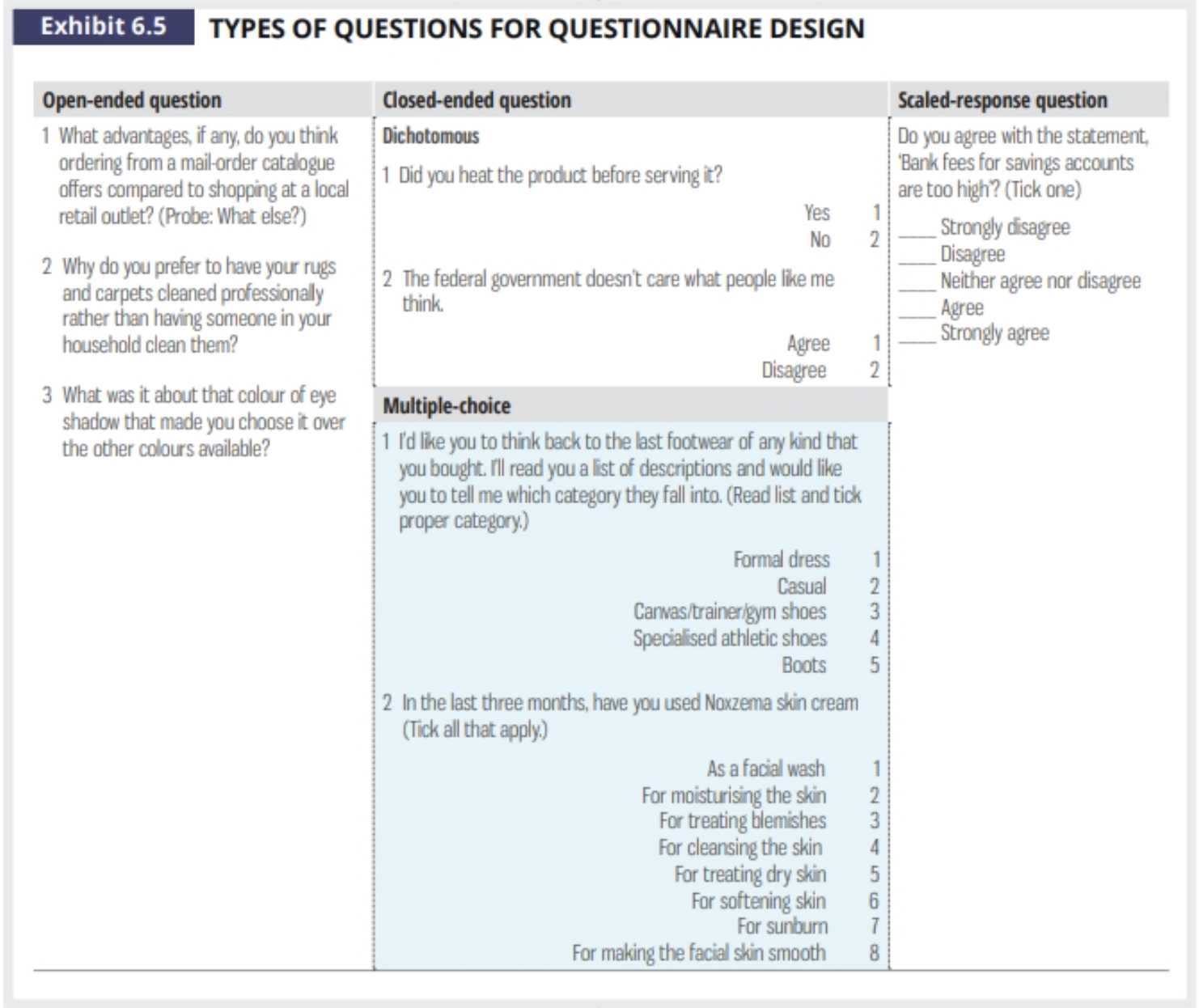
Open-Ended Question
An interview question that encourages an answer phrased in the respondent’s own words.
Closed-Ended Question
An interview question that asks the respondent to select from a limited list of responses.
Scaled-Response Question
A closed-ended question designed to measure the intensity of a respondent’s answer.
TYPES OF QUESTIONS FOR QUESTIONNAIRE DESIGN
Exploritory Research
Definition - an approach that allows the researcher to collect information in a less structured way and will enable respondents to talk around a topic or question
Types:
Focus Group - A type of personal interview in which seven to 10 people participate in a group discussion led by a moderator.
Executive Interviews - approaching expert consumers for the product and asking them tailored questions
Observation Research
A research method, relying on three types of observation: people watching people, people watching an activity and machines watching people