Ancient Egypt
 View linked note
 Call Kai
 Learn
Learn Practice Test
 Spaced Repetition
 Match
Match Flashcards
 Knowt Play
1/24

There's no tags or description
Looks like no tags are added yet.
Name | Mastery | Learn | Test | Matching | Spaced | Call with Kai |
|---|
No analytics yet
Send a link to your students to track their progress
25 Terms
Mastaba
a non-royal tomb from ancient Egypt; a rectangular brick or stone structure with sloping sides erected over a subterranean tomb chamber connected with the outside by a shaft
Hieroglyph
a stylized picture of an object representing a word, syllable, or sound, as found in ancient Egyptian and other writing systems
Ka
a spiritual entity, an aspect of the individual, believed to live within the body during life and to survive it after death
Palette
a flat object used by artists today for mixing paints
Serdab
a small concealed chamber in an Egyptian mastaba for the statue of the deceased
Ben-ben stone
a pyramidal stone associated with creation that supported the supreme god
Necropolis
(literally "city of the dead") a cemetery, especially a large one belonging to an ancient city
Mummification
the methods of embalming, or treating the dead body, that the ancient Egyptians used
An Egyptian chancellor and architect, this person is the first "artist" whose name has been recorded.
Imhotep
In a temple the purpose of art was to maintain the state of Maat, while in tombs the art ensured the tomb owner would have everything necessary for a contented afterlife.
art is regarded as fuctional rather than decorative
The content is organized and separated into horizontal bands.
registers
This ensured a constant relationship between the elements of a composition in accordance with the principle of Maat which required balance and symmetry.
canon of proportion
The failure to depict something in its entirety would imply emptiness; therefore, Egyptian artists wanted to convey the most amount of information in the most efficient manner.
objects and landscapes are depicted more like diagrams rather than realistically
There is a direct link between the size of figures and their importance.
hierarchy of scale
People are always shown as young and beautiful, animals are well-fed, etc. The purpose is not to present a portrait, but an idealized, abstracted concept.
Especially in religious context, idealization is the rule
In ancient Egypt, the most important factor determining the depiction of the human body was
social status
The purpose of funerary sculpture in ancient Egypt (like Khafre, from Giza, c. 2500 BCE) was…
to be an eternal home for one's ka in the event the mummified body is destroyed
When an Egyptian artist wanted to depict something normally hidden from view, he would either move it to make it visible or draw its container as if transparent, because failure to depict the contents would imply emptiness.
true
The Rosetta Stone is important in the study of hieroglyphs because…
with the same text written in three different scripts, it provided an "answer key" to deciphering hieroglyphs
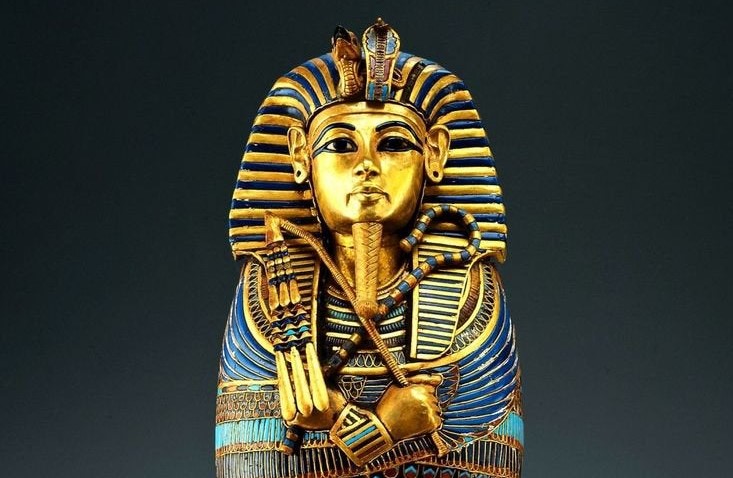
This crown of Egypt is known as…
nemes headdress
According to the textbook, the angles sides of the pyramidal form may have been meant to represent the slanting rays of the sun because inscriptions…
tell of deceased kings climbing up the rays to join the sun god Ra
The site of the Great Pyramids at Giza was carefully planned…
to follow the sun's east-west path
massive gateway, marks the entrance to the temple complex
pylon
large interior room characterized by many closely spaced columns
hypostyle
architectural feature that allows natural light to come in
clerestory