2.CW inhibit P1
 Call Kai
 Learn
Learn Practice Test
 Spaced Repetition
 Match
Match Flashcards
 Knowt Play
1/33

There's no tags or description
Looks like no tags are added yet.
Name | Mastery | Learn | Test | Matching | Spaced | Call with Kai |
|---|
No analytics yet
Send a link to your students to track their progress
34 Terms
Gram (+ve) Physical properties
peptidoglycan layer is much thicker in grampositive than in gram-negative
Penicillin-binding proteins (PBPs) are membrane proteins that cross-link peptidoglycan.
TRUE/FALSE
True
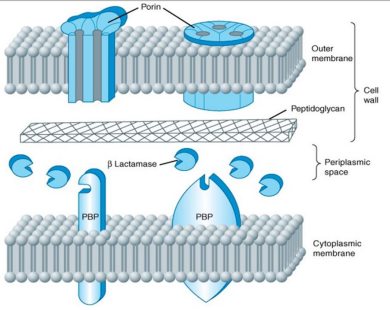
Cell wall inhibitors work on actively proliferating microorganisms (no effect on bacteria that are not growing and dividing)
True/false
True
Characteristic of Penicillin?
widely effective and least toxic
Note: Penicillins
Penicillins are only effective against rapidly growing organisms that synthesize a peptidoglycan cell wall
(inactive against mycobacteria, protozoa, fungi, and viruses).
MOA of penicillin(2)
1.Inhibit PBP
2.Production of autolysins
MOA of penicillin for inhibit PBP?detailed
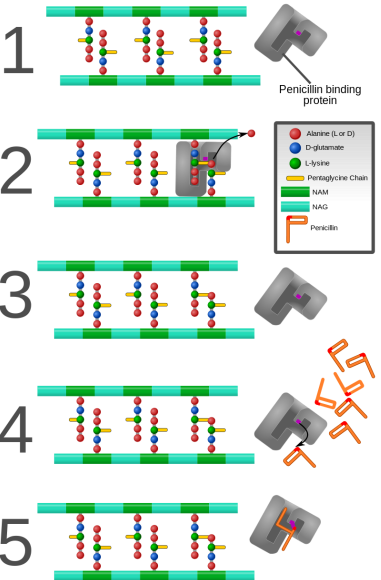
1. Bacterial cell wall consists of strands of repeating (NAG) and (NAM) subunits. The NAM subunits have short peptide chains (used in cross-linking).
2. The penicillin binding protein (PBP) forms a crosslink
3. The PBP dissociates from the wall once the cross-link has been formed.
4. Penicillin is added to the system. It enters the active site of the PBP and reacts with the serine group.
5. The beta-lactam ring of penicillin covalently linked to the PBP and permanently blocks the active site.
Thus blocking cross linking of peptidoglycan
MOA of penicillin for production of autolysins?
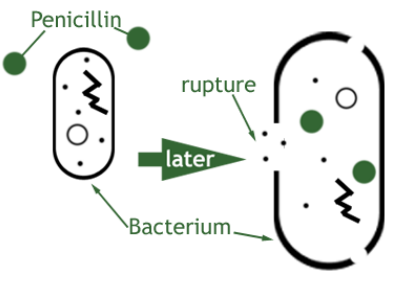
Autolysins are produced by bacteria to remodel the bacterial cell wall. In the presence of penicillin, the cell wall degradation by autolysins proceeds
in short MOA of penicillin?
inhibition of cell wall synthesis and destruction of existing cell wall by autolysins
Is penicillin time dependent and bactericidal?
YES
How to obtain Natural Penicillins
Obtained from fermetation of fungus penicillium chrysogenum)
Properties of Penicillin V
Poor oral absorption
More acid stable than Penicillin G
Natural Penicillin cover what bacteria?
Syphilis
Gonorrhea
Streptococcal Pneumonia
Example pf Antistaphylococcal penicillin(beta-lactamase resistant penicillin)
Methicillin
Methicilin is toxic (interstitial nephritis),not clinically used anymore
True
Example of extended spectrum penicillins
Amoxicillin and Ampicillin
Amoxicillin prevents bacterial endocarditis during dental surgery
True
Extended spectrum penicillin always pair with ?
Beta lactamase inhibitor eg. clavulanic acid /sulbactam
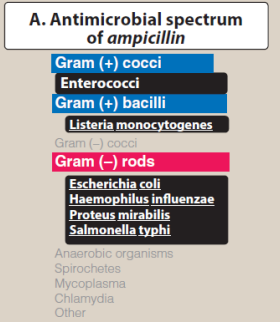
Coverage of Ampicillin
Extended spectrums penicillins are more effective toward gram (-VE)
True
Extended spectrum penicillin is use to treat
respiratory infections
MRSA can be treated by?
vancomycin
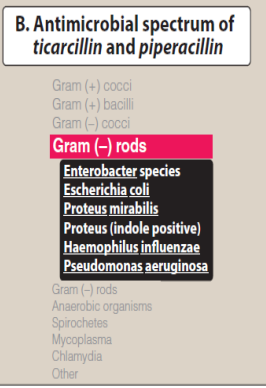
Coverage of Antipseudomonal penicillins (ticarcillin and piperacillin)
not towards Kblesiella
What cause resistance toward penicillin groups?
inactivation of antibiotic by beta-lactamase(major)
modification of PBPs
impaired penetration of drug to target PBPs
efflux
Pharmacokinetics of Penicillins
Absorption?
incompletely oral absorption.
However, amoxicillin is almost completely absorbed
Penicillins should be given on empty stomach (1-2 hours before or after meal). Why?
because food and stomach acids delay absorption, reducing the amount of medicine that enters your bloodstream
Pharmacokinetics of Penicillins
Distribution
Well-distributed
• Cross placental barrier, but none-teratogenic.
• Low penetration into bone and cerebrospinal fluid (Unless the sites are inflamed which will ↑ drug penetration).
• Penicillin is not effective for prostate infection
Pharmacokinetics of Penicillins
Metabolism
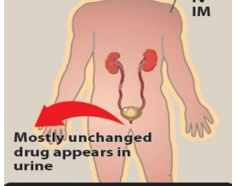
insignificant metabolism(unchanged drug)
But Nafcillin and oxacillin are primarily metabolized in the liver
Pharmacokinetics of Penicillins
Excretion
Glomerular filtration and active tubular secretion.
penicillins are also excreted in breast milk.
What do you have to do for patients with impaired renal function?
Dose Adjustments
Avoid Nephrotoxic Drugs
Dietary Management
Dose adjustment is not required for Nafcillin and oxacillin in patients with impaired renal function are exceptions. Why?
they are primarily eliminated via the hepatobiliary (liver) system rather than the kidneys
Probenecid (used to prevent gout attacks by helping the body eliminate excess uric acid)
inhibits the secretion of penicillins by competing for active tubular secretion via the organic acid transporter So?
Toxic la). Note: Penicillin itself is actually remarkable non-toxic
Adverse effect of Penicillin
1.Hypersensitivity-angioedema,anaphylaxis
2.Diarrhoea-disruption of normal balance intestinal flora(Clostridium difficile)
3.Nephritis
4.Neurotoxicity-seizure if injected intrathecally
-cause GABAergic inhibition(reduce the electrical activity of neurons in the brain)
5.Hematologic toxicity(Cytopenia)-decrease in bone marrow and blood cell