Social Psych Final
 Call Kai
 Learn
Learn Practice Test
 Spaced Repetition
 Match
Match Flashcards
 Knowt Play
1/73

There's no tags or description
Looks like no tags are added yet.
Name | Mastery | Learn | Test | Matching | Spaced | Call with Kai |
|---|
No analytics yet
Send a link to your students to track their progress
74 Terms
What is the definition of social psychology
Scientific study of how people think about, influence, and relate to one another.
Hindsight Bias (I-knew-it-all-along phenomenon)
A phenomenon in which people exaggerate the predictability of an event after it has already happened.
Who is more likely to escalate a cross-sex friendship?
Emerging adults, African Americans, and Men
prejudice
A preconceived negative judgment of a group and its individual members. It is typically supported by stereotypes
social role
the set of behaviors expected of a person in a particular social position, a role schema is the cognitive structure that organizes one’s knowledge about those appropriate behaviors
stereotypes
a particular kind of role schema that organizes peoples’ expectations about other people who fall into certain social categories/a belief about the personal attributes of a group of people. Stereotypes are sometimes over generalized for simplicity, inaccurate, and resistant to new information, however they are not always negative
discrimination
Unjustifiable negative behavior toward a group or its members (especially on the grounds of race, age, or sex)
racism
Prejudicial attitudes & discriminatory behavior toward people of a given race
Sexism
Prejudicial attitudes & discriminatory behavior toward people of a given sex
Modern Racism
subtle racial prejudice, expressed in a less open manner than is traditional overt racial prejudice and characterized by an uncertainty in feeling and action toward minorities
dual attitude system
differing explicit (conscious) and implicit (automatic) attitudes toward the same target
White guilt
feelings of guilt, shame, or responsibility that some white people may experience in response to historical or ongoing racial inequality, oppression, or injustice, particularly toward non white communities. It can arise from the recognition of privilege or advantage that white individuals may have due to systemic racial inequalities, even if they personally have not directly caused harm or discrimination. While white guilt can lead to positive actions, such as efforts to combat racism or support equality, it can also be unproductive if it turns into defensiveness, avoidance, or an inability to engage with these issues constructively. The goal is often to move beyond guilt and toward a productive understanding of privilege and systemic change.
Norms are ______, stereotypes are _______
prescriptive; descriptive
Gender norms
beliefs about how men and women ought to behave
Gender stereotypes
beliefs about how men and women do behave
What are the two types of sexism
Hostile sexism and Benevolent sexism
Hostile sexism
Overtly negative evaluations and stereotypes about gender / “Once a man commits, she puts him on a tight leash”
Benevolent sexism
Evaluations of gender that may appear subjectively positive, but are actually damaging to people and gender equity. / “the man is the provider” “the woman is dependent”
Temporary Inequality
The dominate individual will bring the subordinate up to his/her level. Examples: Child/Parent; Student/Professor
Permanent Inequality
“some people or groups of people are defined by as unequal by means of what sociologists call ascription; that is, your birth defines you” (Miller, 1986, p. 110). Examples: Race, sex, class, nationality, religion or other ascribed at birth
Ethnocentric
believing in the superiority of one’s own ethnic group and having a corresponding disdain for all other groups
Stereotype Threat (Steele)
A self confirming apprehension that one will be evaluated based on a negative stereotype (Steele, 1997). A disruptive concern, when facing a negative stereotype, that one will be evaluated based on a negative stereotype. Unlike self fulfilling prophecies that hammer one’s reputation into one’s self concept, stereotype threat situations have immediate effects.
Need to belong
a motivation to bond with others in relationships that provide ongoing, positive interactions
Interpersonal Attraction
The tendency to evaluate positively, and seek closeness with, a target person to whom we are not (yet) close (Finkel & Baumeister)
Reward theory of attraction
Those who reward us, or whom we associate with rewards, we like/We like those whose behavior is rewarding to us or whom we associate with rewarding events
Merely anticipating interaction with someone
boosts liking (cognitive repetitions)
Mere exposure
Tendency for novel stimuli to be liked more or rated more positively after the rater has been repeatedly exposed to them/Exposure without awareness leads to liking
The Matching Phenomenon
People pair off with people who are about as attractive as they are/ The tendency for men and women to choose as partners those who are a good match in attractiveness and other trait
Physical-Attractiveness Stereotype
Presumption that physically attractive people possess other socially desirable traits as well
Secure attachment style
Have a positive view of relationships and find it easy to get close to others
Avoidant attachment style
Are hesitant about getting involved in romantic relationships
Anxious attachment style
Demand closeness, are less trusting, more emotional, jealous, and possessive
Altruism
A motive to increase another’s welfare without conscious regard for one’s self interests
Prosocial Behavior
Consists of behaviors consensually regarded as beneficial to others, such as Helping, sharing, comforting, guiding, rescuing, and defending. Early socialization attempts to reinforce this behavior
Social exchange theory
We help after doing a cost-benefit analysis. Human interactions are transactions that aim to maximize one’s rewards and minimize their costs
The Bystander Effect is
the finding that a person is less likely to provide help when there are other bystanders
The reciprocity norm
To those who help us, we should return help, not harm, thus, we expect that those who receive favors (gifts, invitations, help) should later return them
The social responsibility norm
We should help those who really need it, without regard to future exchanges/An expectation that people will help those dependent on them even when remaining anonymous
Evolutionary Psychology
the study of the evolution of cognition and behavior using principles of natural selection
Norms
Standards for accepted and expected behavior, prescribed proper behaviors, as well as what is normal
Deindividuation
The loss of self-awareness and evaluation apprehension. It occurs in group situations that foster responsiveness to group norms, good or bad
B=f(p,e)
Kurt Lewin’s formula: Behavior is a function of the person and the environment
Kurt Lewin
Father of modern social psychology.
Proposed B = f(P, E) — behavior results from the interaction of person and environment.
Emphasized real‑world application and group dynamics.
Fundamental Attribution Error (FAE)
tendency for observers to underestimate situational influences and overestimate dispositional influences upon others' behavior
-cultural differences: stronger in western cultures
-in eastern cultures, the roles of context and situational forces as causes of behavior are more commonly acknowledged
Cognitive Dissonance
Leon Festinger- people change their own attitudes when there are discrepancies between attitudes and behavior
-we feel tension when two simultaneously accessible cognitions are psychologically inconsistent
-to reduce the tension we often adjust our thinking
-"attitudes follow behavior effect" was strongest when people felt some choice and when their actions had foreseeable consequences
collectivism
giving priority to the goals of one’s group and defining one’s identity accordingly. This is more common in African and east Asian communities.
individualism
the concept of giving priority to one’s own goals over group goals and defining one’s identity in terms of personal attributes rather that group identifications. This is typically found in western cultures.
Self concept
development of social self / who am I?
Anticipatory Liking
Merely anticipating interaction boosts liking
Self disclosure
revealing intimate aspects of oneself to others
Social Dominance Orientation (SDO)
A personality trait describing how strongly a person prefers hierarchical group relationships. High‑SDO individuals believe some groups should dominate others and tend to support inequality, prejudice, and hierarchy‑enhancing policies. Low‑SDO individuals prefer equality and oppose group‑based dominance.
Need for Attachment
A basic human motivation to form close, stable emotional bonds with others. People high in attachment need seek closeness, security, and reassurance in relationships. Often tied to attachment styles (secure, anxious, avoidant).
Factors Contributing to Friendship
Proximity — physical closeness increases interaction and liking.
Functional distance — how often paths cross (e.g., shared spaces, routines).
Similarity — attitudes, values, interests, background.
Reciprocal liking — we like people who like us.
Self‑disclosure — sharing personal information builds closeness.
Availability — people who are open to connection.
Factors Contributing to Attraction
Physical attractiveness (halo effect, symmetry, “what is beautiful is good”).
Similarity (attitudes, personality, values).
Proximity & functional distance (opportunity to interact).
Reciprocal liking (being liked increases attraction).
Arousal (misattribution of arousal — ties into the two‑factor theory).
Familiarity (mere exposure effect).
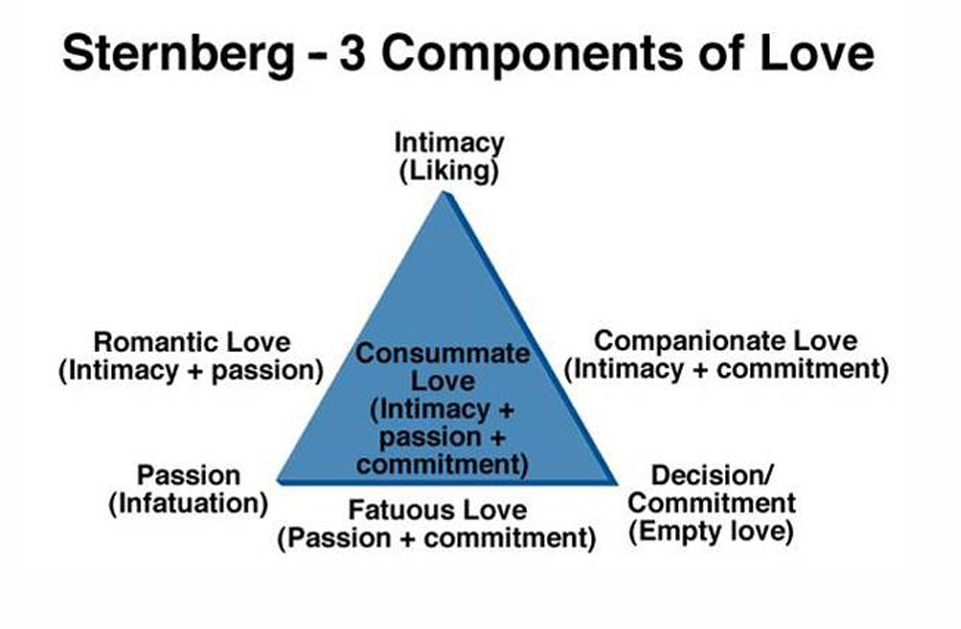
Sternberg’s Triangular Theory of Love
Intimacy — emotional closeness
Passion — physical/sexual arousal
Commitment — decision to maintain the relationship
Different combinations create different types of love (e.g., romantic, companionate, consummate).
Two Factor Theory of Love
Love = physiological arousal + cognitive label You feel arousal → you look for an explanation → you label it as “love” if the situation fits. This is why misattribution of arousal (e.g., scary bridge study) increases attraction.
functional distance
The likelihood that people will interact based on the layout of their environment. Not just physical distance — but how often paths cross. Example: people near stairwells or mailboxes form more friendships.
In Sternberg’s Triangular Theory of Love, what is the combination of intimacy and commitment
compassionate love
In Sternberg’s Triangular Theory of Love, what is the combination of intimacy and passion
Romantic love
In Sternberg’s Triangular Theory of Love, what is the combination of comitment and passion
Fatuous love
What is the social responsibility norm?
help those who depend on us - like children or the elderly
what is the key idea behind social exchange theory in helping behavior?
Weigh cost vs rewards before helping maximize benefits and minimize costs
What does the Fundamental attribution error (FAE) refer to?
Overestimating personal dispositions and underestimating situational factor
what does B = f(P,E)
Behavior is a function of the person and the environment
what is cognitive dissonance
psychological discomfort when actions and attitudes don’t match
What is benevolent sexism
seemingly positive beliefs that keep woman in lower power roles
What did Walster et al. (1966) “Computer Dance Study” find was the strongest predictor of liking?
Physical attractiveness
What is the Matching Phenomenon in attraction?
people tend to pair with those similar in attractiveness and other traits
What did Greenwald et al. (2003) find using the Implicit Association Test (IAT)
Most white participants implicitly associated White=good and Black=bad
What is Social Dominance Orientation (SDO)?
A motivation to have one’s in group dominate other groups
according to the two factor theory of love, what is required to experience romantic emotion?
physiological arousal plus a cognitive label interpreting it as love
What distinguishes prescriptive norms from descriptive stereotypes in the context of gender?
Prescriptive how people should behave; descriptive how the actually behave
What is ethnocentrism?
belief in the superiority of one’s own ethnic or cultural group
which of the following best describe self disclosure in deepening relationships?
reciprocal sharing of intimate information paired with emotional support