Intimate relationships in early adulthood
 Call Kai
 Learn
Learn Practice Test
 Spaced Repetition
 Match
Match Flashcards
 Knowt Play
1/5

There's no tags or description
Looks like no tags are added yet.
Name | Mastery | Learn | Test | Matching | Spaced | Call with Kai |
|---|
No analytics yet
Send a link to your students to track their progress
6 Terms
Intimate relationships
▪ Need for strong, close, stable and committed relationships→ important motivation for human behaviour.
▪ Increased proximity:
• Mutual disclosures.
• Sensitivity to the needs of the other person.
• Acceptance and mutual respect.
▪ Skills needed for good relationships:
• Self-awareness.
• Empathy.
• Emotional intelligence: Skill in communicating emotions.
• Conflict resolution.
• Respect commitments.
▪ Powerful relationship between personality and relationships
Early adulthood and friendships
▪ Greater sense of well-being→ people who have friends feel good/people who feel good are more likely to make friends.
▪ Closer friendships for women: they share information and activities vs. they talk about problems and receive support and advice.
▪ Friends as fictitious relatives → psychological family of the individual.
▪ Today, social networking as a way to maintain and strengthen connections with friends and family.
▪ Fewer and fewer early adults have close confidants.
Triangular theory of love
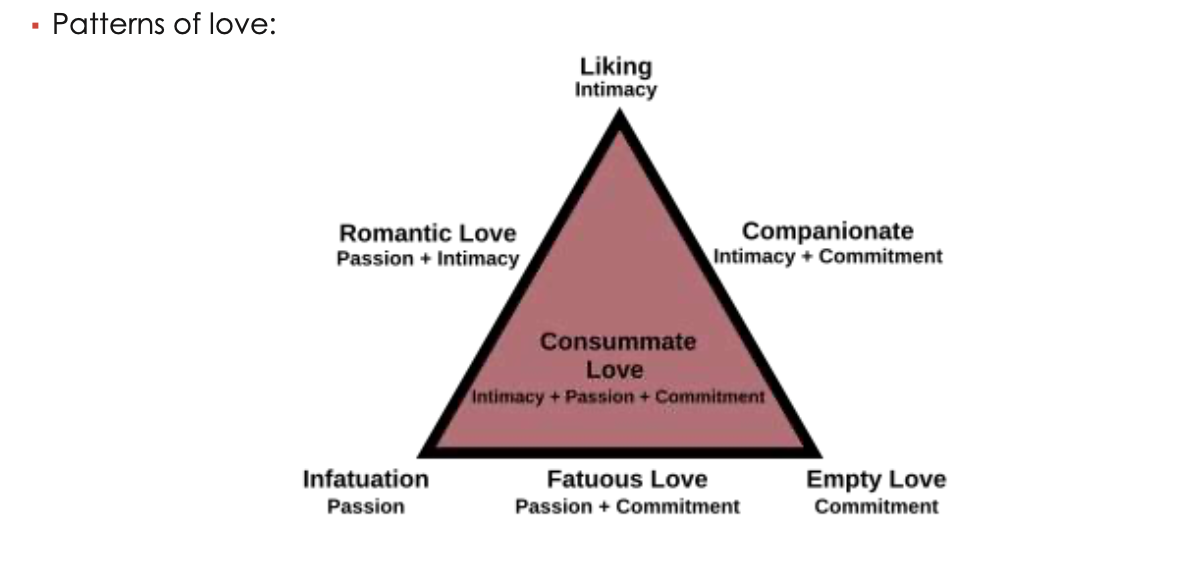
3 elements of love → intimacy, passion and commitment:
• Intimacy: emotional element including self-disclosure → bonding, warmth and trust.
• Passion: motivational element based on internal drives → physiological stimulation in sexual desire.
• Commitment: cognitive element → decision to love and stay with
the beloved.
Patterns of love:
✔ No love: all 3 components are missing. Most relationships.
✔ Liking: only intimacy (friendship).
✔ Infatuation: only passion ("love at first sight")
✔ Empty love: only commitment (arranged marriages).
✔ Romantic love: there is intimacy and passion (but no commitment).
Patterns of love:
✔ Companionate love: there is intimacy and commitment (they
decide to stay together without passion).
✔ Fatuous love: there is passion and commitment, without intimacy
(they commit out of passion without knowing each other).
✔ Consummate love: there are the 3 components. "Complete love".
It is easier to attain it than to sustain it.
Early adulthood and adult relationships with parents
Influences on relationships with parents.
• In emerging adulthood, need for acceptance, empathy and parental support.
• Attachment to parents as a Core element of well-being.
• Financial support from parents as a possibility for success in adult roles.
• Positive parent-child relationships during early adolescence > a more cordial and less conflictual relationship in emerging adulthood.
• Even better relationships when they establish adult roles.
• Mother-parent relationship—> quality of relationship with adult children: early adult caught between two conflicting parents, increased risk of depressive thoughts.
Inability to become independent
• Thirty-somethings who avoid taking responsibility.
• Adults forced to maintain some dependency due to economic hardship, need for higher Degree.
• Problems in redefining their relationship with parents.
• Habituation and positive view of the situation of early adult children remaining in the parental home > new developmental stage: adulthood at home.
Empty nest syndrome
• Supposedly difficult transition that occurs when the youngest child leaves home.
• Difficulties compensated by a sense of liberation with the departure of children.
• Greater difficulties when children have little success → if financial
problems, parents torn between wanting them to be independent and wanting to help them.
• In these cases, → greater stress when there was already tension in
the relationship or the older children return home.
• Consequences of empty nesting depending on the quality and duration of the parental relationship:
- Second "honeymoon", as it increases the couple's satisfaction
as there is more time to spend with each other.
- More difficult if partner identity depends on their role as
parents or if there are previous relationship problems.