BJU Physical Science Chapter 17
 Call Kai
 Learn
Learn Practice Test
 Spaced Repetition
 Match
Match Flashcards
 Knowt Play
1/33

There's no tags or description
Looks like no tags are added yet.
Name | Mastery | Learn | Test | Matching | Spaced | Call with Kai |
|---|
No analytics yet
Send a link to your students to track their progress
34 Terms
examples of periodic motion
1) position of a comet orbiting the sun
2) swing of a pendulum clock
3) movement of the moon around the earth
When is the potential energy of a spring system in motion at its maximum?
when the spring is stretched to its greatest displacement
When an oscillating spring system reaches its equilibrium position, what happens?
the kinetic energy is at its maximum
When does the mass in a moving spring system have no velocity?
when the kinetic energy of the system reaches zero
How many times will the mass pass through the rest position in two cycles of its motion if a spring system is compressed and released?
4
amplitude
the maximum displacement of a spring from its equilibrium position
damping
a force that intentionally works against the motion
What does a wave carry from one location to another?
energy
Three facts about mechanical waves
1) can move through liquids and gases
2) carry energy by disturbing the matter of a physical medium
3) examples: sound wave and water waves
What type of wave transfers more energy?
waves with larger amplitudes
What type of wave can travel down a string?
transverse wave
in a transverse wave, how does the disruption move related to the direction of wave travel?
perpendicular
What happens when a wave arrives at a surface?
reflection, refraction, or diffraction
What happens after two waves collide?
they move on unaffected by each other
which parts of a standing wave appear to have no movement?
nodes
Why does an ambulance seem to have a higher pitch as it approaches and a lower pitch as it moves away?
Doppler effect
doppler effect
A change in sound frequency caused by motion of the sound source, motion of the listener, or both.
restoring force
any force that always acts to pull a system back toward equilibrium
what happens to the matter after a wave has passed?
it remains in its original position
What type of wave can travel without matter involved?
electromagnetic waves
pitch
how the frequency of a sound is perceived
amplitude
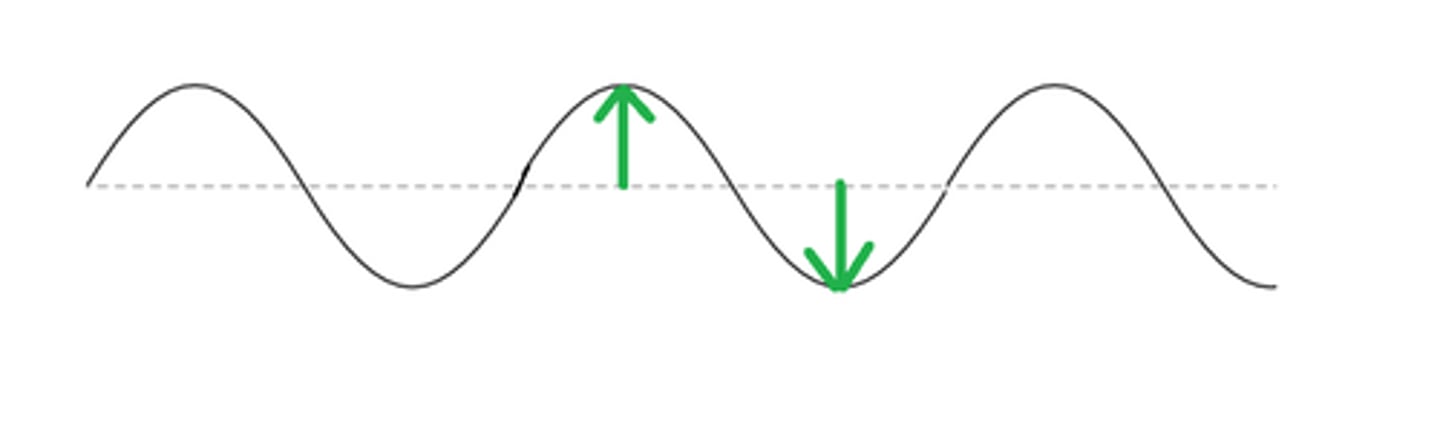
crest
high point of a wave
equilibrium position
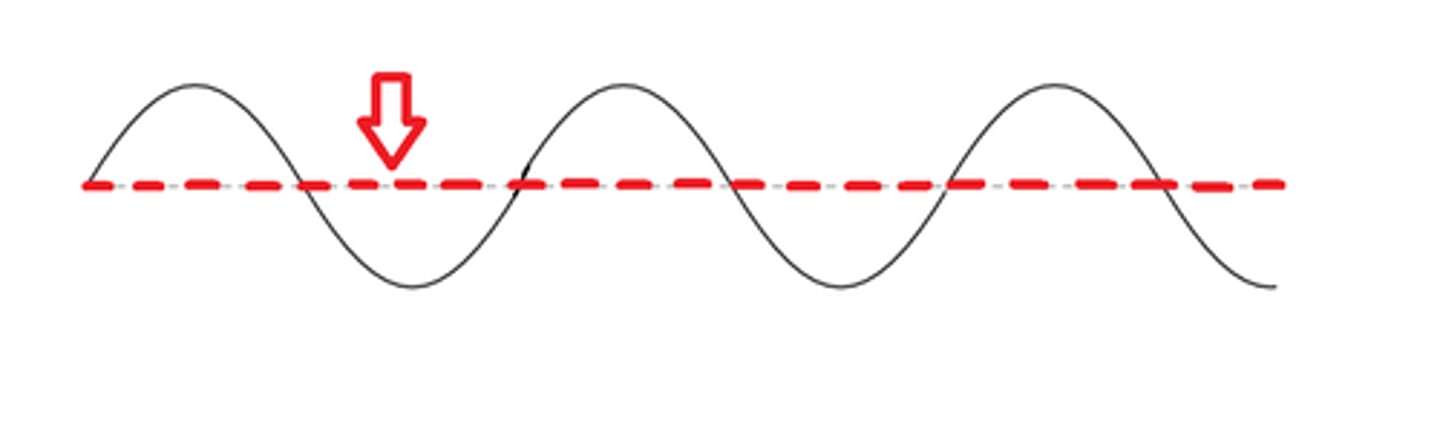
trough
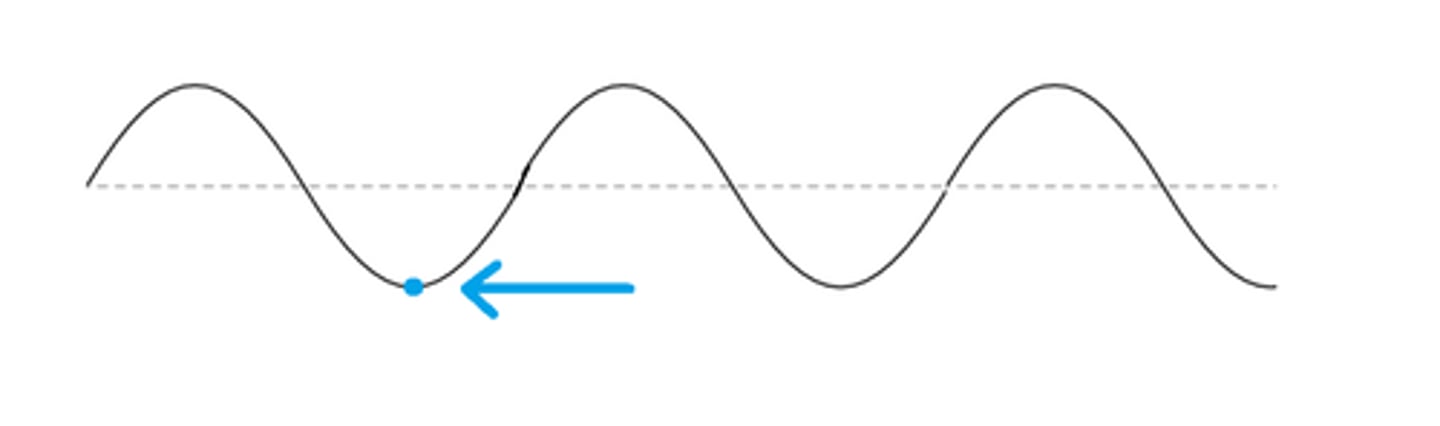
wave height
vertical distance between crest and trough
wavelength
The distance between two corresponding parts of a wave
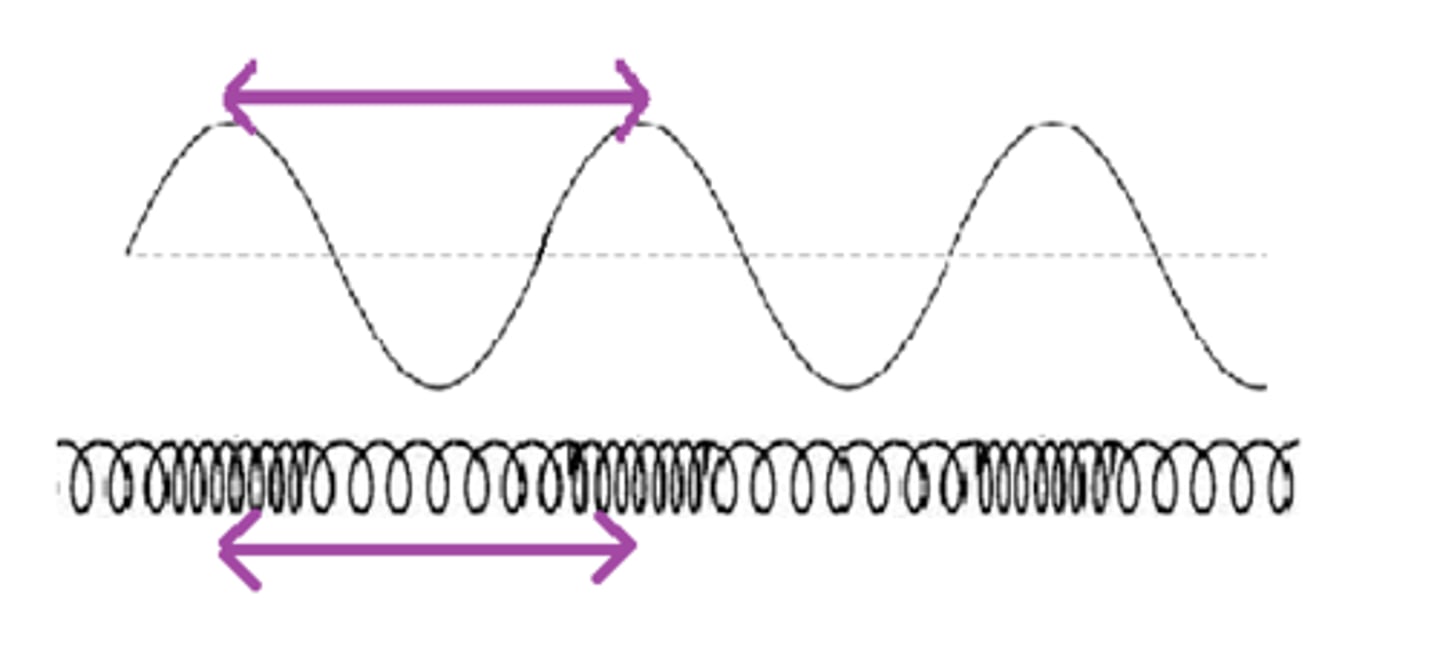
compression
The part of a longitudinal wave where the particles of the medium are close together.
diffraction
The bending of a wave as it moves around an obstacle or passes through a narrow opening
interference
the combination of two or more waves that results in a single wave
rarefaction
a part in a longitudinal wave where the particles are spread apart
reflection
The bouncing back of a wave when it hits a surface through which it cannot pass.
refraction
the bending of a wave as it enters a new medium at an angle
resonance
when the force causes an object to vibrate at greater amplitudes