L6 mock Paper 2 (just research methods)
 Call Kai
 Learn
Learn Practice Test
 Spaced Repetition
 Match
Match Flashcards
 Knowt Play
1/214

There's no tags or description
Looks like no tags are added yet.
Name | Mastery | Learn | Test | Matching | Spaced | Call with Kai |
|---|
No analytics yet
Send a link to your students to track their progress
215 Terms
define sampling
how we recruit our participants
define population
the group of people the researcher is interested in
what are sampling techniques?
the various methods we have in order to choose participants
what is bias?
systematic distortion in sampling – some types of people are over or under represented
define generalisation
the extent to which the findings of research on the sample can be generalised back to the population
what is volunteer sampling?
involves participants selecting themselves to be part of the sample (they self-select)
what are pros and cons of volunteer sampling?
pros:
easy to recruit/cheap/quick
enthusiastic, engaged and motivated people who want to take part
cons:
certain type of person will volunteer (e.g. confident, people pleaser etc.)
participants may change their behaviour (please you effect or screw you effect)
define validity
how genuine or legitimate something is
what are the 2 types of validity?
internal
external
define internal validity
the extent to which we measured what we set out to measure
define external validity
the extent to which the findings and conclusions are generalisable beyond the context of the study
how representative of real life was the study?
what are the 4 types of validity that make up external validity?
population validity
temporal validity
ecological validity
mundane realism
what is population validity?
sample
is the sample representative of the population?
can we generalise beyond the participants in the study
what is temporal validity
time period (historical validity)
is the time period the study was conducted in representative of of today
can we generalise from time study was done to today?
what is ecological validity?
setting/context
is the setting representative of real life (where the behaviour would usually occur)?
can we generalise beyond the setting/context of the study?
what is mundane realism?
the specific task
is the task representative?
can we generalise?
what is an effective evaluation paragraph structured like?
P- point
E- explain, evidence, elaborate
T- therefore, this suggest
what are the levels of measurement?
nominal
ordinal
interval
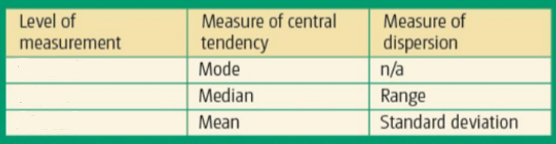
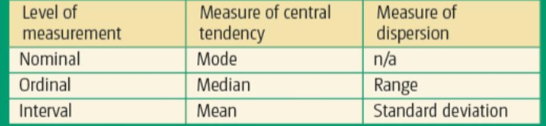
what is the average can be used for each level and which is the best?
nominal - mode (mode is only one so is also best)
ordinal - median and mode (median = best)
interval - mean, median and mode (mean = best)
what is nominal data and some examples?
categorical data
freq. count of a particular variable is recorded at this level of measurement (e.g. how many boys and girls in a class)
data is discrete - one item can only appear in one category e.g. blood type
examples: hair colour, blood type, eye colour
what is ordinal data and some examples?
same properties as nominal data (a form of categorical data) but has a natural order
doesn’t have equal intervals between each unit
subjective
examples: position in a competition, relative height among a group
what is interval data and examples?
numerical scales with units of equal, precisely defined size
continuous: 2.35cm, 24.34572558362527g
ratio is the same but cannot go below 0
example: length
in a race what would the nominal, ordinal and interval data be?
nominal - the country they are representing, the colour they are wearing
ordinal - order they finished the race
interval - their finishing time
how do you convert between levels of measurement?
can only convert down levels:
-rank order
-interval -> ordinal
^ e.g. reaction time in seconds (interval) -> order from fastest to slowest (ordinal)N
-ordinal -> nominal
^e.g. liker scale -> 3 categories e.g. happy, neutral and sad
what are measures of central tendency?
a descriptive statistic that provides information about a ‘typical’ value for a given data set
informs about the central value for a data set
are basically averages
each one is appropriate for different situations
what are the different measures of central tendency?
mean
mode
median
what are the strengths and limitations of the mean?
Strengths:
most representative - included all scores in the data set so more representative
Limitations:
easily distorted by extreme values (outliers/anomalous values)
what are some strengths and limitations of the median?
strengths:
not affected by extreme scores (like the mean)
easy to calculate
Limitations:
less sensitive than the mean as it ignores the value of the highest and lowest values
what are some strengths and limitations of the mode?
strengths:
easy to calculate
only measure of central tendency appropriate for nominal data
limitations:
very crude measure
can have more than one mode (e.g. bimodal) - not very useful
what are measures of dispersion?
a descriptive statistic that provides information about the spread or variation in a set of data
tell us how far scores vary and differ from one another
what are the different measures of dispersion?
range
standard deviation
what is the range?
the arithmetic difference between the highest and lowest values in a data set
what is the standard equation for the range?
range = (highest value - lowest value)+1
we always add 1 to correct for rounding errors in psychology
why do we add one to the range in psych?
to account for numbers that have probably been rounded
what are some strengths and limitations of the range?
strengths:
easy to calculate
useful for ordinal data
limitations:
affected by extreme values
doesn’t take into account the distribution of the data
what is standard deviation?
a precise measure of the dispersion in a set of data
tells us by how much, on average, each value deviates from the mean
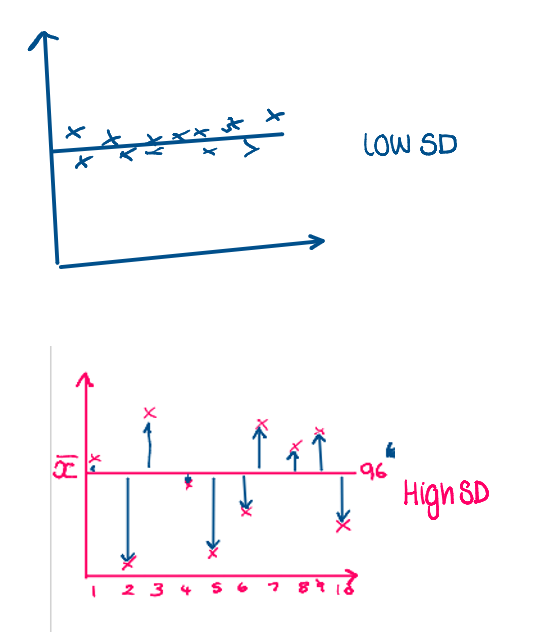
what do high standard deviation values mean and low ones?
high SD:
not all Ps are affected in the same way
there is a lot of variation within the data set
low SD:
values are clustered around the mean
all the Ps may have responded in a similar way
what are the strengths and limitations of standard deviation?
strengths:
precise measure of dispersion - takes all scores into account
useful for interval data
limitations:
affected by extreme values
extreme values may be ‘hidden’ within the data
fill in the gaps
what is quantitative data?
information that represents how much or how long, or how many etc. there are of something (measured in numbers)
what is qualitative data?
information in words that cannot be counted or quantified, can be turned into qualitative data by placing them in categories and counting the frequency
what are some characteristics of quantitative data?
Quantity
Numbers
Dependant variable in an experiment is quantitative
Closed questions in questionnaires - how many hours a week you work, numerical info about your age etc.
In an observational study a tally of behavioural categories is quantitative
Data that can be measured
Psychologists develop measures of psychological variables
Looking at averages and differences between groups
what are some characteristics of qualitative data?
Quality
Descriptions (words)
In an observational study the researcher can describe what they could see
Can't be counted or quantified but can be turned in quantitative data by placing data into categories then counting frequency
Allows people to freely express their thoughts and feelings in own words - contrasts with quantitative which gives limited options
Open questions in questionnaires may collect qualitative data like descriptions
Data that is observed but not measured
Observing people through the messages they produce and the way they act
Concerned with attitudes, beliefs, fears and emotions
what is a strength of quantitative data?
Easy to analyse making conclusions be able to be drawn easily
what is a limitation of quantitative data?
May oversimplify reality
e.g. questionnaire with close questions may force people to tick answers that don't really represent their feelings therefore the conclusions may be meaningless
what is a strength of qualitative data?
Provides rich and detailed info about peoples experiences
Can provide unexpected insights into thoughts and behaviour because answers are not restricted by previous expectations
what is a limitation of qualitative data?
complexity of data makes it more difficult to analyse the data and draw conclusions
is primary data qualitative or quantitative? and secondary?
both primary and secondary data can be quantitative and/or qualitative
what is primary data?
info observed or collected directly from first hand experience
what is secondary data?
info used in a research study that was collected by someone else for a purpose other than the current one
for example, published data or data collected in the past
what would the collection of primary data include?
designing the study
gaining ethical approval
piloting the study
recruiting and testing Ps
analysing the data collected and drawing conclusions
when collecting primary data what will the data relate to?
the data will specifically relate to the aims and/or the hypothesis of the study?
where may a researcher get secondary data from?
Researcher may make use of government material/stats such as info about the treatment of mental health or make use of data held by a hospital or other institution
what type of study often uses secondary data?
a correlation study and review studies conducting a meta-analysis
what is a strength of primary data?
researcher has big control over the data
the data can be collected can be designed so it fits the aims and hypothesis of the study
what is a limitation of primary data?
Very lengthy and expensive process
simply designing a study takes a lot of time and then time is spent recruiting participants, conducting the study and analysing the data
what are 2 strengths of secondary data?
Simpler and cheaper to just access someone else's data because significantly less time and equipment is needed
Such data may have been subjected to statistical testing and thus is known whether it is significant
what is a limitation of secondary data?
the data may not exactly fit the needs of teh study
define extraneous variable
Any variable which is not being investigated but has the potential to affect the outcomes (results and conclusions) of the research
e.g. weather, time of the day – all that might affect behaviour
define confounding variable
Any variable which is not being investigated but affects the outcomes (results and conclusions) of the research (harder to know if there will be an impact than extraneous)
e.g. Monday morning traffic – in August
define reliability
The consistency of a research study or measuring test
Often assessed by replication
Repeat and get same results = reliable
define observational studies
The researcher watches or listens to participants engaging in whatever behaviour is being studied.
Allows researchers to study behaviour within a natural or controlled setting
The researcher records observations in some sort of way e.g. tally chart
observational studies pros
Capture what people actually do
Can be very different to what they think or say they will do
Also captures unexpected or spontaneous behaviours
High internal validity – internal validity is a measure of whether results obtained are solely affected by changes in the variable being manipulated (e.g. by the independent variable) in a cause and effect relationship
observational studies cons
Risk of observer bias
Observer bias = observers interpretation of a situation may be affected by their expectations and previous experiences
Cannot demonstrate casual relationships (unless in an expt)
define naturalistic observations
take place in the setting/context where the behaviour world normally occur
All aspects of the environment are free to vary
Everything is left as it normally is – no interference from researcher
Naturalistic observation pros
High external validity (a measure of whether data can be generalised to other situations outside of the research environment they were originally gathered in)
More likely to be spontaneous
More generalisable
Naturalistic cons
Low control
There may be uncontrolled variables (extraneous and confounding variables)
More difficult to detect patterns in behaviour
Difficult to replicate
define controlled observation
some variables in the environment are controlled by the researcher
controlled observation pros
Can focus on particular aspects of behaviour
Replication easier as extraneous and confounding variables (EVs and CVs) are minimised
controlled observation cons
Low external validity
Environment not as natural
Causes behaviour to not be as natural
define covert observation (and some characteristics)
– participants are unaware they are being observed
Being secretly observed
Observing behaviour across a room or public location
MUST be a public behaviour and happening anyway
covert observation pros
Demand characteristics are reduced
Behaviour is more natural
Increases internal (and external validity)
covert observation cons
Ethics (invasion of privacy?, consent?)
e.g. observation of shopping – shopping = public behaviour, but amount of money spent = private and therefore invasion of privacy if observed and recorded.
define overt observation (and some characteristics)
– participants are aware that they are being observed
Have given consent before hand
Strange situation
overt observation pros
more ethically acceptable
overt observation cons
Demand characteristics are increased
Change behaviour when know being watched
Reduces internal validity
define participant observations
Researcher becomes part of the group they are observing
Being undercover
participant observation pros
Can lead to greater insight and understanding of the target behaviours
Researchers experiences situation as participants do
Enhances external validity
participant observation cons
Possible loss of objectivity
Researcher may identify too strongly 'too native' (get too far in, can't get out)
Threatens the internal validity
define non participant observation (and characteristics)
the observer remains separate from the group being studied
Sometimes not possible to be participant
e.g. female researcher in boys school
non participant observation pros
More objective
Less chance of observer bias
Increases internal validity
non participant observation cons
Loss of insight
Too far removed
Reduces external validity
what can validity and reliability be pictured like?
on scales
when one increases the other usually decreases
define time sampling
an observational technique in which the observer records behaviours in a given time frame.
define sampling
the method used to select participants, such as random, opportunity and volunteer, or to select behaviours in an observation.
define event sampling
an observational technique in which a count is kept of the number of times a certain behaviour (event) occurs.
define behavioural categories
dividing a target behaviour (such as stress or aggression) into a subset of specific and operationalised behaviours.
define operationalised
defining a variable in a clear, precise and measurable way so it can be tested and replicated.
define a structured observation
a researcher uses various systems to organise observations.
what is the difference between structured and unstructured observations?
Unstructured has no system and records all relevant behaviour but structured uses various systems to observe specific behaviours
the more that you control the variables in the experiment the more….
internal validity increases
external validity/realism decreases
what does standardisation mean?
means all Ps experience identical procedures and materials
all Ps have the same experience of being involved in the study
controls for extraneous variables
e.g. watching the same video at the same volume in the same room
what are standardised instructions?
all Ps given exactly the same instructions, delivered in the same way
instructions are scripted and read aloud to Ps or are read aloud to Ps or are read by Ps - this helps control investigator effects or investigator bias
what are investigator effects?
anything an investigator does (consciously or unconsciously) that has an affect on a Ps behaviour in a study.
It can be:
direct (interacting with P)
indirect (as a consequence of how the study was designed)
what is investigator bias?
a type of investigator effects which results in some kind of skew or bias e.g. putting all most intelligent Ps in same group
what is an extraneous variable?
any variable which may effect the DV, other than the IV - either P variables or situational variables
what are situational variables?
features of a situation/environment e.g. time, weather
what is randomisation?
the use of chance wherever possible in the design of the study
e.g. generating a word list - random generation of words, random order of words in the list
what is random allocation?
the use of chance to allocate Ps into the conditions
controls for investigator effects and for participant variables (characteristics of individual Ps e.g. age, motivation, intelligence, traits, experience - type of extraneous variables
when are control groups used?
2 or more levels or conditions of IV
environmental group - change in IV
control group - no change in IV, exactly same experience except for the IV