topic 3: motion and forces
 Call Kai
 Learn
Learn Practice Test
 Spaced Repetition
 Match
Match Flashcards
 Knowt Play
1/18

There's no tags or description
Looks like no tags are added yet.
Name | Mastery | Learn | Test | Matching | Spaced | Call with Kai |
|---|
No analytics yet
Send a link to your students to track their progress
19 Terms
displacement
change in position of the object
speed
rate of change of distance
velocity
rate of change of displacement
acceleration
rate of change of velocity
kinematics equation + conditions
v = u+at
v2 = u2+2as
s = ut + ½ at2
s = ½ (u+v)t
applicable for uniform acceleration in a straight line
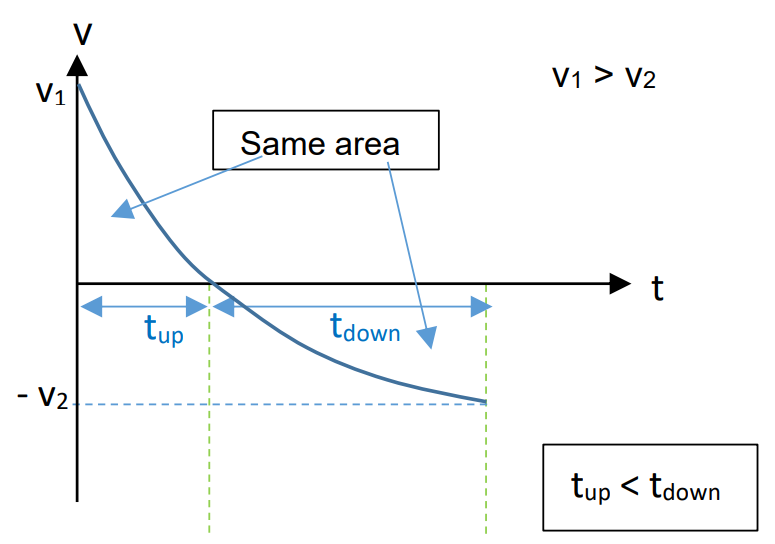
v-t graph of throwing a ball upwards (without air resistance)
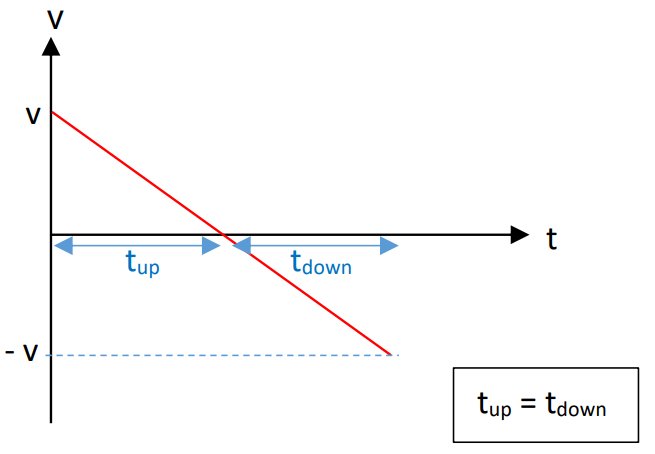
v-t graph of throwing a ball upwards (without air resistance) + explanation
with air resistance, there will be loss of kinetic energy, so the ball returns to the initial position with a final speed less than initial speed. this means that the average speed upwards is greater than the average speed downwards. since the distance is the same, the time taken to travel up to the maximum height is shorter than the time taken for the ball to travel back down to the initial position.
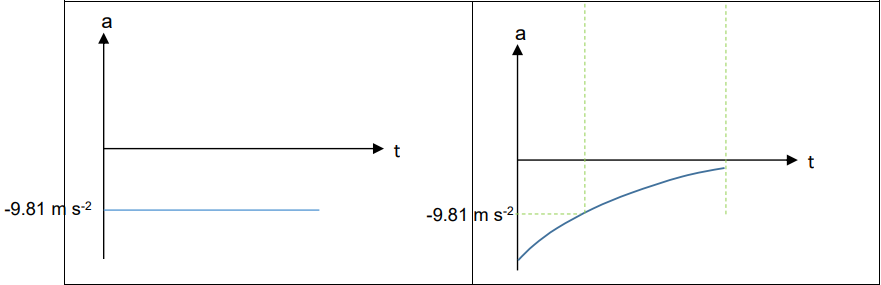
a-t graph of throwing a ball upwards (with and without air resistance)
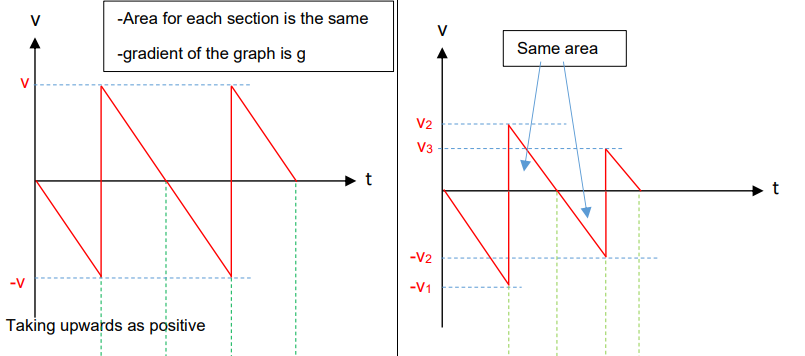
v-t graph of ball released from height H above ground (with + without energy loss)
s-t graph of ball released from height H above ground (with + without energy loss)
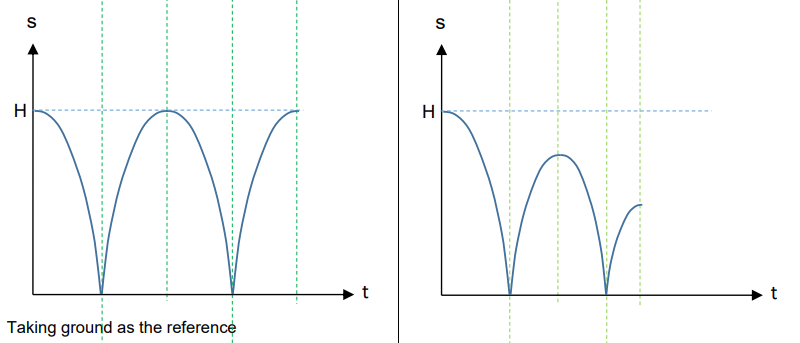
a-t graph of ball released from height H above ground (with + without energy loss)
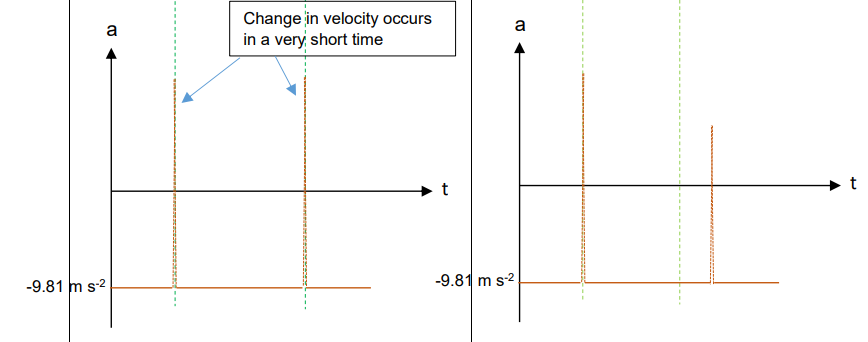
newton’s first law
a body at rest will stay at rest, and a body in motion will continue to move at constant velocity, unless acted upon by a resultant external force
newton’s second law
the rate of change of momentum of a body is directly proportional to the resultant force acting on the body and is in the same direction as the resultant force
newton’s third law
the force exerted by one body on a second body is equal in magnitude but opposite in direction to the force simultaneously exerted by the second body on the first body
inertia
the property of a body that resists change in motion
momentum
p = mv
impulse
F Δt = mv - mu = change in momentum = area under F-t graph
resultant force
F = dp/dt
Fnet = ma , for constant mass
force if mass of the system is varying (rocket, conveyer belt and helicopter)
rocket: F = v dm/dt (v is the velocity of the air wrt rocket)
conveyer belt: F = v dm/dt
helicopter: F = v2 p A (p = density of air, A = area swept out by rotor blades)